Retrofitting a Heat Pump in a 1960s Mid-Terrace: The Unfiltered Truth
A no-spin account of fitting a heat pump in a 1960s terrace. Hot water cylinder logistics, microbore pipework replacement, and a real-world winter COP of 2.44 documented.
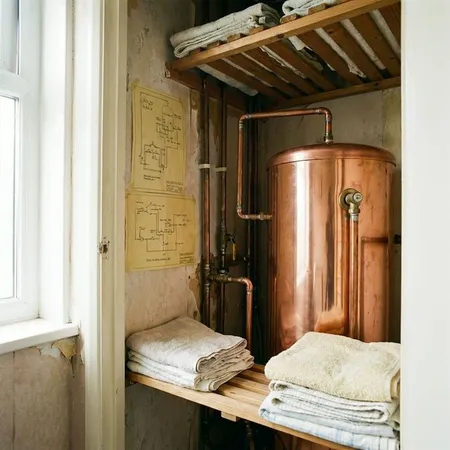
The Spatial Challenge: Squeezing a Modern Cylinder Into a 1960s Airing Cupboard
The moment you request heat pump quotes for a 1960s mid-terrace, the first physical confrontation is almost always the hot water cylinder. Gas combination boilers — which most 1960s terraces migrated to during the 1980s and 1990s — entirely eliminate the need for stored hot water, freeing the old airing cupboard for coats and linen. A heat pump cannot work this way. Because it produces heat at low flow temperatures (45°C–50°C rather than the 70°C–80°C of a gas boiler), it must store a much larger volume of water to deliver the same usable energy to your taps and shower.
The Parker Morris Committee's 1961 report Homes for Today and Tomorrow — which shaped the design of virtually every 1960s council and private estate — allocated just 0.5 square metres for the hot water cylinder and associated services. In practice this translated into an internal airing cupboard approximately 70–75 cm wide and 65–70 cm deep, with a floor-to-ceiling height of around 230–240 cm. The original vented copper cylinders of the era (typically 120 litres) were slender enough to fit, surrounded by loose fibreglass jackets and slatted timber shelving for airing damp towels.
A heat pump-specific cylinder for a three-bedroom, four-person household — the MCS standard for most 1960s mid-terraces — must hold between 200 and 250 litres. Octopus Energy formally recommends 200–250 L for two to four occupants; independent HVAC sizing matrices specify 210–250 L for a three-bedroom home with one or two bathrooms. These cylinders carry dense polyurethane foam insulation and an oversized internal heat-exchanger coil required because the delta-T between the heat pump's primary flow and the stored water is much smaller than with a gas boiler. The external diameter of a 200-litre unvented cylinder typically reaches 55–60 cm.
On paper, 60 cm fits inside a 70 cm cupboard. In the real world, it does not. Modern unvented cylinders — operating at mains pressure under Building Regulations Part G3 — need surrounding infrastructure: expansion vessels, pressure-reducing valves, temperature-and-pressure-relief valves with tundishes, motorised zone valves, and manifold arrays. Manufacturers also mandate specific clearance zones for maintenance access and immersion heater removal. The net result is that virtually every 1960s airing cupboard requires either complete structural expansion or full relocation of the cylinder to a bedroom wardrobe, under-stair space, or utility area.
| Specification | 1960s Vented Cylinder | Heat Pump Unvented Cylinder |
|---|---|---|
| Volume | 120 litres | 200–250 litres |
| Storage temperature | 70–80°C | 45–50°C (60°C Legionella cycle) |
| External diameter | ≈ 40–45 cm | 55–60 cm |
| Regulatory clearances | Minimal | Significant — Part G3 infrastructure |
| Fits original 70 cm cupboard? | Yes | Cylinder yes; full installation — rarely |
The Hydraulic Bottleneck: Why 1960s Pipework Breaks Heat Pumps
The spatial challenge is visible and photographable. The hydraulic challenge is invisible — buried beneath floorboards and behind plasterboard — and is the primary cause of failed heat pump retrofits in post-war terraces. Understanding it requires a brief excursion into fluid dynamics.
A gas boiler operates at a high flow temperature (70–80°C) and a high temperature drop across each radiator — the "delta-T" of around 20°C. This means it can push a small volume of very hot water through the system and deliver adequate heat. A heat pump operates at low flow temperatures (35–50°C) and a narrow radiator delta-T of around 5°C. To deliver the same kilowatts to your rooms, the circulator pump must move roughly four times as much water per minute. This elevated mass flow rate transforms any narrow pipework into a catastrophic hydraulic restriction.
Microbore: The 8 mm Time Bomb
From the late 1960s onwards, UK plumbers widely adopted microbore pipework — typically 8 mm or 10 mm external diameter copper tube — because it could be threaded under floorboards like electrical cable with minimal disruption. It worked perfectly with high-temperature gas boilers. For heat pumps, it is a near-fatal flaw.
The Darcy-Weisbach equation quantifies the relationship between pipe diameter and frictional pressure loss: resistance is inversely proportional to the fifth power of the internal diameter. Halving the pipe diameter increases hydraulic resistance by a factor of 32. Forcing the mass flow rates required by a heat pump through 8 mm microbore creates three compounding problems:
- Hydraulic starvation: The heat pump's circulator cannot overcome the resistance. Radiators at the far end of the circuit never reach design temperature, leaving rooms chronically underheated.
- Acoustic turbulence: Water forced through narrow restrictions at high velocity generates turbulent flow, audible throughout the property as persistent rushing or whistling noises.
- Compressor lockout: If the minimum flow rate across the heat pump's heat exchanger is not met, low-flow safety switches trigger repeated lockout, refusing to run and protecting the refrigerant circuit — but leaving you without heat.
Compounding the diameter problem is physical degradation. After 50–60 years in a mixed-metal system, 8 mm microbore accumulates internal magnetite sludge (black iron oxide from corroding steel radiators) and limescale. A 1 mm deposit inside an 8 mm bore reduces cross-sectional area by nearly 45%, taking an already inadequate pipe to critical restriction. Full replacement with 15 mm or 22 mm copper or modern PEX is almost universally mandatory before a heat pump installation can succeed in a 1960s terrace.
The One-Pipe System
Homes built between the 1950s and 1980s frequently feature an even more problematic configuration: the one-pipe sequential heating loop. In a modern two-pipe system, all radiators receive the same hot supply from a dedicated flow main and return cooled water via a separate return main. In a one-pipe system, radiators are connected in series along a single continuous loop — each successive radiator receives water that has already surrendered heat to the previous one.
With a gas boiler at 80°C, sequential cooling was manageable — installers simply specified progressively larger radiators toward the end of the loop. With a heat pump limited to 50°C supply, the water reaching the third or fourth radiator on the circuit can drop below 35°C. At that temperature, a standard radiator's convective output is negligible. Rooms at the end of the circuit remain cold regardless of how hard the heat pump works. Upgrading a one-pipe system to a modern two-pipe architecture is a mandatory prerequisite, requiring the lifting of floorboards across the entire ground floor.
The Diagnostic Question Every Installer Must Answer First
Before any heat pump quotation is valid, the existing heating distribution must be physically inspected: is it two-pipe 15/22 mm copper (reusable); two-pipe microbore 8/10 mm (full replacement needed); or one-pipe sequential (full replacement needed)? This single question determines whether your net post-grant cost is £3,000 or £9,000.
What It Actually Costs: 2025 Price Breakdown
In 2025, the average gross cost of an ASHP in a standard three-bedroom UK property ranges between £7,000 and £15,000 before grants. For a 1960s mid-terrace — which typically requires 5 kW to 8 kW of heating capacity — the specific cost structure is:
| Component | Cost Range (2025) | Engineering Notes |
|---|---|---|
| ASHP unit (5–8 kW) | £4,000–£6,000 | Outdoor monobloc (Mitsubishi Ecodan, Vaillant aroTHERM, Daikin Altherma) |
| DHW cylinder (200–250 L) | £800–£1,500 | Heat pump-specific unvented unit with oversized primary coil |
| Standard installation labour | £3,000–£4,500 | Assumes existing 15/22 mm two-pipe architecture, chemically clean |
| Full re-pipe labour | £4,500–£7,000 | Mandatory for microbore or one-pipe distribution — entire system replaced |
| Radiator upgrades (per unit) | £300–£500 | Double-panel double-convector (K2/K3) for adequate output at low flow temps |
| Electrical upgrades | £500–£800 | Consumer unit upgrade for compressor and immersion heater amperage |
Scenario 1: The Favourable Case
If the property was comprehensively re-piped during the 1990s or 2000s to standard 15/22 mm two-pipe copper, and only a handful of radiators need upsizing, total gross cost approaches approximately £10,500. After the £7,500 Boiler Upgrade Scheme grant, the net cost to the homeowner is around £3,000.
Scenario 2: The Unfiltered Reality
If the property retains original microbore or one-pipe distribution, and most radiators must be replaced with larger K2/K3 units to deliver adequate heat at low flow temperatures, total gross cost rises to £15,000–£16,500. After the £7,500 BUS grant, the homeowner pays £7,500–£9,000. This is the outcome experienced by the majority of 1960s terrace owners who proceed without first confirming their pipework architecture.
Zero-Rate VAT Until March 2027
The UK government applies 0% VAT to the supply and installation of energy-saving materials, including air source heat pumps. This policy runs until 31 March 2027 and removes 20% from the pre-grant cost. Both scenarios above already reflect 0% VAT.
The BUS Grant and the March 2024 Policy Shift
The Boiler Upgrade Scheme provides a £7,500 upfront grant for any qualifying property replacing a fossil fuel system with an air source or ground source heat pump. A landmark policy change occurred in March 2024: the government removed the previous requirement that a property's EPC show no outstanding recommendations for loft or cavity wall insulation. Before this change, a typical 1960s terrace — almost universally rated EPC D or E with prominent insulation flags — was effectively barred from the grant without first spending thousands on fabric upgrades.
Under the updated framework, a 1960s mid-terrace can access the £7,500 BUS grant with its current EPC rating, provided the certificate is valid within the past 10 years. No prior insulation is required. However, this accessibility carries a thermodynamic penalty: an uninsulated terrace loses heat so rapidly that the system must run at higher continuous flow temperatures (55–60°C instead of 35–40°C), directly degrading the compressor's Coefficient of Performance and substantially raising electricity bills. The policy removes a bureaucratic barrier; it does not remove the physics.
Acoustic Engineering: Noise in a Narrow Terrace Garden
A mid-terrace property presents a specific acoustic challenge: the rear garden is typically narrow and enclosed, with reflective brick party walls and neighbouring windows within a few metres of the installed unit. UK Permitted Development rules cap permissible noise at 42 dB(A) at the boundary of the nearest neighbour's habitable room.
| Model | Sound Pressure (1 m) | Sound Power | Notes |
|---|---|---|---|
| Samsung EHS Mono R290 Gen7 | 35–41 dB(A) | 55–60 dB(A) | Anti-vibration compressor mounts; ideal for narrow, reflective gardens |
| Mitsubishi Ecodan R32 Ultra Quiet | 45 dB(A) | 58 dB(A) | Engineered specifically to pass UK PD noise standards without acoustic enclosures |
| Vaillant aroTHERM Plus | 49 dB(A) | 54 dB(A) | Carries UK Quiet Mark certification; reliable but loudest at close proximity |
The decibel scale is logarithmic: a 3 dB increase represents a doubling of sound energy; 10 dB is perceived as twice as loud to the human ear. At 1 metre, the Vaillant aroTHERM at 49 dB(A) is noticeably louder than the Samsung at 35 dB(A). In a narrow garden where the unit may sit only 2–3 metres from a party wall, reflective amplification is significant. Units with sub-45 dB(A) pressure ratings, mounted on anti-vibration feet positioned away from reflective corners, provide the most reliable margin against noise abatement notices.
Real-World Performance: What the National Field Trial Shows
The Electrification of Heat (EoH) Demonstration Project — a government-funded trial monitoring 742 air source heat pumps across diverse UK housing — is the most robust empirical performance dataset available. Critically for 1960s terrace owners, the trial explicitly included 82 mid-terrace houses spanning properties built from pre-1919 through to post-2001.
The headline finding is decisive: there was no statistically significant variation in heat pump performance based on the architectural era of the house. A correctly sized, hydraulically balanced, professionally commissioned ASHP in a 1960s mid-terrace performs equivalently to one in a modern new build. The persistent narrative that older homes are fundamentally unsuitable for heat pumps is empirically false.
EoH Field Trial: Key Metrics (742 ASHPs across all housing ages)
The winter figure of 2.44 deserves explanation. On the coldest trial day — where the average external temperature across all monitored sites was −0.4°C — the fleet-wide COP dropped to 2.44. Three physical factors drive this: the compressor must "lift" heat across a wider temperature differential as external air cools; moisture near 0°C rapidly ices the evaporator coils, requiring periodic energy-consuming defrost cycles that temporarily halt space heating; and weather compensation curves automatically push flow temperatures higher in the worst weather, further taxing the refrigerant circuit. Despite this, a COP of 2.44 still delivers 2.44 kWh of heat per 1 kWh of electricity — a figure no gas boiler approaches under any conditions.
Viewed across the full heating season — incorporating the highly efficient mild autumn and spring months where COP regularly exceeds 4.0 — the mean Seasonal Performance Factor was 2.80. SPF values across all property age groups ranged tightly between 2.77 and 2.91, confirming that a 1960s terrace owner can expect the same class of annual efficiency as any other housing archetype, provided the hydraulic and spatial groundwork is done properly.
The Bottom Line
Retrofitting an air source heat pump into a 1960s mid-terrace is technically and economically viable. The EoH field trial proves the technology works in older housing stock. The BUS grant — now accessible without mandatory prior insulation upgrades — reduces capital cost by £7,500. At an annual SPF of 2.80, the system delivers heating at roughly three times the electrical efficiency of a direct electric heater, and at substantially lower carbon emissions than any gas boiler.
But the path to that outcome is unforgiving. Retaining 8 mm microbore will cause hydraulic starvation, noise, and eventual compressor failure. Ignoring the cylinder space conflict will create a Part G3 non-compliance. Proceeding without insulation — while now permissible under the revised BUS rules — produces a system running at 55–60°C instead of 40°C, with punishing electricity bills as the result. The 1960s mid-terrace is a capable host for a modern heat pump. It simply demands that the diagnostic and preparation phase receives the same engineering rigour as the installation itself.
Ready to Take Action?
Does your home qualify for the BUS grant?
Check eligibility and compare quotes from local MCS-certified installers — free, no obligation.
Check My Eligibility →Get Your Free Quotes
Takes under 4 minutes · No obligation

Written by
Mark Anthony Haines
Mark has over a decade of experience in the UK renewable energy sector, specialising in solar PV, heat pump systems, and home battery storage. He founded HeatPumpsAndSolar.co.uk to help UK homeowners cut through the noise around green energy installations, government grant schemes, and smart tariffs.
View LinkedIn ProfileMore from Our Insights
Tools & Services Related to This Article
Take the next step with a free calculator or a local installer quote.