The Invisible Load:
Your Inverter Never Sleeps
Even when the sun goes down and your panels are idle, your solar inverter keeps drawing power — from your battery, from the grid, from your savings. Most homeowners have no idea. Find out exactly what your "off" system is costing you.
Invisible Load Battery Drain Estimator
Your inverter never truly sleeps — find out what it's costing you
Always-on BMS adds significant continuous drain — typically 15–35W
Effective usable overnight capacity: 9.2 kWh (after inverter drain is subtracted)
Common UK Inverters — Standby Power Comparison
Standby figures sourced from manufacturer datasheets. Real-world values vary by firmware version, temperature, and load conditions.
Figures last verified:
Why Inverters Never Fully Switch Off
Inverters contain microprocessors, grid monitoring circuits, Wi-Fi modules, and battery management systems that must remain active 24/7. Premium units can drop to under 1W in sleep mode. Unoptimised budget units continue drawing 40–70W with no regulation.
The Battery Sizing Implication
When sizing a home battery, the inverter's overnight standby must be added to your household demand. A 30W inverter drains 0.39 kWh overnight — battery sizing calculators that ignore this will underestimate your required capacity.
What to Do About It
Check your inverter datasheet for standby figures. Update firmware — many manufacturers have released sleep-mode improvements. For hybrid inverters, configure night mode if available. When buying, prioritise inverters with verified low standby — it pays back over 25 years.
Where Does the Standby Power Actually Come From?
Understanding the power flow in your system overnight — and who pays for it.
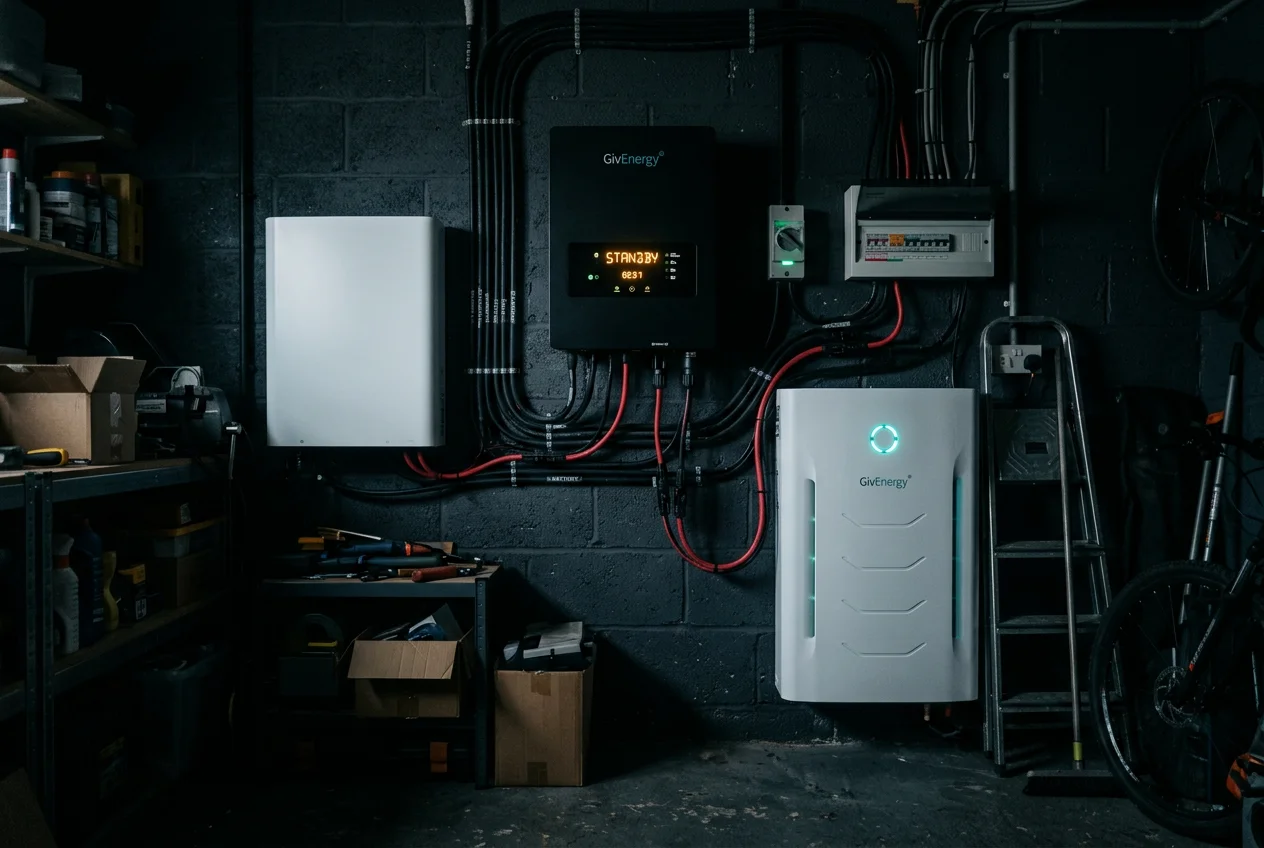
No battery — grid-connected only
Inverter standby is drawn entirely from the grid at the full Ofgem rate.
Battery system — hybrid inverter
Inverter drains the battery overnight. The battery must recharge from solar the next day — reducing net solar benefit.
Microinverter system
Each unit shuts down when its panel stops generating. Only the monitoring gateway (Envoy) draws standby — typically 3–5W.
5 Steps to Reduce Your Inverter's Invisible Load
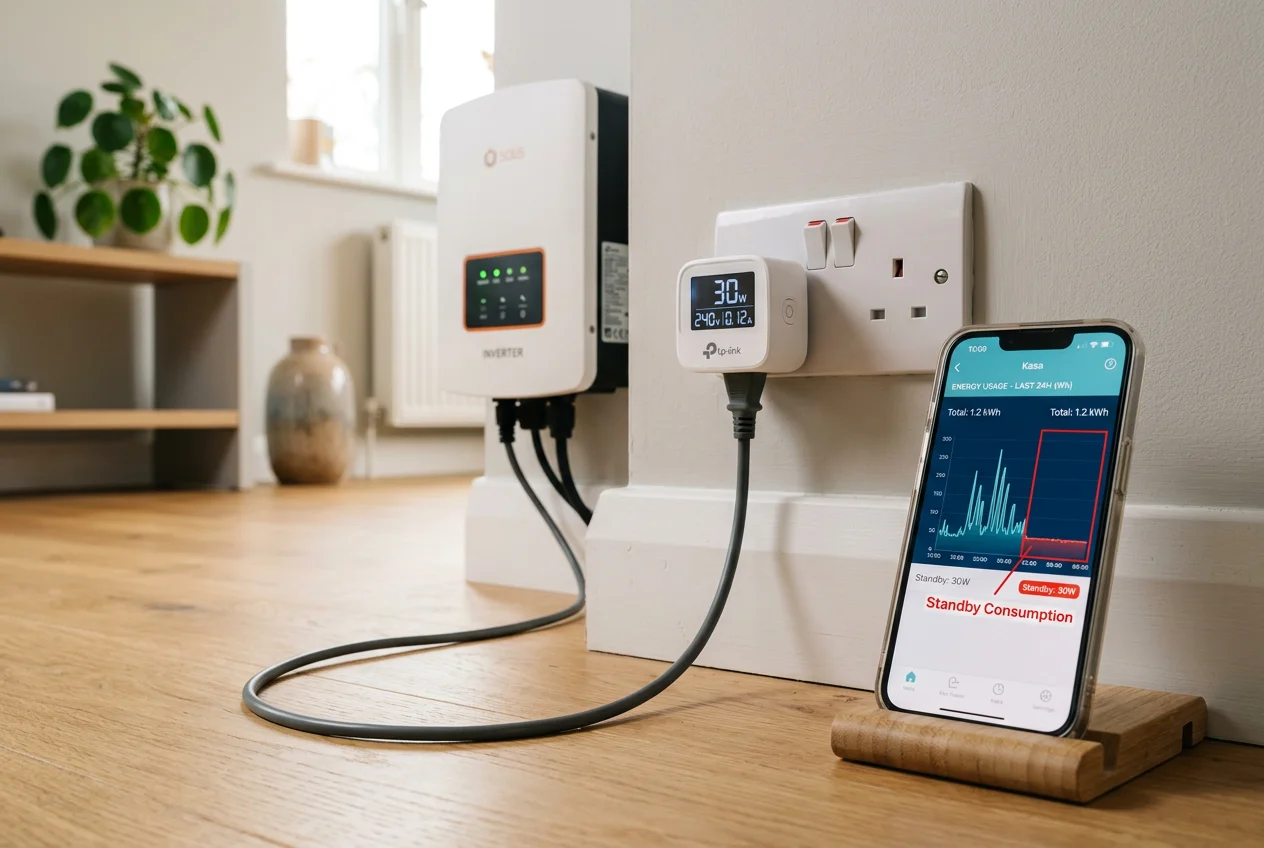
Measure first — get a smart plug energy monitor
Before assuming your inverter's standby matches the datasheet, plug a TP-Link Tapo P110 or similar energy monitoring smart plug into the inverter's AC supply and check real-world overnight draw. Datasheet figures are often best-case.
Check for a firmware update
Manufacturers including Solis, GivEnergy, and Sungrow have released sleep-mode firmware improvements. Log into your monitoring app and check for available updates — these are often free and can reduce standby by 20–40%.
Configure night mode if available
Many hybrid inverters offer a configurable "night mode" or reduced polling interval that puts communication modules to sleep between, say, 22:00 and 06:00. Check your inverter's mobile app or web portal for this setting.
Account for standby when sizing your battery
If you're buying a battery system, add your inverter's overnight standby kWh to your household demand calculation. A 10 kWh battery with a 30W inverter effectively provides only 9.6 kWh of household use — size accordingly.
Specify low-standby inverters at purchase time
When getting installation quotes, ask each installer to confirm their inverter's standby power draw from the datasheet. Request models with under 10W standby for string inverters, or under 20W for hybrid inverters. This simple question separates quality installers from those who haven't considered the detail.
Getting a Solar Quote? Ask the Right Questions
Most homeowners focus entirely on panel wattage and system cost — ignoring inverter quality. Yet the inverter is the most failure-prone component and the source of ongoing invisible losses. A quality inverter costs £200–£400 more; its energy savings and reliability return that many times over.
"What is the inverter's standby power draw from the datasheet?"
"Does it have a certified sleep or night mode?"
"What is the inverter's efficiency at 10% load (partial output on cloudy days)?"
"How long is the inverter warranty and who handles UK claims?"
MCS certification ensures quality standards — but asking the right questions still separates great installers from average ones.
Explore More Solar Tools
Once you've sized your battery correctly, see how shifting solar to evening peak hours on Octopus Agile or Go maximises your savings.
Component quality matters everywhere. Compare premium vs budget panel output over 30 years and the £ difference in lifetime value.
A good installer will specify inverter standby on the datasheet. Check your quote for this and 15 other red flags before signing.