WeatherPower Solar Impact Generator
Britain's 17.4 GWp of solar panels are quietly making a massive impact — every sunny day. See exactly what your region's solar fleet (or your own rooftop system) is achieving right now in terms that mean something.
Figures last verified:
The Numbers Behind UK Solar Impact

How We Calculate CO₂ Avoided
We use the UK National Grid's average carbon intensity figure of 233g CO₂ per kWh (2024 annual average, from Carbon Intensity API). Every kWh generated by a solar panel directly displaces a kWh that would otherwise have been generated from the grid mix — which includes gas peakers during high demand periods, when intensity is actually higher. Our estimate is therefore conservative.
How We Calculate Peak Sun Hours
Peak sun hours (PSH) represent the number of hours per day when solar irradiance averages 1,000 W/m². UK data is derived from PVGIS (Photovoltaic Geographical Information System) and SAP 10.2 methodology. South West England sees ~4.1 PSH in summer, ~0.9 PSH in December. The seasonal multipliers (1.65×/1.10×/0.72×/0.30×) are calculated from 10-year MIDAS/Met Office irradiation averages.
Tree Equivalence Explained
A mature broadleaf tree in the UK absorbs approximately 21 kg of CO₂ per year (Forestry Commission estimate). Dividing the daily CO₂ avoided (in kg) by this figure gives the number of trees that would need to grow for a full year to achieve the same climate impact. This metric makes abstract CO₂ figures viscerally understandable — and highly shareable.
EV Miles — The Modern Comparison
We use the SMMT UK fleet average of 0.27 kWh per mile for battery electric vehicles (2025 UK data). This figure accounts for real-world driving, AC charging losses (typically 85–92% efficient from wall charger to usable energy), and the UK fleet mix of small/medium BEVs. A 4 kWp system in the South East on a typical summer day generates enough electricity to drive a Nissan Leaf approximately 37 miles.
Frequently Asked Questions
How accurate are these solar generation estimates?
These are modelled estimates based on UK regional irradiation data (PVGIS/SAP 10.2), reported installed capacity by region (Solar Energy UK 2025), and standard performance ratios (0.85). Real-world output varies with actual weather, shading, system age, inverter efficiency, and soiling. Professional solar monitoring systems (e.g. SolarEdge, Enphase App, Solis Cloud) provide actual measured output for your specific system. This tool is intended to give meaningful scale and context, not replace live monitoring.
Why does the South West generate more than London despite having similar populations?
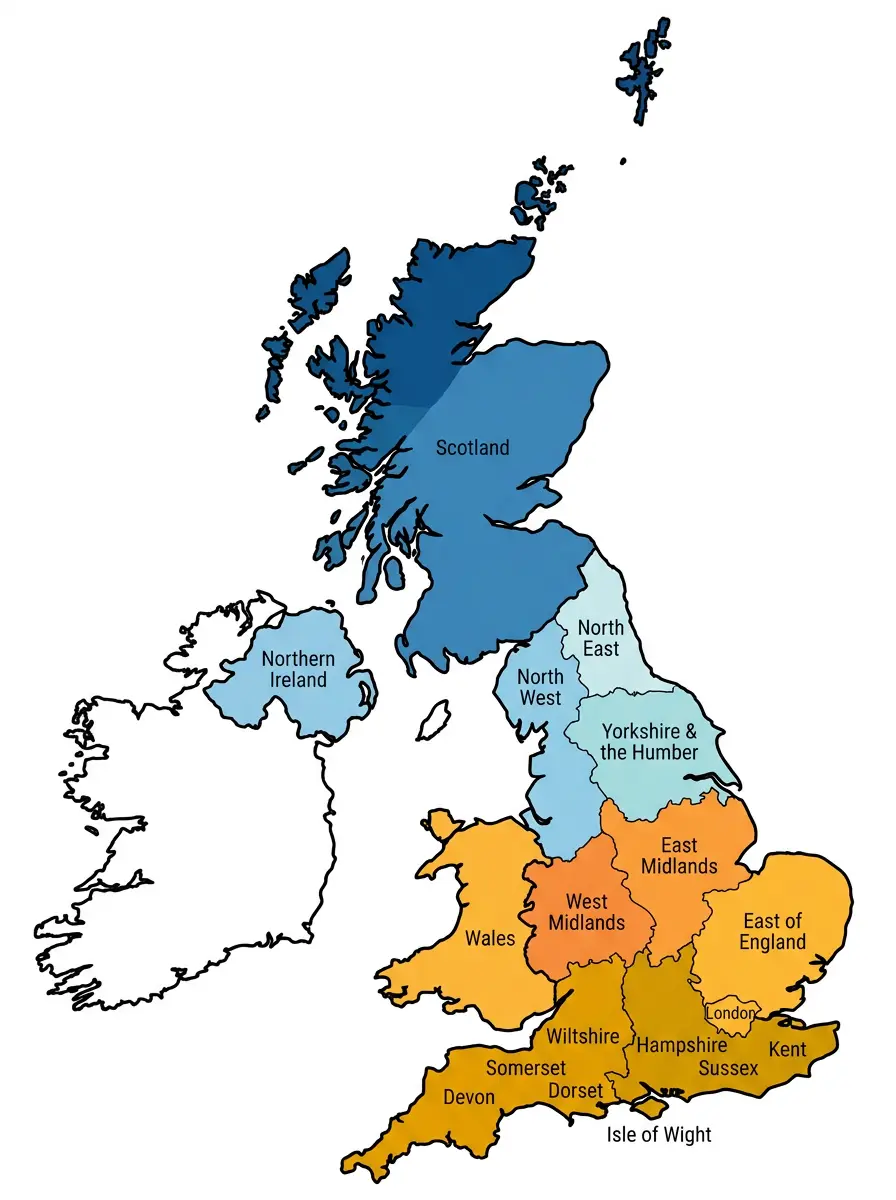
Two factors: irradiation and installed capacity. The South West has approximately 4.1 peak sun hours in summer vs London's 3.6. More importantly, the South West has 2.8 GWp of installed solar vs London's 0.9 GWp — in part because the South West has more suitable housing stock (detached/semi-detached with south-facing roofs) and rural land for ground-mounted systems. Urban density, heritage buildings, and flat roofs explain London's lower per-capita solar capacity.
What is the UK's current grid carbon intensity?
The UK National Grid's grid carbon intensity varies significantly throughout the day and year. The 2024 annual average was approximately 173g CO₂/kWh (down from 233g in 2022). We use 233g/kWh in this tool to be conservative and reflect peak-hour intensity when solar is most likely to be displacing gas generation. During periods of high wind and solar generation (typically summer afternoons), intensity can fall below 50g/kWh. Real-time intensity data is available at carbonintensity.org.uk.
How many homes can 1 GWp of solar power in the UK?
On an annual basis, 1 GWp of solar generates approximately 850 GWh/year in the UK (at 0.85 performance ratio and the UK average of ~1,000 kWh/kWp/year). The average UK home uses 3,100 kWh/year. So 1 GWp ÷ (3,100/1,000) = approximately 274,000 homes per GWp of installed solar — on an annual basis. On a peak summer day, the figure is higher; in winter, far lower. The UK's 17.4 GWp can theoretically power around 4.8 million average UK homes for a full year.
Add Your Own Impact — Get Solar Panels
A typical 4 kWp system on a UK home adds 3,400 kWh of clean generation per year — that's 1.5 tonnes of CO₂ avoided annually.
Get Free Solar QuoteExplore More Solar Tools
The green transition has a dark side. See UK panel waste projections to 2050 — and what needs to change to close the recycling gap.
Solar-powered EV driving eliminates 2.5 tonnes of CO₂ per year. Find out how many panels you need to charge your specific car.
The more output your panels sustain, the more power your region generates. See how premium vs budget panels differ over 30 years.