Battery Storage Shift Calculator
Your solar panels peak at midday. Your electricity costs peak at 5–8pm. A battery bridges that gap — but by exactly how much? See the real £ difference for your system and tariff.
Figures last verified:
The Duck Curve Problem — and Why Storage Fixes It
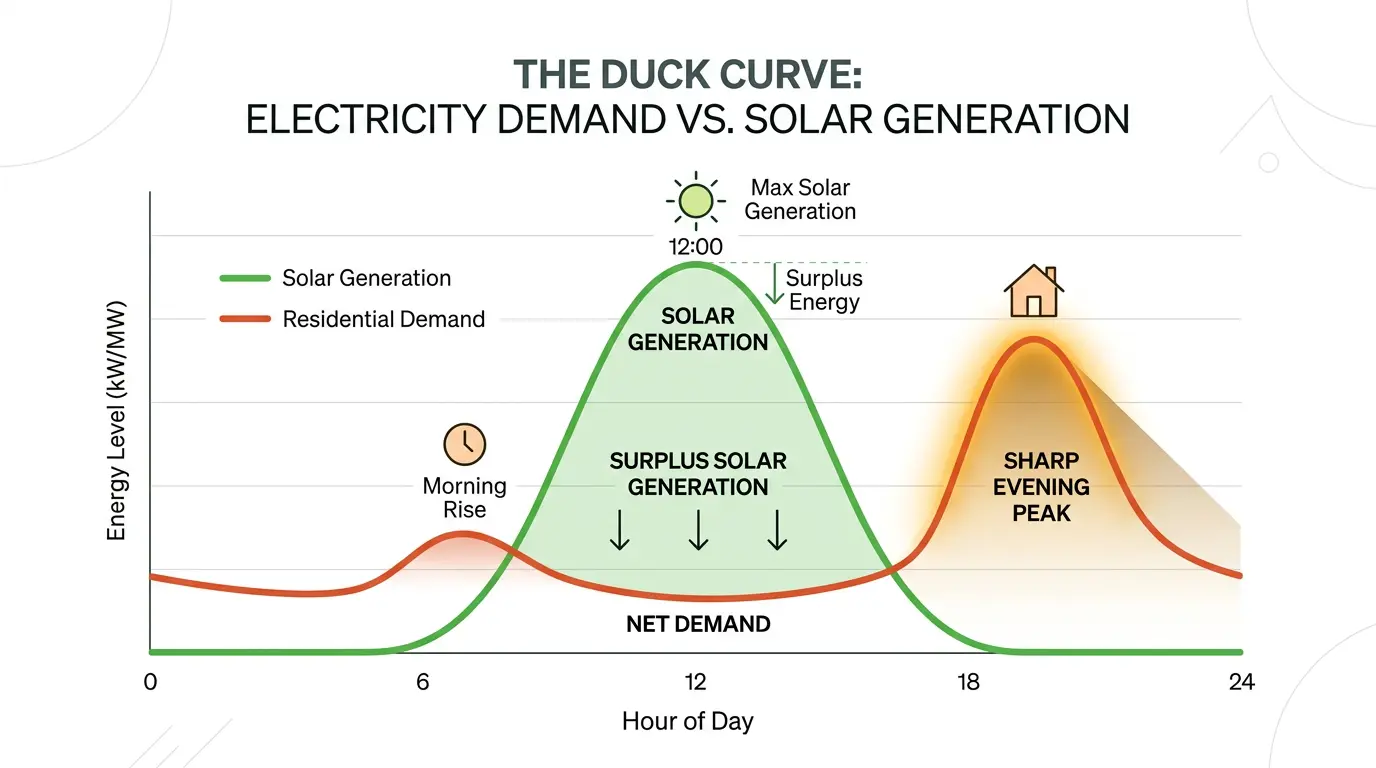
Midday Solar Glut
Your solar panels generate the most electricity between 10am and 3pm — precisely when your household uses the least. Without storage, this cheap, clean energy is exported to the grid for as little as 6p/kWh on a no-switch tariff.
Evening Peak Demand
Between 5pm and 8pm, your home demand surges — cooking, heating, EV charging. On Octopus Agile, grid electricity can cost 30–50p/kWh during this window. Without a battery, you're importing at peak price.
Storage Bridges the Gap
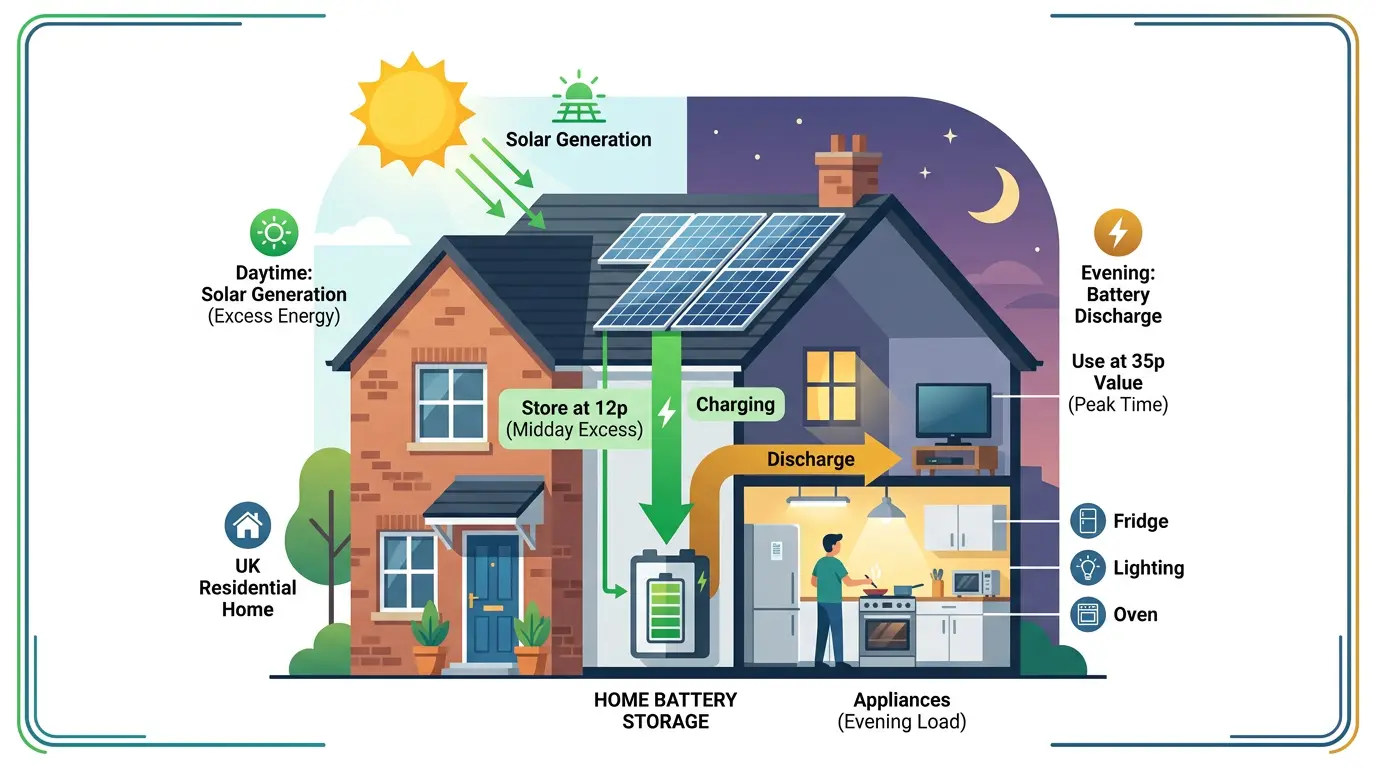
A battery captures your midday solar surplus and releases it during the evening peak. Every kWh shifted from 12p export to 35p+ import avoidance creates up to 23p of additional value — per kilowatt-hour.
UK Time-of-Use Tariffs Explained
| Tariff | Off-Peak Rate | Peak Rate | Battery Value | Best For |
|---|---|---|---|---|
| Octopus Agile | ~7p | 30–50p+ | ⭐⭐⭐⭐⭐ | Tech-savvy users, flexible automation |
| Octopus Go | 7p (5 hrs) | ~26.32p | ⭐⭐⭐ | EV owners charging overnight |
| Octopus Intelligent | 9p (scheduled) | ~26.32p | ⭐⭐⭐ | EV + home battery combined |
| Flat SVT | 26.32p | 26.32p | ⭐⭐ | Simplest — no time pressure |
| Economy 7 | ~11p (7 hrs) | ~28p | ⭐⭐ | Older storage heaters/legacy |
Frequently Asked Questions
What size battery do I need to make storage shift worthwhile?
For most 3–5 kWp solar systems, a 9.5–13.5 kWh battery (e.g. Tesla Powerwall 3 at 13.5 kWh, GivEnergy 9.5 kWh, SolarEdge Home Battery 10 kWh) is the sweet spot. Larger batteries cost more but diminish in value if your daily solar surplus is smaller than their capacity. On Agile tariffs, even a 5 kWh battery can be compelling if you're on a variable rate with volatile peak pricing.
How does the duck curve affect UK solar?
The "duck curve" describes the dip in grid demand during peak solar hours (10am–3pm) followed by a sharp ramp-up in the evening. As UK solar capacity approaches 50 GW by 2030, this effect will intensify — meaning lower export rates and higher peak import rates. Households with batteries benefit from this because their asset becomes more valuable as the duck curve deepens.
Is the calculator based on real UK electricity rates?
Yes. The standard rate baseline is Ofgem's Ofgem Q4 2026 rates cap rate of 26.32p/kWh. Octopus Agile, Go, and Intelligent rates are based on published current tariff data. The SEG export rate used is 15p/kWh (market-leading, no-switch). Battery efficiency is modelled at 90% round-trip (industry standard for modern Li-ion).
Does battery storage actually increase my solar system's ROI?
On a flat-rate tariff, a battery typically adds 4–8 years to payback compared to solar alone, because the financial case relies on avoided import cost rather than peak-rate arbitrage. On a time-of-use tariff like Octopus Agile with peak rates 2–3× the standard rate, the same battery can improve system ROI significantly. The calculator models both scenarios so you can compare directly.
Can I claim a grant for battery storage in the UK?
As of 2026, the Warm Homes Local Grant (for eligible low-income households) can cover battery storage as part of a whole-home package. The BUS (Boiler Upgrade Scheme) does not cover solar or storage. Some local authorities (e.g. under LADS/LAD4) have funded battery storage in social housing. Currently there is no universal consumer grant specifically for retrofit battery storage — but the government's 2030 energy storage strategy may introduce incentives.
What is the best battery to pair with solar panels in the UK?
The most popular UK options in 2026 are: Tesla Powerwall 3 (13.5 kWh, £8,500–£10,000 installed), GivEnergy All-in-One (9.5 kWh, £6,500–£8,000 installed), Sungrow SBH (9.6 kWh, £5,800–£7,500 installed), and SolarEdge Home Battery (10 kWh, £6,000–£8,000 installed). Always ensure your battery is MCS certified and your installer is HIES or RECC registered.
Explore More Solar Tools
Compare UK export tariffs — from 6p to 15p/kWh. Choosing the right supplier adds £100–£150/yr to your solar income.
Is solar + battery a better investment than the S&P 500 or FTSE 100? Compare 25-year returns with full IRR and break-even analysis.
Your inverter's standby load silently drains your battery overnight — up to 547 kWh/year. Factor this in when sizing your storage.
See Battery Storage Quotes for Your Home
Our MCS-certified installers can design a solar + storage system optimised for your tariff and usage profile.
Get Free Battery + Solar Quote