Solar E-Waste
Visualiser
The UK's clean energy revolution will generate hundreds of thousands of tonnes of panel waste by 2050. This tool projects the scale, composition, and recycling challenge — and what the circular economy needs to look like to handle it responsibly.
UK Solar Panel Waste Projection 2025–2050
Adjust the 2030 capacity target and recycling rate to model different scenarios. Hover the chart to see year-by-year data.
Lead solder is used in crystalline silicon cell interconnects. When panels reach landfill, lead leaches into groundwater. The EU WEEE Directive mandates panel takeback — UK post-Brexit rules are still catching up.
Silver paste is screen-printed onto silicon cells for electrical contact. At £800–£900/kg, the 2050 accumulation represents hundreds of millions in recoverable precious metal — a strong economic incentive for formal recycling.
The EU's revised WEEE Directive now requires 85% recycling efficiency for solar panels. UK manufacturers like First Solar and Reclaim PV have operational takeback schemes. Ask your installer about end-of-life recycling before you buy.
Figures last verified:
What's Inside a Solar Panel?
Understanding the materials in a 400W crystalline silicon panel — and which are valuable, which are hazardous, and which are recyclable.
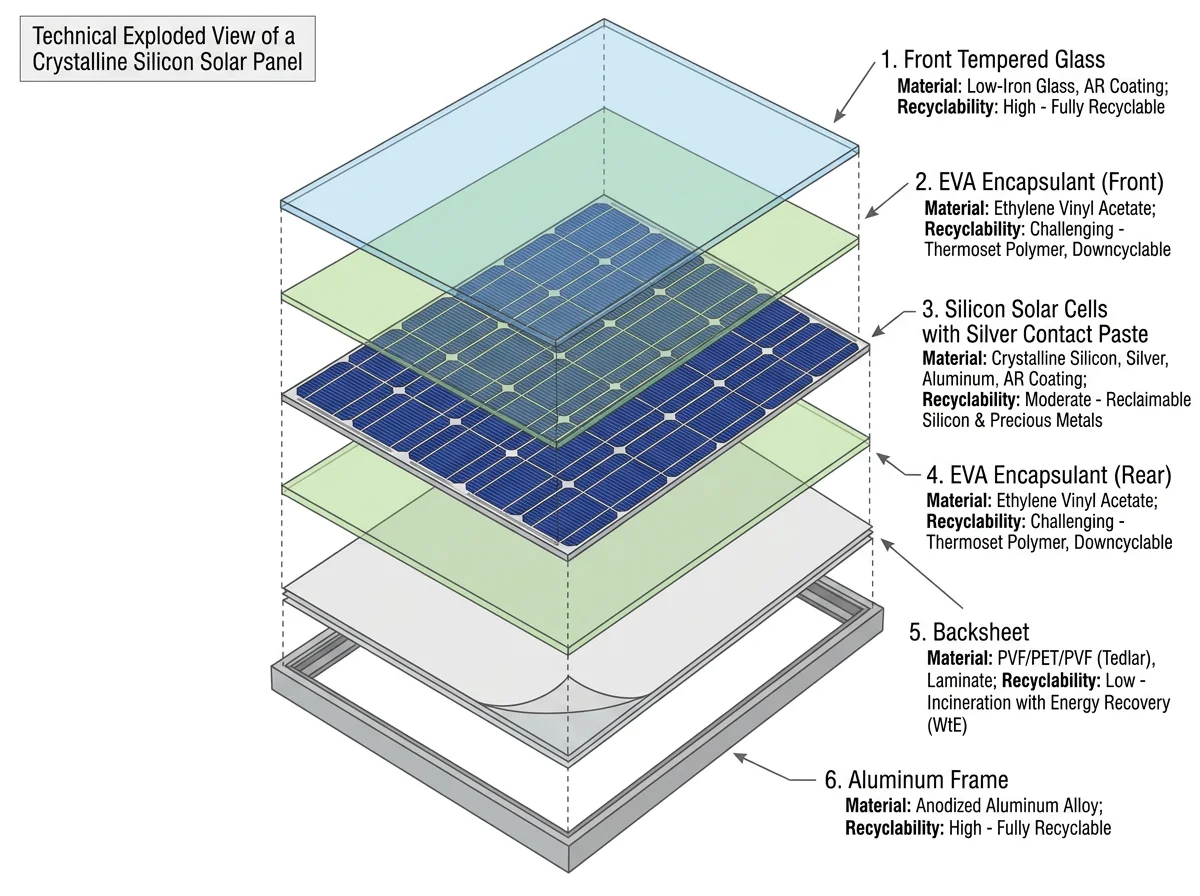
| Material | Amount (400W panel) | Recyclability | Hazard | Notes |
|---|---|---|---|---|
| Glass (tempered) | ~16 kg (76%) | High | None | Must be delaminated from EVA encapsulant before recycling. Regular glass recyclers cannot accept it. |
| Aluminium frame | ~1.5 kg (7%) | High | None | High-value recovered material. Most WEEE processors recover this routinely. |
| Silicon wafer | ~3 kg (14%) | Medium | None | Semiconductor-grade silicon has value but requires specialist processing to reclaim. |
| Copper (wiring) | ~200 g (1%) | High | None | Recovered routinely as part of general WEEE processing. |
| Silver (cell contacts) | ~8 g | High | None | High commercial value (~£7/panel). Strong economic incentive for recovery. |
| Lead (solder) | ~12 g | High | Yes — leaches in landfill | Hazardous if landfilled. Must be processed by licensed WEEE facility. UK WEEE regs mandate this. |
| EVA polymer encapsulant | ~1 kg (5%) | Low | Trace (HF when burned) | Ethylene-vinyl acetate is difficult to separate and recycle economically. Currently the main recycling bottleneck. |
| Cadmium (CdTe only) | N/A (silicon panels) | High | Yes — carcinogen | Only in thin-film CdTe panels. First Solar operates a fully funded global takeback programme. |
Choosing Solar Responsibly
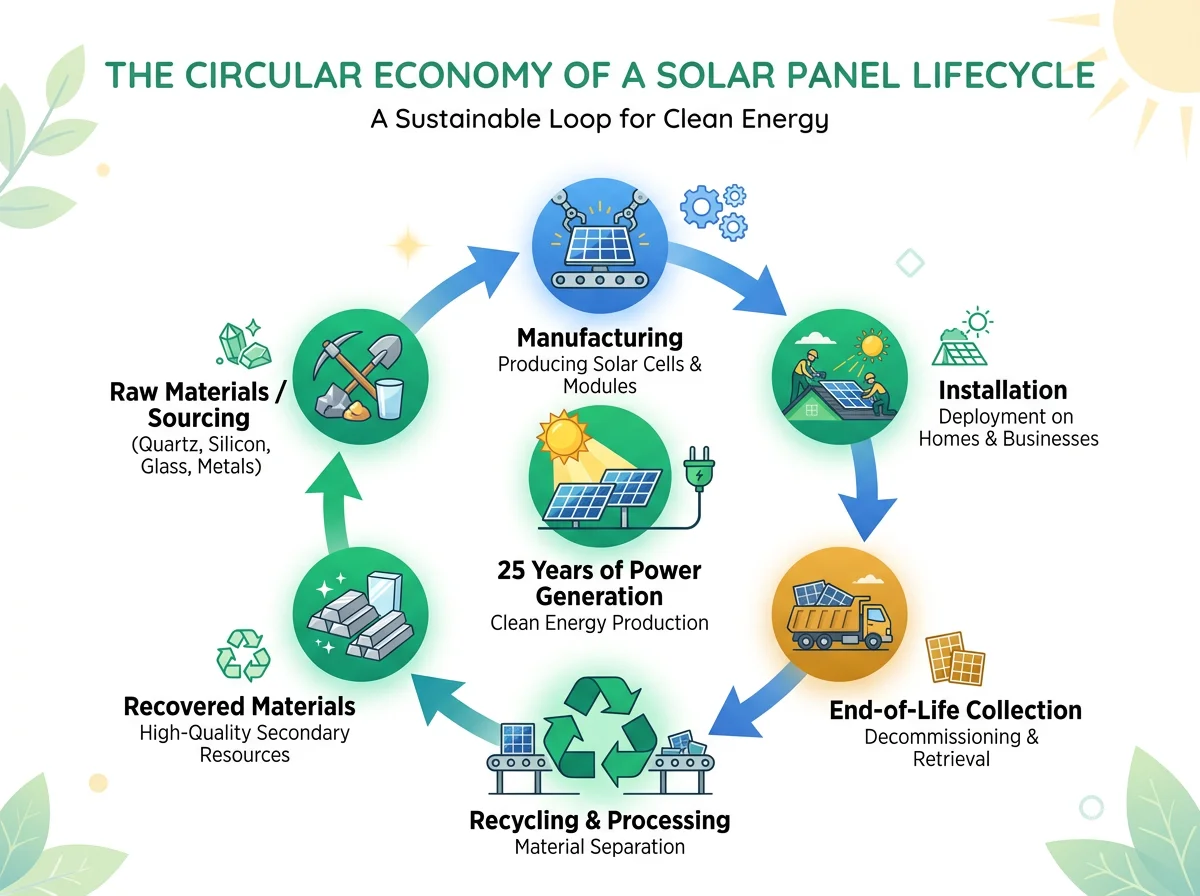
The environmental credentials of solar depend on responsible end-of-life handling. Choose panels from manufacturers with established takeback programmes — and ask your installer to confirm WEEE compliance before signing.
Explore More Solar Tools
Longer-lasting premium panels generate more energy, last longer, and reduce waste. Compare 30-year output of premium vs budget panels.
Can't install panels? Community solar and shared ownership schemes let renters and low-income households access solar without a roof.
Floating solar on UK reservoirs avoids the land-use problem entirely. Explore viability scores for 8 UK sites.