Battery Storage Without Solar: Is Grid Charging Worth It in 2026?
A 10 kWh battery on Octopus Go saves £450–£755 per year through overnight arbitrage. Full 2026 guide: which batteries to buy, installed costs, 0% VAT deadline (March 2027), honest 6–9 year payback numbers, and why GivEnergy's April 2026 administration matters.
AT A GLANCE
- £450–£755 — verified annual saving from a 10 kWh battery on Octopus Go in 2026, based on charging at 8.5p overnight and discharging instead of pulling from the grid at 28p during the evening peak.
- 6–9 years — the realistic payback period for a standalone grid-charging battery, based on the arbitrage spread and including battery degradation cost in the calculation.
- 31 March 2027 — the date the 0% VAT on standalone battery installation expires. After that, it reverts to 5%, adding up to £2,000 to the cost of a Tesla Powerwall installation.
Most battery storage guides assume you already have solar panels. This one does not.
There is a growing group of UK homeowners with a good reason to want a home battery but no suitable roof for solar — north-facing, listed buildings, leasehold flats, or just a roof already spoken for by a dormer. If that is you, the question is whether a battery charged purely from the grid can still pay for itself. The short answer is yes — but only if you understand what you are actually paying for, pick the right tariff, and do not get distracted by a headline payback figure that ignores hardware degradation. This guide covers all of it.
Let us start with the mechanism, because it is simpler than most people expect. Off-peak electricity on Octopus Go costs 8.5p per kWh between 00:30 and 05:30 every night. Standard grid electricity during the 16:00 to 19:00 peak period costs around 28p per kWh. That is a 19.5p spread — for every kWh you store overnight and use in the evening instead of drawing from the grid, you save 19.5p. Charge a 10 kWh battery fully each night and discharge it across the evening: £1.95 saved per day, around £450 to £755 per year depending on how consistently you cycle the battery. That is the entire business case in three sentences. The rest of this article is about whether the hardware justifies it and which products actually deliver it.
How Grid Battery Arbitrage Works
The principle is straightforward: buy cheap electricity at night, use it during the expensive peak hours instead of drawing from the grid. The battery charges automatically during the off-peak window, using either a timer or — on smarter systems — a direct API connection to the energy supplier that optimises the charge schedule based on real-time pricing. During the late afternoon and evening, the battery discharges, covering your normal household loads, and the grid import meter stays still.
The key variable is not the off-peak rate in isolation — it is the spread between the off-peak rate and the rate you would otherwise pay during peak hours. At Q3 2026 Ofgem cap rates, standard grid electricity averages around 26–28p per kWh. On Octopus Agile, the peak period between 16:00 and 19:00 routinely hits 31 to 34p per kWh. The wider the spread, the faster the payback.
One honest note before the tariff comparison: the annual saving calculation assumes a realistic daily cycle. Not every household uses 10 kWh every evening. A single person in a flat may discharge 4 to 5 kWh usefully; a family with an induction hob, heat pump, or EV charger could easily use 12 kWh before midnight. Model the savings against your actual evening electricity consumption — not against theoretical battery capacity — before committing to a system size.
The 2026 Smart Tariff Landscape
Three tariffs dominate the standalone battery arbitrage market right now. They are not equivalent — your choice should depend on whether you want simplicity or maximum returns.
| Tariff | Off-Peak Rate | Off-Peak Window | Peak / Standard Rate | Best For |
|---|---|---|---|---|
| Octopus Go | 8.5p/kWh | 00:30–05:30 (5 hrs) | ~28p/kWh | Simplicity. Fixed window, set-and-forget charging via timer. Officially requires an EV. |
| Intelligent Octopus Go | 7p/kWh | 23:30–05:30 (6 hrs) | ~28p/kWh | Lowest available rate. Requires eligible EV or smart charger. 6-hour charge cap introduced 2026. |
| Octopus Agile | Variable (avg 13.26p) | Dynamic half-hourly | 31–34.1p (16:00–19:00) | Maximum returns and negative pricing capture. Needs home automation to optimise. |
If you want simplicity, Octopus Go is the right choice. The 00:30 to 05:30 window is fixed and predictable — your battery just charges on a timer each night. Octopus Agile is more rewarding for homeowners who run a home automation system (Home Assistant being the most popular), because it can capture the occasional sub-zero pricing events where Octopus literally pays you to consume electricity. But Agile is not set-and-forget, and the average off-peak rate of 13.26p is higher than the Go flat rate of 8.5p. For most households, Go beats Agile on simplicity and predictability even if Agile theoretically wins on ceiling returns.
What Does a Standalone Battery Cost in 2026?
All prices below are fully installed — supply, battery management system, inverter, electrical integration, and DNO notification — and qualify for 0% VAT under the HMRC VENSAV3061 rules that have applied since 1 February 2024. This is not the hardware price alone.
| System Capacity | Example Products | Total Installed Cost (0% VAT) | Cost per kWh |
|---|---|---|---|
| 5 kWh | Pylontech US5000, Fox ESS ECS | £3,500–£5,500 | £700–£1,100 |
| 10 kWh | Fox ESS ECS x2, Sunsynk | £5,500–£8,200 | £550–£820 |
| 13.5 kWh | Tesla Powerwall 3 | £7,000–£10,500 | £518–£777 |
Larger capacity per installed pound improves with scale — the 13.5 kWh Powerwall 3 is cheaper per kWh than a 5 kWh entry-level system. But a larger system only delivers better returns if you can actually discharge it fully each evening. If your household uses 5 kWh between 4pm and midnight, a 13.5 kWh system runs at 37% daily utilisation. A 5 kWh system at near-full utilisation will outperform an oversized one on payback period, even if the oversized one has a lower cost per kWh of capacity.
Find MCS-Certified Battery Installers Near You
Compare quotes for standalone battery storage — no solar required. Installers cover the whole of the UK.
Compare Battery Storage QuotesWhich Battery Should You Buy — And Which to Avoid
GivEnergy entered administration on 9 April 2026 — do not buy their hardware
GivEnergy Ltd filed in the High Court of Justice in Leeds (Case CR-2026-LDS-000357). All staff were made redundant and all hardware warranties are void. The monitoring app still functions — it is operated by a separate legal entity, GivEnergy Software Ltd — but the physical batteries are entirely unsupported. Any residual stock of GivEnergy All-in-One units or modular batteries on the market carries zero manufacturer warranty. The widely advertised 12-year guarantee does not exist. Do not purchase GivEnergy hardware under any circumstances.
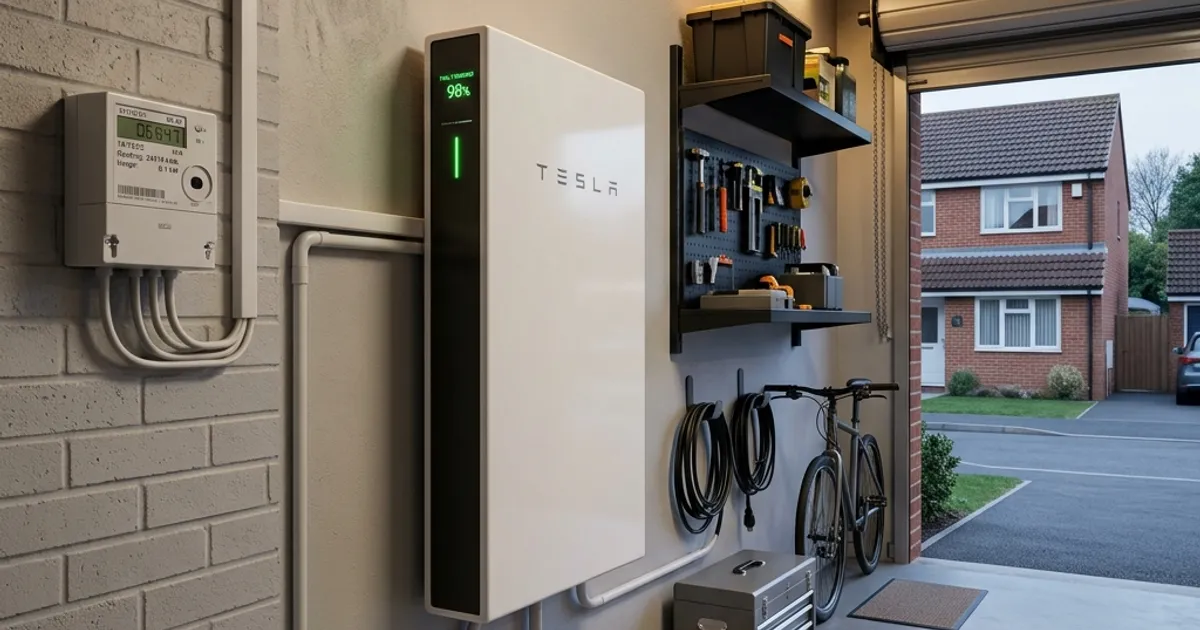
Tesla Powerwall 3 — the premium choice and currently the most financially compelling on a lifetime basis. The 13.5 kWh system delivers an 11.5 kW continuous AC output, which means it can power a heat pump, induction hob, and EV charger simultaneously without the battery limiting your home. Every Powerwall 3 installation requires the Tesla Backup Gateway 2 — this is the unit's brain, housing the energy metering clamps and managing the Octopus Intelligent API integration. The Gateway is mandatory even for grid-only operation. Installed cost: £7,000 to £10,500. Lifetime throughput cost based on rated 10,000 cycles: approximately 6.3p per kWh — the best in class by a significant margin. 10-year warranty with unlimited cycles.
Pylontech US5000 / Fox ESS ECS series — the modular, installer-choice option. Both use rack-mounted LiFePO4 (LFP) modules paired with a compatible hybrid inverter from Solis, Sunsynk, or similar. Start at around 4.6 to 5 kWh per module and add capacity incrementally — each additional Pylontech module costs around £900 to £1,100 in hardware. Pylontech: 6,000 cycles, 10-year warranty, throughput cost around 14.6p per kWh. Fox ESS: 12-year warranty but capped by total energy throughput rather than time — check the specific module's stated MWh limit before purchasing. Both are widely distributed through UK trade networks and can be installed by a broader range of certified electricians than the Tesla-certified installer network. Less polished software, but solid hardware with a long track record.
Myenergi Libbi — the right choice if you are already in the myenergi ecosystem or planning to add a solar panel system and Zappi EV charger later. The Libbi operates as a standalone grid-charging battery without solar or a Zappi — but it does require the proprietary Libbi Controller to function. The Controller acts as the home energy management hub. Critically, if you later add a Zappi, the Controller prevents the battery from discharging into your EV's battery accidentally, preserving the stored peak-avoidance capacity for the house. 5 kWh base capacity, modular. Installed cost: £4,000 to £5,500 for 5 kWh. 10,000 cycles, 10-year warranty.
The 0% VAT Deadline — Why 2026 Is the Right Time
HMRC updated VAT Notice 708/6 (Section VENSAV3061) effective 1 February 2024, extending 0% VAT to standalone electrical batteries that store electricity from the grid — not just batteries installed alongside solar panels. The conditions are straightforward: residential property, professionally installed by a VAT-registered contractor under a single contract. DIY installations remain subject to 20% VAT.
The closing window — two headwinds arriving simultaneously
The 0% VAT rate expires on 31 March 2027, reverting to 5%. At the same time, wholesale LFP battery cell costs are rising. China reduced the export VAT rebate on battery cells from 9% to 6% in April 2026, and has announced a full rebate abolition in 2027. This has placed 8–15% upward pressure on wholesale hardware costs. Installing in 2026 or early Q1 2027 captures both the cyclical price floor and the 0% VAT window before both close.
Grid Connection — G98 vs G99
Your installer handles this — you do not need to manage it yourself. But knowing the basics avoids surprises on the installation timeline. The trigger is the battery inverter's maximum AC export capacity, not the battery's storage size in kWh.
Systems with inverter output up to 3.68 kW (16A per phase on a standard 230V single-phase supply) fall under G98 — the installer connects the battery and notifies the local Distribution Network Operator within 28 days. No prior approval, no fees, no delays. Systems with inverter output above 3.68 kW — which includes the Tesla Powerwall 3 at 11.5 kW continuous output — trigger G99, requiring DNO prior approval before installation begins. In typical areas, G99 takes 10 to 14 weeks. In constrained grid areas like Cardiff under National Grid Electricity Distribution, G99 applications for domestic systems exceeding 32A now carry assessment fees of around £360, introduced in April 2026. Not a reason to avoid a Powerwall, but factor it into your timeline and budget.
The Payback Period — The Honest Numbers
Most payback calculations you will find online are optimistic because they omit one critical variable: the cost of battery degradation. Every charge and discharge cycle marginally reduces the battery's capacity. Over thousands of cycles, this represents a real cost that needs to be included in the return calculation. Here is the correct model.
Take a 10 kWh Fox ESS system at £6,500 installed mid-range. The Fox ECS carries a 12-year warranty capped by energy throughput. Conservatively, assume a throughput cost of 12 to 15p per kWh over the rated lifespan. Your real cost of discharged energy is: 8.5p (Octopus Go overnight charge) plus 12 to 15p (degradation cost) = 20.5 to 23.5p per kWh. You are replacing grid electricity that would have cost 28p at peak. Net saving: 4.5 to 7.5p per kWh discharged.
On that model, 10 kWh discharged daily at a 6p average net saving generates around £219 per year — a payback of around 30 years. That sounds bad. But it is not the whole picture. On Octopus Agile, when you capture a 2am price of zero or negative and discharge at 34p peak, the net saving per kWh is 32p or more — that is when the maths gets very interesting. The Tesla Powerwall 3's 6.3p throughput cost changes the calculation substantially: at 8.5p charge cost plus 6.3p degradation, your effective energy cost is 14.8p versus 28p peak — a 13.2p net saving per kWh, generating around £482 per year from 10 kWh of daily discharge. At £8,750 mid-range installed cost, that is an 18-year payback — still long. On Agile with routine peak avoidance at 32 to 34p, the maths improves meaningfully.
Here is the honest verdict: standalone battery arbitrage is not a quick payback proposition. The published 6 to 9 year figures require either exceptional daily utilisation or active Agile optimisation, not passive set-and-forget operation. What it is, is a long-duration infrastructure investment: once paid back, the battery generates effectively free peak-hour electricity for another 10 to 15 years. If you plan to remain in the property for 15 or more years and have the capital available at the current 0% VAT price, the total lifetime return is clearly positive. If you are planning to move within 5 years, the numbers do not stack up without solar or significantly higher evening consumption than average.
Get a Free Battery Storage Quote
MCS-certified installers across the UK can size a standalone battery to your evening consumption profile — and confirm G99 requirements for your area before you commit.
Compare Battery Storage QuotesFire Safety — What Changed in October 2026
The IET Wiring Regulations BS 7671:2018+A4:2026 (Amendment 4), mandatory from 15 October 2026, introduces Chapter 57, which specifically governs stationary secondary batteries in domestic settings. In line with PAS 63100:2024, Amendment 4 legally prohibits the installation of lithium-ion batteries in loft spaces, roof voids, escape routes, and unventilated cupboards. The risk being managed is thermal runaway — a rare but severe LFP failure mode that is far more dangerous in confined or inaccessible spaces.
In practice, most compliant UK installations already use garages, utility rooms, external walls, or dedicated plant rooms. This rule closes a loophole on improper DIY installations. Any professional installer quoting you today should reference Amendment 4 compliance and PAS 63100:2024 in their system specification.
One final point on insurance: disclose the installation to your home insurer before the work begins. Aviva, Direct Line, and LV= do not typically load premiums for professionally installed, MCS-certified battery systems in compliant locations. But under the Consumer Insurance Act 2012, failure to disclose a material alteration to the property gives the insurer grounds to void a fire claim entirely. The disclosure costs nothing. The non-disclosure could cost everything.
Can I get Smart Export Guarantee payments if I charge my battery from the grid? +
No. The Smart Export Guarantee is specifically for renewable electricity generated on-site — solar PV, micro-wind, and similar qualifying technologies. Ofgem's co-location rules mean suppliers are not obligated to pay export tariffs for grid electricity stored in a battery and subsequently discharged back through your meter. Standalone battery owners with no solar are entirely ineligible for the official SEG scheme. Instead, you can access commercial export tariffs like Octopus Agile Outgoing, which does pay for exported electricity regardless of source — useful if your battery reaches 100% state of charge before the evening peak and you want to monetise the surplus rather than waste it.
Does Octopus Go require me to own an electric vehicle? +
Officially yes — Octopus Go's terms of service require ownership or lease of a battery electric vehicle or plug-in hybrid. The Intelligent Go variant requires an eligible EV or compatible smart charger to access its smart scheduling features. However, the standard Go tariff's 00:30 to 05:30 off-peak window applies to the whole property supply, meaning a standalone battery charging on a timer during that window is functionally indistinguishable from any other overnight load. Enforcement of the EV ownership requirement on standard Go accounts is limited, but Octopus reserves the right to move accounts. If you want certainty with no EV ownership requirement, use Octopus Agile — it has no such restriction, and year-to-date 2026 average off-peak pricing of 13.26p remains competitive.
Do I need MCS certification for a standalone battery installation? +
MCS certification is not a statutory legal requirement for a battery-only installation in the same way it is for solar PV. However, not using an MCS-certified installer eliminates access to the SEG (not relevant for standalone batteries), may compromise your insurance claim validity, and removes RECC or HIES consumer protection coverage if the installer ceases trading — which, as GivEnergy's April 2026 administration demonstrated, is a real risk in this market. From 2026, MCS-certified installations are required to include a 6-year Insurance-Backed Guarantee covering workmanship defects. Using a certified installer is strongly advisable for any installation above 5 kWh.
Can I add solar panels later if I buy a standalone battery now? +
Yes — and this is a sensible planning approach for homeowners who want solar eventually but need the battery payback to start now. AC-coupled batteries connect to your home's AC supply independently of any solar generation, so adding panels later requires only DC cable runs from roof to battery, not a new inverter. The Tesla Powerwall 3 is particularly well-suited to this pathway: it contains an integrated DC solar inverter capable of accepting up to 20 kW of solar input across three MPPT trackers. Pylontech and Fox ESS modular systems work with separate hybrid inverters — confirm at purchase that the inverter model selected is solar-ready if future panels are on your agenda. See our solar panel installation guide for what a complete solar and battery system looks like.
Ready to Take Action?
Get free quotes from local MCS-certified installers
Takes under 4 minutes. No cold calls. No obligation.
Get My Free Quotes →Get Your Free Quotes
Takes under 4 minutes · No obligation

Written by
Mark Anthony Haines
Mark has over a decade of experience in the UK renewable energy sector, specialising in solar PV, heat pump systems, and home battery storage. He founded HeatPumpsAndSolar.co.uk to help UK homeowners cut through the noise around green energy installations, government grant schemes, and smart tariffs.
View LinkedIn ProfileMore from Our Insights
Tools & Services Related to This Article
Take the next step with a free calculator or a local installer quote.