Heat Pump vs Gas Boiler 2026: The Real Costs, Grants, and 15-Year Savings
At Q3 2026 Ofgem rates, a heat pump at SCOP 3.2 delivers useful heat at 8.2p/kWh — virtually identical to a 90% gas boiler at 8.1p. Switch to a dedicated heat pump tariff and the 15-year saving exceeds £8,700. Full cost breakdown, BUS grant explained, 3-scenario TCO model, and the HEM Band D trap waiting for gas boiler owners in 2027.
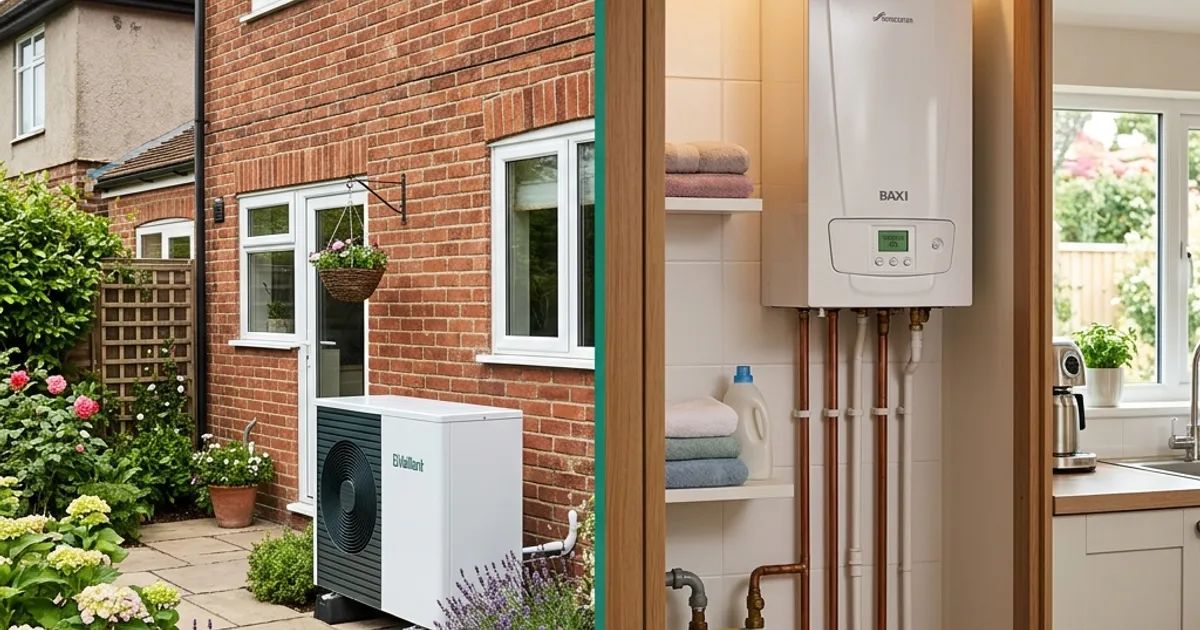
AT A GLANCE
- 8.2p vs 8.1p — the effective cost per kWh of useful heat from a heat pump at SCOP 3.2 versus a 90% efficient gas boiler, at Q3 2026 Ofgem rates. They are nearly identical before grants and specialist tariffs are applied.
- £7,500–£9,000 — the Boiler Upgrade Scheme grant that cuts a heat pump's net upfront cost to roughly the same as a replacement boiler in most homes.
- £8,795 — the 15-year Total Cost of Ownership saving from a heat pump on a dedicated tariff versus a gas boiler, modelled on Q3 2026 South Wales rates.
Your boiler has broken, or is about to. A Gas Safe engineer has told you it needs replacing. The quote for a new boiler sits on your kitchen table. And your spouse — or your own nagging brain — is asking: "Should we just get a heat pump instead?" Good question. It deserves a proper answer, not a brochure.
Here's the thing most people get wrong immediately: they look at electricity at 26.11p per kWh and gas at 7.33p per kWh under the Q3 2026 Ofgem cap, divide one by the other, conclude that electricity is 3.6 times more expensive, and stop there. That maths is technically correct and practically meaningless. A heat pump is not a bar heater. It does not burn electricity to make heat — it uses electricity to move heat from the outside air into your home. Every 1 kWh of electricity powers the movement of roughly 3.2 kWh of thermal energy. Suddenly, electricity does not look quite so expensive.
What does look bad: a poorly installed heat pump in an uninsulated house on a standard variable electricity tariff. That combination is genuinely more expensive to run than a gas boiler. What looks very good: a properly commissioned heat pump in a typical semi-detached, with weather compensation tuned correctly, on a dedicated heat pump electricity tariff. The 15-year total cost of ownership on that combination beats a gas boiler by over £8,700 in verified 2026 modelling. The difference between those two outcomes is mostly about installation quality and tariff choice — not the fundamental technology.
This article covers the upfront costs, the BUS grant, the running cost maths done correctly, hidden costs both sides tend to omit, and a three-scenario 15-year Total Cost of Ownership model built on verified Q3 2026 figures. By the end, you should be able to make a financially grounded decision rather than one based on gut feel or a competitor's selective data.
The Right Way to Compare Running Costs
Right, let's look at the actual numbers — but the right numbers. Not unit prices. Effective cost of useful heat delivered into your home.
A 90% efficient gas boiler burns 1.11 kWh of gas to deliver 1 kWh of useful heat into your radiators. At the Q3 2026 Ofgem national gas rate of 7.33p per kWh, that heat costs you 8.1p per kWh.
A heat pump at SCOP 3.2 uses 0.31 kWh of electricity to deliver 1 kWh of useful heat. At 26.11p per kWh electricity, that heat costs you 8.2p per kWh.
They are effectively tied, at Q3 2026 prices, on a standard tariff. The gas boiler wins by a fraction of a penny. That is the true baseline comparison — not "electricity is 3.6 times more expensive."
What SCOP actually means in practice
The Electrification of Heat demonstration project (Energy Systems Catapult, 2024) monitored 742 real UK heat pump installations and found a median SCOP of 2.93. Octopus Energy's Cosy fleet, operating on smart tariffs with weather compensation, recorded an average of 3.87 across a 90-day winter period. The range 2.9 to 3.5 is realistic for a well-installed system in a typical UK home. Systems achieving below 2.5 are almost always the result of poor commissioning or incorrect flow temperatures — not fundamental technology limitations.
Now apply a dedicated heat pump tariff. Octopus Cosy offers off-peak electricity between 13p and 14.53p per kWh. E.ON Next Pumped goes as low as 16.92p for 21 hours per day. At 14p per kWh on a SCOP 3.5 system: 4p per kWh of useful heat. The gas boiler at 8.1p is now losing by a factor of two on running costs. That is the story — and it is a much more interesting one than the raw unit price comparison suggests.
What You'll Pay Upfront
Let's be straight about the numbers on both sides.
New A-rated condensing gas boiler: A like-for-like combi replacement in the same location — same pipes, no flue changes — runs £1,800 to £3,000 fully installed. Complex conversions (changing from conventional to combi, relocating the boiler) add another £1,000 to £1,500. Call it £2,300 as a realistic mid-range for a standard replacement. You will likely replace it again within 10 to 15 years — that is another £2,300 to factor into a 15-year model.
Air source heat pump: Gross installed cost for an 8 to 12 kW system is £10,000 to £14,000. This includes the outdoor unit, system design and heat loss calculations, necessary pipework, electrical integration, a compatible unvented hot water cylinder, and MCS certification. Heat pumps typically last 20 to 25 years — no mid-lifecycle replacement in a 15-year model.
That looks terrible for the heat pump on paper. But then the Boiler Upgrade Scheme changes the maths entirely.
| Grant | Amount | Eligibility | Net Heat Pump Cost After Grant |
|---|---|---|---|
| BUS — gas/electric homes | £7,500 | Properties on mains gas or electric heating | £2,500–£6,500 |
| BUS — oil/LPG homes | £9,000 (from 21 July 2026) | Properties replacing oil or LPG boilers | £1,000–£5,000 |
| BUS — air-to-air systems | £2,500 | New from 2026 — space heating only, no hot water | Varies |
The BUS grant is deducted directly from your installation invoice by your MCS-certified contractor — you never see the money, you just pay less. The EPC insulation recommendation caveat was scrapped in May 2024, so you no longer need to insulate the loft before applying. The grant applies on a first-come basis and requires an MCS-certified installer and an eligible MCS-certified heat pump model.
After a £7,500 BUS grant on a £12,000 installation, your net cost is £4,500. Compare that to £2,300 for a gas boiler today, plus another £2,300 at year 12 — the heat pump's capital position over 15 years is essentially equivalent.
The Hidden Costs — Both Directions
Every "heat pump vs boiler" article picks a side and inflates the opposition's hidden costs. Here are the actual ones, verified.
Heat pump hidden costs that are real:
- Radiator upgrades — a January 2025 University of Oxford study of 4,600 UK heating systems found that up to 66% of homes could fit a modern high-temperature heat pump without any radiator changes. When upgrades are needed, they are typically one to three radiators in the largest rooms — at £300 to £500 per unit. A full house replacement costs around £3,000 but is the exception, not the rule.
- Annual servicing — budget £150 per year including an F-Gas check. More than a boiler service, but not dramatically so.
- G99 grid connection — if you install a high-output heat pump with an inverter above 3.68 kW, your installer needs DNO prior approval. In most areas, this is straightforward. Allow for 10 to 14 weeks in constrained grid areas.
Gas boiler hidden costs that are real:
- Two boilers in 15 years — most A-rated condensing boilers carry a 10-year warranty. Plan for a replacement at year 10 to 12.
- Annual servicing — £100 per year, less than a heat pump, but you also keep paying the gas standing charge of £106.94 per year. Gas disconnection on heat pump installation eliminates this permanently.
- HEM Band D penalty from 2027 — the Home Energy Model replacing EPC ratings from 2027 locks homes with gas boilers into lower energy ratings. If you are a landlord, MEES regulations require Band C by 2030. A gas boiler is unlikely to get you there without significant additional works. A heat pump with solar panels gets most homes to Band B or above. The regulatory trajectory for gas-heated properties is one-way.
The Noise Question
Look, this comes up in every heat pump conversation and the honest answer is: modern heat pumps are quiet, not silent. Under MCS 020(a), planning rules limit heat pump noise to 42 dB(A) at one metre. From October 2026, the MCS 020(a) amendment tightens the acoustic limit to 37 dB(A) — that is roughly equivalent to a quiet library. Premium units from Vaillant, Mitsubishi, and Daikin are already designed to meet this. Budget units from lesser-known brands may require careful siting to comply.
The practical reality is that most neighbours never notice a well-sited heat pump. The cases that generate noise complaints — and installer online reported a 24-fold increase in complaints over three years — are almost entirely confined to units installed directly under bedroom windows, in acoustically reflective courtyard configurations, or simply commissioned at too high a flow temperature, causing the compressor to cycle harder than necessary. These are installation failures, not technology failures.
Get MCS-Certified Heat Pump Quotes
Compare quotes from MCS-certified installers near you — BUS grant applied directly to your invoice.
Compare Heat Pump Quotes15-Year Total Cost of Ownership — Three Scenarios
All three scenarios model a 3-bedroom semi-detached in Cardiff, South Wales, requiring 12,000 kWh of useful heat annually. Q3 2026 South Wales Ofgem rates: 26.33p per kWh electricity, 7.42p per kWh gas.
| Cost Category | Scenario A: Gas Boiler | Scenario B: Heat Pump (Standard Tariff) | Scenario C: Heat Pump (Dedicated Tariff) |
|---|---|---|---|
| SCOP / Efficiency | 90% efficient boiler | SCOP 3.2 | SCOP 3.5 |
| Annual electricity rate | N/A (gas only) | 26.33p/kWh (standard) | 14p/kWh (E.ON Next Pumped) |
| Annual fuel consumption | 13,333 kWh gas | 3,750 kWh electricity | 3,428 kWh electricity |
| Annual fuel cost | £989 (gas at 7.42p) | £987 (electricity at 26.33p) | £480 (electricity at 14p) |
| Annual gas standing charge | £107 | £0 (gas disconnected) | £0 (gas disconnected) |
| Annual maintenance | £100 | £150 | £150 |
| 15-year capital (incl. replacement) | £4,800 (two boilers) | £4,500 (net after BUS grant) | £4,500 (net after BUS grant) |
| 15-year running costs | £16,440 | £14,810 | £7,200 |
| 15-year maintenance | £1,500 | £2,250 | £2,250 |
| 15-YEAR TOTAL (TCO) | £22,744 | £21,561 | £13,949 |
Scenario A versus Scenario B: the heat pump on a standard tariff saves £1,183 over 15 years. Modest — and it illustrates exactly why "just switch to a heat pump" without addressing the tariff is a missed opportunity.
Scenario A versus Scenario C: the heat pump on a dedicated tariff saves £8,795 over 15 years. That is the full case for switching — and it requires a specifically trained, well-commissioned heat pump with weather compensation and a heat pump electricity tariff. Both of those are achievable in 2026. Neither requires unusual technology or a perfect house.
The Regulatory Outlook — Why Gas Gets Harder Over Time
None of the TCO model above includes the regulatory cost trajectory for gas-heated homes. It probably should, because it is real.
The Home Energy Model (HEM), replacing the current EPC system from 2027, assesses properties on carbon intensity rather than just energy efficiency. Gas boilers — even A-rated condensing units — score significantly worse than heat pumps on the new metric. The government has confirmed that landlords must achieve Band C under HEM by 2030 to let properties legally. For many gas-heated properties, reaching Band C without a heat pump or significant solar installation will be difficult or impossible without extensive retrofitting.
For owner-occupiers, there is no legal compliance deadline — but resale value is a factor. UK mortgage valuations increasingly note HEM ratings. Properties in Band E or below will face growing buyer resistance and potential valuation discounts as the 2030 MEES deadline approaches for landlords and buyers factor in upgrade costs. None of this is speculative — it is the confirmed regulatory direction from DESNZ documentation published in early 2026.
Gas is not being banned immediately. But the financial and regulatory tail risk attached to gas heating from 2027 onwards is real and asymmetric. The heat pump positions you on the right side of that trajectory.
Do I need to insulate my home before getting a heat pump? +
Not as a legal prerequisite for the BUS grant — the EPC insulation recommendation requirement was scrapped in May 2024. However, insulation does directly improve the SCOP your heat pump achieves. A poorly insulated home loses heat faster, requiring the heat pump to run longer and harder, reducing its seasonal efficiency. The University of Oxford's January 2025 study found that 66% of UK homes can take a modern high-temperature heat pump without insulation upgrades. If your home is already post-1970s cavity wall construction with a loft, you are likely in that majority. A heat loss survey by your installer will confirm whether additional insulation is mechanically advisable before the system is designed.
What happens to the hot water — does a heat pump replace my boiler's hot water function? +
Yes — a properly specified heat pump system includes a dedicated unvented hot water cylinder, typically 200 to 250 litres. This cylinder stores domestic hot water heated to 55 to 60°C by the heat pump during off-peak periods. A weekly legionella pasteurisation cycle heats the cylinder to 65°C. Most standard heat pump quotations include the cylinder in the base price. If you are switching from a combi boiler, there will be physical space requirements for the cylinder — typically a 600 x 600mm floor area, minimum 1.8 metres headroom. Your installer should model this during the site survey.
Can a heat pump heat my home in very cold weather? +
Yes. Modern air source heat pumps operate down to minus 25°C ambient air temperature — well below anything the UK normally experiences. Performance does reduce at lower temperatures: a heat pump achieving SCOP 3.5 in autumn may deliver SCOP 2.5 during a January cold snap when the outside air is 2°C. This is not a failure — it is a normal thermodynamic property. The heat pump just runs longer to compensate. In the UK climate, sustained periods below minus 5°C are rare and brief enough that they do not materially affect the annual SCOP figure. The EoH demonstration data (2.93 median SCOP across a full UK winter including cold spells) confirms this.
Will a heat pump work with my existing underfloor heating? +
Underfloor heating is ideal for heat pumps — it is the best emitter type. UFH operates at low flow temperatures, typically 35 to 45°C, which is exactly the range where heat pumps achieve their highest SCOP. If you have existing wet UFH (hydronic, not electric), it will pair extremely well with a heat pump without any modifications. Electric underfloor heating is separate technology and is not connected to a heat pump system. If you are considering adding UFH during a heat pump installation, this is the moment to do it — the combined system design is simpler and cheaper than retrofitting later.
Ready to Take Action?
Does your home qualify for the BUS grant?
Check eligibility and compare quotes from local MCS-certified installers — free, no obligation.
Check My Eligibility →Get Your Free Quotes
Takes under 4 minutes · No obligation

Written by
Mark Anthony Haines
Mark has over a decade of experience in the UK renewable energy sector, specialising in solar PV, heat pump systems, and home battery storage. He founded HeatPumpsAndSolar.co.uk to help UK homeowners cut through the noise around green energy installations, government grant schemes, and smart tariffs.
View LinkedIn ProfileMore from Our Insights
Tools & Services Related to This Article
Take the next step with a free calculator or a local installer quote.