ECO4 Scheme Eligibility 2026: Qualifying Rules for Free Heat Pumps, Solar Panels, and Insulation
Full guide to ECO4 and LA Flex eligibility in 2026: qualifying DWP benefits, the four LA Flex routes, EPC band requirements, the mandatory two-band improvement rule, and why fabric-first insulation must come before a free heat pump or solar array.
AT A GLANCE
- 100% funded - a qualifying ECO4 or LA Flex household pays nothing towards insulation, a heat pump, or solar panels. There is no partial grant here, unlike the Boiler Upgrade Scheme.
- £31,000-£36,000 - the gross household income ceiling under LA Flex Route 1, which lets councils qualify homes that fall outside the standard DWP benefits list.
- 31 December 2026 - the date ECO4 closes before being replaced by the Warm Homes Plan, so any project not started soon risks missing the funding window entirely.
ECO4 scheme eligibility is one of the most misunderstood topics in UK home energy, and it's easy to see why. The scheme genuinely does fund 100% of the cost of a new heat pump, solar panels, or a full insulation upgrade for qualifying households, with zero contribution from the homeowner. That sounds almost too good to be true, which is exactly why so much low-quality marketing around it promises "free grants" without ever explaining who actually qualifies or how the process works.
This guide cuts through that noise. We'll walk through exactly which benefits get you in under the standard route, how the Local Authority Flexible Eligibility route works if you don't receive any of those benefits, what property standards your home needs to meet, and why insulation almost always has to come before a heat pump or solar array under the scheme's rules. We'll also flag the parts that catch people out, like the state pension not automatically qualifying you, and the scheme's hard closing date at the end of 2026.
If you've been told you're eligible for a "free heat pump" by someone cold-calling or knocking on your door, read this first. Genuine ECO4 and LA Flex eligibility follows clear statutory rules, and understanding them is the best protection against the marketing noise around this scheme.
What ECO4 Actually Is, and Why It's Not a Government Handout
The Energy Company Obligation, now in its fourth iteration as ECO4, is not funded by general taxation. It's a statutory obligation placed on large licensed energy suppliers by the government, requiring them to fund energy efficiency and low-carbon heating measures for a defined proportion of low-income and vulnerable households. Suppliers meet this obligation by paying for the work directly, which is why a qualifying household never sees an invoice.
This distinguishes ECO4 fundamentally from the Boiler Upgrade Scheme, which provides a fixed partial grant (£7,500 to £9,000) to any homeowner regardless of income, still leaving a net cost to pay. ECO4 is means-tested and covers the entire cost, including insulation, for households that qualify. The scheme runs until 31 December 2026, after which it's due to be replaced by the government's Warm Homes Plan framework, which at the time of writing has not published its detailed eligibility rules.
Route One: Qualifying Through Means-Tested Benefits
The primary ECO4 qualification route works through a specific list of DWP-administered benefits. If anyone in your household receives one of the following, you're very likely eligible for the Help to Heat Group under ECO4:
- Universal Credit
- Pension Credit (Guarantee Credit or Savings Credit)
- Income Support
- Income-based Jobseeker's Allowance (JSA)
- Income-related Employment and Support Allowance (ESA)
- Housing Benefit
- Working Tax Credit or Child Tax Credit
- Child Benefit (subject to household composition and income thresholds)
This is where a lot of confusion sets in. Two of the most common misconceptions are worth addressing directly. First, receiving the basic State Pension alone does not qualify you, it needs to be Pension Credit specifically, which is a separate means-tested top-up that not every pensioner claims even when eligible. Second, non-means-tested disability benefits like Personal Independence Payment (PIP) do not automatically qualify a household either, since PIP isn't income-assessed and doesn't appear on the qualifying benefits list on its own. If your only income is the State Pension and PIP, you don't automatically qualify under the standard route, though you may still qualify under LA Flex, covered next.
Check Your Eligibility for Grants and Funded Retrofits
Answer a few quick questions to see which schemes, including ECO4, LA Flex, and the Boiler Upgrade Scheme, your household may qualify for.
Check My EligibilityRoute Two: Local Authority Flexible Eligibility (LA Flex)
Not everyone who needs support receives one of the qualifying benefits above, which is exactly the gap LA Flex was designed to fill. Under Ofgem's rules, energy suppliers can allocate up to 50% of their ECO4 obligation to households identified as in need by their local council through a published Statement of Intent, rather than through the national benefits list. There are four formal LA Flex routes:
- Route 1 qualifies households with a total gross annual income below £31,000, though some councils set a localised limit as high as £36,000.
- Route 2 uses proxy indicators such as Council Tax reduction eligibility combined with living in a Lower-layer Super Output Area (LSOA) that falls within a specified deprivation decile.
- Route 3 covers households where a resident has a chronic health condition, such as a respiratory, cardiovascular, or mobility disorder, that is medically confirmed to be exacerbated by living in a cold home.
- Route 4 covers other targeted local schemes defined individually by each energy supplier and local authority.
The practical starting point for LA Flex is your own local council, since each one publishes its own Statement of Intent setting out exactly which of these routes it has adopted and what evidence it requires. This is also the route worth exploring if you found the Boiler Upgrade Scheme's £7,500 grant helpful but still can't cover the net cost, our guide to the Warm Homes Local Grant covers a related fully-funded scheme with its own income thresholds, and the zero-interest government solar loan option is worth reading if your income sits just above the LA Flex ceiling.
Property Eligibility: EPC Bands and the Two-Band Improvement Rule
Qualifying on income or benefits alone isn't enough, your property also needs to meet specific technical criteria. ECO4 targets homes with an Energy Performance Certificate rating of D, E, F, or G, with clear priority given to the worst-performing F and G rated properties. If your home is already rated A, B, or C, it won't qualify for ECO4 funded measures, on the basis that the scheme's statutory purpose is improving the least efficient housing stock first.
There's also a mandatory technical target built into every ECO4 project: the two-band EPC improvement rule. This requires that any qualifying retrofit lift a Band F or G property to at least Band D, or lift a Band E or D property to at least Band C. In practice, this is what determines the scope of work on your property, a single measure like loft insulation alone is rarely enough to meet the two-band jump, which is why most ECO4 projects bundle multiple measures together into a single retrofit plan.
| Programme | Funding Level | Assessment Basis | Eligible EPC Bands | Runs Until |
|---|---|---|---|---|
| ECO4 (Benefits Pathway) | 100% fully funded | Qualifying DWP benefits | D, E, F, G (priority F/G) | 31 December 2026 |
| ECO4 (LA Flex Pathway) | 100% fully funded | Council-assessed income or health need | D, E, F, G (priority F/G) | 31 December 2026 |
| Warm Homes: Local Grant | Up to £30,000 funded | Means-tested, household income typically below £36k | D, E, F, G | March 2028 |
| Boiler Upgrade Scheme (BUS) | £7,500-£9,000 partial grant | No means-testing | Any valid EPC | 2027/2028 |
Why Insulation Comes Before a Heat Pump or Solar Panels
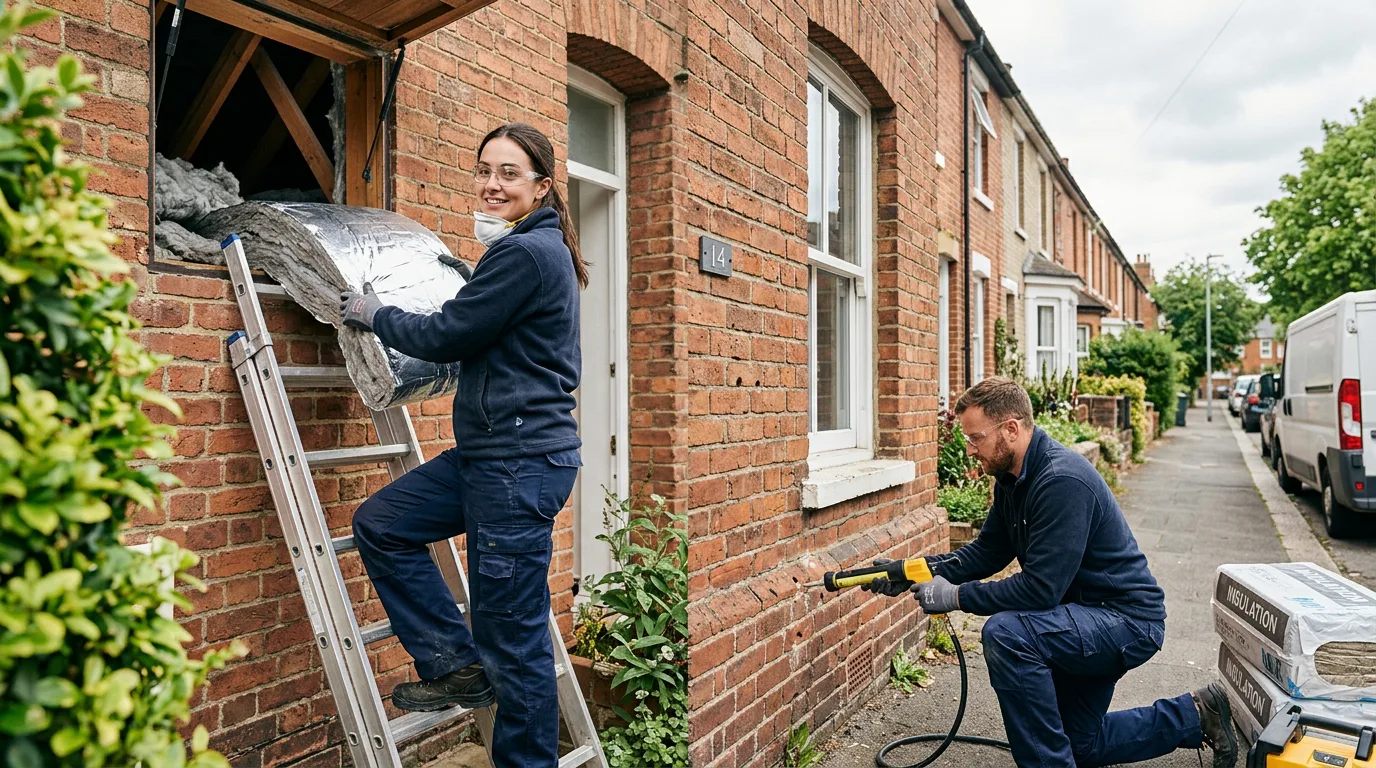
Every ECO4 project follows the "fabric-first" principle set out in the government's PAS 2035 retrofit standard. In plain terms, this means an installer cannot simply fit a heat pump or solar panels onto a poorly insulated home and call it a day. Building fabric measures, cavity wall insulation, solid wall insulation, loft insulation, or underfloor insulation, have to be assessed and, where needed, installed first, designed and overseen by an accredited Retrofit Coordinator.
There's sound technical logic behind this rule, not just bureaucracy. A heat pump running at a lower flow temperature than a gas boiler needs a well-insulated building envelope to heat the home efficiently, install one into a draughty solid-wall Victorian terrace with no cavity insulation and it will run constantly at high output, undermining both comfort and running costs. Fitting the fabric measures first means the heat pump that follows is properly sized and actually performs as intended, rather than fighting a losing battle against heat loss through the walls and roof.
What ECO4 Actually Funds
Depending on your property's specific needs and EPC gap, a fully funded ECO4 or LA Flex project can include any combination of the following, decided by the Retrofit Coordinator's assessment of your home:
- Cavity wall, solid wall, or underfloor insulation
- Loft insulation and draught-proofing
- Air source heat pumps
- Solar PV panels
- First-time central heating for homes with none
- Heating controls and smart thermostats
Not every household gets every measure, the Retrofit Coordinator's PAS 2035 assessment determines exactly what's needed to hit the required two-band EPC improvement, and no more.
How to Apply Without Getting Caught Out by Scams
Because ECO4 offers genuinely free installations, it has unfortunately attracted a fair amount of aggressive and sometimes misleading marketing, cold calls and door-knockers promising "free government grants" without properly checking eligibility first. A few practical steps will keep you on solid ground.
- Check your local council's published Statement of Intent directly on their website to confirm which LA Flex routes they currently support, rather than taking a salesperson's word for it.
- Only proceed with installers who are TrustMark-registered and PAS 2035 compliant, since this is a legal requirement for ECO4-funded work, not an optional badge.
- Be wary of anyone who guarantees eligibility before assessing your actual benefits, income, or EPC rating, genuine assessment always comes before any promise of funding.
- Confirm in writing that the work is being funded under ECO4 or LA Flex with zero cost to you, before any survey or installation date is booked.
- If your income sits just above the LA Flex threshold, don't assume you're out of options entirely, the Warm Homes Local Grant and government solar loan schemes have their own separate criteria worth checking.
Genuine ECO4 delivery is methodical: an EPC check, a benefits or income assessment, a PAS 2035 survey by an accredited Retrofit Coordinator, and only then a funded installation plan. If any part of that sequence is being skipped or rushed, treat it as a red flag.
Find Out What You Could Get Funded, Free
Get matched with TrustMark-registered installers who handle the full ECO4 and LA Flex application process on your behalf.
Find a Local InstallerReady to Take Action?
Get free quotes from local MCS-certified installers
Takes under 4 minutes. No cold calls. No obligation.
Get My Free Quotes →Get Your Free Quotes
Takes under 4 minutes · No obligation

Written by
Mark Anthony Haines
Mark has over a decade of experience in the UK renewable energy sector, specialising in solar PV, heat pump systems, and home battery storage. He founded HeatPumpsAndSolar.co.uk to help UK homeowners cut through the noise around green energy installations, government grant schemes, and smart tariffs.
View LinkedIn Profile