Can I Add a Plug In Solar Panel to Existing Solar? The 3.8kW Grid Trap
Can I add a plug in solar panel to existing solar? Adding an 800W kit to a 3kW rooftop array breaches the G98 3.68kW limit and triggers a G99 DNO bill. Read why.
Quick Summary
- Owners of older 3kW rooftop arrays assume a £400 800W plug-in kit can top up their generation independently, since it plugs into a separate socket.
- DNOs sum the continuous AC rating of every on-site inverter, so 3.0kW plus 0.8kW equals 3.8kW and 16.52A, breaching the G98 16A per-phase ceiling and forcing the home into the G99 regime.
- The legal route is an MCS-certified expansion with G100 export limiting, or an AC-coupled battery retrofit, both 0 per cent VAT-eligible and DNO-compliant.
The Misconception
Because a plug-in solar kit uses a standard 13A socket, it functions independently of an existing rooftop array and its grid connection agreement, so an 800W kit can cheaply top up an older 3kW system without any paperwork.
Table of Contents
The £300 Letter That Turned a £400 Top-Up Into a Grid Breach
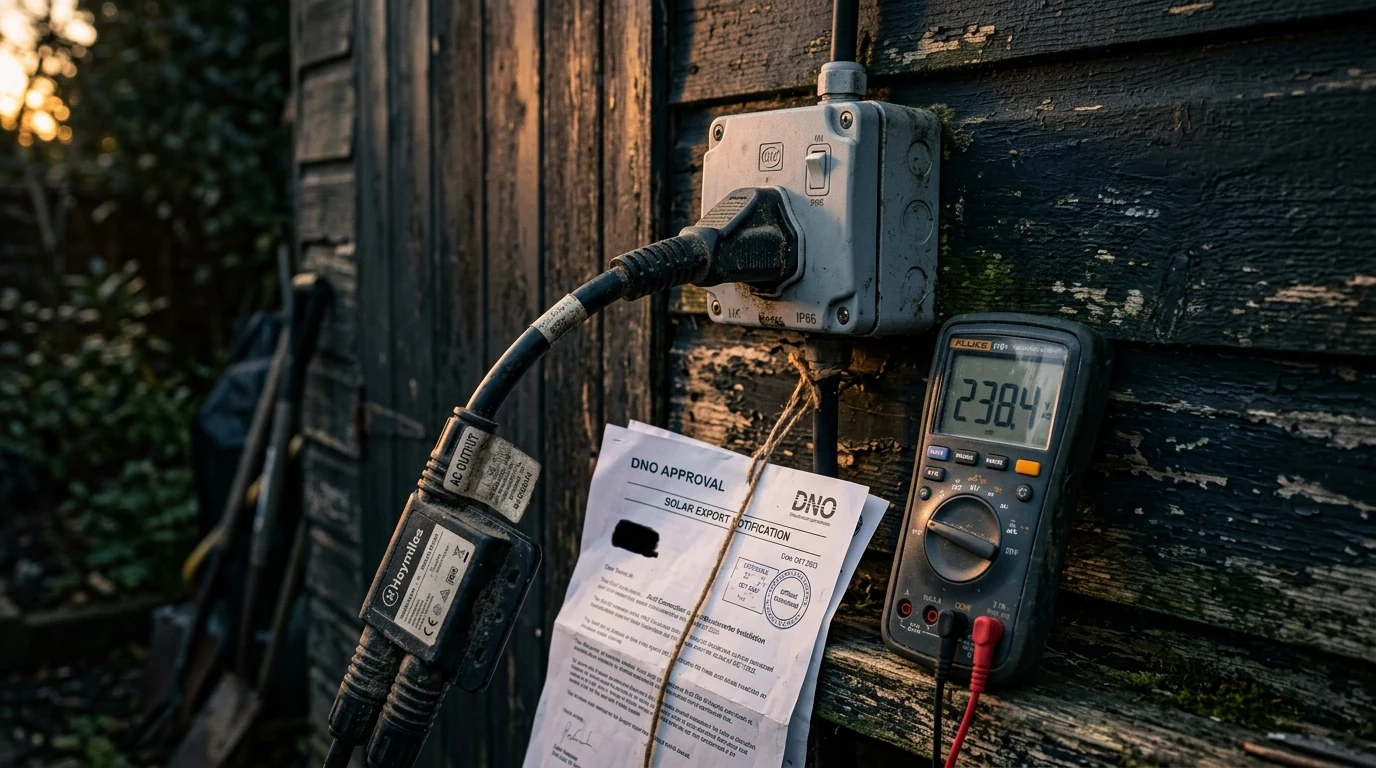
The question Reginald Mowbray typed into his phone that October was the one thousands of early solar adopters were asking: can I add a plug in solar panel to existing solar, or does the new £400 kit bolted to his shed quietly turn his 2018 rooftop array into a grid breach? The 63-year-old retired teacher in Nottingham had a perfectly serviceable 3kW rooftop system, installed back in 2018 by a local firm that had since dissolved, leaving no one to call when he wanted more generation. The August 2026 legalisation of sub-800W plug-in solar looked like the answer: no scaffolding, no electrician, no MCS paperwork, just a panel on the shed and a plug in the wall.
He bought an 800W kit for £400, clamped the panel to his south-facing shed, and plugged the microinverter into the outdoor socket on a clear Saturday in late September 2026. For a fortnight the app showed a tidy extra 60 to 90 kWh a week, and Reginald congratulated himself on a smart, cheap upgrade. Then the letter arrived from his distribution network operator, National Grid Electricity Distribution. Citing smart meter telemetry, it informed him that his property's aggregate continuous AC generation now stood at 3.8 kW, or 16.52 amps, breaching the 16A per-phase ceiling of Engineering Recommendation G98. He was directed to submit a retrospective G99 application within 28 days, at a non-refundable assessment fee of £350, with witness testing at £95 plus VAT if the local feeder was constrained. Under the Electricity Safety, Quality and Continuity Regulations 2002, Regulation 26, the DNO reserved the right to disconnect the supply until he complied. A £400 top-up had just become a £350 regulatory liability, on top of a kit he might have to decommission.
Can I Add a Plug In Solar Panel to Existing Solar Without Breaking the Law?
Why did a panel plugged into a separate shed socket, on a separate circuit, count against a rooftop system installed eight years earlier on the other side of the house? The fault was not the kit, which was legal on its own, nor the rooftop array, which had served faultlessly for eight years. It lay in a hidden arithmetic the distribution network performs on every home, an arithmetic that ignores sockets, circuits and installation dates and sees only one number: the total continuous AC current the property could push onto the phase. Understanding that arithmetic is the difference between a legal upgrade and a disconnection notice.
The 3.68 kW Ceiling That Splits G98 From G99
Grid connections for low-voltage residential generation in Great Britain are governed by the Energy Networks Association Engineering Recommendations EREC G98 and G99. The line between a simple notification and a full engineering assessment is drawn by maximum continuous AC current per phase. Under G98, a home qualifies for the streamlined fit-and-inform procedure only if the aggregate continuous steady-state AC rating of every inverter on the premises does not exceed 16 amps per phase. At the standard UK low-voltage baseline of 230V, that ceiling equates to 3.68 kW. For three-phase supplies the equivalent G98 threshold is 11.04 kW, 3.68 kW per phase.
The friction lies in how distribution network operators calculate compliance. They sum the continuous AC rating of all connected inverters, not the peak DC rating of the panels and not the real-time weather. When a property with an existing 3.0kW rooftop inverter adds an 800W plug-in microinverter, the combined aggregate is 3.8 kW, which converts back to 16.52 amps at 230V. Because 3.8 kW exceeds 3.68 kW, and 16.52A exceeds 16.00A, the property immediately falls out of the G98 framework and into G99. Under G99, energising generation above 16A per phase without prior written DNO approval is illegal; the DNO must assess local network headroom, fault level contributions and transformer capacity before any equipment is connected.
Statutory Instrument 2026/848 and BS 7671 Amendment 4 permit consumers to self-install standalone plug-in kits up to an 800W AC microinverter limit, with a maximum 2,000W of DC panels. Crucially, that exemption applies only to standalone properties with no existing grid-tied generation. It grants no carve-out from the aggregate site capacity calculation. The moment an 800W kit is energised alongside a 3kW array, the whole site transitions into the G99 regime, and the homeowner, not a defunct installer, owns the compliance problem.
| Regulatory parameter | EREC G98 microgeneration | EREC G99 standard generation |
|---|---|---|
| AC capacity limit, single phase | 3.68 kW, 16A continuous at 230V | Above 3.68 kW up to 50 kW |
| AC capacity limit, three phase | 11.04 kW aggregate | Higher, assessed per phase |
| Application order | Commission first, notify within 28 days | Prior application and DNO offer before connection |
| DNO authority | Cannot reject a fully type-tested system | Can reject, require reinforcement, or cap export |
| Capacity basis | Sum of continuous AC ratings of all on-site inverters | Sum of continuous AC ratings of all on-site inverters |
| Typical approval timeline | Immediate, 28-day admin period | 10 days fast track to 45 to 65 working days full study |
| Typical DNO fees | £0, post-install registration | £300 to £800 for a residential network study |
What Reginald's Smart Meter Voltage Log Revealed
Read through the lens of aggregate capacity, every entry in Reginald's smart meter log snaps into focus. The meter had been recording bidirectional RMS voltage for years, but the rooftop array alone never pushed the local feeder anywhere near its limit. The moment the shed microinverter joined the system, sunny midday export climbed by roughly 3.5 amps, and the service voltage at his terminals began creeping toward the 253V statutory ceiling set by ESQCR Regulation 27. The DNO's automated monitoring flagged the unregistered jump in net site export against the MPAN registry of approved G98 notifications, and the compliance letter followed within weeks.
The financial picture compounded quickly. The £400 plug-in kit could not earn a penny of Smart Export Guarantee revenue, because it carried no MCS or Electrical Installation Certificate, so its surplus flowed to the grid for free while inviting enforcement. The defunct 2018 installer could not reissue paperwork, and MCS rules bar certifying a DIY self-installation, so the rooftop array's own export status was dragged into question alongside the new kit. By the time an electrician audited the consumer unit, Reginald was facing £350 of retrospective G99 fees, the threat of £95 plus VAT in witness testing, and the possible decommissioning of a kit he had only just bought. The smart meter had not betrayed him; it had simply counted the current the physics guaranteed he would export.
The Legal Expansion: G100 Limiting and AC-Coupled Storage
The resolution is not to stop expanding. It is to expand within the rules. Where roof space allows, an MCS-certified installer replaces the ageing inverter with a higher-capacity hybrid unit, adds high-efficiency panels, and fits an EREC G100-compliant Export Limitation Scheme. A G100 controller monitors export current at the meter boundary with a current transformer sensor and dynamically throttles the inverter's AC output so total grid export never exceeds the pre-approved 3.68 kW. That lets a property carry 5 or 6 kW of DC panels to maximise generation in overcast conditions while staying G98-compliant at the summer peak, all on a managed connection the installer files and the DNO approves.
Where roof area is exhausted or the existing panels still perform well, an AC-coupled battery retrofit is the cleaner path. A unit from Fox ESS, Tesla or Sigenergy connects to a dedicated breaker in the consumer unit, a CT clamp on the incoming supply tails watches net power flow, and surplus generation charges the battery instead of spilling to the grid. Because it adds storage rather than generation, it does not raise the aggregate AC inverter rating and so does not trigger a G99 review. Professionally installed energy storage also qualifies for the 0 per cent VAT relief on energy-saving materials, available to 31 March 2027, and on Octopus Agile or Flux the same charge-cheap, discharge-peak arbitrage Reginald attempted yields £400 to £700 a year. GivEnergy ceased trading in April 2026, so only active certified installers can reliably honour long battery warranties.
| Option | DIY 800W plug-in addition | Certified expansion with G100 | AC-coupled battery retrofit |
|---|---|---|---|
| Typical capital cost | £350 to £600 | £1,800 to £3,500 | £2,300 to £7,000 |
| Grid compliance | Triggers G99 breach | Pre-approved, export limited | G98 or G99 compliant via installer |
| SEG export eligibility | 0p, ineligible | 4p to 15p per kWh | Up to 30p peak arbitrage |
| VAT rate | 20 per cent retail | 0 per cent installed | 0 per cent to 31 March 2027 |
| Hardware lifespan | 5 to 10 year kit warranty | 25 year panel warranty | 10 to 12 year warranty |
| Voltage risk | Can drive terminals above 253V | DNO or G100 limited | Zero export, CT controlled |
| AC-coupled battery | Capacity | Installed cost | Warranty |
|---|---|---|---|
| Fox ESS ECS 5.2 | 5.2 kWh | £2,300 to £3,800 | 10 years |
| Tesla Powerwall 3 | 13.5 kWh | £7,500 to £9,500 | 10 years |
| Sigenergy Sig8 with battery | 8 to 16 kWh | £5,500 to £8,500 | 10 to 12 years |
What This Means for Your Home
The August 2026 rules gave Britain a legal sub-800W kit for homes with no existing generation. They did not give Britain a way to bolt extra capacity onto an older rooftop array through a wall socket, because the distribution network has never cared which socket the current comes from, only how much of it flows onto the phase. Reginald's £400 top-up collided with a 3.68 kW ceiling his 2018 array already sat beneath, and the arithmetic handed him a £350 bill and a disconnection threat. The homeowner who genuinely wants more generation crosses the threshold deliberately, with an MCS-certified G100-limited expansion or an AC-coupled battery that keeps the grid connection legal and the surplus working for the house rather than the enforcement team. Takeaway: scaling your rooftop solar does not need an uncertified plug-in kit that breaches the 3.68kW G98 limit and invites a retrospective G99 bill; it needs an MCS-certified expansion with G100 export limiting or an AC-coupled battery that keeps your grid connection legal.
Key Takeaways
- Distribution network operators sum the continuous AC rating of every on-site inverter, so a 3.0kW rooftop array plus an 800W plug-in kit totals 3.8kW or 16.52 amps.
- EREC G98 caps microgeneration at 16 amps per phase, 3.68kW at 230V; exceeding that ceiling forces the whole property into the G99 regime.
- G99 requires prior DNO approval before connection, not a 28-day post-install notification, with residential assessment fees of £300 to £800.
- A retrospective G99 application after energising typically costs £300 to £500, plus witness testing at £95 plus VAT if the local feeder is constrained.
- Uncertified plug-in additions earn 0p SEG because they carry no MCS or Electrical Installation Certificate, so their surplus exports for free.
- Statutory Instrument 2026/848's self-install exemption applies only to standalone properties with no existing grid-tied generation, not to homes topping up an older array.
- A G100 export limitation scheme lets a 5 to 6kW DC array stay G98-compliant by throttling aggregate AC export to 3.68kW.
- An AC-coupled battery retrofit, 0 per cent VAT-eligible to 31 March 2027, can save £400 to £700 a year on Octopus Agile or Flux without raising the aggregate inverter rating.
Frequently Asked Questions
Can I add a plug in solar panel to existing solar?
No. The DNO sums the continuous AC rating of every on-site inverter, so a 3kW rooftop array plus an 800W plug-in kit reaches 3.8kW or 16.52 amps, breaching the 3.68kW G98 ceiling and forcing a G99 application with DNO approval before connection.
What is the G98 vs G99 plug in solar limit?
G98 allows up to 16 amps per phase, 3.68kW aggregate at 230V, with a 28-day post-install notification. Above that you must apply for G99 and obtain written DNO approval, including a network study, before energising any equipment.
Can I run multiple solar systems on one house?
Only if the aggregate continuous AC rating stays at or below 3.68kW per phase. Above that the DNO must approve a G99 connection, and plug-in kits are capped at one 800W device per household regardless of how many socket circuits exist.
What happens if my DNO detects an unregistered plug-in addition?
You face a retrospective G99 application fee of £300 to £500, possible witness testing at £95 plus VAT, and under ESQCR Regulation 26 the DNO can disconnect the supply until the installation is made compliant.
How do I legally expand my existing rooftop solar?
Use an MCS-certified expansion with a G100 export limitation scheme to stay within 3.68kW, or add an AC-coupled battery. Both are 0 per cent VAT-eligible to 31 March 2027 and keep your grid connection legal.
Get Your Free Quotes
Takes under 4 minutes · No obligation

Written by
Mark Anthony Haines
Mark has over a decade of experience in the UK renewable energy sector, specialising in solar PV, heat pump systems, and home battery storage. He founded HeatPumpsAndSolar.co.uk to help UK homeowners cut through the noise around green energy installations, government grant schemes, and smart tariffs.
View LinkedIn ProfileMore from Our Insights
Tools & Services Related to This Article
Take the next step with a free calculator or a local installer quote.