The 13-Amp Illusion: Why the UK Banned Plug-in Solar Panels with Battery Storage
Want plug-in solar panels with battery storage? UK law bans them on ring mains - plugging one in voids your home insurance and risks fire. Here is the legal fix.
Quick Summary
- Britain's August 2026 plug-in solar rules legalise sub-800W panel kits, leading homeowners to assume a bought-online battery can be plugged into a wall socket to store solar energy.
- Statutory Instrument 2026/848 and the DESNZ Interim Product Specification explicitly exclude battery storage, because bidirectional current on a UK ring main masks faults and DC leakage blinds RCDs.
- The only safe, legal and tax-efficient route is a hardwired, MCS-certified AC-coupled battery on a dedicated circuit, which qualifies for 0% VAT and unlocks smart-tariff savings.
The Misconception
Because the new UK rules legalise sub-800W plug-in solar panels, a battery can be bought online and plugged into a standard wall socket to store solar energy and dodge professional installation costs.
Table of Contents
The £1,890 Cost of Plugging a Battery Into a Wall Socket
When Statutory Instrument 2026/848 came into force on 27 August 2026, Gareth Hollings believed the expensive solar installer was finally obsolete. The adverts promised the new law had legalised sub-800W plug-in solar panels with battery storage, and his 1960s mid-terrace in Leamington Spa looked the perfect test case. Why pay an MCS-certified electrician around £1,500 to hardwire a battery when a European hub claimed to do the same job for the price of a washing machine?
He bypassed the certified UK suppliers observing the DESNZ Interim Product Specification and ordered a "Smart Solar-Plus-Storage Hub" resembling the LIONSHEE LS-H1600 kits popular in Germany. It cost £1,450, packing a 2 kWh lithium iron phosphate battery and a built-in microinverter behind a standard BS 1363 plug. On 4 September 2026 he plugged it into the living room ring main. His strategy was textbook arbitrage: charge overnight on Octopus Agile's cheapest slots, which can fall to 7 p/kWh, then discharge 800 W during the 4 pm to 7 pm peak, when rates climb above 35 p/kWh.
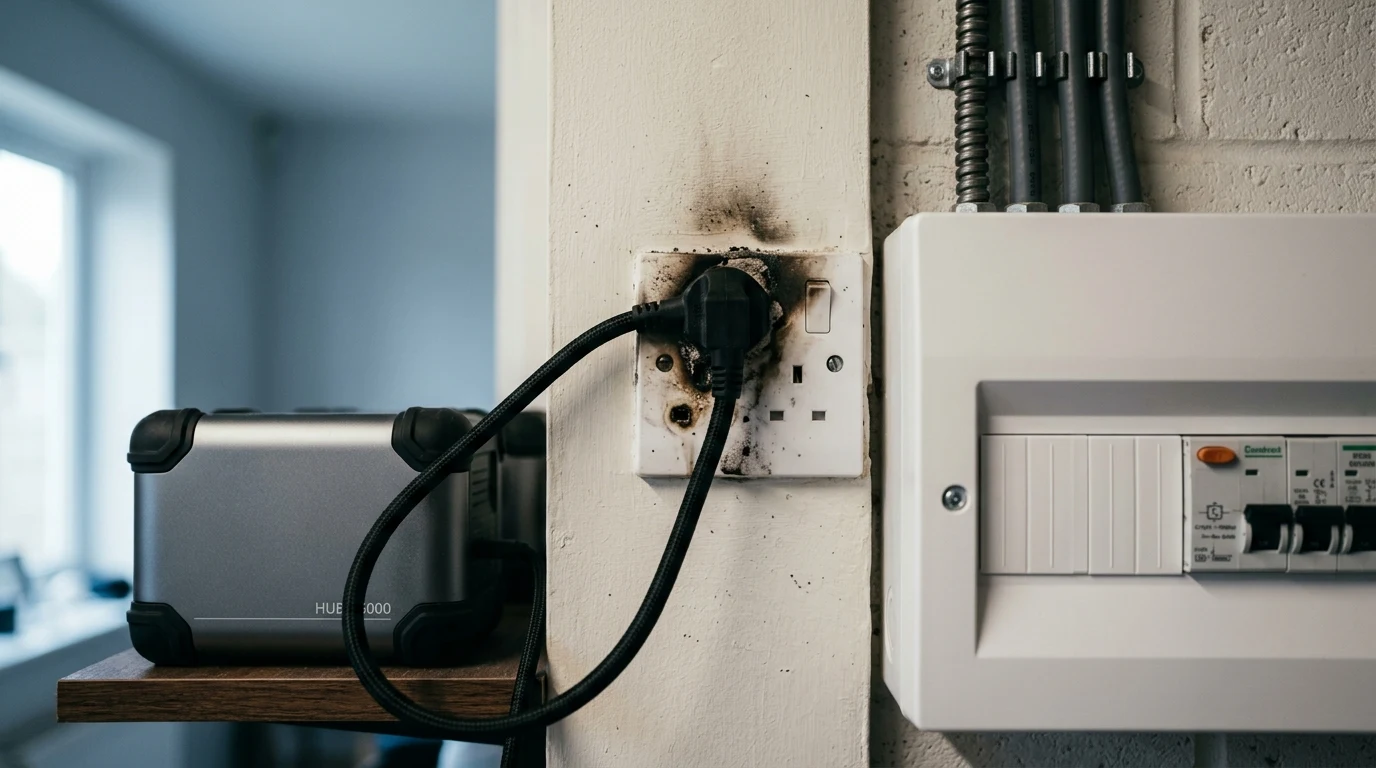
For three weeks the smartphone app reported flawless cycling. On 28 September he noticed the 13-amp socket faceplate was warm during the evening discharge and put it down to the 3.5 A current. The real failure arrived on 14 October, when the consumer unit began tripping repeatedly, the 32 A breaker and the residual current device cutting the whole ground floor. Resetting bought him less than an hour. Unplugging appliances one by one, he reached the hub and found the plug pins scorched and the socket faceplate warped and partly melted.
An emergency electrician charged a £90 call-out fee and delivered a damning verdict: the uncertified hub had injected direct current leakage into the AC circuit and fed unregulated bidirectional current into the ring main. Upgrading to a Type A RCD that tolerates DC leakage, replacing the socket, and testing the 2.5 mm² wiring cost another £350. His insurer then logged the uncertified equipment and threatened cancellation unless he produced a Minor Electrical Installation Works Certificate proving its removal. Because the unit lacked an ENA G98 Type Test registration, no electrician could legally salvage it. Gareth was left with a total sunk cost of £1,890, zero usable storage, a near-miss fire, and a permanent red flag on his insurance profile.
Why Did a Compliant-Looking Kit Trip the Whole House?
Why did a device that looked identical to the legal balcony units on every European review channel take out a whole consumer unit and nearly void a British insurance policy? The fault was not the build quality of the hub. It lay in a hidden constraint baked into every British ring main, one the new plug-in solar rules were designed around, and one that any device pushing stored energy back through a 13-amp plug silently defeats. No branding can change the physics of a UK wall socket.
The Ring Main Trap Behind Plug-in Solar Panels with Battery Storage
The reason no plug-in battery will ever be legal in a UK socket begins with copper. After the Second World War, Britain faced a copper shortage, so engineers invented the ring final circuit to do more with less. A single 2.5 mm² twin-and-earth cable loops out of the consumer unit, visits every socket on a floor, and loops back to the same 32 A breaker. Continental Europe runs radial circuits, a single cable branching linearly from the fuse board. Both safely power kettles and televisions; only one safely accepts a second power source pushing current backwards.
That distinction is the entire ballgame. A standard circuit breaker watches current flowing in one direction. Apply Kirchhoff's current law and the danger turns mechanical: if a 3 kW heater draws 13 A on a ring while a plug-in battery injects 3.5 A downstream of the breaker, a 35 A fault pulls 31.5 A through the breaker and 3.5 A from the battery. The breaker sees only 31.5 A, never trips, and the cable quietly overheats. That is fault masking, and it is why the DESNZ Plug-in Solar Electrical Safety Study, authored by Arceio Limited, modelled only solar microinverters capped at 800 VA, which stop generating the instant the grid fails. The government expressly noted that battery products "raise additional technical and regulatory issues that have not been assessed", because a battery discharges sustained current on command, grid or no grid.
A second, lethal mechanism is DC leakage. A cheap inverter that fails BS 7671 Amendment 4 can leak direct current back into the AC wiring. In homes still fitted with Type AC RCDs, that leakage magnetically blinds the safety core, so the device that should stop you being electrocuted silently stops working. The legislation reflects every one of these risks. Statutory Instrument 2026/848 defines a compliant plug-in microgenerator as one that "cannot be designed to import electricity for the purpose of storage", and the Interim Product Specification excludes plug-in battery systems entirely, mandating a factory warning label against pairing any kit with a battery.
| Circuit feature | European radial | UK ring final |
|---|---|---|
| Topology | Linear single branch from the consumer unit | Continuous loop returning to the same breaker |
| Standard cable | 1.5 mm² to 2.5 mm² | 2.5 mm² twin and earth |
| Breaker rating | Typically 16 A or 20 A | Typically 32 A |
| Fault-masking risk | Low, one upstream source | High, a battery can feed a downstream fault |
| Compliance metric | IPS v2 plug-in solar | Uncertified plug-in battery |
|---|---|---|
| UK legal status | Legal under SI 2026/848 | Illegal on a domestic socket |
| Maximum output | Capped at 800 VA and 3.5 A | Frequently unregulated |
| Battery integration | Excluded by statutory definition | The core function of the device |
| RCD compatibility | Validated by the Arceio study | High risk of blinding Type AC RCDs |
What Gareth's Scorched Socket and Smart Meter Revealed
Read through the lens of the ring main, every symptom in Gareth's timeline snaps into focus. The warm faceplate on 28 September was not harmless heat; it was the cable carrying current from two directions at once, the battery's 3.5 A meeting the grid's supply on the same loop, the exact thermal hotspot the Arceio study never assessed. The repeated tripping on 14 October was the system finally failing, not working. His smart meter telemetry, pulled for the insurer, showed sporadic 3.5 A export spikes colliding with appliance demand, proof the hub was dumping stored energy onto the ring main regardless of what else was drawing power.
The forensic picture was ugly. The DC leakage had already desensitised the older RCD, so the 14 October near-miss could as easily have been a ground-floor fire in a sleeping household. Had it taken hold, the insurer's position would have been unequivocal: an uncertified bidirectional generator, installed in breach of Part P, voids the policy. Gareth's £1,890 was not the worst-case cost of his experiment but the cheapest outcome of a fault that, an hour later, might have been an uninsured house fire.
The Only Legal Route: Hardwire an AC-Coupled Battery
The resolution is not to abandon storage. Domestic batteries remain entirely legal and genuinely lucrative in the UK, provided they are hardwired into the consumer unit on a dedicated radial circuit by an MCS-certified electrician. Units from Fox ESS, Tesla and Sigenergy are built precisely for this. On a dedicated circuit, the electrician fits the protective devices BS 7671 Amendment 4 demands, a dedicated breaker and a Type A or Type B RCD that safely absorbs DC leakage, with proper earthing and the option of whole-home backup during a power cut.
The economics flip decisively in favour of the professional route. A 5.1 kWh AC-coupled battery installs for around £2,500 to £4,200, and because the 0% VAT relief on energy-saving materials applies to professionally installed systems, not retail products, the legal route is tax-free while the £1,500 plug-in hub carries 20% VAT. On Octopus Agile, the same charge-cheap, discharge-peak arbitrage Gareth attempted yields £280 to £650 a year and pays back in 7.5 to 11 years. A certified installer also files the mandatory DNO notification, G98 under 3.68 kW per phase or G99 above, and pairs the battery with solar to unlock Smart Export Guarantee payments a plug-in kit can never earn. Note that GivEnergy ceased trading in April 2026, leaving its grey-market warranties unsupported.
| Implementation metric | Plug-in battery hub | Fixed AC-coupled battery |
|---|---|---|
| Connection | 13 A socket on a shared ring | Hardwired to the consumer unit |
| UK legal status | Illegal, outside IPS v2 | Legal, BS 7671 Amendment 4 |
| Typical capacity | 1 kWh to 2.5 kWh | 5.1 kWh to 13.5 kWh |
| Installed cost | £800 to £1,500 plus DIY liability | £2,500 to £4,200 for 5.1 kWh |
| VAT | 20% standard retail rate | 0% relief |
| DNO notification | Impossible, no G98 type test | Handled by the installer |
| 5 kWh fixed battery ROI | UK 2026 values |
|---|---|
| Installed cost with 0% VAT | £2,500 to £3,500 |
| Annual Octopus Agile arbitrage | £280 to £650 |
| Simple payback | 7.5 to 11 years |
| Warranty lifespan | 10 to 12 years |
What This Means for Your Home
The August 2026 rules gave Britain a useful tool: a sub-800W plug-in kit that quietly offsets daytime consumption for around £40 to £85 a year. They did not, and could not, give Britain a plug-in battery, because the ring main powering every British home was never designed to accept stored energy pushed backwards through a 13-amp plug. Gareth mistook a consumption device for a storage system, and the physics of his own wiring charged him £1,890 to learn the difference. The safe, legal and tax-efficient path is the one the legislation was written to funnel homeowners towards: a certified, hardwired AC-coupled battery a professional signs off and an insurer accepts. Takeaway: domestic energy storage does not need a dangerous plug-and-play workaround that voids your insurance; it needs a hardwired, MCS-certified AC-coupled installation that is safe, legal and 0% VAT-eligible.
Key Takeaways
- Statutory Instrument 2026/848, effective 27 August 2026, legalises plug-in solar capped at 800 W and 3.5 A but excludes any device that imports electricity for storage.
- The DESNZ Interim Product Specification v2 requires every compliant kit to carry a warning label against pairing it with a battery.
- Plugging a battery into a UK ring main causes fault masking, where a downstream 3.5 A feed stops a 32 A breaker seeing the true fault current.
- DC leakage from uncertified inverters blinds Type AC RCDs, the safety switch that prevents electrocution, forcing an upgrade to a Type A or Type B RCD.
- The ABI reports 63% of consumers accidentally void home insurance; uncertified DIY electrical work breaches Part P and risks a £5,000 fine.
- A legal, hardwired 5.1 kWh AC-coupled battery costs £2,500 to £4,200 installed and qualifies for 0% VAT, against 20% VAT on a retail plug-in hub.
- On Octopus Agile, a 5 kWh battery saves £280 to £650 a year through tariff arbitrage, paying back in 7.5 to 11 years without needing rooftop solar.
- GivEnergy ceased trading in April 2026, so only active certified installers can reliably honour long battery warranties.
Frequently Asked Questions
Can I add a battery to my plug-in solar panels in the UK?
No. Under SI 2026/848 and the DESNZ Interim Product Specification, plug-in solar devices are capped at 800 W and cannot include battery storage. Adding a battery to a balcony solar kit is illegal on a UK ring main and can instantly void your home insurance.
Are plug-in solar batteries legal to buy in the UK?
It is legal to buy one online, but illegal to plug it into a UK wall socket. To use battery storage legally, it must be hardwired into your consumer unit on a dedicated radial circuit by a certified electrician following BS 7671 Amendment 4, which a plug-in hub can never satisfy.
Will a DIY solar battery void my house insurance?
Yes. Plugging an uncertified bidirectional battery into a ring main breaches Part P of the Building Regulations. If a fire follows, insurers classify it as uncertified electrical work, which typically voids the policy and rejects the claim.
How much does a legal home battery cost in the UK?
A professionally installed, hardwired 5.1 kWh AC-coupled battery costs £2,500 to £4,200. Unlike DIY plug-in solar panels with battery storage, which carry 20% VAT, a certified installation automatically qualifies for 0% VAT relief on energy-saving materials.
Do I need an electrician for balcony solar with a battery?
Yes. Plug-in solar panels up to 800 W no longer need an electrician, but the moment you add a battery the system leaves the plug-and-play framework. Battery storage always requires a qualified professional to integrate it safely with your consumer unit.
Get Your Free Quotes
Takes under 4 minutes · No obligation

Written by
Mark Anthony Haines
Mark has over a decade of experience in the UK renewable energy sector, specialising in solar PV, heat pump systems, and home battery storage. He founded HeatPumpsAndSolar.co.uk to help UK homeowners cut through the noise around green energy installations, government grant schemes, and smart tariffs.
View LinkedIn ProfileMore from Our Insights
Tools & Services Related to This Article
Take the next step with a free calculator or a local installer quote.