The Export Illusion: Why Plug In Solar Smart Export Guarantee Payments Never Arrive
Does plug in solar smart export guarantee you payments? Discover why DIY balcony kits earn £0 for exported power and how MCS certified solar yields higher ROI.
Quick Summary
- Britain's August 2026 plug-in solar rules lead homeowners with a smart meter to assume their supplier will automatically pay them for every surplus kilowatt-hour their 800W kit exports.
- Energy suppliers require an MCS or Flexi-Orb installation certificate to register an Export MPAN, so self-installed plug-in kits surrender 40 to 50 per cent of their annual output to the grid for nothing.
- The only way to monetise exported power is an MCS-certified, hardwired rooftop system that unlocks SEG tariffs of 12p to 15p per kWh and a 10-year net yield around £6,205.
The Misconception
Because a modern SMETS2 smart meter tracks electricity flowing both ways, plugging an 800W solar kit into a wall socket automatically entitles the household to Smart Export Guarantee payments for every surplus kilowatt-hour exported to the grid.
Table of Contents
The 312 kWh That Barnaby's Smart Meter Counted for Nothing
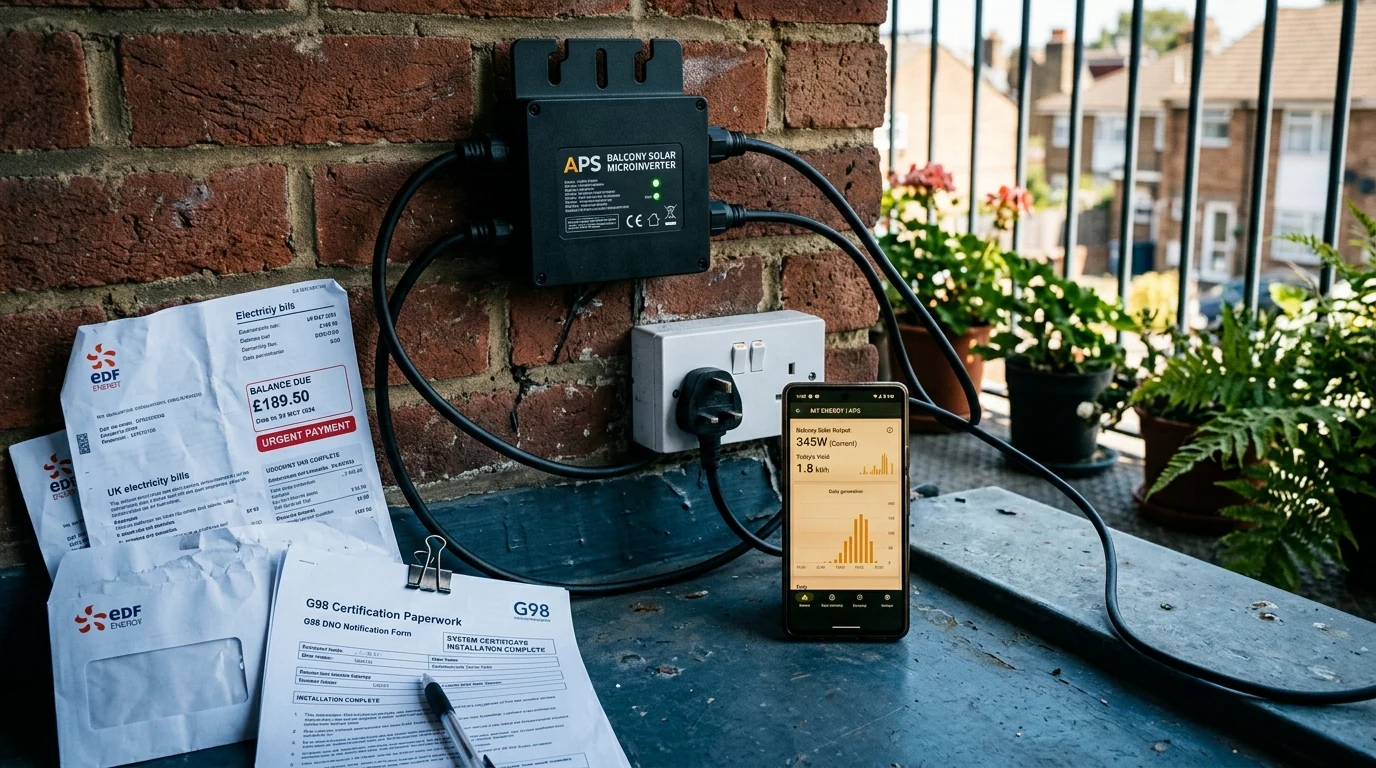
Barnaby Thistlethwaite checked his microinverter app every lunchtime, watching the figure he assumed was his by right under the plug in solar smart export guarantee tick up in bright green digits. By 2 November 2026 the app read 312 kWh exported, and the 68-year-old retired civil engineer from Harrogate allowed himself a small celebration. His £449 800W balcony kit, two panels bolted to the south-facing garage wall and plugged into an outdoor BS 1363 socket, had done exactly what the adverts promised. Now his supplier, Octopus Energy, would pay him 12p for every one of those exported kilowatt-hours. He logged into his account and applied for the Octopus Outgoing Fixed tariff, confidently expecting a £37.44 credit on his next bill.
Three days later the reply landed, and it was not a credit. Octopus rejected the application outright. The reason was not the kit, which was perfectly legal under Statutory Instrument 2026/848, nor his G98 notification, which Northern Powergrid had accepted. It was a single piece of paper he did not possess and could never obtain: an MCS installation certificate. Without it, Octopus could not register an Export MPAN, and without an Export MPAN the 312 kWh of clean electricity Barnaby had pushed into the local network was worth precisely zero pence. Over a summer and autumn he had generated 520 kWh, self-consumed 208 kWh to offset his imports, and donated the remainder to the grid. His entire benefit came to £50.96 in import savings, against the £88.40 he had budgeted for. Projected over the ten-year life of the kit, that gap widens to £374.40 of surrendered export revenue, a sum within touching distance of the purchase price itself.
Does Plug In Solar Smart Export Guarantee You an Automatic Export Payment?
Why did a smart meter that faithfully recorded every watt flowing backwards through the consumer unit refuse to translate that flow into money? The answer is not a fault on Barnaby's account, nor a quirk of Octopus's billing platform. It lies in a hidden administrative gate that sits between the physics of exported electricity and the payment of it, a gate the August 2026 plug-in solar rules were never designed to open. Understanding that gate is the difference between treating a balcony kit as a revenue stream and watching it bleed power into the grid for nothing.
The Export MPAN Gate That Blocks Uncertified Kits
The Smart Export Guarantee is not a law of physics. It is a financial contract, and like every contract it carries conditions. Under the Smart Export Guarantee Order 2019, Ofgem forces every licensed supplier with more than 150,000 customers to offer at least one export tariff. But the Order also sets an eligibility test: the generating installation must hold certification under the Microgeneration Certification Scheme or an equivalent accredited standard such as Flexi-Orb. That certificate is the evidence the supplier uses to register an Export Meter Point Administration Number, the 13-digit identifier that tells the billing engine which meter point is permitted to export for money.
A SMETS2 smart meter does the physical work. It registers reverse power flow on an internal register and can transmit half-hourly readings to the supplier through the Data Communications Company. But the meter only measures; the billing engine decides whether to pay. Without an Export MPAN attached to the meter point, the supplier's settlement system ignores the export register entirely. The electrons are absorbed into regional network balancing calculations, and the generating household is assigned zero monetary value. This is why 100 per cent of licensed UK suppliers reject plug-in kits: none can issue an Export MPAN without an accredited installation certificate, and MCS rules expressly prohibit certifying a self-installed device.
Crucially, Statutory Instrument 2026/848 amended only the product safety regulations. It rewrote the Plugs and Sockets etc. (Safety) Regulations 1994 to permit sub-800VA devices meeting the DESNZ Interim Product Specification to connect through a standard BS 1363 socket. It made no amendment to the Smart Export Guarantee Order 2019 or to Ofgem's generator guidance. A kit can be perfectly legal to plug in and structurally ineligible to be paid for, at the same time and in the same home. Submitting the G98 Form B to the DNO within 28 days is mandatory, but it merely records the asset on the network's geographic database for transformer balancing; it does not create an Export MPAN.
| Regulatory metric | 800W DIY plug-in kit | 4kWp MCS rooftop array |
|---|---|---|
| UK legal basis | SI 2026/848, DESNZ Interim Spec | Building Regs Part P, BS 7671 |
| Installation sign-off | Self-installed, no electrician | MCS or Flexi-Orb accredited installer |
| Export MPAN eligibility | Ineligible | Fully eligible |
| SEG export tariff access | 0 per cent, 0p per kWh | 100 per cent, 3p to 17.5p per kWh |
| DNO connection process | G98 post-install notification | G98 or G99 handled by installer |
| Hardware VAT rate | 20 per cent standard retail | 0 per cent installed relief |
What Barnaby's 312 kWh Export Log Really Proved
Read through the lens of the Export MPAN gate, every line of Barnaby's monitoring data tells the same story. The 312 kWh his app displayed was real electricity, physically measured and genuinely delivered to his neighbours' homes through the low-voltage feeder. His SMETS2 meter recorded the reverse flow correctly. Nothing was broken. The system was performing exactly as designed, and the design stops at the meter.
The financial breakdown is where the illusion dies. Of the 520 kWh his kit generated across September and October, only 208 kWh was self-consumed, because his daytime baseline load sat around 140W while the microinverter pushed out far more on sunny afternoons. At his import rate of 24.5p per kWh, that self-consumption saved him £50.96. The remaining 312 kWh, the export he had been counting on, earned nothing at all. Had the same array been MCS-certified and registered on Octopus Outgoing Fixed at 12p per kWh, it would have returned £37.44. Scaling the same surrendered export across a decade produces £374.40 donated to the grid, a figure that swallows most of the £449 the kit cost him in the first place. The smart meter did not cheat him. It simply counted electrons that no contract existed to pay for.
The MCS Route That Turns Exported Watts Into Guaranteed Income
The resolution is not to abandon solar. It is to cross the certification gate on purpose. An MCS-certified installer hardwires the inverter directly to a dedicated breaker in the consumer unit, complying with BS 7671 Section 712, issues the installation certificate, and coordinates with the DNO and supplier to register the Export MPAN. From that moment every exported kilowatt-hour is settled against a live SEG tariff, and the system qualifies for the 0 per cent VAT relief on energy-saving materials that retail plug-in kits, carrying 20 per cent VAT, can never claim.
The mathematics flip decisively once export is monetised. A certified 4kWp rooftop array generates roughly 3,400 kWh a year, self-consumes about half, and exports the remainder. At Octopus Outgoing Fixed that export alone earns around £204 a year, and import savings add another £416.50, for a total annual yield near £620.50. Over ten years the certified system returns about £6,205, against the £943.30 a plug-in kit can ever manage. A larger 6kWp array paired with a 10kWh battery, cycling export through Octopus Flux at peak rates up to 24p per kWh, lifts the ten-year net yield to £13,890. The plug-in kit's zero-pound export line is not a minor wrinkle; it is the single largest line item separating a consumption toy from a revenue-generating asset.
| Financial metric | 800W plug-in kit | 4kWp MCS system | 6kWp plus 10kWh battery |
|---|---|---|---|
| Upfront outlay | £450 | £6,500 | £11,500 |
| 10-year total output | 7,000 kWh | 34,000 kWh | 57,000 kWh |
| 10-year SEG export income | £0 | £2,040 at 12p | £3,600 at 24p Flux |
| 10-year import bill savings | £943 | £4,165 | £10,290 |
| 10-year combined net yield | £943 | £6,205 | £13,890 |
| Simple payback | 4.8 years | 10.4 years | 8.3 years |
What This Means for Your Home
The August 2026 rules gave Britain a legal, useful consumption offset: a sub-800W plug-in kit that shaves perhaps £40 to £95 a year off your daytime import bill. They did not, and could not, give Britain a revenue stream, because the Smart Export Guarantee was built around certified, registered, metered generation, and a self-installed socket kit is none of those things. Barnaby's 312 kWh was real, valuable to his neighbours, and entirely given away. The homeowner who genuinely wants to monetise surplus power crosses the certification gate deliberately, with a hardwired MCS installation that earns 12p to 15p per exported kilowatt-hour, qualifies for 0 per cent VAT, and returns roughly six times the lifetime value of a balcony kit. Takeaway: maximising home solar ROI does not need an uncertified plug-in kit that forfeits surplus power to the grid for free; it needs an MCS-certified installation that unlocks Export MPAN registration and high-yield Smart Export Guarantee tariffs.
Key Takeaways
- Statutory Instrument 2026/848 legalises sub-800VA plug-in solar from 27 August 2026 but leaves it entirely excluded from UK export compensation.
- Ofgem mandates an MCS or Flexi-Orb installation certificate to assign an Export MPAN, which blocks every DIY plug-in kit from all SEG tariffs.
- An 800W plug-in kit surrenders 40 to 50 per cent of its annual output, between 300 and 350 kWh, to the grid uncompensated.
- At market export rates of 12p to 15.1p per kWh, a plug-in kit forfeits £36 to £52.85 of income every year.
- Over ten years that uncompensated export totals £360 to £528.50, matching or exceeding the kit's £419 to £500 purchase price.
- A certified 4kWp MCS rooftop array earns about £2,040 in SEG over ten years and £6,205 in total net benefit, against £943.30 from a plug-in kit.
- Submitting a G98 Form B to the DNO within 28 days is mandatory for plug-in kits, but it does not create an Export MPAN or unlock SEG payments.
Frequently Asked Questions
Can you sell electricity back to the grid with plug in solar?
No. UK energy suppliers require an MCS or Flexi-Orb installation certificate to assign an Export MPAN and issue Smart Export Guarantee payments. Because self-installed plug-in kits cannot obtain this certificate, their surplus electricity is exported to the grid for zero financial return.
Do I need MCS for plug in solar?
You do not need an MCS certificate to legally plug an 800W solar kit into a wall socket under SI 2026/848. You do need an MCS or Flexi-Orb certificate, issued by an accredited installer, if you want to register an Export MPAN and claim Smart Export Guarantee payments for exported electricity.
Do balcony solar panels qualify for SEG payments in the UK?
Only if they are installed by an accredited professional who issues a valid MCS or Flexi-Orb certificate and registers an Export MPAN with your supplier. Self-installed balcony solar panels do not qualify for SEG payments in the UK and export their surplus for free.
What happens to excess power generated by a plug in solar kit?
Excess electricity flows backward through your fuse board and out into the local low-voltage grid. Because plug-in systems lack an Export MPAN, your SMETS2 smart meter registers the reverse flow but your supplier assigns it zero monetary value and pays you nothing.
Get Your Free Quotes
Takes under 4 minutes · No obligation

Written by
Mark Anthony Haines
Mark has over a decade of experience in the UK renewable energy sector, specialising in solar PV, heat pump systems, and home battery storage. He founded HeatPumpsAndSolar.co.uk to help UK homeowners cut through the noise around green energy installations, government grant schemes, and smart tariffs.
View LinkedIn ProfileMore from Our Insights
Tools & Services Related to This Article
Take the next step with a free calculator or a local installer quote.