The Vertical Solar Paradox: Why Plug In Solar Panels for Flats UK Turn a 3-Year Payback into a 10-Year Drag
Researching plug in solar panels for flats UK? Discover why vertical balcony mounting slashes real-world output by 50% and pushes payback to 10 years.
Quick Summary
- Flat owners assume an 800W balcony kit mounted flush to the railing will hit the advertised £150 to £200 annual savings and a 3-year payback.
- Lambert's cosine law and urban shading cut a 90-degree vertical south-facing array from 818 kWh to roughly 420 kWh a year, and shading drops microinverter voltage below its 22V startup threshold.
- For flats on direct electric heating, a grant-funded air-to-air heat pump with SCOP 3.6 saves £450 to £750 a year, around eight times the solar yield.
The Misconception
An 800W plug-in balcony solar kit mounted flush against a balcony railing will achieve the advertised £150 to £200 annual savings and a 3-year payback derived from maximum manufacturer specifications.
Table of Contents
The 800W Balcony Kit That Never Cleared 250 Watts
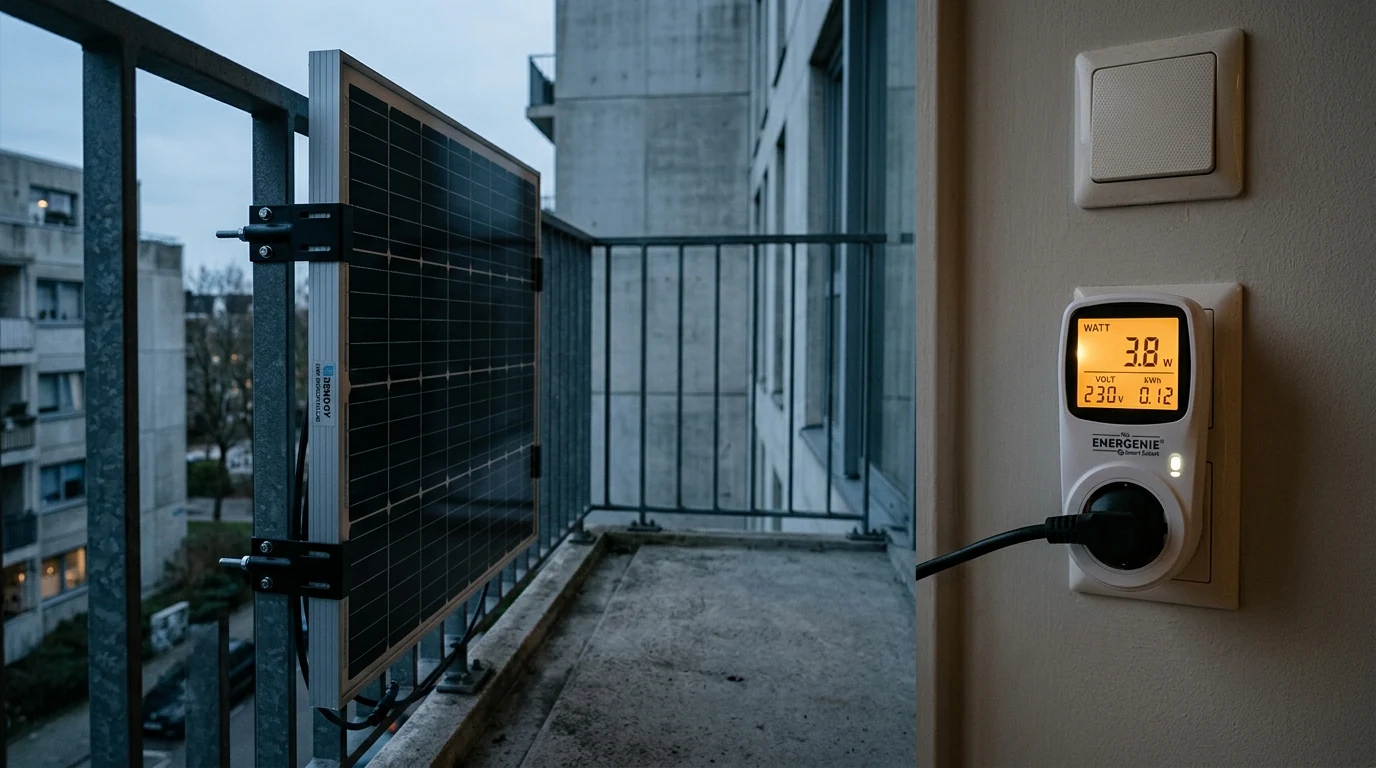
Peregrine Vance had read every review of plug in solar panels for flats UK before he bought his 800W kit, and the maths looked unarguable. Two 400W panels and an 800VA microinverter, clamped to the south-facing metal balustrade of his 4th-floor leasehold flat in Greenwich, would generate around 750 kWh a year and shave roughly £195 off his electricity bill, paying for themselves in under three years. In May 2026 he spent £520 on the kit and £45 on stainless brackets and an outdoor IP55 socket, £565 in total, and mounted the panels flush at 90 degrees to the railing.
The first reading told him something was off. At 1:15pm on a clear mid-June day, with the sun high and the sky empty, the smart-plug wattmeter peaked at 248W. It never crossed 300W. By the end of June the logs showed 41.2 kWh, against the 95 kWh the marketing implied. Through July the microinverter disconnected every morning between 9:00am and 11:30am, because a 20mm shadow line from the balustrade bars crept across the bottom cell row and collapsed the string voltage. By the end of August the three-month summer total was 118 kWh, less than half the 270 kWh benchmark. Then, in September, a letter arrived from the freeholder's managing agent: the external balustrades were non-demised property, and he must produce a structural wind-loading certificate or remove the panels within 14 days. A 90-degree array on a London balcony was underperforming, intermittently shutting down, and legally precarious all at once.
Why Did an 800W Kit Peak at 248 Watts on a Clear June Day?
Why did a kit rated at 800W peak at less than a third of its nameplate on a cloudless summer noon, and why did it switch itself off every morning? The fault was not the hardware, which was legal under Statutory Instrument 2026/848, nor the installer, because there was none. It lay in the geometry of a balcony itself, a geometry that breaks the one assumption every manufacturer's yield figure depends on: that sunlight strikes the panel face squarely. The answer lives in a trigonometric law and a 22-volt threshold, and together they explain why a vertical flat array loses half its output before a single watt reaches the socket.
Why Plug In Solar Panels for Flats UK Lose Half Their Output
Solar modules carry an industry rating set under Standard Test Conditions: 1,000 W per square metre of irradiance striking the face at a perpendicular 90 degrees. Outdoors, the direct beam reaching a collector follows Lambert's cosine law, falling with the cosine of the angle between the sunlight and the panel's normal. In London, at latitude 51.5 degrees north, the sun peaks at roughly 62 degrees on the summer solstice, so a vertical 90-degree panel facing south already loses nearly 12 per cent of direct beam intensity at solar noon relative to a perpendicular surface. Integrated across the whole year, a 90-degree tilt captures 27.4 per cent less energy than an optimal 35-degree pitch, dropping an 800W array from 818 kWh to 594 kWh.
Urban shading compounds the loss. Balcony balustrade bars, upper-floor overhangs and building reveals throw narrow shadows that activate a panel's bypass diodes, dropping one-third of the cells out of the string. That collapses the operating voltage from around 33V to roughly 11V, below the 22V startup threshold of a typical microinverter, so the inverter shuts down entirely even while two-thirds of the panel sits in bright light. Add a 20 per cent shading penalty and the vertical south-facing array falls to about 420 kWh a year, a 49 per cent loss against an unshaded rooftop. At the Ofgem cap of 26.11p per kWh and a realistic 70 per cent self-consumption rate, that yields about £76 a year, pushing payback on a £520 kit from the advertised 2.8 years to 7.8.
| Mounting geometry | Tilt | Yield (kWh/kWp) | 800W yield (kWh/yr) | vs optimal | Value at 26.11p |
|---|---|---|---|---|---|
| Optimal roof pitch | 35 degrees south | 1,022 | 818 | 100.0% | £213.58 |
| Steep wall mount | 60 degrees south | 970 | 776 | 94.9% | £202.61 |
| Vertical unshaded balcony | 90 degrees south | 743 | 594 | 72.6% | £155.09 |
| Vertical balcony plus 20% shade | 90 degrees south | 525 | 420 | 51.3% | £109.66 |
| Vertical unshaded east or west | 90 degrees E/W | 506 | 405 | 49.5% | £105.75 |
| Vertical east or west plus shade | 90 degrees E/W | 412 | 330 | 40.3% | £86.16 |
| Season | Optimal roof (35 degrees south) | Vertical balcony (90 degrees south) | Vertical shaded balcony | Vertical vs roof |
|---|---|---|---|---|
| Midsummer (June) daily kWh | 3.33 | 1.67 | 1.18 | 50.1% |
| Equinox daily kWh | 2.25 | 1.82 | 1.28 | 80.9% |
| Midwinter (December) daily kWh | 0.93 | 1.20 | 0.84 | 129.0% |
| Full year average daily kWh | 2.24 | 1.63 | 1.15 | 72.8% |
What Peregrine's 41 kWh June Log Revealed
Read through the lens of cosine law and the 22V threshold, Peregrine's monitoring data stops being mysterious. The 248W peak at 1:15pm was the cosine penalty made visible: a vertical panel in June simply cannot present its face square to a sun that climbs to 62 degrees, so a third of the rated watts vanish before any conversion loss. The 41.2 kWh June total, against an expected 95 kWh, was the geometric 27 per cent loss stacked on top of inverter downtime and cable losses. The morning shutdowns in July were the balustrade shadow crossing the bottom cell row, activating a bypass diode, collapsing the string to 11V, and dropping the microinverter below its 22V startup threshold until the shadow moved on.
Over a full twelve months the array generated 385 kWh. Because Peregrine worked away three days a week, his daytime self-consumption ran at 72 per cent, and the remaining 28 per cent exported to the grid for nothing, since a non-MCS plug-in kit has no Export MPAN. At the Ofgem cap of 26.11p per kWh, his net annual saving was £72.38, giving a payback of 7.8 years on the £565 outlay, before any removal or legal costs. The freeholder's letter added the final twist: because the balustrade is external common property, the panels were arguably unauthorised, and a wind-loading certificate could cost more than the kit saved in a year. The smart plug had measured the truth precisely; the truth was that a vertical balcony is a poor solar collector.
The Fix That Beats Solar: A Grant-Funded Air-to-Air Heat Pump
The resolution for a flat is not to angle the panels harder, though a 30-to-45-degree engineered overhang bracket can recover 20 to 25 per cent of the lost yield if the freeholder and wind-loading calculus allow it. The deeper problem is that flat owners on direct electric heating, panel convectors or old storage radiators pay for heat at a brutal 1:1 ratio, 26.11p for every kilowatt-hour, and no balcony kit touches that dominant load. Solar is seasonally mismatched too: it peaks in summer when heating demand is zero.
The asset that actually cuts a flat's bill is an air-to-air heat pump. A modern unit running in the UK climate achieves a Seasonal Coefficient of Performance of 3.6, delivering 3.6 kWh of heat for every kilowatt-hour of electricity, an effective heating cost of about 7.25p per kWh. On a typical one- or two-bedroom flat needing 3,500 kWh of heat a year, that swaps a £913.85 direct-electric bill for a £253.85 heat-pump bill, saving £660 a year, roughly eight times the £76 the balcony kit returns. The Boiler Upgrade Scheme gives £2,500 toward an air-to-air system, and the Warm Homes Local Grant can cover 100 per cent of costs for eligible households, cutting net outlay to between £0 and £700 and payback to under 18 months. A balcony solar kit remains legal and useful for offsetting standby load, but it is the wrong tool for the bill that actually hurts.
| Option | 90 degree vertical plug-in solar | 30 degree angled balcony solar | Air-to-air heat pump retrofit |
|---|---|---|---|
| Installed cost | £500 to £600 | £650 to £800 | £2,200 to £3,200 pre-grant |
| Government grant | £0 | £0 | £2,500 BUS, up to 100% WHLG |
| Net out-of-pocket | £500 to £600 | £650 to £800 | £0 to £700 |
| Annual benefit | £70 to £109 | £115 to £145 | £470 to £730 |
| Simple payback | 6.8 to 8.5 years | 5.2 to 6.5 years | 0 to 1.5 years |
| Heating metric | Direct electric plus vertical solar | Air-to-air heat pump | Net benefit |
|---|---|---|---|
| Annual heat demand | 3,500 kWh thermal | 3,500 kWh thermal | Identical comfort |
| Heating electricity used | 3,500 kWh | 972 kWh | 72% less |
| Annual heating cost at 26.11p | £913.85 | £253.85 | £660 saved |
What This Means for Your Flat
The August 2026 rules gave leaseholders a legal 800W kit that quietly offsets standby load for perhaps £70 to £100 a year, when the balcony orientation, shading and freeholder consent all align. They did not give flats a £200 saver on a three-year payback, because a vertical railing is not a roof, and the physics of cosine law and the microinverter's 22V threshold ensure a real-world yield closer to 420 kWh than 818. Peregrine's kit underperformed, shut down each morning, and faced a removal notice, all for £72 a year. The flat owner whose bill is dominated by electric heating should spend that £565 on the asset designed for the job: a grant-funded air-to-air heat pump that cuts the heating line item by 72 per cent and pays back inside two years. Takeaway: an urban flat does not need an inefficient 90-degree plug-in solar panel; it needs a grant-funded heat pump solution that targets the dominant electric heating bill.
Key Takeaways
- A 90-degree vertical array loses 27.4 per cent of annual yield to collector geometry alone, dropping an 800W kit from 818 kWh to 594 kWh.
- Urban micro-shading from balustrades and overhangs adds a further 20 to 30 per cent loss, cutting real-world output to around 420 kWh a year.
- At the Ofgem cap of 26.11p per kWh and 70 per cent self-consumption, a shaded vertical kit saves about £76 a year, not the advertised £150 to £200.
- The advertised 2.8-year payback stretches to 7.8 years on a £520 kit, before any removal or legal costs.
- A microinverter needs 22V to start; balustrade shading collapses a panel string to about 11V, shutting the inverter down despite partial sun.
- Statutory Instrument 2026/848 caps plug-in kits at 800VA with no battery, and external balustrades may require freeholder consent.
- An air-to-air heat pump with SCOP 3.6 cuts heating cost by 72 per cent, saving £450 to £750 a year, with a £2,500 BUS grant and Warm Homes Local Grant support.
Frequently Asked Questions
Do plug-in solar panels work on flat balconies in the UK?
Yes, but only modestly. A vertical 90-degree kit on a UK flat balcony typically yields £70 to £100 of savings a year, far below the advertised £150 to £200, because cosine-law losses and urban shading halve the output.
How much power do vertical solar panels yield in the UK?
An unshaded vertical south-facing 800W array yields about 594 kWh a year in southern England. With typical urban micro-shading that falls to around 420 kWh, roughly half the output of an optimal 35-degree rooftop.
Are plug-in solar panels legal for UK flats in 2026?
Yes, under Statutory Instrument 2026/848 an 800VA battery-free kit is legal to plug in. However, mounting panels on an external balcony balustrade usually needs freeholder permission, as balustrades are often non-demised common property.
What is the payback period for balcony solar panels in the UK?
Manufacturers quote around 3 years, but real-world vertical mounting and shading push payback to between 7 and 10 years on a £520 kit, before any removal or wind-loading certification costs.
What is the best alternative to balcony solar for cutting flat energy bills?
A grant-funded air-to-air heat pump. With a SCOP of 3.6 it cuts heating cost by 72 per cent, saving £450 to £750 a year, and the Boiler Upgrade Scheme and Warm Homes Local Grant can reduce the net cost to near zero.
Get Your Free Quotes
Takes under 4 minutes · No obligation

Written by
Mark Anthony Haines
Mark has over a decade of experience in the UK renewable energy sector, specialising in solar PV, heat pump systems, and home battery storage. He founded HeatPumpsAndSolar.co.uk to help UK homeowners cut through the noise around green energy installations, government grant schemes, and smart tariffs.
View LinkedIn ProfileMore from Our Insights
Tools & Services Related to This Article
Take the next step with a free calculator or a local installer quote.