The MCS Scope Trap: Why Two-Thirds of "Certified" Solar Installers Cannot Legally Sign Off Your Battery
Only 34% of mcs accredited installers can legally certify a battery. Learn how to check the exact scope before you sign, so grants and SEG payments stay valid.
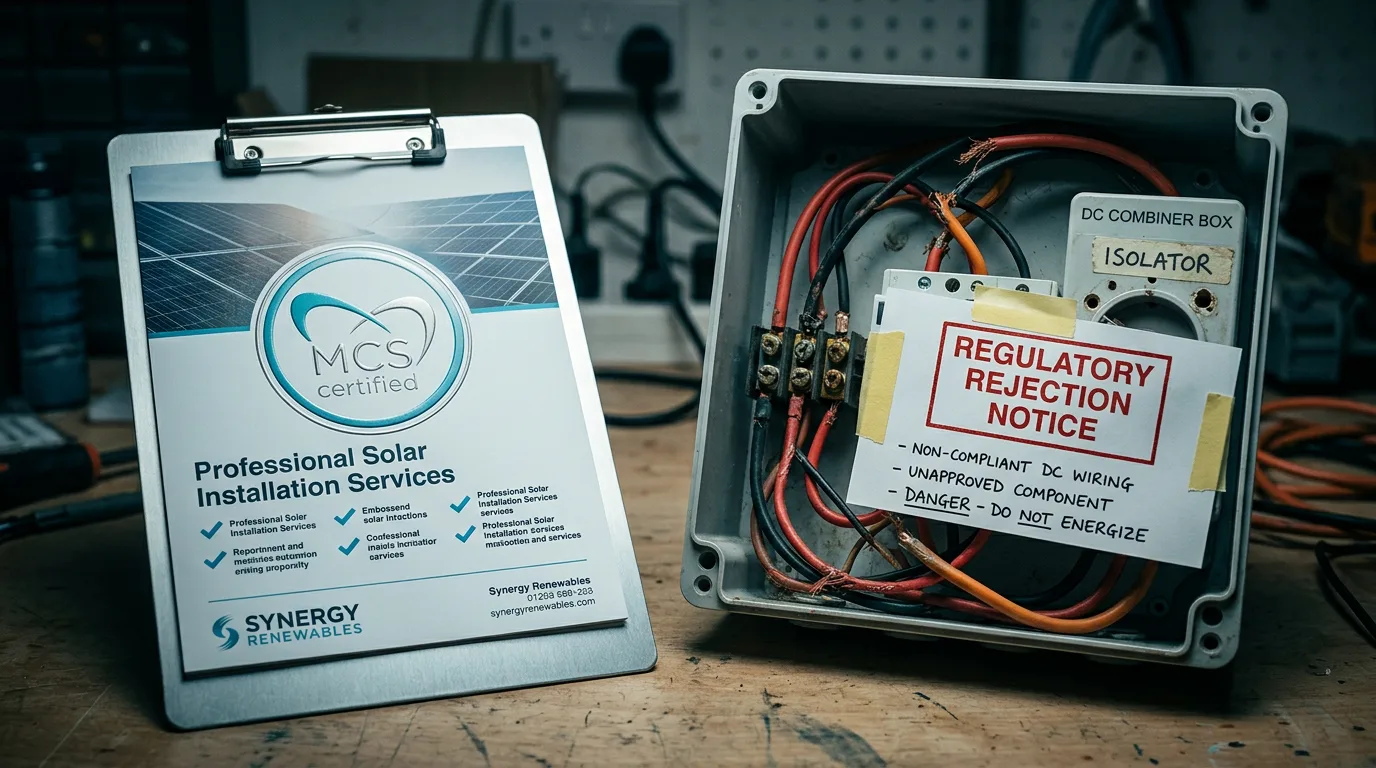
Quick Summary
- Homeowners assume any MCS-certified company can install and certify solar, battery, and heat pump systems interchangeably, but only 34% of the UK's 5,250-plus certified contractors hold accreditation for battery storage under MIS 3012.
- MCS certification is awarded per technology standard (MIS 3002 for solar PV, MIS 3012 for batteries, MIS 3005-D/I for heat pumps), and a firm can be fully accredited for one while holding zero standing for another on the same invoice.
- A five-minute scope check on mcscertified.com before signing protects the £7,500 Boiler Upgrade Scheme grant and Smart Export Guarantee income that a scope-deficient installation forfeits outright.
The Misconception
Homeowners believe MCS certified is one universal badge of competence - if a company shows the MCS logo, it is safe to assume they can properly install and certify solar panels, battery storage, AND heat pumps to the same standard.
Table of Contents
The £14,650 Contract That Only Covered Half the Roof
Dr. Alistair Vance, a senior analytical toxicologist, lives in a 1934 detached stone house in Harrogate with a 44-degree pitched slate roof. In October 2024 he signed a £14,650 turnkey contract with "Verdant Horizon Technologies Ltd," one of thousands of mcs accredited installers listed on the official register, for a 5.16 kWp solar array, a 5 kW hybrid inverter, and a 9.5 kWh lithium iron phosphate battery. The sales consultant showed him the company's MCS certificate and said it covered everything on the invoice. Dr. Vance checked that MCS logo was genuine and assumed that settled the matter.
It did not. Verdant Horizon held live MCS accreditation for solar PV under standard MIS 3002 through NAPIT, but held zero certification for battery storage under MIS 3012. The battery was fitted by an independent electrical subcontractor and never appeared on the MCS Installation Database certificate, only as a line item on the commercial invoice. On 8 January 2025, a Tier-1 energy supplier rejected Dr. Vance's Smart Export Guarantee application outright, citing an uncertified co-located storage asset. Six weeks later, sub-zero temperatures in Harrogate triggered the battery's charge-inhibit safety cutoff because the uncertified installer had skipped the low-temperature thermal protection required under MIS 3012:2025. Telemetry from his inverter showed the battery had absorbed just 412 kWh of a possible 1,210 kWh across the winter, a 65.9 percent shortfall.
Why Did a Genuine MCS Certificate Fail Him?
Dr. Vance had done the one thing every guide tells homeowners to do: he checked for the MCS logo. So why did a certified company's paperwork leave him locked out of export payments and sitting on a battery that would not charge below freezing? The answer is that mcs accredited installers are not certified as a company in general. They are certified technology by technology, and most of them are not certified for everything on their own invoice.
Verifying MCS Accredited Installers: Why the Badge Is Not One Standard
The Microgeneration Certification Scheme does not issue a single "renewables competent" licence. It operates separate, independently assessed installation standards for each technology: MIS 3002 for solar PV systems up to 50 kWp, MIS 3012 for battery energy storage systems (EESS) up to 50 kW, and MIS 3005, which splits further into MIS 3005-D for heat pump design (including BS EN 12831-1 heat loss calculations) and MIS 3005-I for physical heat pump installation and commissioning. A company must pass a separate on-site technical assessment, run by a UKAS-accredited certification body such as NAPIT, NICEIC, BSI, APHC, HETAS or OFTEC, for every single standard it wants to hold.
The result is a certified contractor base that looks solid on paper but is deeply uneven underneath. Of the more than 5,250 MCS-certified contractors in the UK, 77 percent are certified for solar PV, 58 percent for heat pumps, and only 34 percent for battery storage. That means roughly two-thirds of MCS-certified companies in the UK have no legal accreditation to install or certify a domestic battery, even if the battery sits in the same invoice as their solar PV work.
| MCS Standard | Technology Covered | Percentage of UK Contractors Holding It | What It Unlocks |
|---|---|---|---|
| MIS 3002 | Solar PV up to 50 kWp | 77% | Smart Export Guarantee eligibility |
| MIS 3005-D / 3005-I | Heat pump design and installation | 58% | Boiler Upgrade Scheme voucher |
| MIS 3012 | Battery storage (EESS) up to 50 kW | 34% | MID registration for co-located storage |
Subcontracting itself is not illegal. MCS 001-1 Clause 4.11 permits a certified firm to subcontract physical work, provided the customer holds a single direct contract with the certified business, a formal written agreement governs the subcontractor's scope, the certified firm's Nominated Technical Supervisor directly supervises the work, and the certified firm registers the finished system on the MCS Installation Database within 10 working days. What is not permitted is a certified firm subcontracting an entire technology it holds no accreditation for and then issuing paperwork that implies it does.
| Compliance Model | Contracting Structure | On-Site Supervision | SEG / BUS Outcome |
|---|---|---|---|
| Directly certified principal contractor | Single contract, in-house technical supervisor | Direct internal oversight | Guaranteed approval |
| Compliant umbrella operator | Single contract with umbrella firm | Documented technical inspection before energisation | Approved via umbrella MID registration |
| Non-compliant "rubber stamping" | Uncertified trade contracts customer directly | No physical inspection, photo-only sign-off | Blocked or clawed back on audit |
What a Genuine Scope Audit Would Have Shown
The fix is not avoiding MCS-certified companies. It is auditing the specific technology scope before signing anything, using the same public tools that already exist. A homeowner needs the contractor's legal entity name as registered at Companies House and their MCS certification number, then a search of the "Find an Installer" tool at mcscertified.com to check the "Certified Technologies" schedule on that company's live profile. Solar PV must show MIS 3002. Battery storage must show MIS 3012. Heat pumps must show both MIS 3005-D and MIS 3005-I for the specific heat pump type being quoted. If the quote is issued by a different legal entity than the one on the MCS register, or if subcontracting is involved, the contract should state explicitly that the certified principal contractor retains full liability and will personally issue the MID certificate.
Had Dr. Vance completed this five-minute check, he would have seen Verdant Horizon's MIS 3012 field was blank and could have asked for a battery installed and certified by an MIS 3012-accredited firm, or a properly structured umbrella arrangement with documented supervision.
| Verification Approach | BUS Grant Approval Certainty | SEG Registration Outcome | Remedial Cost Exposure |
|---|---|---|---|
| Passive trust in the MCS logo | Up to 58% baseline, depending on technology mix | High failure risk for hybrid PV-plus-battery systems | £1,450 to £3,500 |
| Asset-specific scope audit | 100% statutory grant redemption | Guaranteed export MPAN issuance | £0 |
The financial gap is not abstract. Ofgem's Boiler Upgrade Scheme pays £7,500 for air-to-water and ground-source heat pumps and £2,500 for air-to-air systems, deducted directly from the installer's invoice, but only where MIS 3005-D and MIS 3005-I are both held by the certifying firm. Where a scope gap surfaces after installation, third-party remedial certification, covering a full technical audit, rectification of non-compliant switchgear or isolators, and re-commissioning, typically costs between £1,450 and £3,500. Dr. Vance's own remediation and lost export income across the first year came to £3,391.20, on top of 68 hours of his own time spent chasing the original installer, his energy supplier, and the MCS helpdesk over 19 weeks.
Getting the Certificate Checked Before the Deposit Goes Down
Dr. Vance eventually had his battery independently surveyed and re-registered by an MIS 3012-accredited engineer for £950, on top of £1,850 in replacement isolators, fire-stopping, and the DNO G99 application that should have been lodged before the system was ever energised. None of it was necessary. The MCS register that told him Verdant Horizon was accredited would also have told him, in the same search, exactly what it was not accredited for.
A "certified" quote does not need blanket trust in a logo; it needs a technology-by-technology check of the certificate behind it.
What This Means Before You Sign Anything
If your quote covers more than one technology, whether that is solar plus battery, or a heat pump with a hot water cylinder upgrade, treat it as more than one certification question. A genuinely qualified installer for mcs accredited installers status on one technology can be entirely unaccredited on another, and the certificate they show you will say so if you read the right line. Checking that line before the deposit is paid is the difference between a protected Boiler Upgrade Scheme voucher and Smart Export Guarantee income, and a winter spent arguing with an energy supplier over paperwork that was never valid in the first place.
Key Takeaways
- Only 34% of the UK's 5,250-plus MCS-certified contractors hold accreditation for battery storage under MIS 3012, even though 77% are certified for solar PV.
- MCS certification is split by technology: MIS 3002 for solar PV, MIS 3012 for battery storage, and MIS 3005-D plus MIS 3005-I for heat pump design and installation.
- A Boiler Upgrade Scheme voucher (£7,500 for air-to-water and ground-source heat pumps, £2,500 for air-to-air) is cancelled if the installer lacks MIS 3005-D and MIS 3005-I accreditation, leaving the homeowner liable for the balance.
- Smart Export Guarantee applications are rejected outright when a co-located battery is not registered under MIS 3012, even if the solar PV component is fully certified.
- Retrospective third-party certification of a scope-deficient installation costs between £1,450 and £3,500, covering audit, rectification and re-commissioning.
- RECC audit data shows 100% of 48 sampled member businesses failed their initial 2024 compliance audit, with disputes taking an average of 27 weeks to resolve.
- MCS 001-1 Clause 4.11 permits subcontracting only under a formal written agreement, direct supervision by the certified firm's Nominated Technical Supervisor, and MID registration within 10 working days of commissioning.
- Checking a contractor's specific "Certified Technologies" schedule on mcscertified.com takes minutes and confirms exactly which standards, not just which logo, that company holds.
Frequently Asked Questions
Does MCS certification cover all renewable technologies under one badge?
No. MCS certification is awarded per technology. A company can hold MIS 3002 for solar PV while having zero accreditation for battery storage (MIS 3012) or heat pumps (MIS 3005). Being an mcs accredited installer for one technology does not authorise a firm to install or certify a different one on the same invoice.
How do I check if my installer is really MCS certified for what I'm buying?
Search mcscertified.com's "Find an Installer" tool using the company's trading name or certification number, then check the "Certified Technologies" schedule on their live profile. This confirms whether every technology on your quote, not just the headline solar PV work, is actually covered by an active accreditation.
Can an MCS accredited installer legally subcontract part of my installation?
Yes, under MCS 001-1 Clause 4.11, provided you hold a single direct contract with the certified firm, a formal written agreement governs the subcontractor's scope, the certified firm supervises the work directly, and that firm registers the system on the MCS Installation Database within 10 working days.
What happens to my Boiler Upgrade Scheme grant if my installer lacks the right scope?
Ofgem cancels the voucher redemption if the installer is not certified under both MIS 3005-D (design) and MIS 3005-I (installation) for heat pumps. You forfeit the £7,500 grant (£2,500 for air-to-air systems) and remain contractually liable for the full project cost.
Why would my Smart Export Guarantee application get rejected if my solar panels are certified?
Suppliers check the MCS Installation Database for every piece of co-located generation and storage equipment. If a battery sits alongside a certified solar array but was never registered under MIS 3012, the supplier cannot verify compliant microgeneration and will reject the export application entirely.
What does it cost to fix a scope-deficient installation after the fact?
Independent third-party remediation, including a full technical audit, rectification of non-compliant switchgear or isolators, and formal re-commissioning, typically costs between £1,450 and £3,500, on top of any grant or export income already forfeited.
Get Your Free Quotes
Takes under 4 minutes · No obligation

Written by
Mark Anthony Haines
Mark has over a decade of experience in the UK renewable energy sector, specialising in solar PV, heat pump systems, and home battery storage. He founded HeatPumpsAndSolar.co.uk to help UK homeowners cut through the noise around green energy installations, government grant schemes, and smart tariffs.
View LinkedIn ProfileMore from Our Insights
Tools & Services Related to This Article
Take the next step with a free calculator or a local installer quote.