
Quick Summary
- Unlike heat pumps, there is no universal cash voucher for solar panels in the UK; non-repayable grant schemes like ECO4 and the Warm Homes: Local Grant are strictly means-tested.
- Some online 'free solar postcode checkers' are commercial lead-generation funnels; check the named scheme and finance terms before sharing your details.
- For most able-to-pay homeowners, the real savings come from 0% VAT before 31 March 2027, DESNZ-backed Warm Homes Loans, and MCS-certified Smart Export Guarantee tariffs.
The Misconception
There is a universal UK government cash grant that helps any homeowner pay for solar panels, similar to the £7,500 Boiler Upgrade Scheme for heat pumps.
Table of Contents
The Postcode Checker That Promises Free Solar Panels
Scroll through your phone on a Sunday evening and it rarely takes long before an advert offers to check whether your postcode qualifies for grants for solar PV panels. Usually there is an official-looking crest, a progress bar, and a promise of "2026 government funding" with nothing to pay upfront.
It feels plausible. Whitehall pays £7,500 towards an air source heat pump through the Boiler Upgrade Scheme regardless of your salary, so many homeowners assume solar works the same way.
Here is the catch. It does not.
There is no universal government cash grant for solar panels in England or Wales. Unless your household receives means-tested benefits or sits below strict low-income and EPC thresholds, clicking that advert will not unlock public funding. Far more often, your postcode goes straight to a lead broker whose goal is a living-room sales appointment selling high-interest finance dressed up with an invented "voucher".
If There Is No Universal Grant, What Are Those Adverts Actually Offering?
The gap between social media promises and UK legislation leaves most homeowners guessing blindly at the kitchen table:
- Who genuinely qualifies for free or subsidised solar before ECO4 closes?
- Why do national lead brokers keep advertising "funding allocations" for households earning £45,000 or £60,000?
- If you earn too much for means-tested schemes, what tax relief or low-cost finance actually cuts the bill in 2026?
The answers sit inside three primary sources: Ofgem's grant rules, HMRC's VAT calendar, and Advertising Standards Authority rulings.
Who Actually Gets Solar PV Panel Grants - And Who Just Gets a Sales Call
Official numbers strip away the mystery quickly. Direct government grants for solar panels exist to tackle fuel poverty, which affects roughly 11% of households in England, 14% in Wales, 24% in Northern Ireland, and 34% in Scotland.
In Great Britain, the main supplier-funded scheme is ECO4, which closes on 31 December 2026. Yet DESNZ figures reflected in Ofgem's ECO4 guidance show that out of 1,043,846 measures installed by the end of Q1 2026, solar PV accounted for just 65,484 installations - 6.2% of the total.
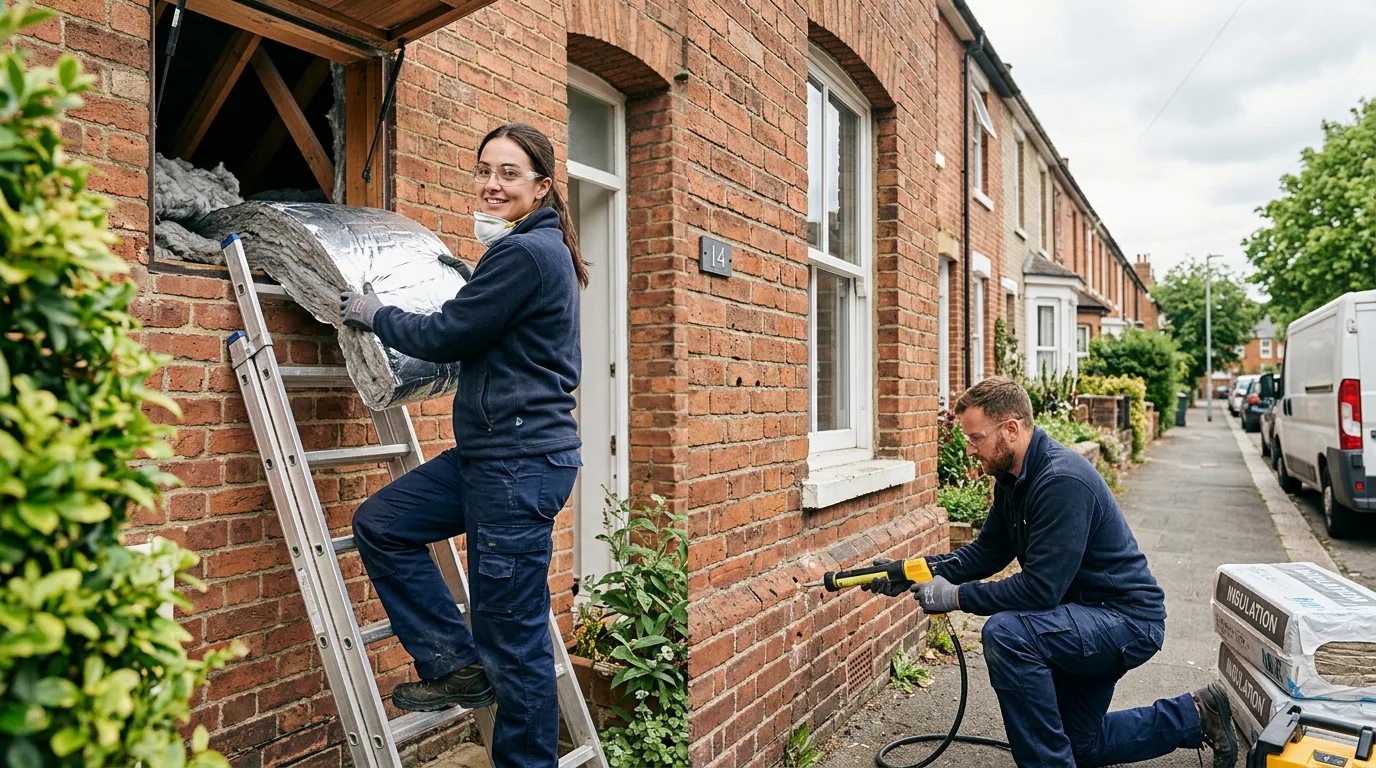
Why so few? Because ECO4 enforces PAS 2035 "fabric-first" rules. A Retrofit Coordinator must fix loft and wall insulation before generation kit is approved, solar capacity is capped at 10 kWp per home, and batteries are excluded from SAP scoring.
There is also a quality warning buried in the audit trail. In October 2025, the National Audit Office (NAO) reported that 98% of external wall insulation and 29% of internal wall insulation fitted under ECO4 and GBIS needed major remediation. Free work is not automatically trouble-free work.
Meanwhile, the Advertising Standards Authority (ASA) has banned repeated "grant checker" campaigns. In its Green Home claims guidance and lead-generation rules, the ASA singled out brokers such as Rock Paper Click Ltd for promoting "solar funding schemes" that harvested postcodes without disclosing commercial intent. In August 2025, the ASA also ruled against Contact Solar Ltd over a "£5,995 Fully Installed Solar - No Deposit Needed" advert that omitted material extra costs.
Every legitimate UK solar support route sits in one of the five rows below:
| UK scheme (2026) | Who qualifies | Typical solar support | Key catch or deadline |
|---|---|---|---|
| ECO4 (GB) | EPC D-G; means-tested benefits or under £31k income (LA Flex) | 100% funded package up to 10 kWp | Closes 31 December 2026; insulation first; no batteries |
| Warm Homes: Local Grant (England) | EPC D-G owners or private renters; income up to £36k (or IMD 1-2 postcode) | Funded solar PV and battery storage within council caps | Runs to March 2028, though many councils fill annual pots early |
| Home Energy Scotland Grant and Loan | Scottish owner-occupiers | No funding currently listed for standard solar PV | Funding for solar thermal or hybrid PV-T is a loan only; check eligibility with an adviser |
| Warm Homes Nest (Wales) | Owners or private renters; EPC E-G (or D with health condition) | Whole-house funded package | Strict means-tested or low-income limits (£15,521 single, £23,166 couple) |
| 0% VAT Notice 708/6 (UK) | Any UK homeowner buying supply-and-install | 0% VAT on solar panels and batteries | Ends 31 March 2027, reverting to 5% reduced VAT |
If you live in England or Wales, earn over £36,000, and hold an EPC rating of C or above, these means-tested routes are unlikely to apply. If you live in Scotland, the Home Energy Scotland Grant and Loan does not currently fund standard solar PV. Check the full eligibility rules for each scheme before assuming you qualify; otherwise, look at VAT relief and fair finance.
What Happens When You Spot the Fake Voucher on a Quote
Take an illustrative kitchen-table example to see the maths in black and white. Suppose you own a three-bed semi in Northampton, earn £48,000, and fill out a "2026 regional solar funding" postcode checker online.
Your phone rings within minutes. Two days later a salesperson prices an 8-to-10-panel 4 kWp array at £13,000, then "phones the office" to apply a £3,000 "Green Initiative Voucher" - dropping the bill to £10,000 if you sign a 10-year loan at 11.9% APR tonight.
Put down the pen and check three facts first:
- The starting price is doubled: Across the UK, an ordinary 4 kWp solar system from an independent MCS installer typically costs £6,000 to £7,000 installed. Knocking £3,000 off £13,000 still leaves you £3,000 over the market rate before interest.
- Real grants never bypass PAS 2035: ECO4 and the Warm Homes: Local Grant require EPC verification, council or supplier approval, and an independent Retrofit Coordinator. No commission salesperson can release public money on your sofa.
- 11.9% APR doubles the damage: Financing £10,000 over 10 years at 11.9% APR pushes total repayments past £16,800 for hardware worth roughly £6,500.
Check whether your home genuinely qualifies before giving out your phone number. Our grant eligibility checker tests your income, EPC, and heating rules in two minutes with zero call-centre chase.
Three Legitimate Ways to Cut Your Solar Cost in 2026
Once you stop chasing fictitious vouchers, three real financial levers do the heavy lifting for able-to-pay households.
Lock In 0% VAT Before 31 March 2027
Under HMRC VAT Notice 708/6, supply-and-install solar panels and domestic batteries (including standalone or retrofitted batteries) carry 0% VAT until 31 March 2027. On 1 April 2027, qualifying installations revert to the 5% reduced VAT rate (whereas DIY hardware-only orders carry 20% VAT).
| Illustrative system | Net cost at 0% VAT (by 31 Mar 2027) | Cost at 5% VAT (from 1 Apr 2027) | Cost at 20% DIY/standard VAT | Penalty of missing March 2027 |
|---|---|---|---|---|
| 4 kWp Solar PV array | £6,000 | £6,300 | £7,200 | £300 extra |
| 6 kWp Solar + 10 kWh battery | £10,000 | £10,500 | £12,000 | £500 extra |
Missing the 31 March 2027 tax point adds £300 to £500 to the bill without adding a single watt on your roof.
Use the Warm Homes Loan Scheme Instead of 11.9% Finance
Launched on 27 October 2026, DESNZ's Warm Homes Loan Scheme subsidises participating commercial lenders and credit unions to cut interest rates by up to 5 percentage points. You can borrow up to £15,000 for solar PV and £15,000 for battery storage, provided an MCS-certified installer fits the kit.
Get a clean cash quote first, then test monthly repayments and total interest in our Warm Homes loan calculator so a long loan term does not erase your bill savings.
Check MCS Certification and DNO G99 Timing Early
Insist on an MCS certificate - without it, you cannot join a Smart Export Guarantee (SEG) tariff or draw a Warm Homes Loan. Also check inverter size early: single-phase inverters up to 3.68 kW use quick ENA G98 notification, whereas larger solar-plus-battery inverters trigger ENA G99 prior approval, which can take up to 45 working days. Once you have clean cash figures, test real payback in our solar payback calculator.
The Kitchen-Table Rule Before You Sign Anything
If a company claims a solar grant is included in your quote, ask it to name the specific scheme, such as ECO4 or Warm Homes: Local Grant, and identify the body administering it. Check that eligibility independently before signing.
Walking away from a fake £3,000 voucher is a financial win. Honest 0% VAT pricing, government-subsidised Warm Homes Loans, and strong SEG export rates make a sensibly sized system stack up without sales-room gimmicks.
Confirm grant rules independently first, collect itemised 0% VAT cash quotes well ahead of March 2027, and ignore same-night expiry timers. When you are ready for transparent numbers, compare vetted solar quotes or browse our local MCS installer directory.
Key Takeaways
- No universal cash grant exists: England and Wales offer no non-means-tested solar grant comparable to the £7,500 Boiler Upgrade Scheme.
- Means-tested schemes are tightly capped: ECO4 closes on 31 December 2026 (benefits or under £31k income via LA Flex) and solar makes up only 6.2% of measures due to fabric-first rules.
- Council funding is patchy: England's Warm Homes: Local Grant supports EPC D-G homes on up to £36k income, though local council pots close once budgets fill.
- 0% VAT ends 31 March 2027: Qualifying installations revert to 5% reduced VAT on 1 April 2027, adding £300 to £500 to typical quotes.
- Warm Homes Loans launched October 2026: Borrow up to £15,000 for solar and £15,000 for batteries via approved lenders with up to 5 percentage points off baseline APRs.
- Guard against ASA red flags: Legitimate grants require formal EPC and Retrofit Coordinator checks, never a cold-called "voucher" tied to 11.9% finance.
- Protect your SEG export income: Demand MCS certification and check whether a >3.68 kW inverter requires 45-working-day DNO G99 approval.
Frequently Asked Questions
Are there any solar PV panels grants for UK homeowners in 2026?
Some low-income or vulnerable households may qualify for solar through schemes such as ECO4 or the Warm Homes: Local Grant, subject to local eligibility rules. There is no universal solar PV grant. Home Energy Scotland does not currently list funding for standard solar PV under its Grant and Loan scheme.
What is the household income limit for UK solar panel grants?
Under ECO4 Local Authority Flex, gross household income is typically capped at £31,000 before closure on 31 December 2026. Under England's Warm Homes: Local Grant, the ceiling is £36,000 (or an eligible IMD Decile 1-2 postcode) for EPC D-G homes.
When does 0% VAT on solar panels and batteries expire?
Under HMRC VAT Notice 708/6, temporary 0% VAT on professionally supplied and installed solar panels and home batteries expires on 31 March 2027. From 1 April 2027, installations revert to the 5% reduced VAT rate, adding £300 to £500 to typical system costs.
Can I get the Boiler Upgrade Scheme £7,500 grant for solar panels?
No. The £7,500 Boiler Upgrade Scheme (BUS) voucher funds low-carbon heating systems - air source heat pumps, ground source heat pumps, and eligible biomass boilers (plus £2,500 for eligible air-to-air units) - not standalone solar PV panels.
How can middle-income homeowners fund solar panels without overpaying on finance?
Collect itemised 0% VAT cash quotes from MCS-certified installers before 31 March 2027. If spreading payments, benchmark commercial finance against the DESNZ Warm Homes Loan Scheme (up to £15,000 each for solar and batteries) and pair the system with a Smart Export Guarantee tariff.
Ready to Compare Real Quotes?
Does your home qualify for the BUS grant?
Check eligibility and compare quotes from local MCS-certified installers — up to £9,000 off, no obligation.