The Solar Panel Roof Survey Your Quote May Be Missing
A solar panel roof survey checks more than panel space. Learn what installers should assess, when an engineer may be needed and which quote questions matter.
Quick Summary
- An array fitting on a roof does not establish that its structure, covering and mounting design are suitable.
- MCS calls for a competent structural check on ordinary pitched roofs, with specialist engineering for specified unusual cases.
- Ask for a roof-specific assessment, recorded assumptions and a written decision point before committing to a solar quote.
The Misconception
If panels fit on a roof in an aerial design, that roof is automatically ready for solar installation.
Table of Contents
The Panels Fit. Does the Roof?
A solar panel roof survey sounds like a formality when the roof is large enough for the proposed array. The sales drawing shows neat rectangles within the tiles. The annual generation estimate looks persuasive. It is tempting to think that if the panels fit, the roof is ready.
Imagine Leah, a fictional homeowner in Gloucestershire, comparing two solar quotes for her older house. One installer has drawn the array from aerial imagery and will confirm details before fitting it. The other wants to inspect the loft and covering before finalising the mounting design. These are illustrative approaches, not actual companies, prices or evidence of a failed installation.
Leah notices a stain below an old chimney and cannot remember when the tiles were last checked. Neither observation proves that the roof is unsuitable. Neither disappears because an overhead image has enough space for panels. The missing part of the drawing is the roof underneath it.
There is a related myth: if a roof needs checking, every homeowner must commission an expensive structural engineer before asking for a quote. That is not how the current MCS solar installation standard describes an ordinary pitched roof. The useful question is not simply "Do I need an engineer?" It is "What has been checked, by whom, and what happens if the survey changes this quote?"
What Can an Aerial Quote Actually See?
A remote design can help decide whether it is worth investigating a roof. It can show orientation, obvious obstructions and approximate usable space. But can it establish the condition of concealed timbers, the state of the underlay, or how mounting loads will travel into the building?
Leah asks both installers to point to the roof assessment in their proposals. One quote has a generic condition that the roof must be suitable. The other explains that its design is provisional until the roof and installation method have been assessed. Neither statement by itself decides which company is competent. What evidence turns the roof outline into an installable design?
Solar Panel Roof Survey: Three Different Checks
For an MCS-certified domestic PV job, the MCS update to MIS 3002 v6.0 took effect for certified installers on 18 June 2026. Structural engineer Sahir Raihan's explanation of the standard distinguishes an ordinary pitched roof, which must be checked by a suitably competent person, from specified unusual structures and ballasted systems that need engineering input. This is an MCS scheme requirement, not a claim that every roof is subject to the same statutory engineer-sign-off rule.
| Question | What a useful assessment addresses | What a panel layout alone cannot establish |
|---|---|---|
| Can the structure carry it? | Roof construction, alterations, visible distress, array and environmental loads | Capacity of concealed or altered structural members |
| Can it be fixed securely? | Appropriate mounting kit, fixing locations and roof-specific wind/loading calculations | That generic brackets suit this covering and location |
| Can it stay weathertight? | Tile or slate condition, roof interfaces, flashing and repair access | Condition of underlay and the result of disturbing old coverings |
The loads are not just the weight of the modules. Wind can try to lift an array; snow can add downward loading. Brackets transfer forces into particular parts of a roof. A good design therefore relates fixing and loading information to this building rather than attaching a manufacturer's general brochure to a quote. MCS's March 2026 update specifically discusses site-relevant structural and wind calculations for mounting arrangements outside the scope of its certified mounting product standard, together with evidence about fire performance, compatibility and weather-tightness. It does not say that all calculations must be signed by an engineer.
For pitched-roof kits, Kiwa's MCS 012 certification overview says certified kit data is used for relevant calculations. Ask which mounting system is specified and how it suits the proposed roof. Do not infer that a certification logo on one component alone proves the finished roof has been checked.
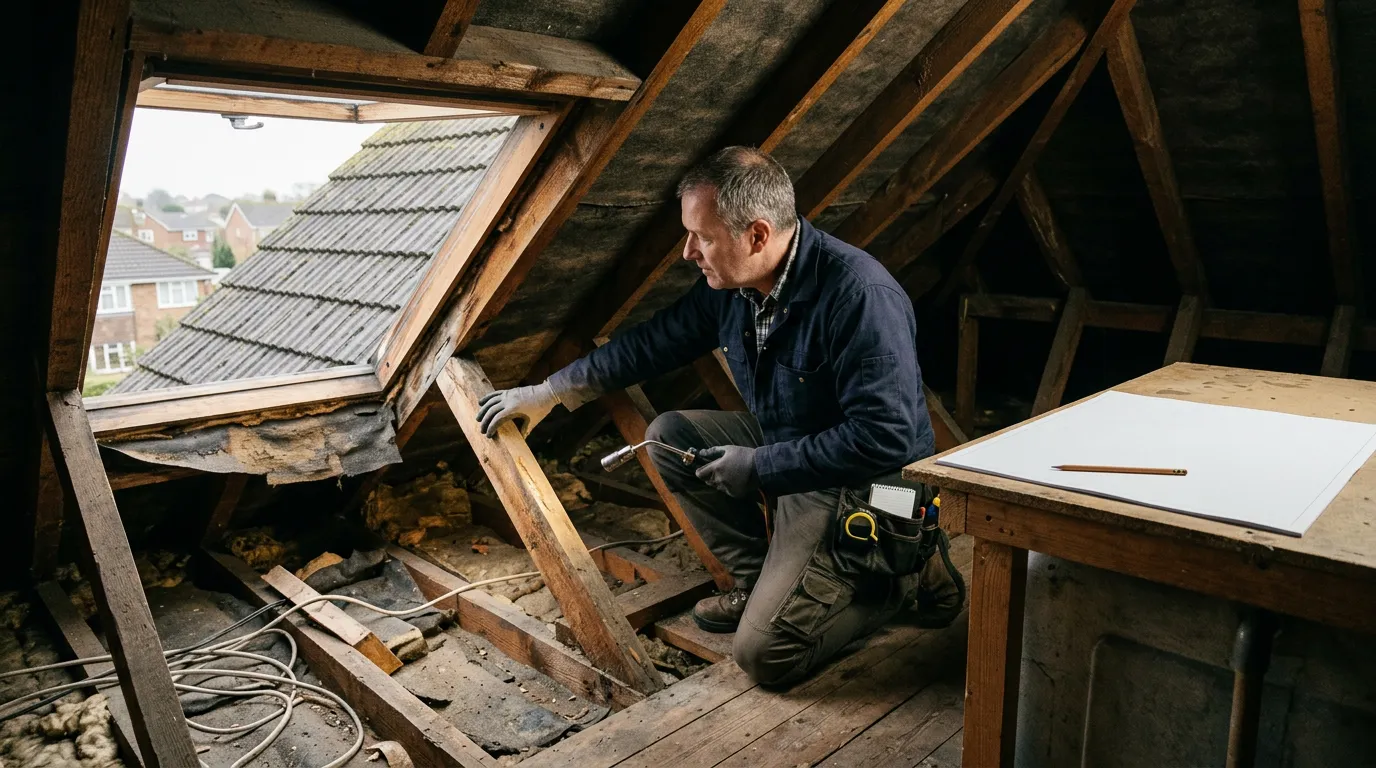
A competent structural check is different from a roof-condition inspection. Sound rafters do not repair cracked tiles or weathered flashing. Equally, tidy tiles seen from the road do not tell you whether framing has been modified in the loft. The first check concerns support, the second the weather envelope and remaining roof work, and the third the design that joins panels to both. A survey may require access arrangements or a specialist if the condition cannot be seen safely; a photograph should not be treated as a structural calculation.
Raihan identifies engineering triggers including unusual or modified roofs, certain traditional cut-timber roofs with hips or valleys, asymmetric pitched roofs and ballasted installations. An ordinary pitched roof is not automatically an engineer job. Ask which assessment route applies and what remains inaccessible. Let a competent professional decide whether further evidence is needed.
Leah Finds the Difference Between Two Quotes
Leah returns to the proposals with three concrete questions: will someone check the roof structure, who will inspect the covering and flashings, and is the mounting design included in the quoted scope? Her stain might be old and harmless; it might merit a roofer's visit. In this fictional example nobody has diagnosed it yet, so the story cannot honestly end with a leak bill or a dramatic structural failure.
The first installer agrees to a pre-install inspection but says remedial roof work would need a separate price. The second makes its offer conditional on checking the roof before confirming the final layout. Either may be a reasonable way to quote, provided the scope and decision point are written down. What matters to Leah is when she will learn whether the roof is fit, whether she can decline changed work, and who pays for any investigation or remedial work. She does not assume an apparently cheaper quote is negligent or that a higher quote guarantees no future leak.
A quote that says "subject to survey" raises an important follow-up: survey when? If the answer is on installation morning, there may be little time to obtain independent advice or compare a revised proposal. Leah asks for the decision and any revised price before a firm installation date. If the roof needs repair first, that may be a sensible pause rather than a failed solar project.
Make the Roof a Written Part of the Decision
Before signing, ask the installer what they will inspect and record. A site visit is useful, but the scope matters more than its label. Will the assessor look in an accessible loft, note obvious changes to rafters or trusses, examine the covering and check the fixing approach? If parts are inaccessible, ask what assumptions the design relies on and when those will be resolved. Do not enter an unsafe loft or climb the roof yourself to supply missing measurements.
| If a quote only says... | Ask for a written answer to... |
|---|---|
| "Roof suitable, subject to survey" | Who carries out the assessment, what will they check, and when can the price or design change? |
| "Standard mounting system" | Which system and fixings are proposed, and how will roof-specific loading and weathering be addressed? |
| "Any repairs are excluded" | Which pre-existing conditions are excluded, who arranges repairs, and what happens if problems are found before fitting? |
| "Warranty included" | What workmanship and roof-interface work is covered, for how long, and what is the route for a disputed leak? |
Where a roofer recommends repairs, obtain a defined scope for those works and agree the order with the solar installer. Repairing an ageing covering before putting panels over it can avoid disturbing a new array later. But roof age alone is not a universal pass/fail threshold: materials, exposure, prior repairs and present condition matter. Ask whether scaffolding and access are shared, who coordinates the work, and whether the solar design changes after repairs. Get any variation and cost in writing rather than assuming it is included in the original figure.
Ask which MCS standard applies and who performed the checks. The Planning Portal's England guidance explains that some domestic solar proposals may be permitted development subject to conditions. Planning permission does not prove roof capacity; check local requirements for listed or sensitive sites. Rules differ across the UK.
Keep the contract's exclusions and warranties beside the survey record. A later leak may involve pre-existing deterioration, a disturbed covering, a flashing detail or another cause; no generic warranty sentence proves responsibility in advance. If the cause is disputed, photographs and written survey findings give both parties something concrete to examine. Avoid promises that a particular installer will cover every future roof repair or that all roof work is automatically the homeowner's expense.
Only after that scope is clear should Leah compare the generation estimate and system price. Our solar panel service overview explains the wider installation journey, and the solar payback calculator lets you model the finances using your own assumptions. If you are ready to compare installers, find a local installer and ask each for a roof-specific proposal. A good quote should tell you what is known and what remains conditional.
A Drawing Is the Start, Not the Survey
In Leah's fictional story, the stain prompts a roof-condition check, not a made-up discovery of rot. She can proceed if the covering, structure and mounting design check out, or request repairs and a revised proposal if they do not. An ordinary roof may not need an engineer at all. The outcome is deliberately conditional because the whole point of a survey is to find out rather than to declare every roof safe or unsafe from a photograph.
A solar array fitting on a roof tells you where panels might go; a roof-specific assessment tells you what must be checked before they can stay there safely and weathertightly. Ask for that distinction in writing while you still have room to compare quotes.
Key Takeaways
- 18 June 2026 is the implementation date MCS gives for MIS 3002 v6.0 for its certified installers; verify the standard applying to your quote.
- One competent check can be appropriate for an ordinary pitched roof; an engineer is not automatic.
- Unusual or altered structures and specified ballasted designs may call for structural engineering under MIS 3002.
- Three distinct questions concern structural capacity, the fixing design and the existing roof covering.
- Aerial imagery can help plan an array but cannot reveal concealed roof condition.
- Two written decision points matter: what is assessed before fitting, and who authorises a changed scope or price.
- No universal roof-age cutoff or repair bill can be inferred from this article; commission advice for the actual property.
Frequently Asked Questions
Does every solar panel installation need a structural engineer?
No. For an ordinary pitched roof under the MCS solar PV installation standard, a suitably competent person checks structural adequacy. Some unusual or modified roof forms and ballasted installations call for an engineer. Ask your installer which route applies and why; a visual array drawing cannot settle a structural question.
What should a solar panel roof survey include?
Ask about the roof's construction, accessible structural elements, alterations, covering and flashing condition, and the intended fixing and loading design. The exact inspection scope depends on the property. Get limitations and assumptions recorded, particularly if parts of the roof or loft cannot be inspected safely before a firm installation date.
Can solar panels go on an older tiled roof?
Possibly. Age by itself does not establish whether tiles, underlay, flashings and supporting structure are serviceable. Ask a competent installer or roofer to assess their actual condition and discuss repairs before fitting if needed. Do not rely on a blanket age limit or assume a clean-looking aerial image rules out concealed deterioration.
Who pays if the roof needs repairs before installation?
That depends on the contract and the reason for the work. Ask which assessment and remedial work are included, who obtains any specialist report, and how a revised scope or price is approved. Record the roof's pre-install condition and agree responsibility for repairs in writing rather than assuming every future leak has one cause.
Is planning approval proof that my roof can support panels?
No. Planning and structural suitability answer different questions. Some English domestic installations may be permitted development if all conditions are met, but that does not assess the roof, mounting fixings or waterproofing. Ask the installer what structural checks apply and check local planning requirements, especially for listed buildings or unusual sites.
Get Your Free Quotes
Takes under 4 minutes · No obligation

Written by
Mark Anthony Haines
Mark has over a decade of experience in the UK renewable energy sector, specialising in solar PV, heat pump systems, and home battery storage. He founded HeatPumpsAndSolar.co.uk to help UK homeowners cut through the noise around green energy installations, government grant schemes, and smart tariffs.
View LinkedIn ProfileMore from Our Insights
Tools & Services Related to This Article
Take the next step with a free calculator or a local installer quote.