The 253V Trap: Why Solar Is Tripping Your EV Charger (And What to Do About It)
On solar-saturated UK streets, standard EV chargers are cutting out mid-session — not because anything is broken, but because the grid voltage hits 253V and Clause D protection kicks in. This guide explains the physics, the regulatory stalemate with your DNO, and the Clause E hardware fix that solves the problem without an earth rod.
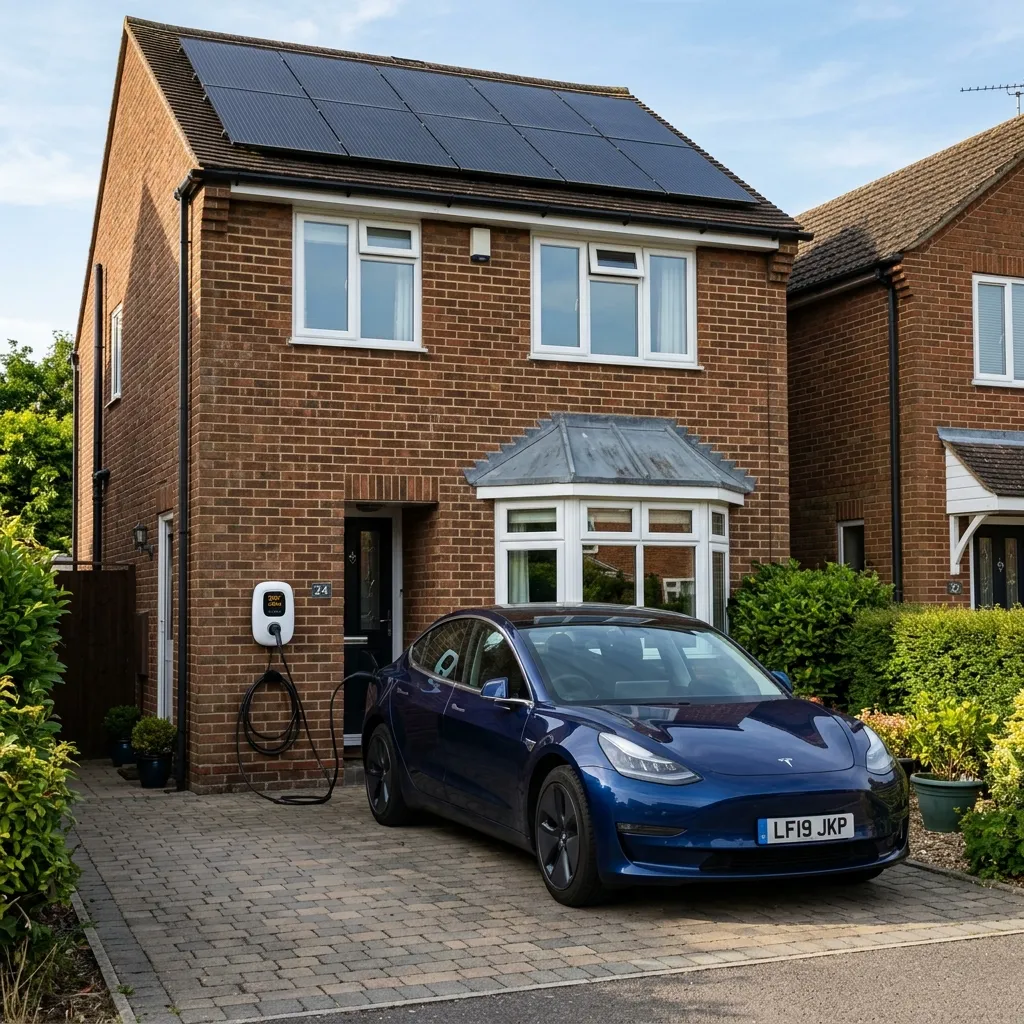
The 253V Problem at a Glance
- 253V — the statutory voltage ceiling under the ESQCR where standard Clause D EV chargers are legally required to cut out within five seconds.
- ~10% — estimated share of EV charging sessions interrupted by overvoltage on solar-saturated UK networks in 2025, according to data submitted to the ENA.
- 10x — reduction in nuisance trips observed when switching from standard Clause D voltage-proxy chargers to Clause E true earth-current detection devices.
- £7.6 billion — the grid capacity value the Energy Networks Association estimates would be unlocked for distributed solar if its proposed 207V lower voltage floor is enacted.
Here is a scenario that is becoming increasingly common across the UK. You install solar panels. A few months later, you buy an electric vehicle and have a home charger fitted. Then, on sunny days, you walk out in the morning to find the car only half charged — or not charged at all. The charger has tripped out during the night, or stopped mid-session in the afternoon. You call the installer. They check everything. The charger is fine. The wiring is fine. The solar system is fine. So what on earth is going on?
The answer is 253 volts — and understanding why that number matters is the first step to fixing the problem.
What Happens at 253V
The UK mains supply is nominally 230V, but it is not rigidly fixed at that figure. Under the Electricity Safety, Quality and Continuity Regulations (ESQCR), the legal tolerance band runs from 230V minus 6% at the bottom to 230V plus 10% at the top. That upper limit works out to exactly 253V. In practice, the UK grid tends to run higher than 230V — the national average supply voltage is closer to 243V — partly because the network was originally built to handle long rural cable runs where voltage drops off with distance.
Solar panels change that dynamic significantly. To push surplus electricity back into the grid, a solar inverter has to generate a local voltage that is slightly higher than the ambient grid voltage at your connection point. This is basic electrical physics: current flows from a higher potential to a lower one. On a bright summer afternoon, when your panels are generating at full output and household consumption is low, your inverter is actively pushing voltage up at your property. When several homes on the same street are doing the same thing simultaneously, the cumulative effect drives the local network voltage toward that 253V ceiling.
That is not a fault. It is the grid behaving exactly as you would expect it to when distributed generation is operating correctly. The problem is what happens to your EV charger when it hits that number.
Why Your EV Charger Keeps Stopping
About 80% of UK properties are connected to a Protective Multiple Earthing (PME) system — also called TN-C-S — where the neutral conductor and the protective earth are combined into a single cable in the street. This arrangement is highly reliable for standard household circuits, but it creates a specific hazard for EV charging.
If that combined conductor develops a fault — known as an open PEN fault — the neutral return path breaks. Current then attempts to find an alternative path to earth. Because an EV charger connects the car's metallic chassis to the installation's earth, an open PEN fault can raise the bodywork of a charging vehicle to something approaching line voltage. In real terms, someone touching the car while it is connected to a faulty PME supply can receive a lethal shock.
This is a real and serious hazard, and the wiring regulations (BS 7671) take it seriously. The most common protective mechanism in standard domestic EV chargers is what the industry calls Clause D, or Indent (iv). It works like this: the charger monitors supply voltage, and if it goes above 253V or below 207V, it must automatically disconnect all conductors within five seconds. The engineering logic is that an open PEN fault causes dramatic voltage swings, so extreme voltage is used as a proxy signal for a broken neutral.
Right. You can see where this is going.
A perfectly functioning solar array pushing the local grid voltage to 253.1V looks, from the charger's perspective, identical to a life-threatening PEN fault. The charger cannot tell the difference. It does what it is designed to do, and cuts the session. Your car sits uncharged. No fault. No error. Just a system doing exactly what the regulations require it to do, at exactly the wrong moment.
The Stalemate With Your Network Operator
If you report persistent EV charger shutdowns to your Distribution Network Operator (DNO) — Western Power Distribution, UK Power Networks, Northern Powergrid, whoever covers your area — you will almost certainly hit a wall.
DNOs measure and report power quality using a European standard called EN 50160. This standard assesses voltage compliance using 10-minute root-mean-square averages. Ninety-five percent of those 10-minute blocks, across a continuous week-long measurement period, must fall within the statutory limits. That is how the DNO will defend its supply, and by that metric it is likely to be perfectly compliant.
The problem is that a Clause D EV charger reacts in under five seconds. A transient voltage swell to 255V that lasts for 30 seconds — caused by a passing cloud clearing and your neighbour's inverters instantly ramping up — is more than enough to trigger a trip. But when that 30-second spike is averaged against 9.5 minutes of normal 240V operation, the 10-minute EN 50160 block shows a compliant average of perhaps 240.7V. The DNO produces data showing the supply is fine. Your charger logs a legitimate overvoltage fault. Both are correct.
Some installers are now deploying IEC 61000-4-30 Class A power quality analysers — specialist instruments that capture time-synchronised event data, including sags, swells, and transients, rather than aggregated averages. This kind of granular evidence can sometimes compel a DNO to adjust a local transformer tap. But that is an expensive route, and it does not fix the underlying incompatibility between solar-driven voltage profiles and Clause D hardware.
The Hardware Fix: Moving to Clause E
The IET addressed the limitations of voltage-proxy protection by introducing what is now widely called Clause E, or Indent (v), in BS 7671 Amendment 1. This permits alternative protective devices, provided they deliver a level of safety equivalent to or greater than the earlier clauses. The key word is alternative: instead of using voltage as a blunt proxy for an open PEN fault, Clause E devices measure actual earth fault current directly.
True Open PEN Detection Devices (OPDDs) work by monitoring the current flowing through the actual fault path — including the vehicle's bodywork — in real time. If the device detects fault current above a safe threshold (typically a few milliamperes), it disconnects. If the voltage rises to 255V because your solar system is exporting aggressively on a bright afternoon, but there is no fault current, the charger continues charging.
A commercially available example leading this space in the UK is the myenergi Zappi Glo, which incorporates technology myenergi brands as Zapsafe. The practical difference between the two approaches looks like this:
| Feature | Standard Clause D Charger | Clause E OPDD (e.g. Zappi Glo) |
|---|---|---|
| Fault detection method | Voltage proxy — trips above 253V or below 207V | Direct earth fault current measurement |
| Behaviour during solar export | Trips if voltage breaches 253V | Continues charging — no fault current present |
| Open PEN protection | Yes, via voltage threshold | Yes, via direct fault current detection |
| Solar system compatibility | Poor on saturated local feeders | Excellent — operates through voltage swells |
| Smart tariff integration | Varies by model | Full — integrates with Octopus Agile, CT clamps |
Safety equivalence for Clause E devices is demonstrated through compliance with the IET 01 standard, which defines operational requirements for EV charging equipment during an open PEN fault event.
Field testing suggests Clause E OPDDs deliver roughly a 10-fold reduction in voltage-related nuisance trips compared with standard Clause D hardware on the same volatile network feeder. For households running solar, that figure matters. It is the difference between reliably waking up to a fully charged car and not.
One point worth noting on installation: neither Clause D nor Clause E OPDDs require the separate TT earth electrode (earth rod) that was the older default method for managing the PME open PEN risk on EV circuits. Earth rods require drilling into the ground, carry a risk of striking buried services, and often cannot achieve the required earth impedance in urban areas with paved driveways. Both modern approaches operate directly from the PME supply.
The Bigger Picture: The ENA's 207V Consultation
While upgrading to a Clause E charger solves the problem at the individual property level, the underlying issue — a grid operating too close to its upper voltage limit to accommodate distributed generation comfortably — is something that can only be addressed at the network level.
In 2026, the Energy Networks Association launched a consultation proposing a significant change to the statutory voltage limits under the ESQCR. Currently set at 230V plus 10%/minus 6%, the proposal would shift the lower tolerance to minus 10%, bringing the legal floor down from 216.2V to 207V and aligning the UK with the broader European EN 50160 standard.
The commercial logic is straightforward. Lowering the floor gives DNOs room to reduce their operating voltage targets at primary substations — moving the typical network average from around 243V down toward 238V. That single adjustment creates headroom at the top of the tolerance band, meaning solar arrays can export more power before the local voltage reaches 253V and starts causing problems. The ENA's own analysis puts the value of this capacity release at £7.6 billion for distributed generation assets, alongside £4 billion in consumer energy savings over a decade through lower appliance consumption at reduced voltage.
The catch is that Citizens Advice has pushed back hard on the proposal. In testing, two domestic appliances — a washing machine and a freezer — became completely inoperable at the proposed 207V lower limit. Electrically powered medical equipment used in homes was not tested at all. Resistive heating loads like electric hobs and storage heaters degrade in performance as voltage drops, potentially requiring longer run times and negating any efficiency gains. And there is a circularity problem: if a DNO delivers exactly 207V at your meter origin, a standard 3% voltage drop on a long cable run to a garage EV charger could see the utilisation voltage arrive at 204.7V — below the 207V threshold at which Clause D chargers are required to trip on undervoltage. The proposal risks shifting nuisance tripping from the ceiling to the floor.
The consultation is ongoing. The regulatory outcome will take time to settle. For now, the practical answer is still a hardware upgrade at the charger.
Ghost Generation: The Problem You Cannot See
There is one more layer to this issue that is making things worse, and it is largely invisible to the people who manage the network.
Every solar installation in the UK is supposed to be registered with the relevant DNO under the ENA's Engineering Recommendations G98 or G99. G98 covers smaller systems up to 3.68kW per phase — these can be commissioned and then notified to the DNO within 28 days. G99 covers systems above that threshold and requires explicit DNO approval before installation.
In practice, significant volumes of generation are invisible to network operators. Two specific trends are driving this. First, the rapid growth of home battery storage — up 122% year on year in 2025 — is pushing many existing G98 solar installations into G99 territory, because the DNO must assess the combined peak export capacity of all inverters on the premises. Add a 5kWh battery with its own inverter to a 3kWp solar system and the combined potential export can easily exceed the G98 threshold. Many of these battery additions are never notified or are notified under the wrong classification.
Second, the rapid spread of 800W plug-in balcony solar kits — sold through supermarkets and online retailers — has added thousands of small, entirely unregistered generation sources to the network. These technically require G98 notification within 30 days of installation. In practice, because no qualified electrician is involved in their setup, almost none of them are ever registered.
The consequence is a grid that cannot see a significant portion of the generation it is actually hosting. DNOs rely on accurate capacity registers to determine when transformer taps need adjusting or when network reinforcement is required. When hundreds of unregistered solar arrays and batteries on a single street feeder are all exporting simultaneously, the voltage rises to levels the operator's models did not predict and cannot explain. Compliant installations on the same feeder — with properly approved G99 applications — bear the brunt of the resulting instability.
Quick checks if you are experiencing nuisance EV charger trips
- Confirm your charger type. Check whether your installed charger operates under Clause D (voltage proxy) or Clause E (true OPDD). This will be in the product datasheet or visible in the installation certificate.
- Log the trip times. If trips correlate with sunny midday or early afternoon periods, solar-driven overvoltage is the most likely cause. Trips at night suggest a different issue entirely.
- Request a voltage log. Ask your installer or an independent electrician to install a data logger at the supply intake to capture sub-minute voltage data. This will evidence whether 253V is being breached transiently.
- Consider a charger upgrade. Replacing a Clause D unit with a Clause E OPDD is the most reliable fix on a solar-saturated feeder. This does not require a new earth rod installation.
- Check your solar registration. Confirm your installation was correctly notified to your DNO under G98 or G99, especially if you have added battery storage since the original solar array was installed.
What to Do Next
If you have solar panels and an EV charger and you are experiencing unexplained charging interruptions on sunny days, the most likely cause is exactly what this article describes. The good news is that there is a clear, commercially available fix, and it does not require digging up your driveway for an earth rod.
Upgrading to a Clause E OPDD — a charger that monitors actual fault current rather than using voltage as a proxy — resolves the conflict between solar export and EV charger protection logic. It also opens up integration with smart tariffs and solar diversion, which on a household combining panels, a battery, and an EV can meaningfully reduce energy costs beyond just fixing the tripping problem.
If you are planning a solar installation alongside EV charging and want to avoid this issue from the outset, specifying a Clause E smart charger at the design stage is the right approach. The premium over a standard Clause D unit is modest relative to the cost of persistent callouts and customer frustration.
To understand how solar, battery storage, and EV charging can work together effectively in a UK home, see our guides to solar panel installation and battery storage. If you want to explore the EV and solar compatibility question in more detail before specifying hardware, our EV Solar Matchmaker tool models how different system configurations interact with typical household usage patterns.
Ready to Take Action?
Planning solar and EV charging together?
Get matched with MCS-certified installers who design solar and EV charging as an integrated system. Free, no obligation.
Get Free Solar Quotes →Get Your Free Quotes
Takes under 4 minutes · No obligation

Written by
Mark Anthony Haines
Mark has over a decade of experience in the UK renewable energy sector, specialising in solar PV, heat pump systems, and home battery storage. He founded HeatPumpsAndSolar.co.uk to help UK homeowners cut through the noise around green energy installations, government grant schemes, and smart tariffs.
View LinkedIn ProfileMore from Our Insights
Tools & Services Related to This Article
Take the next step with a free calculator or a local installer quote.