What's Changing for UK Solar Panels and Heat Pumps in August 2026?
August 2026: Gas bills up 27.7% as Q3 cap bites at 7.33p/kWh. BUS hits £9,000 for oil homes from 21 July. UK solar passes 2 million installs. Heat pumps now cheaper to run than gas at the 3.56 spark gap. Warm Homes Loan Scheme launches September.
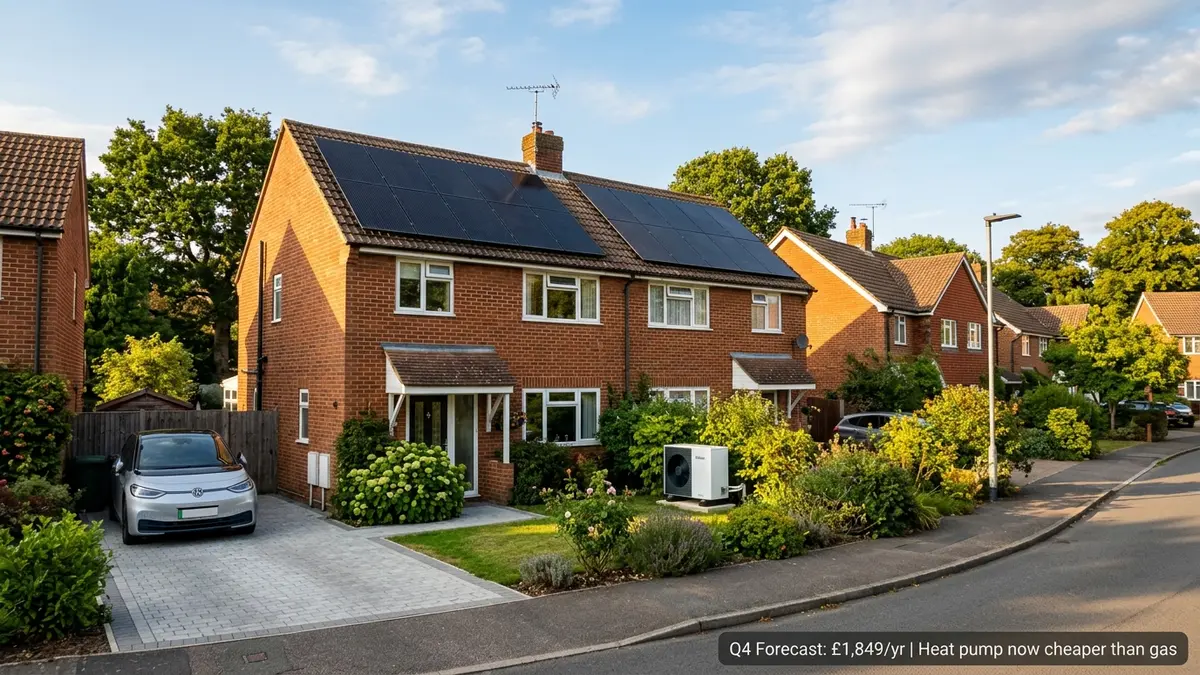
August 2026 at a Glance
- 26.11p/kWh — The Q3 electricity rate is now live. Gas jumped 27.7% to 7.33p/kWh in the same move. Every unit of solar generation you avoid buying from the grid is now worth more than at any point since the 2022 energy crisis.
- £9,000 — The Boiler Upgrade Scheme grant increased for off-gas-grid homes from 21 July. For the 1.7 million UK households on heating oil or LPG, the net cost of a heat pump has dropped to as little as £2,000 to £5,000.
- 3.56:1 — The electricity-to-gas price ratio under the Q3 cap. A heat pump running at SCOP 3.5 now costs the same per unit of heat as a 90% efficient gas boiler. Pair it with a smart tariff and it costs significantly less.
The Q3 cap has been in force since 1 July. If your energy bills went up this month and you were not sure exactly why, this article covers it precisely. Electricity is now 26.11p per kWh. Gas is 7.33p. The gas rise — 27.7% in a single quarter — is the headline the comparison sites did not shout loudly enough. It is the number that changes the maths on heat pumps most dramatically.
Meanwhile, the installation market has hit two milestones worth noting. The UK has now exceeded 2 million cumulative certified solar installations, and the 250,000th domestic heat pump was certified in June. Neither figure is promotional spin - both come from MCS and DESNZ data. These are simply mainstream home upgrades now, which matters when you are assessing lead times and installer choice.
There is also a concrete date coming that has not had much coverage: September 2026. That is when the Warm Homes Loan Scheme opens to the public, allowing homeowners to borrow up to £20,000 at near-zero interest for heat pumps and up to £15,000 for solar and battery installations. The lender application window just closed. We will cover what is confirmed and what is still to be announced.
The Q3 Price Cap: What You Are Actually Paying Now
Ofgem confirmed the Q3 rates on 27 May 2026 and they took effect on 1 July. The headline figure is a 13.5% rise from Q2 to Q3, but the structure of the change matters more than the percentage.
| Component | Q2 2026 (Apr-Jun) | Q3 2026 (Jul-Sep) | Change |
|---|---|---|---|
| Electricity unit rate | 24.67p/kWh | 26.11p/kWh | +5.8% |
| Electricity standing charge | 57.21p/day | 57.19p/day | flat |
| Gas unit rate | 5.74p/kWh | 7.33p/kWh | +27.7% |
| Gas standing charge | 29.09p/day | 29.04p/day | flat |
| Typical annual bill (old TDCV) | £1,641 | £1,862 | +£221 |
| Typical annual bill (new TDCV) | - | £1,663 | new baseline |
A note on the two different headline figures: Ofgem changed the Typical Domestic Consumption Values on 1 July 2026, reducing assumed electricity usage from 2,700 to 2,500 kWh and gas from 11,500 to 9,500 kWh per year. This created two simultaneous "average bill" figures — £1,862 under the old benchmark and £1,663 under the new one. The unit rates are identical regardless of which benchmark is quoted. Your actual bill depends entirely on how much you consume.
The primary cause of the Q3 spike is a 50% rise in the wholesale gas allowance inside the cap calculation. Strikes on Iranian infrastructure and disruption to LNG shipping routes through the Strait of Hormuz drove wholesale gas costs sharply higher during Ofgem's May observation window. Because gas-fired power stations frequently set the marginal price of electricity in the UK market, the electricity rate moved up with it, even as wind and solar output continued to grow.
Q4 2026 Forecast: High Prices Are Not Temporary
Cornwall Insight published its final Q4 forecast on 30 June 2026. The projection is £1,849 per year at the old TDCV benchmark — a 0.5% reduction from Q3. That is not a meaningful fall. The practical reading is that the sharp price jump that hit on 1 July will remain in force through winter, when heating demand is at its highest.
What this means in practice
Analysts are already flagging early Q1 2027 indicators, with typical bills likely to remain around 35% above pre-crisis historical averages. There is no forecast basis for waiting out high energy prices.
Export Tariffs and Smart Import Rates: July 2026
The export market continues to reward homeowners with batteries over those without. Here is where every major tariff stands as of late July 2026.
| Supplier | Tariff | Rate | Type | Key Condition |
|---|---|---|---|---|
| Octopus Energy | Intelligent Octopus Flux | Up to 32.17p/kWh (peak) | Time-of-use | Octopus import + compatible battery required |
| Good Energy | Solar Savings Exclusive | 25p/kWh | Flat | Good Energy install and import supply |
| EDF | Export Exclusive 12m V2 | 24p/kWh | Flat | Contact Solar install and EDF import supply |
| E.ON Next | Next Export Premium v3 | 17.5p/kWh | Flat | E.ON install and import supply |
| British Gas | Export and Earn Plus | 15.1p/kWh (15kW+ systems: 8p) | Flat | British Gas dual-fuel supply |
| Ecotricity | Ecotricity Export | 8.9p/kWh | Flat | Open market |
| Octopus Energy | Outgoing Octopus | 12p/kWh | Flat | Octopus import supply |
Worth flagging a change that landed in July: British Gas announced it is cutting the Export and Earn Plus rate for systems above 15kW from 15.1p to 8p per kWh. Most domestic installations sit below that threshold, but anyone with a larger commercial-scale residential system needs to check their tariff status.
For import, Intelligent Octopus Go remains the market leader at 7p per kWh between 11:30pm and 5:30am. At 26.11p during the day, that is an 19.11p spread per kWh. Charge a 10 kWh battery fully overnight and discharge it in the evening instead of importing from the grid: roughly £1.91 saved per cycle, around £700 per year before accounting for battery degradation. The case for storage has not been this clear-cut since the peak of the 2022 crisis.
Find out how fast solar panels pay back at current rates
Enter your roof size and current bill. The calculator uses live Q3 2026 unit rates.
Run the Payback CalculatorGrants and Policy: What Changed in July
BUS Grant Increases to £9,000 for Off-Gas Homes
The Boiler Upgrade Scheme uplift for oil and LPG households came into force on 21 July 2026. From that date, any property currently heated by heating oil or LPG can claim £9,000 toward a new air source or ground source heat pump installation. The standard rate for gas-connected homes remains £7,500. Both grants are funded through to March 2027 at minimum.
| Current Heating System | BUS Grant | Typical Gross Install Cost | Typical Net Cost |
|---|---|---|---|
| Heating oil or LPG | £9,000 | £11,000 – £14,000 | £2,000 – £5,000 |
| Mains gas | £7,500 | £11,000 – £14,000 | £3,500 – £6,500 |
| Any system (air-to-air heat pump) | £2,500 | £3,000 – £6,000 | £500 – £3,500 |
The July regulatory notice also formally included air-to-air heat pumps in the BUS for the first time, at a £2,500 grant level. These units cannot drive wet central heating systems like radiators or underfloor heating, but they are highly effective for room-by-room heating and cooling, and they cost significantly less than air-to-water systems. For homeowners in smaller properties or those wanting to complement an existing gas system, this opens a new funding route. More on the Boiler Upgrade Scheme eligibility rules here.
Cumulative BUS data as of late June 2026 stands at 130,988 voucher applications and 84,879 redemptions, with air-to-water heat pumps accounting for 98% of volume. Application momentum in May 2026 was 4,411 — a 19% year-on-year increase. The scheme is being used at scale. That also means installer calendars are filling up and lead times are stretching, particularly in southern England and the South West.
Warm Homes Loan Scheme: September 2026 Launch
The Phase 1 lender application window for the £1.7 billion Warm Homes Loan Scheme closed on 17 July 2026. High-street banks, building societies, and specialist lenders submitted applications to underwrite the government-backed zero and low-interest loans. The September 2026 public launch date remains on track, which means the scheme will be live when homeowners are actively planning their autumn and winter retrofit decisions.
The loan limits are confirmed: up to £15,000 for solar PV and battery storage, and up to £20,000 for air source heat pumps before the BUS grant is applied. Crucially, the loans can cover enabling works — radiator upgrades, pipework replacement, electrical upgrades — that commercial lenders typically refuse to include. This removes the most common hidden cost barrier that inflates heat pump quotes above the headline price. Keep an eye on our heat pump pages for scheme updates as lender approvals are announced.
Balcony Solar: Delayed Until Late 2027
This is a clear case of a promising regulatory development moving slower than the headlines suggested. The BS 7671 wiring regulation update (Amendment 4, Chapter 708) that legalised sub-800W plug-in solar connections came into force in April 2026. But the BSI product safety standard — the certification framework that actually allows manufacturers to bring compliant kit to market — has slipped from its expected summer 2026 publication to late 2027.
Until that standard is published, no retailer can sell a properly certified plug-in solar kit for DIY domestic use. Lidl, Amazon, and EcoFlow are not going to launch these products without product liability coverage, and that coverage depends on the standard existing. If you have been waiting for a cheap balcony solar kit from a supermarket, you are looking at 2028 at the earliest for a properly certified product at scale.
Future Homes Standard: Confirmed March 2028
Secondary legislation formally enacted on 24 March 2026 confirmed the Future Homes Standard takes legal effect in March 2028. All new-build homes from that date must be built as "zero carbon ready" — in practice, this means no gas boilers and either a heat pump or district heating as the primary heat source, with solar PV mandated across 40% of ground floor area. The transition is already visible in planning applications, where major housebuilders are pre-emptively specifying heat pump and solar combinations to avoid last-minute compliance issues.
Market Data: 2 Million Solar Installs, 250,000 Heat Pumps
Two milestones landed in June and July that are worth recording precisely.
First, the UK surpassed 2 million cumulative certified solar PV installations by the close of Q1 2026, reaching approximately 22.1 GW of total capacity. Q1 2026 alone delivered over 57,000 certified rooftop systems — the strongest opening quarter since the peak of the Feed-in Tariff era in 2012. March 2026 set a single-month record of 27,607 installations. The 0% VAT deadline of March 2027 is clearly pulling purchasing decisions forward. If you have been thinking about solar panels, you have roughly seven months to get ahead of the VAT change.
Second, MCS confirmed the 250,000th certified domestic heat pump installation in the UK. The sector delivered 132,000 installations in 2025 — a 34% year-on-year increase, and the third consecutive year of roughly one-third annual growth. The supply chain has scaled. Lead times that sat at six months or more in 2023 and 2024 are now four to eight weeks for a survey, with installation following six to twelve weeks after. That is fast enough to have a system running before the winter heating season.
On costs, the market has stabilised. Current fully installed benchmarks (0% VAT, excluding grant) from summer 2026 data:
| System | Installed Cost (0% VAT) | Net of Grant |
|---|---|---|
| 4kWp solar array | £6,000 – £8,000 | £6,000 – £8,000 |
| 4kWp solar + 5kWh battery | £9,000 – £12,500 | £9,000 – £12,500 |
| 8kW ASHP (gas home) | £11,000 – £14,000 | £3,500 – £6,500 |
| 8kW ASHP (oil/LPG home) | £11,000 – £14,000 | £2,000 – £5,000 |
Use our heat pump savings calculator to model the running cost difference versus your current heating system at Q3 unit rates.
Real-World Performance: The Heat Pump Spark Gap Has Flipped
Here is the headline performance statistic from July 2026 that deserves more attention than it has received. The electricity-to-gas price ratio under the Q3 cap is 3.56 (26.11p divided by 7.33p). A modern air source heat pump with a Seasonal COP of 3.5 or higher delivers 3.5 units of heat for every unit of electricity it consumes. At that efficiency, the cost per kWh of useful heat from a heat pump is now approximately equal to — or marginally below — the cost from a 90% efficient gas boiler.
The spark gap calculation, simplified
Gas boiler at 90% efficiency: 7.33p ÷ 0.9 = 8.14p per kWh of useful heat delivered. Heat pump at SCOP 3.5: 26.11p ÷ 3.5 = 7.46p per kWh of useful heat delivered. The heat pump is cheaper. Switch to Octopus Cosy (average 13p/kWh off-peak) and it drops to 3.71p — less than half the gas boiler cost.
This is a meaningful threshold. Throughout 2024 and early 2025, the spark gap sat above 4.0, meaning electricity was four times more expensive than gas per unit, and a heat pump needed a SCOP above 4.0 to match gas boiler economics. With gas now at 7.33p and the ratio at 3.56, a competently installed heat pump operating at real-world SCOP figures (typically 3.2 to 4.0 for a correctly sized modern unit) is now the cheaper heating option per unit of heat at standard tariff rates.
On solar self-consumption, one data point from July 2026 is worth flagging directly: homes without battery storage self-consume only 35% to 50% of their generated solar power during summer. The remainder is exported, typically at 8p to 15p per kWh under standard SEG tariffs. Because the Q3 import rate is 26.11p, every kWh exported rather than self-consumed costs you the 11p to 18p difference. A battery eliminates most of this by time-shifting generation to the evening peak. Self-consumption rates rise to 70% to 80% with storage, typically adding £600 to £900 per year to the financial case.
On battery safety: PAS 63100:2024 has become the enforced benchmark across the installation sector in 2026. The key practical point for homeowners: batteries should be installed outdoors where possible. Indoor lithium-ion installations are prohibited in lofts, roof spaces, escape routes, and cupboards opening onto sleeping areas. If an installer quotes for a loft installation, that is no longer acceptable practice. Ask specifically where the battery will be mounted before signing any contract.
Finance: BoE Holds at 3.75%, Green Loans Still the Better Route
The Bank of England's Monetary Policy Committee voted 6-3 to hold the base rate at 3.75% at its meeting on 30 July 2026. This was the fifth consecutive hold. The MPC cited Middle Eastern energy market volatility and sticky services inflation as the primary justification. Because there is no August MPC meeting, this rate is locked until at least 17 September 2026.
Average two-year fixed mortgage rates sit at 5.62% and five-year fixes at 5.61% as of late July. Unsecured personal loans for home improvement (£7,500 to £14,999) are running at commercial APRs well above the base rate. Financing a £10,000 solar and battery system through a standard mortgage or personal loan over 25 years or five years respectively generates significant interest costs that erode the energy savings.
The practical options for homeowners who do not want to self-fund:
- Green mortgage cashback — Halifax/Lloyds offers £2,000 cashback for heat pump installations, £1,000 for solar, on qualifying EPC-B+ properties. HSBC has a five-year fixed green mortgage at competitive rates for high-efficiency homes. Not a loan, but a meaningful offset against installation cost.
- Warm Homes Loan Scheme (September 2026) — Zero or near-zero interest loans up to £20,000 for heat pumps and £15,000 for solar and battery. The interest rate subsidy is paid directly to the lender by the government. No mortgage security required. Wait if you can — this is the best financing route for most homeowners.
- Supplier green finance — E.ON Next and Octopus both offer interest-free or low-rate finance products for their installer networks. Terms vary significantly, so compare the total cost of credit carefully.
Act Now: Timing, Lead Times, and Fraud Alert
Three practical points for homeowners who are actively considering an installation.
First, on timing: the 0% VAT rate on solar panels, batteries, and heat pumps expires in March 2027. At current installed costs, the difference between 0% and 5% VAT is £300 to £700 on a solar installation and up to £700 on a heat pump. Surveying now, getting quotes in September, and booking for an October or November installation is entirely achievable with current lead times and safely ahead of the VAT deadline.
Second, on the Warm Homes Loan Scheme: if you are planning a heat pump installation and want to use the scheme, do not proceed with a cash purchase before September 2026 if you can delay. The scheme is designed to work alongside the BUS grant, not instead of it. An oil-heated home could combine the £9,000 BUS grant with a zero-interest loan for the remaining balance — potentially covering the entire installation without a large cash outlay.
Third, a fraud warning that is directly relevant to August. Door-to-door solar and heat pump sales peak in late summer and autumn. The newly announced £9,000 BUS uplift for oil homes is already being misrepresented by some cold-call companies as a "guaranteed government grant" available immediately without MCS certification. The BUS grant is only available through MCS-certified installers. No MCS certification means no grant, regardless of what the salesperson says. DESNZ has opened a formal consultation to establish a Warm Homes Agency with powers to permanently ban rogue installers from government-funded work — but that body does not yet exist. For now, verify MCS certification before signing anything, and do not pay a deposit to any company that cold-called you.
Smart Meters: 40 Million Installed, 3.5 Million Stuck in Dumb Mode
DESNZ data published in Q2 2026 shows 40 million smart meters installed in the UK — roughly 70% penetration of the domestic market. The significance for solar and battery owners is that smart meters are the essential gateway to accessing dynamic tariffs like Octopus Agile and Intelligent Octopus Flux. Without a working smart meter, you cannot access the export tariffs that make battery storage most financially effective.
The complication: 3.5 million installed smart meters (approximately 8.3% of the total) are currently operating in traditional "dumb" mode because of 2G/3G network decommissioning breaking their communications hub. New Ofgem licence conditions will require suppliers to resolve disconnected meters within 90 days and replace older communications hardware with 4G-compatible units by 2033. If your smart meter has lost connectivity, contact your supplier directly and reference the 90-day resolution requirement.
Four Questions We Are Getting Asked Right Now
My electricity bill went up in July but I have solar panels. Why did my bill not go down? +
Solar panels reduce your daytime import from the grid, but they do not eliminate your energy bill. Standing charges, evening and overnight consumption, and any gas heating costs are not affected by solar generation. Without battery storage, UK homes typically self-consume only 35% to 50% of what their panels generate. If your July bills are higher than last July despite having solar, check whether your supplier has adjusted your direct debit to reflect the higher Q3 unit rates — the standing charge and non-solar consumption will both have increased.
Should I wait for the Warm Homes Loan Scheme before getting a heat pump? +
If you can realistically wait until late September or October 2026, yes — it is worth checking whether the scheme is live and whether your installation qualifies before committing to an alternative financing route. The scheme allows you to borrow up to £20,000 at near-zero interest, which combined with the BUS grant eliminates the need for significant upfront capital. If your boiler has failed and you need replacement heating immediately, proceed with the BUS grant and check whether the loan scheme will retrospectively apply once it launches. If you are planning ahead and can fund the survey now for an installation in autumn, survey now and book once the loan scheme terms are confirmed in September.
Is it true a heat pump is now cheaper to run than a gas boiler? +
At Q3 standard cap rates, a heat pump at SCOP 3.5 costs approximately 7.46p per kWh of useful heat — very slightly below a 90% efficient gas boiler at 8.14p. The margin is narrow at standard tariff rates. However, switch to a heat-pump-optimised smart tariff like Octopus Cosy (three off-peak windows averaging around 13p/kWh) and the comparison shifts substantially: the heat pump costs roughly 3.71p per kWh of useful heat versus 8.14p for gas. The key caveat is SCOP: a poorly designed or undersized heat pump that runs at SCOP 2.5 will cost more to operate than gas even at current prices. Correct sizing and commissioning matter significantly here.
Someone cold-called me about a £9,000 heat pump grant. Is this legitimate? +
The £9,000 BUS grant for off-gas-grid homes is real and came into force on 21 July 2026. However, companies that cold-call you cannot legitimately guarantee this grant — it is only available through MCS-certified installers who submit a voucher application to the scheme on your behalf. Any company that contacts you unsolicited, demands a large upfront deposit, or claims you must "act today" to secure the grant is exhibiting the standard warning signs of installer fraud. Check the MCS installer directory at mcs.org.uk and request at least two quotes from certified companies before committing to anything.
For context on where the Q3 rates and the July policy changes originated, read our July 2026 UK energy update.
Ready to Take Action?
Does your home qualify for the BUS grant?
Check eligibility and compare quotes from local MCS-certified installers — free, no obligation.
Check My Eligibility →Get Your Free Quotes
Takes under 4 minutes · No obligation

Written by
Mark Anthony Haines
Mark has over a decade of experience in the UK renewable energy sector, specialising in solar PV, heat pump systems, and home battery storage. He founded HeatPumpsAndSolar.co.uk to help UK homeowners cut through the noise around green energy installations, government grant schemes, and smart tariffs.
View LinkedIn ProfileMore from Our Insights
Tools & Services Related to This Article
Take the next step with a free calculator or a local installer quote.