What's Changing for UK Solar Panels and Heat Pumps in July 2026?
July 2026: The Q3 cap is now live at £1,862 - a 13% rise from 1 July. UK solar broke a historic 16GW during the June heatwave. BUS grant rises to £9,000 for oil-heated homes. Full breakdown of Q3 rates, the Octopus Nook battery, COP 4.71 heat pump data, and the September Warm Homes Loan.
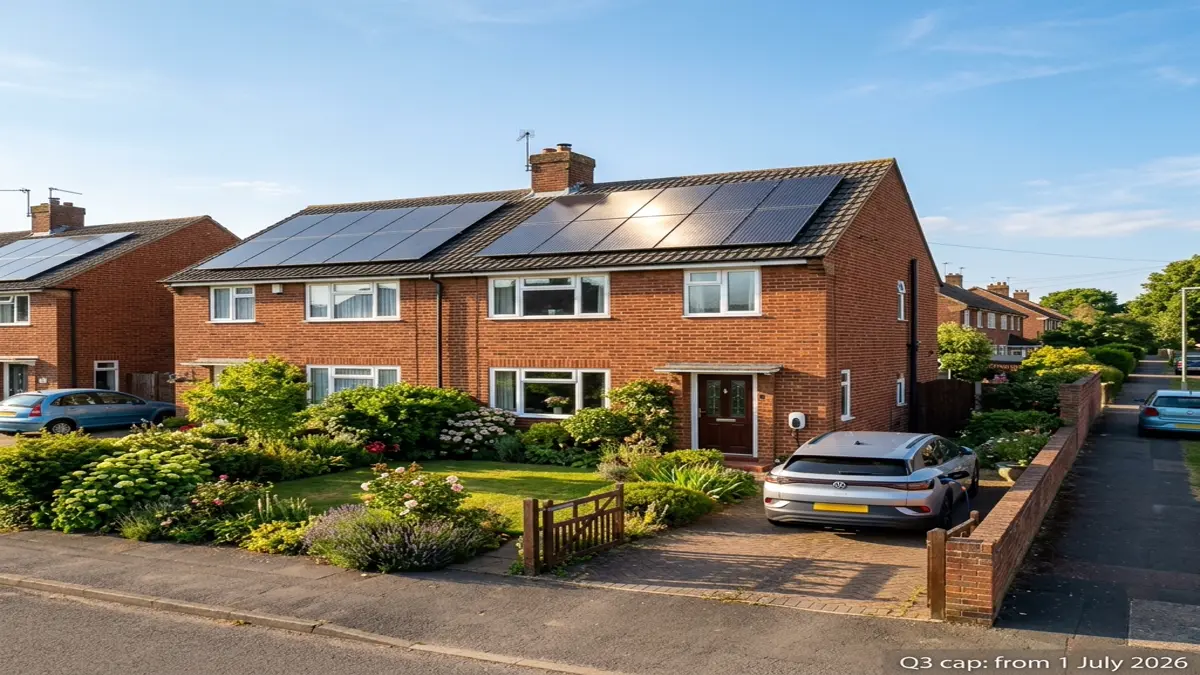
July 2026 at a Glance
- £1,862 - The Q3 2026 Ofgem price cap is now live from 1 July. That is a 13% spike in one quarter, driven by wholesale gas costs surging 50% inside the cap observation window. Electricity is up 5.8%, gas is up 27.7%. The direction of travel is not ambiguous.
- £9,000 - The Boiler Upgrade Scheme grant rises for homes on heating oil or LPG from 21 July 2026. If you are one of the 1.7 million off-gas-grid households in the UK, this is the largest single grant increase the scheme has ever offered.
- 16 GW - UK solar smashed its all-time peak during the June heatwave, generating enough power to provide five hours of free air conditioning daily for a typical solar home. Q2 2026 was the cleanest electricity quarter the UK grid has ever recorded.
Right. The Q3 price cap is in force. As of 1 July 2026, electricity costs 26.11p per kWh and gas costs 7.33p per kWh under the Ofgem cap - a 13% rise from Q2 in a single quarterly adjustment. The mechanism driving this is the one we have been tracking all year: wholesale gas prices surged 50% during Ofgem's observation window, triggered by geopolitical disruption to LNG shipping through the Strait of Hormuz. The political story has not changed. The bill figure has.
Meanwhile, the grid's own data from June tells a different and rather striking story. During the late-June European heatwave, UK solar generation broke 16 gigawatts for the first time in history. On the same days, cooling demand was at a seasonal peak. The solar panels absorbed both - meeting the surge without gas-fired backup, and briefly driving wholesale electricity prices negative. For homeowners already generating, that is the system doing exactly what it is designed to do. For everyone still weighing up the decision, it is useful context.
And there is one more headline this month that is more concrete than most policy announcements. From 21 July 2026, the Boiler Upgrade Scheme increases its heat pump grant from £7,500 to £9,000 for homes currently heated by oil or LPG. That covers 1.7 million UK households. Here is what changed in June, what is now in force, and what it means for your home.
The Q3 2026 Price Cap: What You Are Now Paying
Ofgem confirmed the Q3 rates on 27 May 2026. They took effect on 1 July. The headline increase from Q2 to Q3 was 13% at the standard dual-fuel benchmark, but the structure of the rise matters as much as the headline number.
| Component | Q2 2026 (Apr-Jun) | Q3 2026 (Jul-Sep) | Change |
|---|---|---|---|
| Electricity unit rate | 24.67p/kWh | 26.11p/kWh | +5.8% |
| Electricity standing charge | 57.21p/day | 57.19p/day | flat |
| Gas unit rate | 5.74p/kWh | 7.33p/kWh | +27.7% |
| Gas standing charge | 29.09p/day | 29.04p/day | flat |
| Typical annual dual-fuel bill | £1,641 | £1,862 | +£221 (+13%) |
The electricity rate rose by 5.8%. The gas rate rose by 27.7%. Those are not equivalent numbers, and the implications split cleanly along technology lines. Homes still heated by mains gas are facing a near-28% rise in their primary heating fuel this quarter. The 50% rise in the wholesale gas allowance within the cap calculation - driven by LNG supply disruption - is the single biggest factor in this quarter's increase. Standing charges moved barely a fraction of a penny in either direction.
There is also a structural change embedded in this cap announcement. Ofgem introduced revised Typical Domestic Consumption Values from 1 July 2026, reducing the assumed annual usage from 2,700 kWh of electricity and 11,500 kWh of gas to 2,500 kWh and 9,500 kWh respectively - reflecting genuine behavioural shifts from years of high prices. This produces a lower headline figure of £1,663. The unit rates are identical under both benchmarks; only the assumed volume changes. If your actual consumption exceeds the new benchmarks (very likely if you heat with gas), your bill will be proportionally higher than either headline figure suggests. The unit rate is the variable that matters.
On Q4 2026: Cornwall Insight's final June forecast puts the October-December cap at £1,849 at the 2023 benchmarks - roughly flat on Q3 rather than a reversal. Winter gas consumption volumes applied to a £1,849 cap rate will produce monthly direct debits substantially higher than the summer average. There is no forecast signal of a meaningful price reduction before spring 2027.
What this means in practice
At Q3 gas rates of 7.33p/kWh, running an air-source heat pump at a SCOP of 3.5 now produces heat more cheaply than a gas boiler - roughly 7.5p versus 8.1p per kWh of heat delivered. Switch that heat pump to Octopus Cosy off-peak windows at approximately 14.5p/kWh import and the effective heat cost drops to around 4.1p per kWh. The Q3 cap has shifted the running cost comparison decisively. Use the heat pump savings calculator to model your specific tariff and consumption.
Export Tariffs: Summer Peak, Battery Premium Widens
The SEG market entering Q3 2026 is in its most stratified state yet. The gap between what a battery owner can earn on a time-of-use tariff versus what a panel-only household earns on a flat rate is approaching 170%. Here is the current picture as of late June 2026:
| Supplier | Tariff | Rate Type | Peak Export Rate (p/kWh) |
|---|---|---|---|
| Octopus Energy | Intelligent Octopus Flux | AI-managed TOU | Up to 32.17p |
| Good Energy | Solar Savings Exclusive | Flat rate | 25.0p |
| EDF Energy | Export Exclusive 12m V2 | Flat rate | 24.0p |
| E.ON Next | Next Export Premium v3 | Flat rate | 17.5p |
| Ecotricity | Smart Export Tariff | Variable | 16.0p |
| British Gas | Export and Earn Plus | Variable | 15.1p |
| Octopus Energy | Outgoing Octopus Fixed | Flat rate | 12.0p |
Outgoing Octopus has been at 12p since the March 2026 cut and has not moved. The top two flat-rate tariffs - Good Energy at 25p and EDF at 24p - both carry installer exclusivity clauses, meaning your solar system must have been fitted by their designated partners. Worth checking at the quote stage if you have not yet committed to an installer.
The hardware case for adding a home battery is becoming harder to argue against. At a 20p premium per kWh on every evening discharge with Intelligent Octopus Flux, a 5kWh battery cycling daily pays back its incremental cost in a tight window. For solar panel owners still on flat-rate export, switching to a battery and a smart tariff is worth modelling before the summer export season peaks further.
On smart import tariffs: Intelligent Octopus Go remains the most aggressive overnight rate at 7p/kWh between 11:30pm and 5:30am, designed primarily for EV charging but equally useful for battery top-up. Cosy Octopus for heat pump owners runs off-peak windows at around 14.5p per kWh - against a Q3 standard rate of 26.11p, that is a 44% discount for timing your heating and hot water correctly.
How much will solar save you at Q3 2026 rates?
Model your roof size, location, and current bill against the new 26.11p/kWh rate.
Calculate Your Solar PaybackGrants and Policy: Four Changes Worth Acting On
BUS grant rises to £9,000 for off-gas-grid homes from 21 July. The Department for Energy Security and Net Zero has confirmed a targeted uplift to the Boiler Upgrade Scheme. From 21 July 2026 to 31 March 2027, properties currently heated by oil or LPG are eligible for a £9,000 grant toward the cost of an air-source or ground-source heat pump - up from the standard £7,500. Homes on mains gas remain at £7,500. The scheme has logged 130,988 voucher applications to date, with 98% directed toward air-to-water systems. Average installation cost in Q1 2026 was £13,100, meaning the net outlay for an oil-heated home drops to approximately £4,100 after the grant - comparable to a standard boiler replacement. DESNZ has committed £2.39 billion to sustain the scheme through 2029/30 as part of the broader Warm Homes Plan, so the medium-term funding floor is confirmed. Importantly, properties are no longer required to have implemented outstanding EPC insulation recommendations before applying - a previous barrier that has now been removed. Read the full detail on the Boiler Upgrade Scheme.
Balcony solar: BS 7671 Amendment 4 is in force, but plug-and-play is still pending. On 15 April 2026, Amendment 4 to the BS 7671 IET Wiring Regulations came into force, introducing Chapter 708 - the first UK legal framework allowing sub-800W generators to connect to domestic ring circuits via standard sockets. The BSI product safety standard that certifies specific hardware for fully DIY connections is still pending, with publication expected this summer. Until that standard is published, a competent electrician and G98 DNO notification remain technically required for full compliance. Lidl, Amazon, and EcoFlow are preparing consumer kits targeting the £300-£600 price range. Worth watching closely, but not yet actionable as a pure DIY purchase. For homeowners who can accommodate a permanent rooftop solar installation, the 25-year financial return comprehensively outperforms any portable kit at current prices.
Warm Homes Loan Scheme: September 2026 launch confirmed. DESNZ opened Phase 1 lender applications in June 2026, with a deadline of 17 July, aiming for loans to reach consumers by September 2026. The mechanism: £300 million of government grant capital subsidises commercial lending rates by up to five percentage points, allowing regulated lenders to offer solar, battery, and heat pump loans at zero or heavily discounted interest rates. Loan caps are £15,000 for solar and battery, £20,000 for ASHP, pre-grant. Crucially, the WHLS sits alongside BUS - you can claim the £7,500 or £9,000 grant and then finance the remaining balance through the subsidised loan. No income thresholds apply. This is the mechanism the able-to-pay middle market has been waiting for.
Future Homes Standard: confirmed for 24 March 2027
Secondary legislation has confirmed the Future Homes Standard takes effect on 24 March 2027. All new homes built from that date must produce 75% fewer carbon emissions than current regulations - which in practice means heat pumps as standard and solar PV covering a significant proportion of the ground floor area. The Home Energy Model (HEM) will assess compliance using half-hourly simulations rather than the monthly averages used by the existing SAP calculation. For the heat pump installation market and new build solar, the demand signal from this date is structural and long-term.
June Was the UK Grid's Best Quarter for Clean Power on Record
June 2026 delivered the most significant solar generation numbers this country has ever recorded. During the late-June European heatwave, UK solar generation exceeded 16 gigawatts for the first time in history - 50% more peak output than during the 2022 energy crisis. Over four consecutive heatwave days, domestic and utility-scale solar combined for 483.6 GWh, a 45.9% increase on the preceding week. A typical 4kWp domestic array was generating approximately 15 kWh per day during the solstice peak - mathematically sufficient to power a 3kW air conditioning system for five hours entirely from self-generation.
That heatwave generation also demonstrates something important about how the modern grid handles extreme heat events. In previous summers, heatwaves strained the network as cooling loads rose while wind generation dropped. In June 2026, the 1.9 million residential solar arrays on UK rooftops collectively absorbed much of the demand surge, occasionally pushing wholesale prices into negative territory and triggering Demand Flexibility Service reward events. The performance of distributed solar during peak summer heat is the system doing exactly what it was installed to do.
Looking at the full Q2 picture: in April 2026, zero-carbon sources reached 99% of total UK electricity demand for brief intervals - the highest clean generation share ever recorded. Wind accounted for 31% of generation in April and 25% in May, with solar stepping up through June to set the records already described. For Agile Octopus subscribers, those renewable surplus periods translate directly to negative pricing events where you pay nothing - or get paid - to consume. The grid mix has structurally changed.
On heat pump performance in the real world: a University of Salford study published in June 2026 put a full-scale house built to 2027 Future Homes Standard specifications through rigorous climate chamber testing. A properly specified air-source heat pump achieved a COP of 4.71 at 5°C - meaning 4.71 units of heat delivered for every single unit of electricity consumed. At -5°C, it maintained a COP of 2.98. A modern condensing gas boiler in the same test delivered a maximum of 0.90 units of heat per unit of energy. The performance gap has been independently verified under controlled conditions. Running costs are one consequence; the environmental arithmetic is another.
New Products: Octopus Nook, Duracell Trial, Tesla Update
Octopus Energy launched its own home battery range on 22 June. The Nook range has two products. The Nook Cube is a 2kWh unit that plugs directly into a standard 13-amp wall socket, stackable to 10.5kWh total capacity, requiring no landlord permission and no fixed wiring - it specifically targets the 10 million rented UK households who cannot modify their electrical installation. The Nook Colossus is a fixed, wall-mounted unit for homeowners, starting at 5kWh and stackable to 30kWh, priced at roughly a third less than a Tesla Powerwall 3 according to Octopus. Both carry a 12-year warranty, include an integrated solar MPPT input, and run on Octopus's proprietary Intelligence software - natively integrating with Flux and Agile tariffs without third-party APIs. General retail availability across Europe is slated for 2027. For homeowners comparing options now, established units - GivEnergy, Pylontech, Tesla Powerwall 3, Duracell Dura5 - remain the quotes to obtain.
Duracell and EDF commenced a residential grid flexibility trial in June. A three-month trial running June to August 2026 is aggregating approximately 50 residential Duracell Energy batteries across England into local flexibility markets. EDF manages the market operations and dispatch strategy; Puredrive Energy - the authorised manufacturer and licensee - handles hardware and customer integration. The trial tests whether domestic storage can stabilise local distribution networks during stress events, with the long-term objective of allowing Duracell battery owners to earn passive revenue from grid services alongside their solar export income. The Dura5 (5kWh modular) and Dura16 (designed for high-load homes with EVs and heat pumps) use LiFePO4 chemistry controlled via an AI-enabled app. Both remain worth including in quotes from MCS-certified installers.
Tesla VPP: supply licence confirmed, UK tariff not yet launched. Tesla Energy Ventures has held its Ofgem electricity supply licence since March 2026. As of late June, no UK retail tariff, household trial, or firm commercial launch date has been announced. The supply licence is the final legal prerequisite; the commercial product is the outstanding step. UK Powerwall owners should monitor Tesla's communications directly. For battery arbitrage now, third-party tariffs like Octopus Flux remain the route to use. More on the current battery market at solar battery storage.
On smart meters: DESNZ Q1 2026 statistics published 28 May confirm 41 million smart and advanced meters active in Great Britain - 72% of all domestic meters - but roughly 3 million of those are operating in traditional mode due to communication failures. The Post-2025 Smart Metering Policy Framework, in force since May 2026, requires suppliers to restore malfunctioning meters to smart mode within 90 days or face Ofgem fines. If you are planning to install solar or a battery and do not have a functioning smart meter, request one before or alongside the installation. Without it, you cannot access half-hourly settlement or time-of-use tariffs like Agile or Flux.
Finance: Green Loans Are Now the Cheapest Route to Installation
The Bank of England's Monetary Policy Committee voted 7-2 on 17 June 2026 to hold the base rate at 3.75%. CPI inflation dropped to 2.8%, but the MPC cited ongoing Middle East energy supply disruption as an upside risk that ruled out a June cut. Average two-year fixed mortgage rates currently sit at 5.24%; five-year fixed at 5.34%. The forward signal from the MPC does not point clearly toward a near-term reduction.
For households financing solar, batteries, or heat pumps, the commercial borrowing environment makes the case for specialist green finance products stronger than it has been at any point this cycle:
Nationwide Building Society has expanded its 0% Green Additional Borrowing scheme to 10,000 households, offering £5,000 to £20,000 interest-free over two to five years for qualifying energy efficiency investments including solar, batteries, and heat pumps. The scheme has already lent £60 million since inception, with solar panels proving the most popular investment. Existing Nationwide mortgage customers should check eligibility before looking at any other financing route.
Halifax and Lloyds Bank offer the Green Living Reward: £2,000 cashback for a completed heat pump installation, £1,000 for solar or battery storage. Post-installation, not upfront finance - but a real reduction in net project cost for existing mortgage customers without access to 0% products.
Barclays offers up to £2,000 under its Greener Home Reward scheme on a similar post-completion cashback model.
The contrast with standard commercial lending is stark. The average APR for an unsecured personal loan of £10,000 is currently 12.28%. Over five years, that adds approximately £3,842 in pure interest to a typical solar and battery project - a meaningful erosion of the installation's return on investment. At 0% via Nationwide or September's Warm Homes Loan Scheme, the same capital costs nothing beyond the principal. The financing route is not a secondary decision.
Market Conditions: Installer Demand, 0% VAT Deadline, and Fraud
The MCS-certified installer base stands at 5,624 contractors across the UK. Home battery installations surged 130% year on year in 2025, with approximately 20,000 systems certified in the first half of the year alone - momentum that has continued into 2026. Solar PV reached 205,340 certified residential installations across 2025. Heat pumps hit a record 125,037 in 2025, but growth decelerated to 27% - below the 33% annual compound rate required to reach the government's 450,000-per-year target by 2030. The shortfall is being targeted by the Clean Heat Market Mechanism's second year, which now mandates boiler manufacturers sell heat pumps equal to 8% of boiler sales or face significant financial penalties. Expect manufacturer-backed incentives and discounted units through the second half of 2026 as the heat pump market adjusts to that pressure.
| System | Storage | Installed Cost (0% VAT) | Notes |
|---|---|---|---|
| 4kWp Solar PV | None | £6,800 - £8,200 | 10-panel standard semi-detached |
| 4kWp Solar PV | 10kWh battery | £10,000 - £14,000 | Integrated installation, 0% VAT |
| 8kW Air Source Heat Pump | - | £13,100 pre-grant | £5,600 net after £7,500 BUS; £4,100 for oil homes after £9,000 BUS |
The 0% VAT relief on solar, batteries, and heat pumps runs until 31 March 2027. When it reverts to 5%, a £12,000 project becomes £12,600. That is £600 in additional cost with no functional return - a delay tax. Quality MCS-certified contractors in high-demand areas are booking well ahead for Q3 and Q4 2026. Getting quotes now for a late summer or autumn installation is the correct sequence if you have not yet started.
Now, the fraud picture - and this month it produced a criminal conviction.
Three directors convicted at Maidstone Crown Court, June 2026. Operation Clementine, led by National Trading Standards and Kent County Council, concluded with the conviction of three men running Clear Renewables Ltd and Efficient Homes SE Ltd. The operation targeted elderly and vulnerable homeowners through cold-calling, falsely claiming their existing solar systems required urgent safety checks, then using high-pressure sales tactics to sell unnecessary equipment. In one documented case, a victim with a perfectly functioning system paid £4,200 for a SolarEdge inverter and optimisers that cost the company less than £800 to procure. Expert witnesses confirmed the original systems were working correctly; some of the replacement work was physically hazardous. One director received three years in prison; two received suspended sentences. Trading Standards specifically warned that summer is peak season for doorstep solar fraud. Never accept a free solar health check from a cold-caller or door-knocking salesperson. Always verify MCS registration before permitting anyone onto your roof.
Separately, DESNZ launched a formal consultation on 17 June 2026 proposing to consolidate the existing fragmented consumer protection framework - RECC, HIES, TrustMark - into a single, government-accountable body with binding standards and enforceable compensation rights. The Redeveloped MCS Installer Scheme, already live in 2026, requires every certified installation to carry insurance-backed financial protection as a condition of certification. When comparing quotes, ask specifically whether your installer is registered under the Redeveloped MCS framework.
Frequently Asked Questions
What are the exact Q3 2026 electricity and gas unit rates from 1 July? +
The confirmed Ofgem Q3 2026 rates from 1 July are: electricity at 26.11p per kWh with a standing charge of 57.19p per day; gas at 7.33p per kWh with a standing charge of 29.04p per day. The headline annual bill figure of £1,862 uses the older 2023 Typical Domestic Consumption Values of 2,700 kWh electricity and 11,500 kWh gas. Ofgem has simultaneously introduced new lower benchmarks (2,500 kWh electricity, 9,500 kWh gas), which produce a headline of £1,663. The unit rates are identical under both benchmarks. If your actual consumption exceeds the new benchmarks - very likely if you heat with gas - your bill will exceed £1,663 proportionally. Cornwall Insight forecasts Q4 2026 at £1,849 at the older benchmarks, meaning no meaningful price reversal is expected before spring 2027.
Is a heat pump now cheaper to run than a gas boiler at Q3 2026 rates? +
Yes - at Q3 rates, a properly specified air-source heat pump on a standard import tariff at 26.11p/kWh achieving a SCOP of 3.5 delivers heat at approximately 7.5p per kWh effective cost. A modern condensing gas boiler at 90% efficiency now costs 8.1p per kWh of heat at the Q3 gas rate of 7.33p. The gap is narrow but has shifted decisively in the heat pump's favour this quarter. On a smart tariff like Octopus Cosy (approximately 14.5p/kWh during off-peak windows), the heat pump's effective heat cost drops to roughly 4.1p per kWh - roughly half the gas boiler rate. The caveat is installation quality: a poorly specified heat pump with inadequate emitters or an incorrect heat loss calculation can drive real-world SCOP to 2.0, at which point the economics reverse. MCS certification and a full heat loss survey are not optional steps.
Who qualifies for the new £9,000 Boiler Upgrade Scheme grant? +
The £9,000 uplift applies to properties currently heated by heating oil or LPG - the approximately 1.7 million UK homes that are off the mains gas grid, predominantly in rural areas. To qualify, the property must have a valid EPC and the installation must be carried out by an MCS-certified installer. The standard £7,500 grant continues to apply to homes currently on mains gas. The uplift runs from 21 July 2026 to 31 March 2027. Properties are no longer required to have implemented outstanding loft or cavity wall insulation recommendations before applying - that barrier has been removed. Applications are made through your MCS-certified installer, who claims the voucher on your behalf before installation begins. Average installation cost is currently £13,100, producing a net outlay of approximately £4,100 for off-gas-grid homes after the full £9,000 grant.
What is the Octopus Nook battery and when can I buy one? +
Octopus launched two Nook products on 22 June 2026. The Nook Cube is a plug-in 2kWh unit for renters - it connects to a standard 13-amp socket, requires no fixed wiring or landlord permission, and can be stacked to 10.5kWh total. The Nook Colossus is a fixed, wall-mounted unit for homeowners, starting at 5kWh and stackable to 30kWh, priced at roughly a third less than a Tesla Powerwall 3. Both carry a 12-year warranty and an integrated solar MPPT input. They run on Octopus Intelligence software, integrating natively with Flux and Agile tariffs. General retail availability is expected in 2027. Until then, the units to request quotes for from MCS-certified installers are GivEnergy, Pylontech, Tesla Powerwall 3, and the Duracell Dura5. All of these are available now at 0% VAT.
For context on the Q3 2026 price cap confirmation and the data behind this month's figures, read the June 2026 UK energy update. For the latest August 2026 figures including the Warm Homes Loan Scheme launch date, heat pump spark gap data, and the 2 million solar installs milestone, read the August 2026 UK energy update.
Ready to Take Action?
Does your home qualify for the BUS grant?
Check eligibility and compare quotes from local MCS-certified installers — free, no obligation.
Check My Eligibility →Get Your Free Quotes
Takes under 4 minutes · No obligation

Written by
Mark Anthony Haines
Mark has over a decade of experience in the UK renewable energy sector, specialising in solar PV, heat pump systems, and home battery storage. He founded HeatPumpsAndSolar.co.uk to help UK homeowners cut through the noise around green energy installations, government grant schemes, and smart tariffs.
View LinkedIn ProfileMore from Our Insights
Tools & Services Related to This Article
Take the next step with a free calculator or a local installer quote.