What's Changing for UK Solar Panels and Heat Pumps in May 2026?
May 2026: UK solar smashes all records with 15.42GW on 23 April. Bills down now but an 18% price spike looms in July. Full breakdown of SEG rate cuts, balcony solar legalisation, Duracell's AI battery launch, and the 0% VAT deadline you must not miss.
May 2026 at a Glance
- 15.42 GW - UK solar generation smashed all records on 23 April 2026. At midday on 22 April, gas fell to just 2% of the grid and wholesale prices turned negative - smart tariff users were paid to run their appliances.
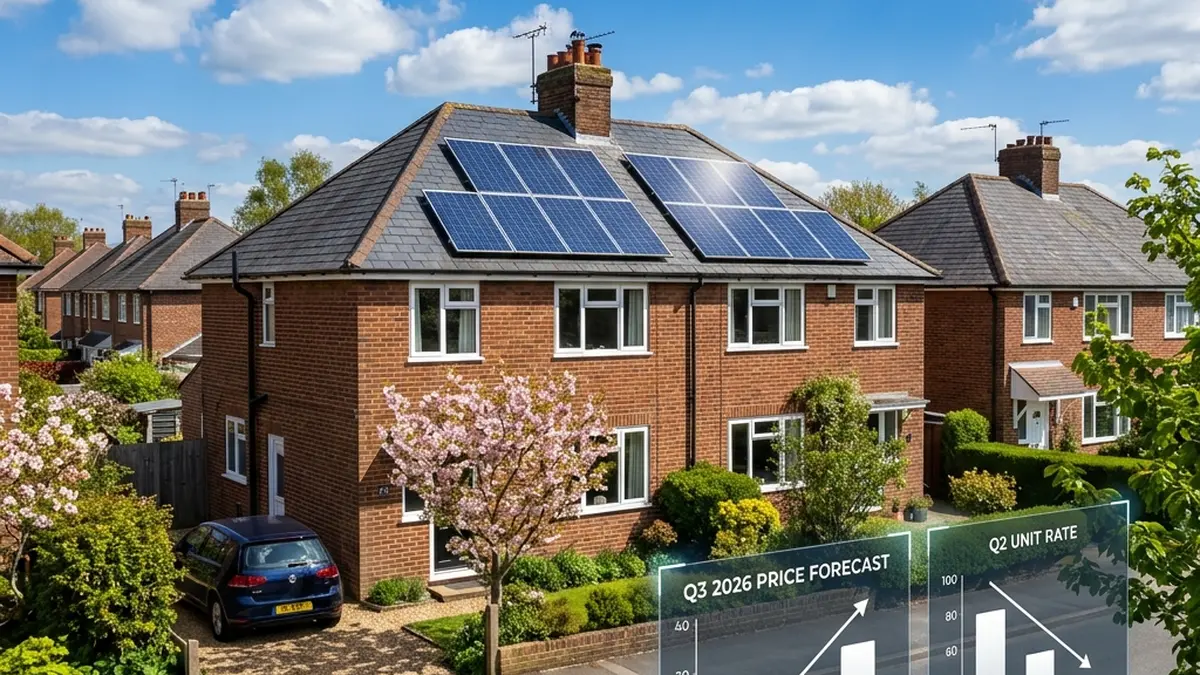
- 18% - Cornwall Insight's revised Q3 2026 price cap forecast sits at £1,929 per year, an 18% spike from April's £1,641. Middle East gas disruption has locked this rise in before the summer even starts.
- 95% - The proportion of the 70,000+ homeowners who installed a heat pump through the Boiler Upgrade Scheme who say they are highly satisfied with it. The "heat pumps don't work in British homes" myth has run out of road.
Right, let's start with the good news. Your energy bills fell again on 1 April 2026. The Ofgem price cap dropped 7% to £1,641 per year for a typical dual-fuel household on direct debit - £117 less than Q1, and a genuine saving you should feel on your next statement.
Now the bad news. That relief has a shelf life, and it is measured in weeks, not years.
Cornwall Insight - the same analysts whose Q1 forecast landed almost exactly on the Ofgem number - have revised their Q3 projection to £1,929.08 per year. That is an 18% spike from April's cap, equivalent to £288 of additional annual cost landing in a single quarterly adjustment. The driver is not domestic policy or energy company profiteering. It is escalating geopolitical conflict in the Middle East disrupting Liquified Natural Gas supply through the Strait of Hormuz, pushing up global wholesale gas costs. And because Ofgem's cap calculation uses a backward-looking observation window that is already halfway through its Q3 data collection period, this summer spike is mathematically locked in before a single consumer bill is issued.
At the same time, April 2026 was the best solar generation month ever recorded in the UK by a substantial margin. The grid hit 15.42 GW of instantaneous solar output on 23 April. Gas fell to 2% of supply for a few hours on Earth Day. Wholesale electricity briefly went negative. For homeowners who already have solar and batteries, that is the system working exactly as promised. For everyone still weighing up the decision, it is a rather pointed demonstration of what the alternative looks like. Here is the full breakdown of what changed in April and what it means for your home.
The Q2 2026 Price Cap: Down Now, Spiking by July
The finalised Ofgem cap for Q2 2026 (1 April to 30 June) confirms the following tariff structure for a typical dual-fuel household on direct debit:
| Component | Q1 2026 (Jan-Mar) | Q2 2026 (Apr-Jun) | Change |
|---|---|---|---|
| Electricity unit rate | 27.69p/kWh | 24.67p/kWh | -10.9% |
| Electricity standing charge | 54.75p/day | 57.21p/day | +4.5% |
| Gas unit rate | 5.93p/kWh | 5.74p/kWh | -3.2% |
| Gas standing charge | 35.09p/day | 29.09p/day | -17.1% |
| Typical annual dual-fuel bill | £1,758 | £1,641 | -£117 |
The unit rate reductions are welcome. The electricity standing charge increase is not. At 57.21p per day, the fixed cost of being connected to the electricity grid has risen by 4.5% despite falling wholesale prices. This is a structural trend, not a blip. Standing charges are being used as a loading mechanism for network maintenance costs, Supplier of Last Resort levies from previous company failures, and the ongoing cost of environmental schemes like Warm Home Discount and ECO4. These costs get socialised across all electricity users as a daily access fee regardless of how much or how little power they consume.
What this means in practice
Even if your solar panels cover 100% of your electricity consumption on a sunny summer day, you still pay 57.21p for the privilege of being connected to the grid. Over a year, that is £208.82 in fixed charges before a single unit is imported. This is the strongest single financial argument for eventually going fully off-grid with a large battery - but it also confirms why eliminating your gas connection by switching to a heat pump removes a second standing charge entirely.
On the Q3 2026 outlook, Cornwall Insight revised their forecast down slightly from £1,972 to £1,929.08 following a minor easing in near-term wholesale markets. But Dr. Craig Lowrey, Principal Consultant at Cornwall Insight, was clear: the escalating Middle East situation has already embedded itself into the Q3 calculation. The observation window for Q3 cap setting is passing its midpoint now, meaning the price spikes recorded in March and early April are mathematically locked into the July figure. Waiting for circumstances to change before acting on solar or storage will mean waiting until at least Q4 2026 at the earliest - and there is no guarantee prices moderate by then.
Smart Export Guarantee Rates: The Easy Export Era Is Over
The spring of 2026 has brought a significant correction to SEG export rates. The era of artificially inflated export payments used as customer-acquisition loss-leaders has ended. Here is the current market as of end-April 2026:
| Supplier | Tariff Name | Rate (p/kWh) | Key Eligibility |
|---|---|---|---|
| Good Energy | Solar Savings Exclusive | 25.0p | Must use Good Energy for hardware installation |
| E.ON Next | Next Export Premium v3 | 17.5p | Must use E.ON for hardware installation |
| British Gas | Export and Earn Plus | 15.1p | Must be a British Gas import customer |
| Octopus Energy | Outgoing Octopus | 12.0p | Must be an Octopus import customer |
Octopus Energy cut its flagship Outgoing Octopus flat rate from 15p to 12p effective March 2026, a 20% reduction. EDF cut its export rate from 24p to 18p. The trend is consistent: as wholesale costs stabilise below crisis levels, suppliers are repricing their export products accordingly.
Here is where it gets interesting for battery owners. The pivot away from flat export rates strengthens the financial case for time-of-use arbitrage significantly. Instead of exporting solar generation at midday for 12p, battery owners can store that power and discharge it during the evening peak when export rates under dynamic tariffs like Intelligent Octopus Flux can reach 32.17p per kWh. That is more than 2.5 times the flat-rate alternative, using the same solar energy. If you are on a flat export tariff and you have or are planning to add storage, this is worth calculating carefully.
The Octopus Cosy Octopus heat pump tariff is also worth flagging: the off-peak import rate runs at roughly 14.53p per kWh in designated cheap periods. For households running heat pumps and batteries, the combination of cheap import overnight and peak export in the evening is the core financial proposition - and April's record solar generation made that spread even more lucrative on sunny days.
How long until your solar panels pay for themselves?
Run your numbers with current Q2 2026 tariff rates, your roof size, and your location.
Calculate Your Solar PaybackGrants, Policy and the Regulatory Calendar
Three significant regulatory developments happened in April that will materially affect the renewable energy market in the months ahead.
Balcony solar is now legal - and supermarkets are preparing to sell it. On 15 April 2026, the BSI published the BS 7671:2018+A4:2026 amendment to the UK wiring regulations, clearing the final electrical safety hurdle for sub-800W plug-in solar arrays. These are the plug-and-play balcony solar units that you connect directly into a standard UK mains socket without an electrician - enormously popular in Germany, where hundreds of thousands are deployed annually, and until now technically illegal here. The remaining step is a product safety standard from BSI, expected in July 2026. Once published, retailers including Lidl and Iceland are expected to stock certified kits by late summer. This is specifically for the 70% of households - renters, flat-dwellers, and homeowners with unsuitable roofs - who cannot access traditional rooftop solar. If that includes you, watch July's product standard publication closely. For those who can install a permanent rooftop solar panel system, the 25-year financial return still comfortably outperforms any portable kit.
The Boiler Upgrade Scheme is under pressure. DESNZ figures confirm BUS applications fell 11% year-on-year in early 2026. This is not a demand problem - it is a supply problem. There are simply not enough MCS-certified heat pump installers to meet the volume of interested households. The £9,000 grant for air-source and ground-source heat pumps (increased from £7,500 from 21 July 2026; and £2,500 for air-to-air systems introduced in late 2025) remains fully funded and available. But the bottleneck means waiting lists are real and growing. If you are planning to apply for BUS funding this year, start the process now rather than in autumn when demand typically increases as homeowners prepare for winter.
The Future Homes Standard is now on the statute book. Secondary regulations were formally laid in Parliament on 24 March 2026, with a compliance deadline of March 2028. All new homes built in England from that date must include on-site renewable generation (effectively solar PV) and low-carbon heating. The Home Energy Model (HEM) replaces SAP calculations for compliance. This creates a guaranteed long-term demand signal for the renewable supply chain and will accelerate manufacturer scaling and installer training over the next 24 months.
On the Warm Homes Plan
The £15 billion Warm Homes Plan consumer loan scheme (Warm Homes Fund) remains in consultation with no confirmed launch date. The government is still working through how to structure the £3.3 billion in innovative finance products. If you are waiting for the loan scheme before acting, there is currently no indication of when it will open. The BUS grant and 0% VAT remain the two actionable financial mechanisms available right now.
April Was the UK's Best Solar Month on Record
The cumulative impact of two years of record solar deployment became unmistakable in April 2026. The UK's installed solar capacity now exceeds 22 GW across domestic rooftops and utility-scale farms. And on 23 April 2026, at 1:00 PM, the National Energy System Operator recorded an instantaneous peak of 15.42 GW - shattering the 12.2 GW record that had been set just three weeks earlier on 1 April.
Before that peak, on 22 April (Earth Day), solar accounted for 37% of Great Britain's total electricity consumption. Natural gas fell to 2% of supply - generating just 799 MW for the entire country. The grid had so much solar power flowing into it that wholesale electricity prices turned negative. Households on Agile Octopus and similar dynamic tariffs were effectively paid by the National Grid to use electricity during those hours.
What this means in practice
If you have a home battery and a dynamic import tariff, you should be automating your charging to capture these negative-price windows. On 22 April, homeowners on Agile Octopus were being paid to charge batteries, run dishwashers, and fill EV tanks during the solar peak. This is not hypothetical future technology. It happened last week.
On the heat pump side, a major consumer survey of over 70,000 BUS homeowners found 95% satisfaction with their heat pump's performance. This matters because persistent media myths around heat pumps failing in older British properties are still deterring homeowners from applying. The data is now robust enough to state plainly: when a heat pump is correctly specified and installed in a UK home, consumer regret is virtually non-existent. For more on what installation actually involves, the air-source heat pump guide walks through the process in detail, and the heat pump savings calculator gives you a number based on your actual home size and current heating costs.
New Products: Tesla VPP and the Duracell Dura5
Two product stories are worth tracking for anyone considering battery storage this year.
Tesla's UK energy tariff is coming, but slowly. Tesla Energy Ventures confirmed its Ofgem electricity supply licence in March 2026. As of end-April, a consumer launch date remains unannounced. The model - aggregating Powerwall batteries into a Virtual Power Plant managed by Tesla's Autobidder AI - is already running successfully in Texas. When it launches here, it will offer a highly dynamic tariff that coordinates your solar generation, EV charging, and home consumption automatically. The £750 rebate on new Powerwall 3 installations is active through June 2026. If you are planning to buy a Powerwall, that discount closes in 60 days. The battery storage guide covers what to look for when comparing systems ahead of installation.
The Duracell Dura5 has launched. Puredrive Energy has fully transitioned to the Duracell Energy brand, and the Dura5 is now available through certified installers. The headline specifications are a 1C charge rate (full cycle in one hour, twice as fast as many competitors), operation to -10°C without parasitic drain, and an integrated AI algorithm that checks weather forecasts to pre-charge from the grid overnight when a cloudy day is forecast. Duracell claims up to 90% bill savings for a fully integrated solar, battery, and dynamic tariff setup. Treat that headline number with appropriate sryness - it depends heavily on your consumption profile and tariff - but the hardware specifications are genuinely competitive, particularly the charge rate for arbitrage users.
Finance: Base Rate Holds, Mortgages Volatile
The Bank of England's Monetary Policy Committee voted 8-1 on 30 April 2026 to hold the base rate at 3.75%. Governor Andrew Bailey cited direct concern about Middle East conflict driving a domestic inflation spike later in the year. With CPI at 3.3% and rising energy prices baked into the Q3 cap, the MPC concluded that rate cuts would be premature.
This has direct implications for green mortgage borrowing and home improvement loans. For households financing solar, battery, and heat pump installations through unsecured loans or equity release remortgages, the cost of capital is not falling this quarter.
The mortgage market itself was volatile in April. HSBC, Halifax, and Coventry Building Society all defensively raised fixed rates as swap rates climbed. Against that backdrop, Nationwide cut its cheapest fixed rate to 4.50% on 24 April, and Barclays and Santander followed with selective reductions of up to 0.36 percentage points. The average two-year fix is running at roughly 5.71% to 5.82%. If you are planning to remortgage to fund home improvements, rate movements are currently tracking daily geopolitical news. Having a mortgage broker on call to lock in rate reductions when they briefly appear is worth doing.
Act Now: The 0% VAT Window and the Lead Time Problem
Two time-sensitive facts worth knowing before you plan any installation this year.
0% VAT on solar and batteries expires 31 March 2027. Every solar panel array, battery storage system (including retrofits to existing arrays), and heat pump installation currently carries 0% VAT. That is a 20% saving on the total project cost - typically £1,300 to £2,800 depending on system size. When this reverts to 5% VAT in April 2027, the same system will cost more. Given that the current installation market is already producing long lead times, an autumn 2026 decision is effectively the last window with any margin for scheduling comfort before the tax change. A 4kWp solar array with 10kWh battery currently costs £10,000 to £14,000 before VAT. The arithmetic on acting sooner is straightforward.
Installer lead times are growing. MCS data shows 5,624 certified contractors across the UK, responsible for 257,397 solar installations in 2025 - roughly one new installation every 90 seconds through the year. That sounds like a healthy market, and it is, but it is also a strained one. New installer businesses are gaining certification fast (1,443 new entrants recently), but the ratio of qualified tradespeople to prospective customers is stretched in high-demand areas, particularly the South East. Lead times of 8 to 14 weeks are not uncommon for quality installers right now. Booking in spring or early summer for an autumn installation before the VAT window closes is the sensible sequence.
Fraud alert: the fake maintenance check scam. Trading Standards in Warwickshire and Norfolk issued specific alerts in April about doorstep cold-callers targeting homes with visible solar arrays. The script is consistent: the caller claims to hold a maintenance or servicing contract for your system, often saying your original installer has gone into administration and they have "taken over the portfolio." Once inside, they invent safety faults to sell unnecessary upgrades, cleaning contracts, or fraudulent subscriptions. Never grant access to an unsolicited maintenance caller. Your genuine installer will contact you in writing and by appointment. If in doubt, call MCS on their verified number to check contractor credentials before anyone goes near your roof.
Frequently Asked Questions
Will my energy bills actually fall in May 2026? +
Your unit rates will be lower than Q1 2026 - electricity has dropped from 27.69p to 24.67p per kWh and gas from 5.93p to 5.74p. For a typical dual-fuel household this means a saving of around £117 annually compared to January to March. However, the electricity standing charge has actually risen to 57.21p per day, so low-energy users and solar households will see less benefit than the headline figure suggests. The relief is real but modest - and Cornwall Insight's £1,929 Q3 forecast means July bills will likely wipe out this spring's savings in a single quarter.
Is May 2026 a good time to install solar panels? +
From a financial timing perspective, it is one of the better windows in recent years. The 0% VAT rate on solar and battery installations runs until 31 March 2027 - acting before then avoids a 5% VAT increase on what is typically a £6,500 to £14,000 project. The Q3 2026 price cap is forecast to spike 18%, strengthening the payback case significantly. And April's record solar generation data confirms that the "too cloudy in the UK" argument has no remaining credibility. The main constraint is installer lead times, which are running at 8 to 14 weeks in many areas, so booking sooner rather than later is advisable if you want installation before winter.
What is the best SEG export rate available right now? +
As of end-April 2026, Good Energy's Solar Savings Exclusive tariff leads the flat-rate market at 25.0p per kWh - but only if Good Energy installed your hardware. For open-market customers, British Gas Export and Earn Plus offers 15.1p if you switch your import supply to them, and Octopus Outgoing Octopus pays 12.0p on a simple flat rate. The more significant number is the Intelligent Octopus Flux peak export rate of 32.17p - but this requires a battery and a smart meter, as it only applies during designated evening peak windows. If you have storage, the smart tariff ecosystem comfortably outperforms any flat export rate.
Can I still get a £9,000 heat pump grant in 2026? +
Yes. The Boiler Upgrade Scheme grant for air-source and ground-source heat pump installations is increasing to £9,000 (up from £7,500) from 21 July 2026, and remains fully funded and open for applications. The scheme also covers air-to-air systems at £2,500, a change introduced in late 2025. Your MCS-certified installer handles the application on your behalf - you do not apply directly to DESNZ. The main practical constraint right now is installer availability, with BUS applications down 11% year-on-year due to a shortage of certified fitters rather than a lack of consumer demand. Starting the process now rather than in autumn will give you the best chance of securing an installation slot before the winter heating season drives up demand again.
For context on the energy market conditions that set up this month's data, read our April 2026 UK energy update. For the latest figures including the confirmed Q3 2026 price cap, read the June 2026 UK energy update.
Ready to Take Action?
Does your home qualify for the BUS grant?
Check eligibility and compare quotes from local MCS-certified installers — free, no obligation.
Check My Eligibility →Get Your Free Quotes
Takes under 4 minutes · No obligation

Written by
Mark Anthony Haines
Mark has over a decade of experience in the UK renewable energy sector, specialising in solar PV, heat pump systems, and home battery storage. He founded HeatPumpsAndSolar.co.uk to help UK homeowners cut through the noise around green energy installations, government grant schemes, and smart tariffs.
View LinkedIn ProfileMore from Our Insights
Tools & Services Related to This Article
Take the next step with a free calculator or a local installer quote.