What's Changing for UK Solar Panels and Heat Pumps in September 2026?
September 2026: Ofgem confirms Q4 cap up 4% to £1,723/yr as gas hits 7.97p. BUS £9,000 grant for oil homes. Heat pumps now beat gas on the spark gap.
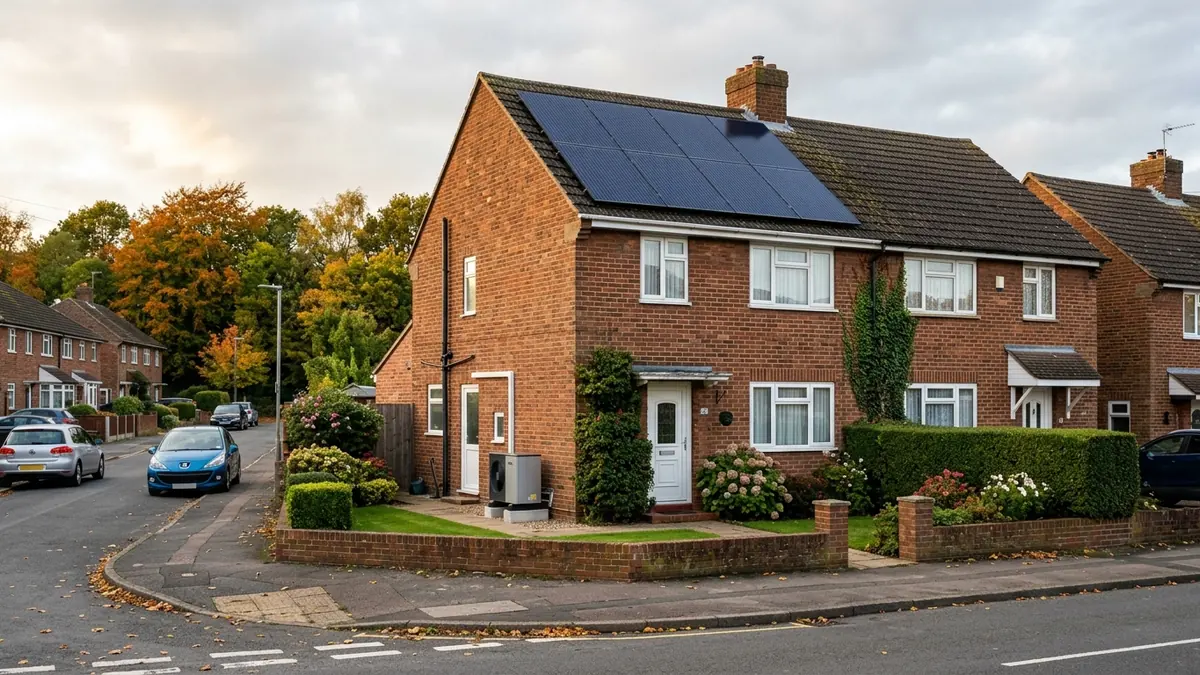
September 2026 at a Glance
- £1,723/year - Ofgem confirmed the Q4 2026 price cap on 26 August. A 4% rise driven almost entirely by gas, which climbs 8.7% to 7.97p/kWh. Electricity stays broadly flat at 26.32p. Winter heating bills are going up again.
- £9,000 - The upgraded Boiler Upgrade Scheme grant for off-gas-grid oil and LPG homes runs until 31 March 2027. Combined with stabilising heat pump costs, a rural oil-to-heat-pump swap can now net out at £1,000 to £5,000.
- 16 GW - The record peak solar generation hit on the GB grid this summer, supplying up to 30% of national demand at midday and making Q2 and early Q3 2026 the cleanest power quarter in UK history.
Right, let's start with the number that matters most this month. On 26 August 2026, Ofgem confirmed the winter price cap, and it is going up, not down. The Q4 cap (1 October to 31 December 2026) lands at £1,723 a year for a typical dual-fuel direct-debit household under the modern consumption benchmark, or £1,935 under the legacy benchmark. That is a 4% rise on Q3, and almost all of it is gas.
If you have been waiting for energy prices to normalise before deciding on solar or a heat pump, this confirmation removes that option. Analysts at Cornwall Insight are already flagging further rises into Q1 2027 as European winter demand pulls on tight gas storage. There is no forecast basis left for waiting out high prices. The question now is how to insulate yourself from them.
Here's where it gets interesting. The gas unit rate is climbing 8.7% to 7.97p/kWh, its highest level since early 2023 and 26.7% higher than October 2025. But the electricity unit rate barely moves, edging up 0.8% to 26.32p/kWh, and the electricity daily standing charge actually falls 4.1% to 54.83p. That asymmetry is the whole story for home energy this autumn: gas heating is getting markedly more expensive, while electrified heating paired with smart tariffs is holding flat.
Correction (October 2026): An earlier version of this update said government-backed Warm Homes consumer loans were opening to the public in September. That was incorrect. Government funding has been allocated, but a public loan product and its final terms were not confirmed. Do not base an installation decision on an assumed loan.
The Q4 Price Cap: Confirmed on 26 August
Ofgem's confirmation on 26 August 2026 settles the rates that will govern every standard variable tariff in Great Britain from 1 October to 31 December 2026. The assessment window ran from 19 May to 18 August, a period dominated by Middle Eastern geopolitical friction, disrupted LNG transit, and slower European gas storage refills. Wholesale gas reached 157.54 pence per therm over the summer, and because gas-fired power stations routinely set the marginal price of electricity in the GB market, both fuels felt the pressure. Day-ahead wholesale electricity averaged around £143/MWh in late August, with Winter 2026 forward contracts trading near £138/MWh.
| Component | Q3 2026 (Jul-Sep) | Q4 2026 (Oct-Dec) | Change |
|---|---|---|---|
| Electricity unit rate | 26.11p/kWh | 26.32p/kWh | +0.8% |
| Electricity standing charge | 57.19p/day | 54.83p/day | -4.1% |
| Gas unit rate | 7.33p/kWh | 7.97p/kWh | +8.7% |
| Gas standing charge | 29.04p/day | 29.68p/day | +2.2% |
| Typical annual bill (new TDCV) | £1,663 | £1,723 | +£60 |
| Typical annual bill (legacy TDCV) | £1,862 | £1,935 | +£73 |
A reminder on the two bill figures, because the comparison sites will quote both and it causes confusion. Ofgem changed the Typical Domestic Consumption Values in July 2026, lowering assumed usage to 2,500 kWh of electricity and 9,500 kWh of gas. The headline £1,723 uses that new, lower benchmark. The £1,935 figure uses the older 2,700 kWh and 11,500 kWh benchmark. The unit rates are identical either way. Your actual bill depends entirely on how much you use, and any household consuming above the new gas benchmark, which is most larger or less-insulated homes, will feel more than the headline £60 increase this winter.
What this means in practice
Gas heating is getting more expensive while electricity is broadly flat. That widens the economic case for a heat pump, which moves you off gas and onto electricity, and for solar plus battery storage, which lets you generate and time-shift your own electricity instead of buying it at 26.32p.
Export Tariffs and Smart Import Rates: August 2026
The export market stayed sharply stratified through August. The headline change to watch is that Octopus's Intelligent Octopus Flux, the highest-paying flat-style export tariff at up to 32.17p/kWh during the 4pm to 7pm peak, remains temporarily closed to new applicants because of grid volatility. New solar-and-battery customers are being directed onto standard manual Octopus Flux (5p to 29.32p/kWh) or fixed export agreements instead. If you were building a payback model around Intelligent Flux, factor in that you may not get onto it immediately.
| Supplier | Tariff | Rate | Type | Key Condition |
|---|---|---|---|---|
| Octopus Energy | Intelligent Octopus Flux | Up to 32.17p/kWh (peak) | Time-of-use | Octopus import + compatible battery; closed to new applicants |
| Good Energy | Solar Savings Exclusive | 25p/kWh | Flat (12m fixed) | System installed by Good Energy or approved partner + import supply |
| So Energy | So Bright | 20p/kWh | Flat | So Energy install channel + import supply |
| OVO Energy | SEG Install Exclusive | 20p/kWh | Flat | OVO install channel + import supply |
| EDF | Export Exclusive V3 | 18p/kWh | Flat | EDF or Contact Solar install + import supply |
| E.ON Next | Next Export Premium v3 | 17.5p/kWh | Flat | E.ON install + import supply |
| Ecotricity | Smart Export Tariff | 16p/kWh | Flat | Open market, any import supplier accepted |
| Octopus Energy | Outgoing Octopus | 12p/kWh | Flat | Octopus import supply |
The practical split is this. If you want a premium rate above 20p, you generally have to bundle: buy your kit through the supplier's installation arm and take your import from them too. If you want to keep your import supplier free, so you can chase the cheapest overnight charging rate for a home battery, the open-market ceiling is now Ecotricity's 16p/kWh flat rate. Standard SEG floor tariffs from Octopus (4.1p), EDF (3p), and British Gas (3p) are not worth staying on if you are exporting any meaningful volume. Outgoing Octopus has also been trimmed to 12p from its historical 15p peak, so check what you are actually on.
On the import side, the spread between passive and proactive consumers has never been wider. Intelligent Octopus Go charges 8p/kWh across a six-hour smart-controlled overnight window, and standard Octopus Go offers 8.5p/kWh over a five-hour window. Against a 26.32p daytime rate, that is an 18p-plus spread per kWh. For heat pump owners, Octopus Cosy offers three off-peak windows at 13p/kWh (4am to 7am, 1pm to 4pm, and 10pm to midnight), a 51% discount on the standard day rate, designed so you can pre-heat your home and coast through the expensive 4pm to 7pm peak. Agile Octopus tracked around a £1,520 annual equivalent through August, but its half-hourly rates regularly spiked to 50p or 80p during the evening peak, a clear reminder that dynamic tariffs only work well if you have a battery to shed load with.
See how fast solar pays back at the confirmed Q4 rates
Enter your roof size and current bill. The calculator runs on the live 26.32p/kWh electricity rate.
Run the Payback CalculatorGrants and Policy: The £9,000 Window Stays Open
Boiler Upgrade Scheme: £9,000 for Oil and LPG Homes
The Boiler Upgrade Scheme uplift that came into force on 21 July 2026 remains the single biggest grant lever for rural homeowners, and it runs until 31 March 2027. Any property currently heated by oil or LPG can claim £9,000 toward an air source or ground source heat pump. Mains-gas homes stay on the standard £7,500 rate, with air-to-air heat pumps covered at £2,500 and biomass at £5,000. The 2025/26 budget allocation stands at £295 million, with funding committed through to 2029/30 under the Warm Homes Plan framework.
| Current Heating System | BUS Grant | Typical Gross Install Cost | Typical Net Cost |
|---|---|---|---|
| Heating oil or LPG | £9,000 | £10,000 - £14,000 | £1,000 - £5,000 |
| Mains gas | £7,500 | £8,000 - £14,000 | £500 - £6,500 |
| Any system (air-to-air heat pump) | £2,500 | £3,000 - £6,000 | £500 - £3,500 |
Two administrative details worth knowing. First, the old rule requiring you to clear all cavity wall or loft insulation recommendations on your Energy Performance Certificate before claiming the grant has been abolished. You only need a valid EPC issued within the last 10 years, in any band from A to G. Second, the grant is an upfront voucher applied directly to the installer's quote, so you pay the net balance, not the full amount and then claim it back. Full rules are on our Boiler Upgrade Scheme page. Cumulative scheme data now shows over 130,000 applications and more than 84,800 redeemed grants, with air source heat pumps making up around 97% of volume.
Warm Homes Consumer Loans: Funding Is Not an Open Product
The government has allocated £1.7 billion towards low- and zero-interest consumer loans through the Warm Homes Fund. It has not confirmed the previously claimed September launch, participating lenders, loan limits or repayment terms. An eligible oil-heated home can apply for the £9,000 BUS grant, but should compare finance using actual lender offers rather than assume it can combine the grant with an unlaunched product.
Balcony Solar: Moving, but Not Yet Live
DESNZ and Ofgem continued progressing the amendments to the BS 7671 wiring regulations and the G98 grid code that will legalise sub-800W plug-in balcony solar arrays. The proposed framework lets systems of 800W or less connect via standard household sockets, provided they use integrated microinverters with loss-of-mains protection that shuts output off within milliseconds if the grid supply drops. The standard G98 notification process is being replaced by an automated online registry, removing DNO prior-approval delays for sub-800W systems. The formal consultation response and statutory instrument are targeted for implementation ahead of the 2027 spring season. An 800W balcony array typically yields 400 to 650 kWh a year, enough to cover baseline loads like refrigeration and routers. Until the standard is finalised, no properly certified DIY plug-in kit is on sale at scale, so treat any "legal now" balcony solar advert with caution.
Future Homes Standard: On Track for March 2028
Secondary legislation reaffirmed in the Q3 2026 policy updates confirms the Future Homes Standard takes legal effect on 24 March 2028. From that date, new-build homes in England must achieve a 75% to 80% carbon reduction against 2013 Building Regulations, which in practice eliminates gas boilers and mandates heat pumps or district heating, with rooftop solar matched to the building's footprint. Major housebuilders are already specifying heat pump and solar combinations in planning applications to avoid last-minute compliance issues, and DNOs are adjusting local capacity models to handle concurrent EV charging, heat pump load, and high-density solar export in new developments.
Real-World Performance: The Heat Pump Has Crossed the Line
Here is the performance story that deserves more attention than it gets. The electricity-to-gas price ratio under the Q4 cap is 3.30 (26.32p divided by 7.97p). A modern air source heat pump with a Seasonal COP of 3.5 delivers 3.5 units of heat for every unit of electricity it consumes. At that efficiency, the cost per kWh of useful heat from a heat pump is now below the cost from a 90% efficient gas boiler.
The spark gap calculation, simplified
Gas boiler at 90% efficiency: 7.97p divided by 0.9 = 8.86p per kWh of useful heat. Heat pump at SCOP 3.5: 26.32p divided by 3.5 = 7.52p per kWh of useful heat. The heat pump is cheaper on standard rates. Switch to Octopus Cosy at 13p/kWh off-peak and it drops to 3.71p, less than half the gas boiler cost.
Field data from the 2025/26 heating season shows modern UK air source heat pumps achieving a real-world average SCOP between 3.2 and 3.5, with correctly sized systems on underfloor heating or properly upgraded radiators consistently above 3.5. Modern inverter heat pumps maintain effective COPs above 2.2 even at -5°C, so reliable heat delivery in cold weather is not the open question it used to be. The caveat that always applies: performance depends on correct sizing and emitter design. A poorly specified heat pump running at SCOP 2.5 will still cost more to run than gas even at these prices. Get the design right and a heat pump is the cheaper heating option, full stop. Use our heat pump savings calculator to model your own running costs at Q4 rates.
On solar, National Grid ESO and Sheffield Solar data confirms GB solar hit a record peak of 16 GW this summer, supplying up to 30% of national electricity demand at midday and helping make Q2 and early Q3 2026 the lowest carbon-intensity quarters ever recorded on the GB grid. At the household level, a standard 4kWp array generated between 380 and 480 kWh in August, and homes with paired battery storage achieved self-consumption rates of 80% to 92%, effectively decoupling from daytime grid use. Which? and Energy Saving Trust surveys put owner satisfaction above 85%. One operational footnote: high solar penetration has caused localised voltage spikes on summer afternoons, occasionally triggering automated inverter curtailment in dense solar areas, which is exactly why a battery to absorb midday generation beats relying on unmanaged export.
Market Data and Costs: Where Prices Stand in August 2026
MCS confirmed a record 369,000 certified renewable installations in 2025, a 34% jump on the 260,000 installed in 2024, taking cumulative certified small-scale installations past 2.4 million. Solar PV dominates the cumulative total, while heat pumps and batteries are the fastest-growing sub-sectors. Alongside the volume growth, MCS is rolling out its Redeveloped Installer Scheme through 2026, replacing the old paperwork-heavy quality management system with a risk-based assessment focused on actual installation quality. Every certified business must now assign a Licensee, a Main Contact, and one or more Technical Supervisors who carry individual sign-off accountability for each installation registered on the MCS Installations Database. Full transition is required ahead of March 2027.
On costs, the market has stabilised. Current fully installed benchmarks (0% VAT included) from summer 2026 data:
| System | Installed Cost (0% VAT) | Net of Grant |
|---|---|---|
| 4kWp solar array | £7,000 - £8,500 | £7,000 - £8,500 |
| 4kWp solar + 10kWh battery | £11,115 | £11,115 |
| 8kW ASHP (gas home) | £8,000 - £14,000 | £500 - £6,500 |
| 8kW ASHP (oil/LPG home) | £10,000 - £14,000 | £1,000 - £5,000 |
| Ground source heat pump | £15,000 - £35,000 | £7,500 - £27,500 |
The 0% VAT rating on domestic clean energy equipment and installation labour remains in force, saving around 20% versus the standard rate, and it runs until March 2027. If you have been weighing up solar panels or an air source heat pump, you have roughly six months left to lock in the VAT saving.
Technology: Tesla's VPP Nears Launch as Half-Hourly Settlement Arrives
Tesla Energy Ventures has been operating under its Ofgem retail electricity supply licence, granted on 11 March 2026, and is progressing through market integration toward a public consumer rollout of Tesla Electric UK in late Q3 or early Q4 2026. The model mirrors its Texas Virtual Power Plant: Powerwall 3 systems (13.5 kWh usable storage, 11.04 kW continuous AC output, an integrated solar inverter handling up to 20 kW of PV across two MPPT strings, and a 20-millisecond automatic transfer switch for outage backup) aggregated via Tesla's Autobidder AI platform, which trades stored energy across wholesale day-ahead and intra-day markets. For Powerwall owners, the pitch is dynamic export sellback rates plus fixed monthly VPP participation credits, with the hardware, software, and billing all inside one ecosystem. By controlling the full stack, Tesla sidesteps the third-party integration friction that limits incumbent smart-tariff providers.
Underpinning all of this, the industry is entering the final phase of Market-wide Half-Hourly Settlement (MHHS), with core system activation targeted for October 2026 under Ofgem and Elexon. MHHS moves every smart-metered home onto automated 30-minute settlement, which is the data architecture that makes dynamic tariffs, VPP aggregation, and accurate export payments possible. With smart meter penetration now above 60% of domestic properties, half-hourly export settlement means a battery discharging into the grid during a 30-minute price spike gets credited at the matching wholesale peak, not an estimated profile. Consumers retain opt-in control over how their granular data is shared with third-party aggregators.
On hardware, AI-enabled home storage is expanding through 2026, led by systems like the Duracell home storage range, which uses built-in software to analyse your consumption, solar forecast, and tariff rates to optimise charge and discharge cycles automatically. Modern units increasingly ship with hybrid solar inverters, bidirectional grid support, and modular stacking up to 50 kWh or more for larger properties, and can earn automated credits in demand-side response events that relieve local substation congestion during peak hours.
Finance: Rates Hold, Green Loans Open Up
The Bank of England's Monetary Policy Committee held the base rate at its late-July meeting, and with no August MPC sitting the rate is locked until the 17 September 2026 decision. The MPC has continued to cite Middle Eastern energy market volatility and sticky services inflation as the justification for a cautious, measured approach to any further easing. That steadiness has fed through into mortgage and credit markets, giving homeowners a predictable environment for funding retrofits.
Fixed-rate residential mortgages have settled into a 4.0% to 4.5% range depending on loan-to-value, which steadies remortgaging costs for anyone looking to release equity to fund a solar or heat pump install. For unsecured home improvement loans of £7,500 to £14,999, commercial APRs are running at 6.2% to 7.8% as of August 2026. Those rates are above historic pre-2022 lows, but when the annual utility savings from a paired solar, battery, and heat pump system are amortised over a 7 to 10 year term, the monthly bill reduction frequently exceeds the loan repayment, making the upgrade cashflow-positive from day one.
The practical financing routes, in rough order of value:
- Warm Homes Fund consumer loans (not yet available) - The government has allocated funding, but has not confirmed a live public offer, loan limits, participating lenders or terms. Do not include this prospective scheme in a current financing comparison.
- Green mortgage cashback - HSBC offers up to £1,000 cashback for properties with an EPC rating of A or B, with NatWest, Barclays, and Halifax offering preferential rate discounts or cashback on qualifying high-efficiency homes. Not a loan, but a meaningful offset against installation cost.
- Supplier green finance - E.ON Next and Octopus both offer interest-free or low-rate finance through their installer networks. Terms vary, so compare the total cost of credit carefully.
Lenders are also increasingly folding clean technology into mortgage affordability calculations. A home with solar panels and a heat pump carries lower projected energy overheads, which improves the disposable income rating and can lift borrowing capacity. Upgrading your EPC to A or B therefore does double duty: it unlocks green mortgage cashback and improves what you can borrow.
Act Now: Timing, Lead Times, and a Fraud Warning
Three things to act on if you are seriously considering an installation this autumn.
First, on timing. The 0% VAT rate on solar panels, batteries, and heat pumps expires in March 2027. At current installed costs, reverting to 5% VAT adds roughly £300 to £700 to a solar install and up to £700 to a heat pump. Surveying now, getting quotes in September, and booking an October or November installation is achievable with current lead times and lands safely ahead of the deadline. With over 2.4 million certified installations now behind the sector and installer capacity at record levels, survey lead times have stabilised at four to eight weeks, with installation following six to twelve weeks after. That is fast enough to have a system running before the worst of the winter heating season.
Second, on grants and finance. If you are on oil or LPG and considering a heat pump, check whether you qualify for the £9,000 BUS uplift before 31 March 2027. The Warm Homes Fund consumer loan product was not confirmed as open in September. Compare the grant-adjusted quote with financing actually offered by regulated lenders, including the full cost of borrowing.
Third, a fraud warning that is directly relevant as the £9,000 grant story circulates. Trading Standards and consumer groups including Which? and Citizens Advice issued fresh warnings in August about cold-callers and social media ads offering "free government batteries" or "free solar upgrades" that in reality lock households into high-interest, unregulated long-term credit. Rogue agents have also been caught claiming traditional meters will attract penalties or that suppliers require mandatory battery retrofits. None of that is true. Legitimate installers do not cold-call or doorstep-sell under pressure, and you have a statutory 14-day cooling-off right for any contract signed at home or off-premises. Always get at least three quotes from MCS-certified contractors who are members of RECC or HIES, and verify active accreditation on the "Find an Installer" tool at mcscertified.com before signing.
Hold back final payment until you see your MCS certificate
Under the redeveloped MCS rules, installers must register your system and generate your certificate within 10 working days of commissioning. The database now blocks late registrations. Without that certificate you cannot claim SEG export income or a BUS grant, so do not pay the final invoice until your installer hands over a valid, database-verified MCS certificate.
Four Questions We Are Getting Asked Right Now
The Q4 cap is rising in October. Should I fix my energy tariff or install solar? +
Both, if your budget allows, but they solve different problems. Fixing your tariff protects you from the 4% October rise and locks in a known monthly cost, though analysts warn autumn fixes are being priced defensively because the wholesale picture is already baked in. Solar with battery storage attacks the structural problem: it lets you generate your own power at 26.32p and time-shift it, rather than just negotiating a slightly better price for buying it. If you can only do one, a competitive fix is the short-term hedge; solar plus storage is the multi-year fix. Run the numbers for your roof with our payback calculator before deciding.
Is the Warm Homes Loan Scheme live now, and can I use it with the £9,000 grant? +
No public Warm Homes Fund consumer loan offer was confirmed for September 2026. The government has allocated funding, but lender participation, eligibility, limits and terms have not been confirmed. An eligible off-gas-grid oil or LPG home can still pursue the £9,000 Boiler Upgrade Scheme grant. Get a written grant-adjusted quote and compare real lender offers; do not assume a future loan will cover the balance.
With gas at 7.97p and electricity flat, is a heat pump finally cheaper to run than a gas boiler? +
Yes, on standard rates, provided it is well designed. At Q4 rates a heat pump running at SCOP 3.5 delivers heat at about 7.52p per kWh, against roughly 8.86p for a 90% efficient gas boiler. Switch to a heat-pump tariff like Octopus Cosy at 13p/kWh off-peak and it falls to about 3.71p, less than half the gas cost. The catch is SCOP: a poorly sized system running at SCOP 2.5 still costs more than gas. Correct sizing, good emitter design, and proper commissioning are what decide whether you actually see the saving.
Why is the electricity standing charge going down but the gas one going up? +
The Q4 cap trims the electricity standing charge by 4.1% to 54.83p a day while nudging the gas standing charge up 2.2% to 29.68p. Standing charges recover the fixed costs of getting energy to your home, and Ofgem rebalances them each quarter based on network and policy costs allocated to each fuel. The net effect for a typical dual-fuel home is still a £60-a-year rise because the gas unit rate jump of 8.7% outweighs the small electricity standing-charge cut. Households that use a lot of gas, larger or less-insulated homes, will feel the increase most sharply.
For context on where the Q3 rates and the July grant uplift came from, read our August 2026 UK energy update. For the live Q4 rates, export conditions and the correction to the loan claim, see our October 2026 UK energy update.
Ready to Take Action?
Does your home qualify for the BUS grant?
Check eligibility and compare quotes from local MCS-certified installers — free, no obligation.
Check My Eligibility →Get Your Free Quotes
Takes under 4 minutes · No obligation

Written by
Mark Anthony Haines
Mark has over a decade of experience in the UK renewable energy sector, specialising in solar PV, heat pump systems, and home battery storage. He founded HeatPumpsAndSolar.co.uk to help UK homeowners cut through the noise around green energy installations, government grant schemes, and smart tariffs.
View LinkedIn ProfileMore from Our Insights
Homeowner questions on this topic
Compare the guide with common questions and experiences from UK homeowners.
Tools & Services Related to This Article
Take the next step with a free calculator or a local installer quote.