What's Changing for UK Solar Panels and Heat Pumps in June 2026?
June 2026: The Q3 price cap is confirmed at £1,862 — a 13% spike from 1 July. UK solar smashed its all-time daily record with 89.74 GWh on 17 May. Full breakdown of the new cap rates, Duracell Dura5 launch, Tesla VPP timeline, and a £44 million ECO4 fraud crackdown.
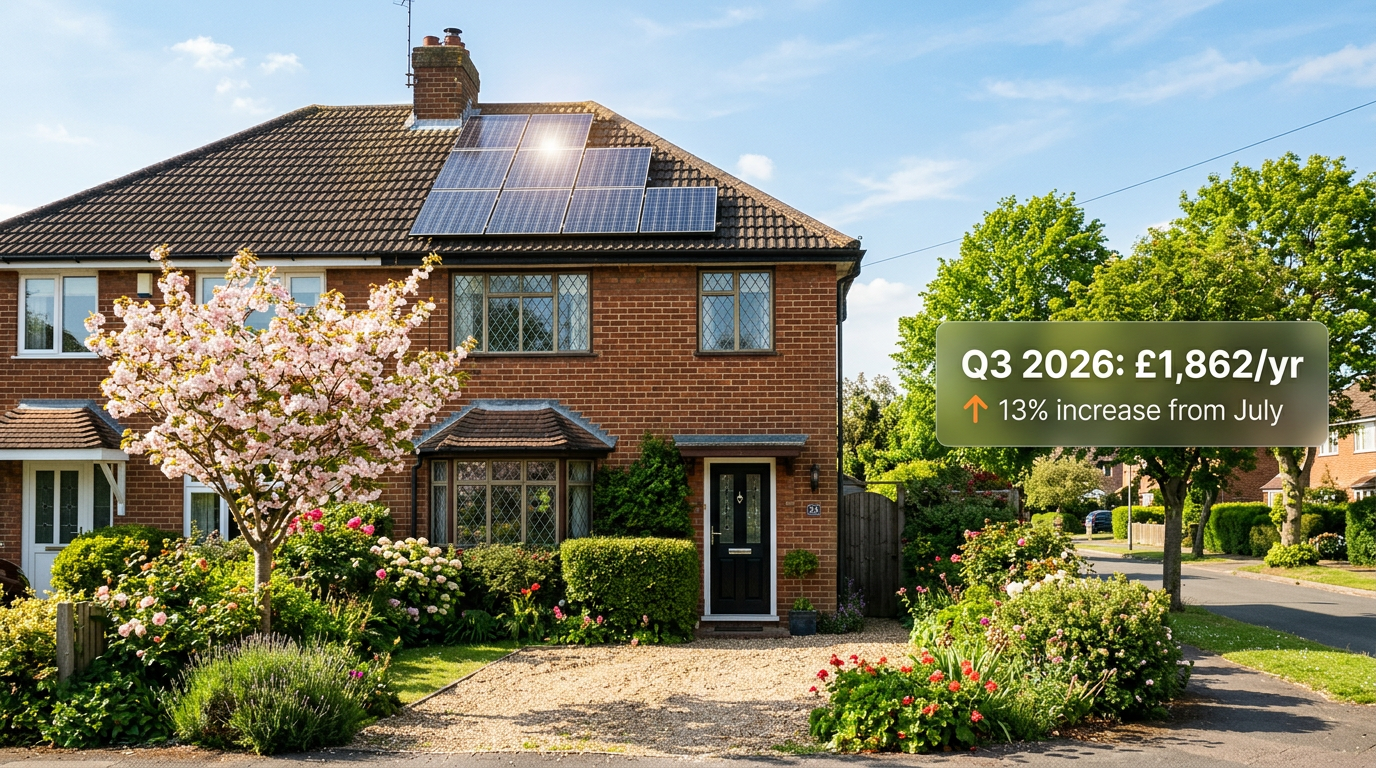
June 2026 at a Glance
- £1,862 - The confirmed Q3 2026 Ofgem price cap, landing on 1 July 2026. That is a 13% spike in a single quarter, driven by wholesale gas surging 28% due to Middle East supply disruption. Your bills are going up regardless of anything the government says.
- 89.74 GWh - UK solar shattered its all-time daily generation record on 17 May 2026. On the same day, the grid's installed 21.5 GW of solar capacity peaked at 10.67 GW. Smart tariff users were paid to consume electricity during the afternoon.
- £7,000 to £9,000 - The current benchmark cost for a fully installed 4kWp solar array paired with a 5kWh battery, at 0% VAT. That rate expires 31 March 2027. The maths on acting before then is simple.
Right. Let's start with the number that matters most this month.
On 27 May 2026, Ofgem confirmed the Q3 2026 price cap at £1,862 per year for a typical dual-fuel household on direct debit. That is a 13% increase from Q2's £1,641 - a jump of £221 annually, landing in a single adjustment on 1 July. Electricity rises 5%. Gas rises 24%. The driver is the same story we have been tracking for months: wholesale gas markets, Middle East supply disruption through the Strait of Hormuz, and the reality that the UK's gas dependence means international shocks become your energy bill inside a quarter.
The same month, UK solar set an all-time generation record. 89.74 GWh in a single day on 17 May - more than the entire daily electricity consumption of 25 million homes. The grid's peak output at 14:00 that day was 10.67 GW. Days later, a 35.1°C heatwave at Kew Gardens broke May's temperature record, a record that had stood since 1944. Extreme early-season heat on the one hand, confirmed bill increases on the other. Both tell the same story about the direction this market is heading.
Here is the full breakdown of what changed in May and what it means for your home.
The Q3 2026 Price Cap: What You Will Actually Pay From 1 July
The confirmed Q3 cap rates are sharper than many households were expecting. The asymmetry between electricity and gas is the most important detail in the announcement.
| Component | Q2 2026 (Apr-Jun) | Q3 2026 (Jul-Sep) | Change |
|---|---|---|---|
| Electricity unit rate | 24.67p/kWh | 26.11p/kWh | +5.8% |
| Electricity standing charge | 57.21p/day | 57.19p/day | flat |
| Gas unit rate | 5.74p/kWh | 7.33p/kWh | +27.7% |
| Gas standing charge | 29.09p/day | 29.04p/day | flat |
| Typical annual dual-fuel bill | £1,641 | £1,862 | +£221 (+13%) |
The electricity standing charge is effectively flat - this quarter it actually fell by a fraction of a penny. What exploded is gas. A 27.7% rise in the gas unit rate in one quarter is significant. For a three-bedroom semi on mains gas heating, that alone adds roughly £180 to an annual bill before you count any electricity movement. And Cornwall Insight are already forecasting Q4 (October to December 2026) at £1,899 - another 2% rise on top of Q3, based on winter baseload contracts that have expanded to £101.70 per MWh.
What this means in practice
If you are on a gas boiler, your heating fuel just became 27.7% more expensive - and that is before winter consumption kicks in. The financial case for switching to an air-source heat pump, which runs on electricity rather than gas, has strengthened materially in this single announcement. At a well-installed SCOP of 3.5, a heat pump delivers heat at roughly 7.0p/kWh effective cost - which now comfortably undercuts a gas boiler running at 7.33p/kWh on Q3 rates.
One structural point worth understanding: the new cap also incorporates Ofgem's revised Typical Domestic Consumption Values. UK households now officially consume 7% less electricity and 17% less gas than the previous benchmark figures assumed. This reflects real behavioural shifts from recent years of high prices. It also means the headline £1,862 annual figure applies to a somewhat lower consumption assumption than before - households with above-average usage, particularly those still heating with gas, will be paying proportionally more.
Export Tariffs: The Battery Premium Is Widening
The Smart Export Guarantee market as of late May 2026 continues to fracture along the same fault line it has been developing all year - battery owners accessing time-of-use rates versus everyone else on declining flat tariffs. Here is the current picture:
| Supplier | Tariff Name | Rate Type | Peak Export Rate (p/kWh) |
|---|---|---|---|
| Octopus Energy | Intelligent Octopus Flux | AI-managed TOU | Up to 32.17p |
| Good Energy | Solar Savings Exclusive | Flat rate | 25.0p |
| EDF Energy | Export Exclusive 12m V2 | Flat rate | 24.0p |
| E.ON Next | Next Export Premium v3 | Flat rate | 17.5p |
| British Gas | Export and Earn Plus | Variable | 15.1p |
| Octopus Energy | Outgoing Octopus Fixed | Flat rate | 12.0p |
| Ecotricity | SEG Tariff | Variable | 8.9p |
The Outgoing Octopus rate has been at 12p since the March cut and has not moved. The flat-rate market has stabilised, but the gap between 12p and the Intelligent Octopus Flux peak of 32.17p is now enormous - nearly 170% more income from the same solar generation for a battery-equipped household choosing the right tariff and automating dispatch correctly.
Here is the thing about flat-rate export tariffs at this level: you are essentially selling midday solar surplus at a time when the grid is flooded with cheap renewable generation. That is exactly when wholesale prices are lowest. Time-of-use tariffs work differently - your battery stores the midday generation and discharges it into the grid during the evening peak when wholesale prices are highest. The hardware cost of adding a quality 5kWh battery sits at roughly £2,000 to £2,500 incremental. At a premium of 20p per kWh on discharge, that pays back quickly in a well-used system.
For smart import tariffs, Octopus Cosy is worth flagging for heat pump owners. Off-peak windows run at approximately 13p per kWh - at Q3 electricity rates of 26.11p, that is a 50% discount for timing your heat pump and dishwasher correctly. The Intelligent Octopus Go overnight rate (roughly 7-8p) is designed primarily for EV charging but works equally well for battery top-up on cheap night power.
How quickly will solar panels pay back at Q3 2026 rates?
Run your actual numbers with current unit rates, your roof size, and your postcode.
Calculate Your Solar PaybackGrants and Policy: What Changed in May
Four policy updates are worth your attention this month, covering the BUS, balcony solar, the Warm Homes Fund, and new builds.
Boiler Upgrade Scheme: record budget, but growth is slowing. DESNZ has confirmed the 2025/2026 BUS budget at a record £295 million. The £9,000 grant for air-source and ground-source heat pumps (increased from £7,500 from 21 July 2026) remains open, as does the £2,500 grant for air-to-air systems. However, Nesta's analysis of four years of BUS data shows a significant slowdown in the growth rate. The scheme subsidised 30,600 ASHP installations in the most recent cycle - a 24% increase, but sharply down from the 85% growth of the previous year. The hard barrier is not funding. It is a shortage of MCS-certified installers capable of completing complex low-temperature hydraulic designs to the required standard. The grant money is there. The bottleneck is supply of qualified tradespeople.
Balcony solar: BSI working group is meeting, but DIY installation is still not legal. Following the Energy Secretary's March 2026 announcement, the British Standards Institution formally established a technical working group in Q2 2026 to draft UK standards for sub-800W plug-in solar systems. Representatives from the IET, BEAMA, and Distribution Network Operators are involved. The mandate is to create a rapid-registration pathway equivalent to Germany's Balkonkraftwerk regulations. The reality check: updating national building codes and hardware testing regimens takes time. Industry analysis suggests full DIY plug-and-play legality is unlikely before late 2027. For now, any legal balcony solar installation still requires a hardwired consumer unit connection by a certified electrician. Worth watching - but not actionable as a DIY purchase yet. For homeowners who can accommodate a permanent rooftop solar installation, the 25-year financial return comprehensively outperforms any portable kit at current prices.
The Warm Homes Fund is real - but it opens in April 2027. DESNZ published critical structural detail in May on the £15 billion Warm Homes Plan. The consumer loan element - £1.7 billion in zero- and low-interest loans for the "able to pay" middle market - now has a confirmed launch target of April 2027. A Warm Homes Agency is being established to act as the single access point, coordinate local authority delivery, and enforce quality standards. The £300 million in government capital backing is designed to absorb the cost differential and suppress the interest rate passed to the consumer. For households currently weighing up whether to wait for this before acting: the BUS grant and 0% VAT are the two financial mechanisms available right now. April 2027 is ten months away.
On the Future Homes Standard
MHCLG confirmed implementation of the Future Homes Standard in Q1 2026, with a compliance deadline of March 2028 for new builds. All new homes built in England from that date must include low-carbon heating (overwhelmingly heat pumps in practice) and on-site renewable generation covering a significant proportion of ground floor area. In Q1 2026, over a third of all new certified solar PV installations were on new-build properties. The long-term demand signal for the heat pump installation market is unambiguous.
May Was the UK's Best Solar Month on Record - Again
The data from May 2026 is worth pausing on, because it demonstrates something that was not obvious even two years ago: UK solar is now a genuine structural feature of the national grid, not a marginal weather-dependent supplement.
On 17 May 2026, Great Britain generated 89.74 GWh of solar electricity across a single 24-hour period. That eclipsed the previous record of 87.6 GWh from April 2025 by 2.4%. The architecture of this record: a cool, clear day in mid-May when ambient temperatures stayed below 25°C, allowing the UK's 21.5 GW of installed solar capacity to run near peak efficiency. Peak output hit 10.67 GW at exactly 14:00. The output was sufficient to power the equivalent of 25.6 million homes for the day.
This matters for two reasons. First, it drives negative wholesale pricing events during peak solar windows - the moments when dynamic tariff users like Octopus Agile subscribers are effectively paid to consume electricity. Second, it demonstrates that the "too cloudy for solar in the UK" argument has no remaining factual basis. It never really did, but the data from the past 18 months has moved the conversation well beyond that point.
The heatwave that followed tells a different but complementary story. On 26 May, Kew Gardens recorded 35.1°C - provisionally the hottest spring temperature ever recorded in the UK, breaking a record that had stood since 1944. For solar panels, ironically, intense heat is not ideal: cell efficiency drops measurably above 25°C. But for the heat pump market, the climate signal is clear. Reversible heat pumps capable of active cooling are transitioning from a premium feature to a practical necessity as early-season extreme heat events become more frequent.
On heat pump running costs: field data from spring 2026 confirms that a properly installed ASHP achieving a SCOP of 3.5 delivers heat at an effective cost of 7.0p per kWh. At Q3 electricity rates of 26.11p, the same heat pump running on Octopus Cosy off-peak import at approximately 13p drops to around 3.7p per kWh of heat delivered. A comparable condensing gas boiler at 90% efficiency costs 8.1p per kWh of heat at Q3 gas rates of 7.33p. The arithmetic has shifted materially in the heat pump's favour this quarter. Use the heat pump savings calculator to model it against your specific consumption and tariff combination.
New Products: Tesla VPP Coming in Q3, Duracell Dura5 Is Here
Two product updates from May that are directly relevant if you are comparing battery storage options right now.
Tesla is now confirmed for a late Q3 2026 UK launch. Following the Ofgem supply licence granted in March, Tesla Energy Ventures spent May accelerating the commercial groundwork for a full UK launch. The model: Tesla Electric will operate as an electricity-only supplier exclusively targeting homes with Powerwall 3 or Tesla EVs. The Autobidder AI aggregates networked home batteries into a Virtual Power Plant, bids their combined capacity into National Grid's Balancing Mechanism, and shares the resulting grid-stability revenues with homeowners as bill credits. Tesla has been running its "Next Million Powerwall Program" since December 2025, offering £750 rebates on new UK hardware installations through May 2026. Check with your installer whether that rebate is still active. The battery storage guide covers what to look for in the current market.
The Duracell Dura5 has launched. This is not a future announcement - the hardware is available now through MCS-certified installers. Duracell Energy (operating as the rebranded Puredrive Energy) has launched the Dura5: a 5.12kWh LiFePO4 module with 4.6kWh usable capacity, 1C/1C charge and discharge rating (full cycle in one hour), IP65 outdoor certification, and operational temperature range of -10°C to +55°C. Retail price is £1,180 to £1,495 excluding VAT and installation, and the modular architecture allows up to 32 units in parallel. The integrated Duracell Energy smart app automates tariff arbitrage based on your specific energy rates. At the incremental cost versus a standard battery, and with 0% VAT currently applicable, it is worth getting into your quotes comparison.
On smart meters: DESNZ published Q1 2026 statistics on 28 May. Over 41 million smart and advanced meters are now active in Great Britain, covering 72% of all domestic and small business meters. The rollout pace is slowing - Q1 installs were 590,000, down 18% year on year. Without a SMETS2 smart meter, households cannot access half-hourly settlement products, meaning no Agile tariff, no TOU export rates, and no Intelligent Octopus Flux. If you are planning to install solar or a battery and you do not have a smart meter, request one from your supplier before or alongside the installation.
Finance: Base Rate Holds, Green Loans Getting More Competitive
The Bank of England's Monetary Policy Committee voted unanimously on 30 April to maintain the base rate at 3.75%. Governor Andrew Bailey cited ongoing Middle East conflict disrupting energy and commodity supply chains, pushing near-term inflation back toward - and in some forecasts above - the 4% mark. With headline CPI at 3.3% and the Q3 energy cap confirmed to add further inflationary pressure, the MPC's forward guidance points firmly toward holding. A June or August cut is considered highly unlikely in current conditions.
For households financing solar, battery, or heat pump installations, this means standard unsecured borrowing costs remain elevated. The average home improvement loan of around £12,700 currently carries a market average APR of 12.9%. Over five years, that is a significant overhead against the savings a solar installation generates. The alternative routes are considerably better value:
Nationwide Building Society offers existing mortgage customers a 0% interest "Green Additional Borrowing" facility of £5,000 to £20,000, repayable over 2 or 5 years, provided 100% of the capital goes toward qualifying energy efficiency improvements including solar, batteries, and heat pumps.
Halifax and Lloyds Bank run the Green Living Reward: £2,000 cashback for a completed heat pump installation, £1,000 for solar or battery storage, and £500 for qualifying insulation upgrades. This is post-installation cashback, not upfront finance - but it reduces the net cost of the project materially.
Barclays mirrors this approach with up to £2,000 under its Greener Home Loan Cashback scheme.
For borrowers with strong credit, best-buy personal loan rates start at 5.7% from providers like M&S Bank for amounts between £7,500 and £20,000. The delta between 5.7% and the market average of 12.9% over five years on a £10,000 loan is several hundred pounds in pure interest. If you are going to borrow commercially, the credit market comparison step is not optional.
Act Now: The 14-Year Installation Boom and the Fraud Picture
The installation market is running hot. MCS data for Q1 2026 shows more than 57,000 certified rooftop solar PV installations between January and March - the strongest start to a year since the Feed-in Tariff era of 2012. March alone accounted for over 21,000 installations, the highest single-month volume since December 2015. The 2025 full-year figure of 269,000 installations - a 37% year-on-year increase - effectively means one new rooftop system was commissioned every two minutes throughout the year.
The consequence of this volume is lead times. Quality MCS-certified contractors in high-demand areas are booking well ahead. A 4kWp system costs £5,000 to £6,500 installed. Add 5kWh of battery storage and you are at £7,000 to £9,000. Add a larger 9-10kWh battery and the range moves to £9,000 to £10,500. All of these figures include 0% VAT, which remains in place until 31 March 2027.
| System | Storage | Installed Cost (0% VAT) |
|---|---|---|
| 4kWp Solar PV | None | £5,000 - £6,500 |
| 4kWp Solar PV | 5kWh battery | £7,000 - £9,000 |
| 4kWp Solar PV | 9-10kWh battery | £9,000 - £10,500 |
When 5% VAT returns in April 2027, a £9,000 system becomes £9,450 - an additional £450 that currently serves no purpose except funding a delay. Autumn 2026 installations are still achievable with reasonable planning lead time. For heat pump installations: the ASHP median cost before the BUS grant has settled at around £12,500. After the £9,000 grant, the net capital outlay is approximately £3,500 - comparable to a premium gas boiler replacement, but with no exposure to Q3's 27.7% gas price increase.
Now, the fraud picture - and this month it is serious.
The ECO4 scheme has been hit by a £44 million fraud ring. In late April 2026, the Serious Fraud Office executed coordinated dawn raids across Staffordshire, Wolverhampton, Hampshire, and Nottinghamshire, arresting four individuals on suspicion of conspiracy to defraud. The alleged mechanism: setting up invoicing networks that billed energy companies tens of millions for ECO4 insulation and heating works that were either drastically substandard or never carried out at all. The parliamentary public accounts committee has previously noted that over 30,000 households were left with defects under ECO4. This is not a peripheral story - it is a systemic failure that the incoming Warm Homes Agency has been explicitly tasked with preventing in the replacement scheme.
A Middlesbrough solar retailer was sentenced in May. On 15 May 2026, Teesside Crown Court handed down an eight-month suspended sentence to a retailer who had systematically defrauded more than 20 customers out of over £16,000 using aggressive doorstep sales tactics - taking heavy upfront deposits for hardware that was never delivered. The summer surge in home improvement activity is peak season for this type of operation. Never pay large upfront cash deposits to an unsolicited caller. Always verify your installer is MCS-registered and holds a recognised consumer protection code (RECC or HIES). These schemes carry insurance-backed deposit protection.
Watch out for hidden dealer fees in solar finance. Consumer watchdogs are flagging a financing practice where a solar company advertises a headline APR as low as 1.49%. The catch: the lender charges the installer a dealer fee of 20-30% of the loan value, which gets baked invisibly into the system price. A £9,000 system becomes £11,700 on paper, and you finance the inflated number. Always ask for a cash-price-equivalent quote alongside any financed quote. If the system costs more when you finance it, the fee is in there.
Frequently Asked Questions
What exactly are the Q3 2026 energy rates from 1 July? +
The confirmed Ofgem Q3 2026 rates for a typical dual-fuel household on direct debit are: electricity at 26.11p per kWh with a standing charge of 57.19p per day; gas at 7.33p per kWh with a standing charge of 29.04p per day. The typical annual bill rises to £1,862 - a 13% increase from Q2's £1,641. These are cap rates, not fixed charges: if you use more than the typical consumption assumed in the cap model, your bill will be higher proportionally. Cornwall Insight is already forecasting Q4 2026 at £1,899, meaning there is no obvious near-term reversal in the price trajectory.
Is June 2026 a good time to install solar panels? +
The financial case has strengthened since this time last year. The 0% VAT rate on solar, batteries, and heat pumps runs until 31 March 2027 - acting in the next few months avoids a 5% increase on what is typically a £6,500 to £14,000 project. The Q3 cap spike reduces payback periods further by raising the value of self-generated electricity. And May's record solar generation confirms that summer output in the UK is substantial. The main practical consideration is lead times: Q1 2026 saw over 57,000 certified installations and the market is stretched in many areas. Getting quotes and booking a quality installer in June for a late summer or autumn installation is the right sequence if you have not started yet.
How does the Duracell Dura5 compare to other home batteries? +
The Dura5's headline differentiator is its 1C charge and discharge rating - it can fully charge or fully discharge in one hour. Many competing batteries are rated at 0.5C, meaning they take two hours to cycle. For smart tariff arbitrage (charging cheaply overnight and discharging during peak evening rates), a faster cycle rate means more usable daily throughput. The 5.12kWh module priced at £1,180 to £1,495 (excluding VAT and installation) is modular to 32 units. It uses LiFePO4 chemistry, which is the more thermally stable and longer-cycle-life option compared to NMC alternatives. The IP65 outdoor rating and -10°C to +55°C operating range make it more flexible for installation locations than some competitors. Worth including in your quotes alongside GivEnergy, Pylontech, and Tesla Powerwall 3 for direct comparison.
Is a heat pump cheaper to run than a gas boiler at Q3 2026 rates? +
At Q3 rates, a well-installed air-source heat pump achieving a SCOP of 3.5 delivers heat at an effective cost of roughly 7.5p per kWh (26.11p electricity divided by 3.5 efficiency). A condensing gas boiler at 90% efficiency now costs approximately 8.1p per kWh of heat delivered at 7.33p gas. So yes - a properly specified heat pump is now cheaper to run than a gas boiler on Q3 cap rates alone. Move to an off-peak smart tariff like Octopus Cosy (approximately 13p per kWh during cheap windows) and the heat pump's effective heat cost drops to around 3.7p per kWh. The financial advantage over gas has shifted decisively this quarter. The caveat is installation quality: a poorly specified system with inadequate emitters or heat loss calculations can drive the in-situ SCOP down to 2.0, at which point the economics reverse. MCS certification and a proper heat loss survey before installation are not optional steps.
For context on where the numbers in this article came from, read our May 2026 UK energy update. For the latest figures including Q3 rates now in force and the new £9,000 BUS grant, read the July 2026 UK energy update.
Ready to Take Action?
Does your home qualify for the BUS grant?
Check eligibility and compare quotes from local MCS-certified installers — free, no obligation.
Check My Eligibility →Get Your Free Quotes
Takes under 4 minutes · No obligation

Written by
Mark Anthony Haines
Mark has over a decade of experience in the UK renewable energy sector, specialising in solar PV, heat pump systems, and home battery storage. He founded HeatPumpsAndSolar.co.uk to help UK homeowners cut through the noise around green energy installations, government grant schemes, and smart tariffs.
View LinkedIn ProfileMore from Our Insights
Homeowner questions on this topic
Compare the guide with common questions and experiences from UK homeowners.
Tools & Services Related to This Article
Take the next step with a free calculator or a local installer quote.