The Top 5 Quietest Air Source Heat Pumps in the UK (2026)
The legal PDR noise limit is 42 dB(A) at your neighbour's window — but the quietest models on the market now operate at 32 dB(A), quieter than a library. Verified manufacturer specs, Quiet Mark rankings, real-world acoustic physics, and the £9,000 grant that makes a premium quiet unit financially viable.
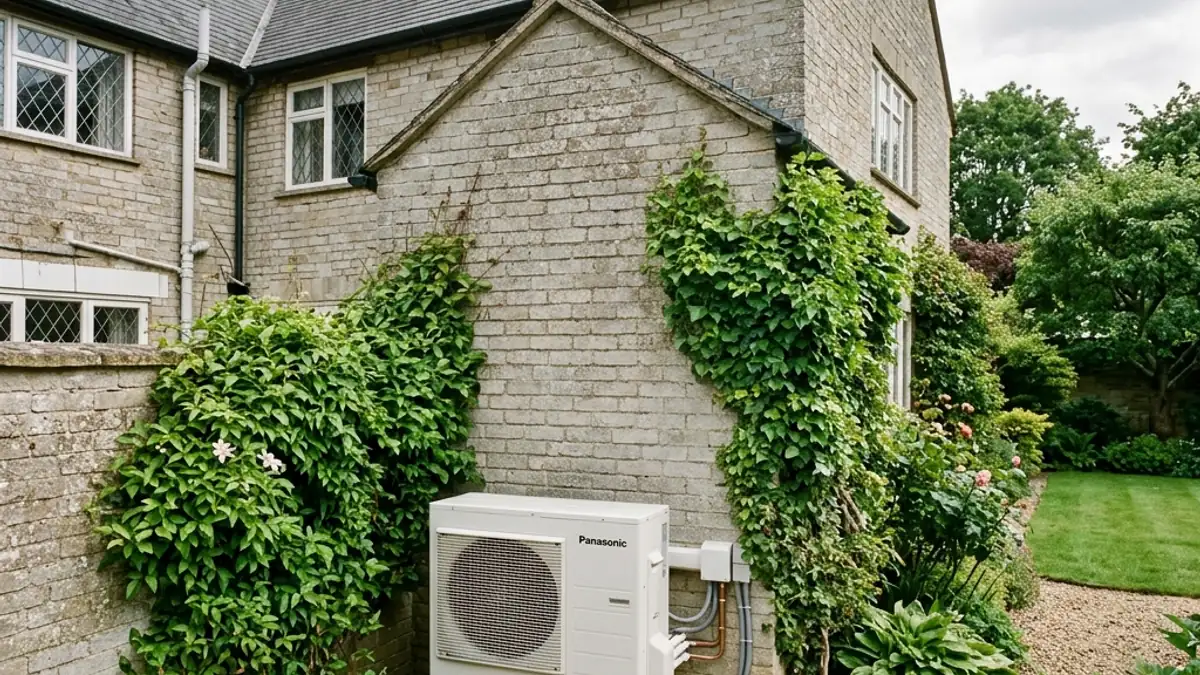
AT A GLANCE
- 42 dB(A) — the legal maximum noise level, measured at 1 metre from a neighbour's habitable room window, that an air source heat pump must not exceed to qualify for Permitted Development Rights in England and Wales
- 32–34 dB(A) — the sound pressure level of the quietest model in this guide, the Worcester Bosch Compress 5800i AW, which operates at approximately the same acoustic level as a quiet library reading room
- 23% — the verified proportion of UK consumers who incorrectly believe a heat pump is louder than a kitchen refrigerator; the primary barriers to installation are cost (71%) and heating efficacy concerns (37%), not noise
Noise is the objection that appears most dramatically in heat pump planning disputes — and it is, statistically, the objection that is most disproportionate to reality. The UK Clean Power Taskforce report published in January 2026 found that 23% of British consumers believe a heat pump operates louder than a standard kitchen refrigerator. In practice, the quietest models reviewed in this guide generate less acoustic output than that same refrigerator at a distance of two metres. The 55% noise-concern figure that circulates persistently in the trade press cannot be verified against any acoustic or consumer sentiment research; it is a misattribution of an entirely unrelated dataset about boiler replacement behaviour.
That said, acoustic performance is a legitimate engineering specification and a legal compliance matter. The permitted development regime imposes a hard limit. Neighbour disputes over heat pump noise are a growing category within Environmental Health case files. And the difference between the loudest and quietest mid-market units is 16 decibels — a perceptual difference of approximately four times the perceived loudness. Choosing the right unit for a constrained urban plot is not merely a comfort preference; in some installations it is the difference between Permitted Development and a full planning application.
This guide provides verified, manufacturer-confirmed acoustic and pricing data for the five quietest air source heat pumps available to UK homeowners in 2026, explains the legal framework in precise terms, and covers the installation practices that determine whether even a quiet unit remains quiet in service.
The Legal Framework: What 42 dB(A) Actually Means
The noise limit for air source heat pumps under Permitted Development Rights in England and Wales is defined in the Town and Country Planning (General Permitted Development) (England) Order 2015, as amended by the 2025 Amendment Order. The limit is 42 dB(A), assessed at a specific measurement point: exactly one metre external to the centre of any door or window serving a "habitable room" of a neighbouring property.
Three aspects of this rule are routinely misunderstood. First, the calculation must use the manufacturer's maximum sound power level — the absolute worst-case acoustic output of the unit. Manufacturers frequently market a "Quiet Mode" or nighttime attenuation setting that reduces acoustic output by 6–12 dB; using these lower figures to pass the MCS 020 calculation is explicitly prohibited. The MCS 020 Planning Standard requires the calculation to reflect full operating mode. Second, the limit is assessed at the neighbour's window, not at the unit itself — which means the physical distance between the unit and the neighbour's property, and the intervening surfaces, are critical variables in whether any given unit passes. Third, since the May 2025 amendment to the PDR legislation, the historical requirement to site the unit at least one metre from the property boundary has been removed, giving greater flexibility in placement provided the 42 dB threshold at the neighbour's window is not breached.
An additional tightening of the framework is the MCS-020(a) standard, which has introduced a stricter 37 dB(A) limit for what the standard defines as "neighbour-sensitive" installations — properties with close boundary separations, shared walls, or other acoustic risk factors that go beyond standard detached and semi-detached configurations. Installers using MCS 020 compliant planning tools will flag neighbour-sensitive sites automatically.
How Quiet Mark Certification Works
Quiet Mark is the acoustic certification arm of the UK's Noise Abatement Society, and its accreditation for heat pumps is the most reliable independent quality indicator available to consumers. Understanding how the certification process works explains why it is more meaningful than a raw decibel figure in a manufacturer's brochure.
Quiet Mark does not impose a single decibel threshold across all heat pumps. Instead, it employs a comparative methodology: the market is divided into precise output sub-categories (for example, 4–6 kW and 7–9 kW cohorts), ensuring that small residential units are only compared against other small residential units rather than against larger commercial systems. Within each cohort, Quiet Mark evaluates the legally declared sound power levels measured under ISO standards including BS EN 12102:2019. Accreditation is exclusively awarded to the quietest 10–20% of the highest-performing products within each bracket.
This means that a Quiet Mark badge is not a fixed performance standard — it is a statement that the unit is among the quietest in its class at the time of assessment, relative to its thermodynamic output. As of 2025–2026, manufacturers holding Quiet Mark accreditation for their UK residential ASHP ranges include Daikin, Grant UK, Ideal Heating, LG Electronics, Samsung, Vaillant, Warmflow, NIBE, Panasonic, and Worcester Bosch. All five models reviewed below hold current Quiet Mark certification.
Understanding the Decibel Scale in Practice
The decibel scale is logarithmic, not linear. This means that the perceptual difference between two units that appear close together numerically can be substantial. A 10 dB increase roughly doubles perceived loudness; a 3 dB increase represents a doubling of acoustic intensity (energy). The table below anchors the figures used in this guide against familiar everyday reference points.
| Sound Pressure Level | Everyday Reference Point | Heat Pump Context |
|---|---|---|
| 30 dB(A) | Countryside at night, no wind | Worcester Bosch Compress 5800i AW at 1m (lower end) |
| 35 dB(A) | Quiet library reading room | Samsung EHS in Quiet Mode; Daikin Low Sound Mode at 3m |
| 40 dB(A) | Residential street at night; refrigerator at 1m | Mitsubishi Ecodan PUZ-WZ at 1m |
| 42 dB(A) | PDR legal maximum at neighbour's window | Planning compliance threshold (MCS 020) |
| 46 dB(A) | Quiet office background noise | Vaillant aroTherm Plus / Samsung EHS (full mode) at 1m |
| 48 dB(A) | Rainfall; average office conversation at 5m | Daikin Altherma 3 R (mid-high range) at 1m |
The Physics of Sound in a Real UK Garden
The fundamental acoustic principle governing outdoor sound propagation is the inverse square law: in a theoretically open, reflective-surface-free environment (called a "free field"), sound pressure decreases by 6 dB each time the distance from the source doubles. A unit producing 46 dB(A) at 1 metre will, in free-field conditions, produce approximately 40 dB(A) at 2 metres, 34 dB(A) at 4 metres, and 28 dB(A) at 8 metres.
However, free-field conditions are essentially non-existent in UK residential gardens. An ASHP is typically sited against a brick wall, positioned on a concrete or paved base, or located in a narrow side passage. Each reflective boundary introduces what acousticians call a "directivity factor" — rather than spreading sound energy spherically in all directions, the reflective surfaces force the acoustic energy into a hemispherical (one wall) or quarter-spherical (a corner) geometry. The practical effect is that the sound pressure directed towards neighbouring properties is substantially amplified beyond what the free-field calculation predicts.
In particularly confined spaces — a 1.2-metre-wide passage between two semi-detached houses is a common installation scenario — reflected sound can dominate, creating a "reverberant field" in which acoustic attenuation is severely blunted. In these reverberant zones, the decibel decay occurs at a far slower rate than 6 dB per doubling of distance. This is why MCS 020 calculations are not straightforward additions and subtractions of decibels from distance — they use standardised correction factors for the specific installation geometry, and why an MCS-certified installer will model each proposed installation individually rather than relying on headline manufacturer figures.
#1 — Worcester Bosch Compress 5800i AW: 32–34 dB(A)
The Worcester Bosch Compress 5800i AW is, by a meaningful margin, the quietest air source heat pump available for UK residential installation in 2026. Its nominal sound pressure level of 32–34 dB(A) at 1 metre positions it acoustically below the ambient noise floor of a typical rural garden at night. It is Quiet Mark certified, uses the low-global-warming-potential R290 refrigerant, and has a capacity range of 4 kW to 12 kW — covering the thermal demands of properties from a well-insulated two-bedroom flat to a large Victorian terrace with upgraded radiators.
At this acoustic level, the unit is effectively inaudible from a neighbour's window at any realistic installation distance. The MCS 020 calculation for the Compress 5800i AW passes comfortably in virtually all residential configurations, including the most constrained urban terraced plots and neighbour-sensitive sites where the 37 dB(A) MCS-020(a) limit applies. For homeowners in conservation areas, flats with outdoor space, or semi-detached properties with close boundaries, this is the unit that eliminates acoustic anxiety entirely.
| Specification | Worcester Bosch Compress 5800i AW |
|---|---|
| Sound Pressure Level (1m) | 32–34 dB(A) |
| Capacity Range | 4 kW – 12 kW |
| Refrigerant | R290 (natural, low-GWP) |
| Quiet Mark Certified | Yes |
| Gross Installed Cost (2026) | £6,505 – £10,200 |
| Net Cost After £9,000 BUS Grant | from £0 to £1,200 |
#2 — Mitsubishi Electric Ecodan PUZ-WZ (R290 Ultra Quiet): 40 dB(A)
The Mitsubishi Electric Ecodan PUZ-WZ "Ultra Quiet" series represents the premium tier of the Ecodan range, utilising R290 refrigerant and delivering a sound pressure level of 40 dB(A) at 1 metre. This places it at the same acoustic level as a quiet residential street at night, and comfortably within the 42 dB(A) PDR compliance threshold at virtually any installation distance of more than 1 metre from a neighbour's window.
The PUZ-WZ carries Quiet Mark certification and is available in 5 kW, 6 kW, 8.5 kW, 10 kW, and 12 kW configurations — a capacity range suited to the full spectrum of UK domestic installations. As a premium-tier product, the gross installed cost ranges from £11,000 to £13,500 before the BUS grant deduction. Mitsubishi Electric's track record in the UK commercial and residential sectors, and the brand's extensive installer network, means that commissioning support and post-installation servicing are consistently available across the country.
| Specification | Mitsubishi Electric Ecodan PUZ-WZ |
|---|---|
| Sound Pressure Level (1m) | 40 dB(A) |
| Capacity Range | 5 kW, 6 kW, 8.5 kW, 10 kW, 12 kW |
| Refrigerant | R290 (natural, low-GWP) |
| Quiet Mark Certified | Yes |
| Gross Installed Cost (2026) | £11,000 – £13,500 |
| Net Cost After £9,000 BUS Grant | £2,000 – £4,500 |
#3 — Vaillant aroTherm Plus: 46 dB(A)
The Vaillant aroTherm Plus is one of the most widely installed heat pumps in the UK market, and its acoustic profile — 46 dB(A) at 1 metre for the 5 kW model, derived from a maximum sound power level of 54 dB(A) — places it within the Quiet Mark accreditation bracket for its output class. The core range uses R290 refrigerant and spans 3.5 kW, 5 kW, 7 kW, 10 kW, and 12 kW capacities. Quiet Mark certification covers the 3.5 kW, 5 kW, 7 kW, and 12 kW models.
At 46 dB(A) at 1 metre, the aroTherm Plus will pass the 42 dB(A) PDR test at all standard installation distances from a neighbour's window. The fully installed cost in 2026 ranges from £8,000 to £15,000, with the wide range reflecting significant variation in the complexity of domestic hot water cylinder upgrades and pipework modifications required in different property types. Vaillant's strong UK installer network and competitive mid-market positioning make this one of the most accessible routes to a Quiet Mark certified installation.
| Specification | Vaillant aroTherm Plus |
|---|---|
| Sound Pressure Level (1m) | 46 dB(A) (5 kW model) |
| Sound Power Level (max) | 54 dB(A) |
| Capacity Range | 3.5 kW, 5 kW, 7 kW, 10 kW, 12 kW |
| Refrigerant | R290 (natural, low-GWP) |
| Quiet Mark Certified | Yes (3.5, 5, 7, 12 kW models) |
| Gross Installed Cost (2026) | £8,000 – £15,000 |
| Net Cost After £9,000 BUS Grant | from £0 to £6,000 |
#4 — Samsung EHS Monobloc HT Quiet: 46 dB(A)
The Samsung EHS Monobloc HT Quiet (AE050RXY series and equivalent) generates a nominal sound pressure level of 46 dB(A) at 1 metre under standard operating conditions (A7/W35). It is notable for its four-step "Quiet Mode," which can reduce acoustic output to as low as 35 dB(A) during noise-sensitive periods — equivalent to a quiet library. However, it bears repeating that this lower figure cannot be used in MCS 020 planning calculations; the full 46 dB(A) maximum is what the calculator must apply.
Available in 5 kW, 8 kW, 12 kW, 14 kW, and 16 kW configurations, the Samsung EHS range addresses properties from compact flats to large detached homes with high heat demand. The 16 kW capacity option is particularly relevant for older properties without full cavity or solid wall insulation, where heat losses remain elevated. Quiet Mark certification is held across UK and EU territories. The gross installed cost for a standard residential integration in 2026 is approximately £12,500, yielding a net cost of £3,500 after the BUS grant.
| Specification | Samsung EHS Monobloc HT Quiet |
|---|---|
| Sound Pressure Level (1m, full mode) | 46 dB(A) |
| Sound Pressure Level (Quiet Mode) | 35 dB(A) (not for MCS calculations) |
| Capacity Range | 5 kW, 8 kW, 12 kW, 14 kW, 16 kW |
| Quiet Mark Certified | Yes |
| Gross Installed Cost (2026) | ~£12,500 |
| Net Cost After £9,000 BUS Grant | ~£3,500 |
#5 — Daikin Altherma 3 R: 48 dB(A)
The Daikin Altherma 3 R generates a nominal sound pressure level of 48 dB(A) at 1 metre for its mid-to-high capacity units (11–16 kW range). Daikin also advertises a "Low Sound Mode" that reduces acoustic output to 35 dB(A) at a distance of 3 metres, though again this figure is inapplicable to MCS 020 planning calculations. The capacity range is extensive: 4 kW, 6 kW, 8 kW, 9 kW, 11 kW, 14 kW, and 16 kW — making it one of the most modular offerings in the market. Quiet Mark certification is held across the Altherma portfolio.
At 48 dB(A) at 1 metre, the Altherma 3 R sits 6 dB above the Vaillant and Samsung models reviewed above — a perceptually noticeable difference equivalent to approximately 1.3× the perceived loudness. Whether this unit passes the 42 dB(A) PDR test depends entirely on the distance between the proposed installation point and the nearest neighbour's habitable room window. In open garden settings with 4–6 metres of clear distance, it will typically pass. In urban terraced plots with close boundary separations, MCS 020 modelling is essential before assuming PDR compliance. The gross installed cost ranges from £7,000 to £14,000, making it one of the more price-accessible Quiet Mark certified options in the mid-range.
| Specification | Daikin Altherma 3 R |
|---|---|
| Sound Pressure Level (1m) | 48 dB(A) (mid-high range units) |
| Capacity Range | 4 kW, 6 kW, 8 kW, 9 kW, 11 kW, 14 kW, 16 kW |
| Quiet Mark Certified | Yes |
| Gross Installed Cost (2026) | £7,000 – £14,000 |
| Net Cost After £9,000 BUS Grant | from £0 to £5,000 |
Side-by-Side Comparison
| Model | Noise at 1m | Capacity Range | Quiet Mark | Gross Cost | Net After BUS |
|---|---|---|---|---|---|
| WB Compress 5800i AW | 32–34 dB(A) | 4–12 kW | Yes | £6,505–£10,200 | from £0 |
| Mitsubishi Ecodan PUZ-WZ | 40 dB(A) | 5–12 kW | Yes | £11,000–£13,500 | £2,000–£4,500 |
| Vaillant aroTherm Plus | 46 dB(A) | 3.5–12 kW | Yes | £8,000–£15,000 | from £0 to £6,000 |
| Samsung EHS Monobloc HTQ | 46 dB(A) | 5–16 kW | Yes | ~£12,500 | ~£3,500 |
| Daikin Altherma 3 R | 48 dB(A) | 4–16 kW | Yes | £7,000–£14,000 | from £0 |
Anti-Vibration Mounting: The Installation Detail That Matters
Manufacturer-stated sound pressure levels are measured in anechoic chambers — an acoustic laboratory environment that is as unlike a real garden as conditions can be. In practice, an ASHP generates two distinct types of noise that are rarely distinguished in marketing literature: the aerodynamic airborne noise produced by fan turbulence, and the low-frequency structure-borne vibration from the mechanical cycling of the compressor.
If a unit is rigidly bolted to a wall or mounted on a concrete base that is directly connected to the building's foundation, the compressor vibration propagates through the dense building fabric. It frequently resonates and amplifies within interior wall cavities and floor voids, producing a low-frequency drone that is perceptible inside the house — particularly in bedrooms at night — even when the outdoor airborne noise level is well within legal limits. This is the most common source of genuine post-installation noise complaints that cannot be resolved by choosing a quieter model alone.
The Microgeneration Installation Standard MIS 3005 (Issue 5.0, Section 6.3.3) mandates as best practice that "anti-vibration pads/mats/mounts and flexible hose connections should be installed according to the manufacturer's instructions to reduce the effects of vibration on the building structure." In practice, this requires: rubber isolation feet or spring mounts between the unit chassis and any rigid base or wall bracket; braided flexible hose connections between the unit and the building's pipework to prevent vibration transmission through the hydraulic circuit; and careful avoidance of rigid metal fixings that create direct vibration pathways into structural elements. Any installer omitting these measures on a wall-mounted unit is operating below MCS installation standards and is creating a potential statutory nuisance liability regardless of the unit's headline decibel figure.
Permitted Development Rules: Scotland and the Rest of the UK
The 42 dB(A) noise limit applies across England, Wales, and Scotland — all jurisdictions require adherence to MCS 020. However, the spatial and volumetric rules governing what qualifies for Permitted Development differ materially between nations.
In Scotland, detached homes can now install up to two air source heat pumps under Permitted Development following 2025–2026 Scottish Government amendments introduced as part of the housing emergency package. This is a significant departure from England, where Permitted Development typically covers only the first ASHP installation. Scotland historically enforced a 100-metre boundary rule that was removed in 2016; the current framework is substantially more permissive for detached properties. However, multiple units on flatted buildings, terraced homes, or semi-detached properties still require a full planning application due to the cumulative acoustic load — the combined output of two units must still pass the 42 dB(A) threshold assessment. Volume limits remain: 1.5 cubic metres for houses, 0.6 cubic metres for flats.
In England, the May 2025 PDR amendment removed the requirement to site the unit at least one metre from the property boundary, which was frequently a binding constraint for narrow urban gardens. The unit can now be positioned closer to the boundary provided the acoustic test at the neighbour's window passes — an important planning flexibility for urban homeowners who previously faced automatic disqualification from PDR based on garden geometry alone.
Claiming the £9,000 Boiler Upgrade Scheme Grant
Every air source heat pump reviewed in this guide qualifies for the Boiler Upgrade Scheme grant of £9,000 (increased from £7,500 from 21 July 2026), which remains open for new applications until 31 December 2027. The scheme is administered by Ofgem and operates exclusively through MCS-certified installers — the grant is never paid directly to the homeowner. Instead, the certified installer applies for the voucher on your behalf and deducts the £9,000 value directly from the final installation invoice. Combined with the ongoing 0% VAT rate on energy-saving materials (locked in until 31 March 2027), the effective tax-inclusive net cost of an entry-level installation from the Worcester Bosch Compress 5800i AW can be as low as zero or even negative before accounting for heating bill savings.
For a noise-sensitive property where the quietest available unit is genuinely required for planning compliance, the BUS grant represents the mechanism that makes a premium acoustic specification financially accessible. A homeowner who would otherwise have chosen a cheaper, louder unit to reduce upfront cost can use the grant to close the price gap and specify the Worcester Bosch or Mitsubishi Ecodan Ultra Quiet without a meaningful premium in net terms.
To explore which of the models in this guide is the right size for your property's heat load, and to connect with an MCS-certified installer who can conduct a formal MCS 020 acoustic assessment for your specific plot, visit our air source heat pumps guide.
Ready to Take Action?
Does your home qualify for the BUS grant?
Check eligibility and compare quotes from local MCS-certified installers — free, no obligation.
Check My Eligibility →Get Your Free Quotes
Takes under 4 minutes · No obligation

Written by
Mark Anthony Haines
Mark has over a decade of experience in the UK renewable energy sector, specialising in solar PV, heat pump systems, and home battery storage. He founded HeatPumpsAndSolar.co.uk to help UK homeowners cut through the noise around green energy installations, government grant schemes, and smart tariffs.
View LinkedIn ProfileMore from Our Insights
Homeowner questions on this topic
Compare the guide with common questions and experiences from UK homeowners.
Tools & Services Related to This Article
Take the next step with a free calculator or a local installer quote.