Ground Source Heat Pump Cost UK: Why the Same £7,500 Grant Still Beats Air Source
Ground source heat pump cost UK: the same £7,500 Boiler Upgrade Scheme grant as air source. Real metered data shows exactly when the extra capital pays off.
Quick Summary
- The UK Boiler Upgrade Scheme pays the identical £7,500 grant (£9,000 off-gas) for ground source and air source heat pumps, so the higher ground source quote is not a subsidy gap - it's a garden and a lower running cost.
- Because UK subsoil stays a stable 8-12°C all winter versus freezing air, field trials measure ground source systems achieving a real-world SPF of 3.30-3.65 against 2.69-2.80 for air source, cutting running costs by roughly 22%.
- Over a 20-year horizon in a typical detached home, ground source can save over £5,000 once the air source unit's 14-16 year outdoor replacement is factored in - but a small urban plot needing a vertical borehole can still favour air source.
The Misconception
Homeowners assume ground source heat pumps are technically unfeasible for standard UK homes, requiring acres of land, and categorically uncompetitive on cost against air source heat pumps.
Table of Contents
The Boiler Upgrade Scheme Pays the Same £7,500 for Ground Source. So Why Are UK Homeowners Still Buying Air Source?
Dr Alistair Vance, a 48-year-old chartered surveyor and senior environmental consultant, lives in a 1930s detached four-bedroom brick house in Market Harborough, Leicestershire. Researching ground source heat pump cost uk before he switched off his old LPG boiler, he found two very different numbers for the same £7,500 government grant. The property has 190 square metres of internal floor space and a 420-square-metre rear lawn with clear side access for a mini-excavator, on a 16,000 kWh annual heat demand.
He got two MCS-certified quotes. The air-source option: a 10 kW monobloc unit at £13,200 gross, dropping to a net £5,700 after the £7,500 Boiler Upgrade Scheme grant. The ground-source option: a 10 kW plant unit paired with an 800-metre horizontal slinky ground loop at £21,200 gross, also qualifying for the identical £7,500 grant, leaving a net £13,700. Same government subsidy, same heat output, an £8,000 gap in what he had to write a cheque for.
Alistair dismissed ground source as an indulgence for country estates. Paying £8,000 more for what looked like the same job, he decided, was poor financial management. He signed for the air-source system, confident in his restraint.
If the Grant Is Identical, What Was Alistair Actually Paying For?
Here is the question his spreadsheet never asked: if the Boiler Upgrade Scheme hands out exactly the same £7,500 (or £9,000 off-gas) voucher regardless of which technology you choose, what is the extra £8,000 of ground-source capital actually buying? Is it eccentricity, or is it something the day-one quote comparison structurally cannot show you?
The answer sits underground, in a number neither installer put on either quote: the temperature of the thing each heat pump has to extract warmth from.
Ground Source Heat Pump Cost UK: The Carnot Problem Neither Quote Mentions
A heat pump does not create heat; it moves it, using a compressor to lift low-grade warmth from an outdoor source up to a useful indoor temperature. How hard that lift is depends entirely on the temperature gap it has to bridge, expressed by the Carnot Coefficient of Performance: the narrower the gap between source and delivery temperature, the less electricity the compressor burns per unit of heat delivered.
In a UK winter, an air-source heat pump draws from ambient air that can fall to -5°C to 4°C. To deliver 45°C water to radiators, it bridges a 41–50 Kelvin lift. When humid air below 6°C crosses the evaporator, moisture freezes onto the fins, and the unit must periodically reverse its refrigerant cycle to melt the ice - burning electricity to defrost instead of heating the house.
Subterranean ground, by contrast, stays a stable 8°C to 12°C all winter, insulated by the earth's thermal mass. A ground-source system delivering the same 45°C flow only bridges a 33–37 Kelvin lift - and because the closed loop is buried, no ice ever forms on it. Defrost cycles are eliminated entirely, not reduced.
That thermodynamic gap is why UK field trials (Energy Systems Catapult, RECC/GSHPA) measure a median real-world Seasonal Performance Factor of 2.69–2.80 for air-source systems against 3.30–3.65 for ground-source horizontal loops - with roughly two-thirds of ground-source installs hitting SPF 3.0 or above, versus around 30% of air-source installs.
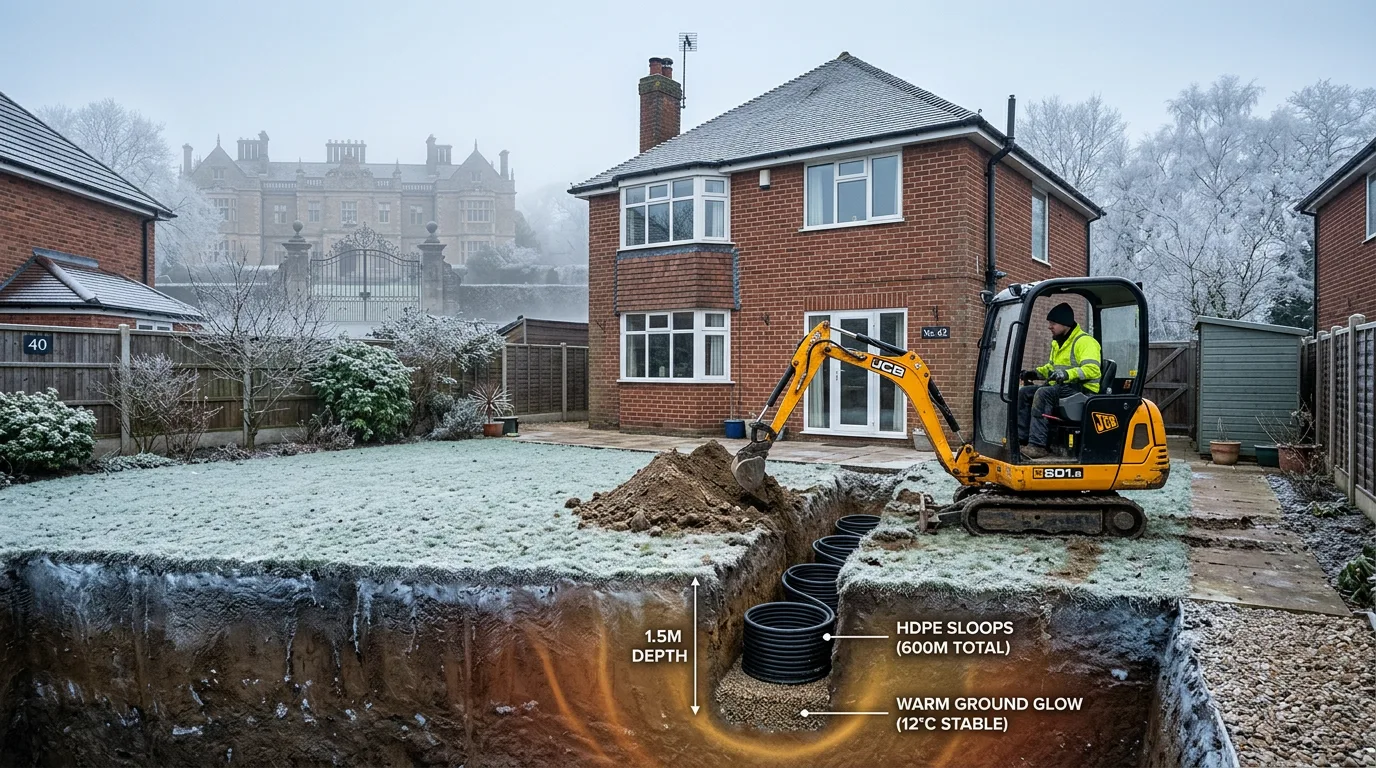
Ground loops come in two forms. Horizontal "slinky" arrays coil 600–1,000 metres of HDPE pipe into trenches at 1.2–2.0 metres depth, needing 200–500 square metres of open garden - not acres, but a normal suburban plot. Vertical boreholes sink 90–150 metres down in a 25–40 square metre footprint, at a civil drilling cost of roughly £13,000–£22,000, for gardens too small for trenching.
| Technical Parameter | ASHP (8–10 kW) | GSHP Horizontal Slinky | GSHP Vertical Borehole |
|---|---|---|---|
| Outdoor footprint | 1.2m × 0.5m fan unit | 250–450 m² open land | 25–40 m² rig access |
| Civil/drilling cost | £0 | £4,000–£7,500 | £8,000–£15,000 |
| Gross installed cost | £11,500–£14,500 | £18,000–£24,000 | £25,000–£34,000 |
| Net cost after £7,500 grant | £4,000–£7,000 | £10,500–£16,500 | £17,500–£26,500 |
What the Meter Showed After Alistair's First Real Winter
By the middle of his second winter, Alistair noticed his running costs climbing hard during cold snaps. During a two-week freeze in January, with outdoor temperatures averaging -4°C to 2°C, his air-source unit ran continuously, triggering frequent defrost cycles that consumed electricity without heating a single radiator.
Wanting real numbers, he fitted Class 1 heat meters and current-transformer monitoring clamps logging to an OpenEnergyMonitor dashboard. Over a full heating season, his air-source system delivered 16,000 kWh of heat from 5,839 kWh of electricity - a measured SPF of 2.74. At the Ofgem price cap default of 26.32p/kWh, that came to £1,537 a year.
His neighbour, in an identical 1930s detached house with an identical heat loss profile, had installed the horizontal ground-source system Alistair turned down. Drawing from subsoil holding steady at 8.8°C to 10.2°C, that system delivered the same 16,000 kWh from just 4,348 kWh of electricity - a measured SPF of 3.68, costing £1,144 a year. An operational saving of £393 a year, rising to £298 even on a smart time-of-use tariff at 20p/kWh.
The month-by-month data made the mechanism visible:
| Month | Mean Air Temp (°C) | ASHP Monthly COP | GSHP Monthly COP | ASHP Electricity (kWh) | GSHP Electricity (kWh) | Monthly Cash Gap |
|---|---|---|---|---|---|---|
| October | 10.4 | 3.45 | 3.90 | 348 | 308 | +£10.53 |
| November | 6.8 | 2.95 | 3.80 | 610 | 474 | +£35.80 |
| December | 3.2 | 2.45 | 3.65 | 1,020 | 685 | +£88.17 |
| January | 1.8 | 2.30 | 3.52 | 1,217 | 795 | +£111.07 |
| February | 2.9 | 2.40 | 3.50 | 1,000 | 686 | +£82.63 |
| March | 7.1 | 3.10 | 3.75 | 581 | 480 | +£26.58 |
| Season total | - | 2.67 weighted | 3.65 weighted | 4,776 | 3,428 | +£354.78 |
The gap widened exactly when Alistair needed his heating most - the colder the air got, the worse his air-source COP fell and the more his neighbour's ground-source system pulled ahead.
The bigger number was still coming. Exposed to wind, humidity, and winter salt air, Alistair's outdoor unit faces a 14–16 year working life before a compressor or full unit replacement costing £5,000–£6,000. His neighbour's ground array - buried HDPE rated for over 100 years - and indoor plant unit (20–25 year design life, sheltered from the weather) face no equivalent bill. Run the numbers to year 20 and Alistair's total outlay (net capital, electricity, servicing, and one mid-life replacement) reaches £44,180. His neighbour's ground-source system totals £38,796 - a £5,384 penalty for choosing on day-one price alone.
The Whole-Life Framework the Quote Comparison Never Showed Him
The mistake was not overpaying attention to the numbers - it was reading the wrong ones. A single-quote comparison only captures initial capital minus grant. The number that actually determines the winner is total cost of ownership: initial cost, minus the BUS voucher, plus (annual heat demand ÷ SPF) × electricity price × years, plus maintenance, plus any mid-life replacement, minus residual asset value.
Three whole-life scenarios (Ofgem price cap, 26.32p/kWh) show how demand and land availability shift the outcome:
| Scenario | 10-Year TCO Winner | 15-Year TCO Winner | 20-Year TCO Winner |
|---|---|---|---|
| A: Suburban semi-detached, 16,000 kWh, on-gas | ASHP cheaper by £3,558 | GSHP cheaper by £3,413 | GSHP cheaper by £5,384 |
| B: Rural off-gas, 25,000 kWh, £9,000 grant | ASHP cheaper by £1,016 | GSHP cheaper by £8,476 | GSHP cheaper by £11,968 |
| C: Urban constrained plot, vertical boreholes, 14,000 kWh | ASHP cheaper by £11,199 | ASHP cheaper by £4,298 | ASHP cheaper by £2,398 |
Scenario A is Alistair's exact situation, and the crossover - the year ground source overtakes air source on cumulative spend - lands right where his neighbour's outdoor unit would otherwise need replacing. Scenario B shows that high-demand, off-gas rural homes with the uplifted £9,000 grant break even within about 11.5 years. Scenario C is the honest counter-case: on a small urban plot needing an expensive vertical borehole rather than a cheap horizontal trench, air source stays cheaper even after 20 years, because the drilling premium is too large relative to a modest heat demand to ever fully amortise.
Three practical checks determine which column you sit in before you request quotes:
- Thermal demand. Above 20,000 kWh/year (typically off-gas, larger, or older properties), ground source pulls ahead fast. Between 10,000–16,000 kWh/year, land availability becomes the deciding factor.
- Land availability. 300 square metres or more of clear garden supports a horizontal slinky loop at the lowest installed cost. Smaller plots force a vertical borehole, which needs a higher heat demand to justify the extra £8,000–£15,000 in drilling.
- Grant parity. The £7,500 (or £9,000 off-gas) voucher applies equally to both technologies and absorbs a large share of the upfront gap, letting the ground-source efficiency advantage do the rest of the work over the system's lifetime.
Regulation favours getting this right before signing: ground-source BUS vouchers carry a six-month validity window (versus three months for air source), most domestic installs fall under Permitted Development (GPDO Part 14, Class C, provided total excavation stays under 0.5 hectares), and boreholes deeper than 30 metres require a Water Resources Act 1991 notification to the British Geological Survey. Every BUS-funded install still needs an MCS MIS 3005-D heat loss survey regardless of which technology you choose.
What to Ask Your Installer Before You Choose on Price Alone
Choosing a heat pump does not need an exclusive focus on the number at the bottom of the quote; it needs a whole-life assessment that accounts for identical government grant support, stable winter ground temperatures, and long-term asset durability. If your garden has 300 square metres or more of clear space and your annual heat demand sits above roughly 16,000 kWh, ask your MCS installer for a ground-source quote alongside the air-source one, and request the in-situ SPF data behind their number, not just the manufacturer's SCOP rating. The £7,500 grant does not care which box you tick - only your garden and your annual heat demand should decide that.
Key Takeaways
- Ground-source and air-source heat pumps qualify for the identical Boiler Upgrade Scheme grant: £7,500 standard, rising to £9,000 for off-gas properties replacing oil or LPG.
- UK field trials measure a median real-world SPF of 3.30–3.65 for ground-source systems versus 2.69–2.80 for air-source systems, because stable 8–12°C ground temperatures require a smaller compressor lift than freezing winter air.
- Ground-source systems eliminate defrost cycles entirely, since the buried closed loop never experiences the airborne humidity that freezes on an air-source evaporator.
- A horizontal slinky loop needs 200–450 square metres of ordinary garden space, not acres - vertical boreholes fit smaller plots but add £8,000–£15,000 in drilling cost.
- Over a 20-year horizon in a typical 16,000 kWh detached home, ground source can save £5,384 versus air source once the air-source unit's 14–16 year outdoor replacement is factored in.
- On constrained urban plots needing vertical boreholes with modest heat demand, air source often remains cheaper even after 20 years - ground source is not automatically the right answer everywhere.
- Ground-source BUS vouchers carry a six-month validity window versus three months for air source, giving more time for groundworks and commissioning.
Frequently Asked Questions
How much does a ground source heat pump cost to install in the UK?
A complete domestic ground source heat pump installation in the UK typically costs between £18,000 and £25,000 for a horizontal slinky array, and £25,000 to £35,000 for a vertical borehole system. After deducting the government's £7,500 Boiler Upgrade Scheme grant (or £9,000 for off-gas properties replacing oil or LPG), out-of-pocket costs average £10,500 to £17,500 for horizontal systems.
What is the cost difference between ground source and air source heat pumps?
An air source heat pump typically costs £11,000 to £15,000 before grants, leaving a net cost of £3,500 to £7,500 after the £7,500 Boiler Upgrade Scheme voucher. A horizontal ground source heat pump costs roughly £7,000 to £9,000 more upfront, but its higher seasonal efficiency and longer operating lifespan frequently recover this difference over 12 to 18 years.
Does a ground source heat pump qualify for a government grant in the UK?
Yes. Ground source heat pumps qualify for the Boiler Upgrade Scheme across England and Wales, receiving the exact same £7,500 capital grant as air source systems. Properties off the mains gas network currently relying on heating oil or LPG qualify for an increased grant of £9,000. The voucher is deducted directly from your installer's quote.
Is a ground source heat pump worth the extra investment over air source?
A ground source heat pump is typically worth the investment for detached or rural properties with high heat demand and sufficient garden space. Because the ground remains at a stable 8°C to 12°C throughout winter, ground source systems deliver 20% to 25% lower running costs than air source units, and the underground collector pipes last for over 100 years.
How much garden space is needed for a ground source heat pump?
A standard horizontal slinky system requires roughly 200 to 450 square metres of open garden space - typically 1.5 to 2.5 times the internal floor area of your home. If you have a smaller garden, vertical boreholes require very little surface area, but drilling deep vertical shafts adds £8,000 to £15,000 to upfront installation costs.
Get Your Free Quotes
Takes under 4 minutes · No obligation

Written by
Mark Anthony Haines
Mark has over a decade of experience in the UK renewable energy sector, specialising in solar PV, heat pump systems, and home battery storage. He founded HeatPumpsAndSolar.co.uk to help UK homeowners cut through the noise around green energy installations, government grant schemes, and smart tariffs.
View LinkedIn ProfileMore from Our Insights
Tools & Services Related to This Article
Take the next step with a free calculator or a local installer quote.