Defrost Cycle on a Heat Pump: Why Heating Stops to Keep You Warm
A defrost cycle on a heat pump can look like a breakdown. Learn which winter sights are normal, which ice patterns need an engineer and what to avoid.
Quick Summary
- A heat pump may pause heating, stop its outdoor fan and release white vapour while carrying out a normal defrost cycle.
- The useful distinction is whether frost clears, meltwater drains and heating returns, not how dramatic the mist looks.
- Record persistent ice, drainage problems and fault codes for your original installer; never chip ice or pour hot water on the appliance.
The Misconception
A heat pump that pauses heating and emits white vapour on a frosty morning must be broken.
Table of Contents
The Morning the Heating Appeared to Stop
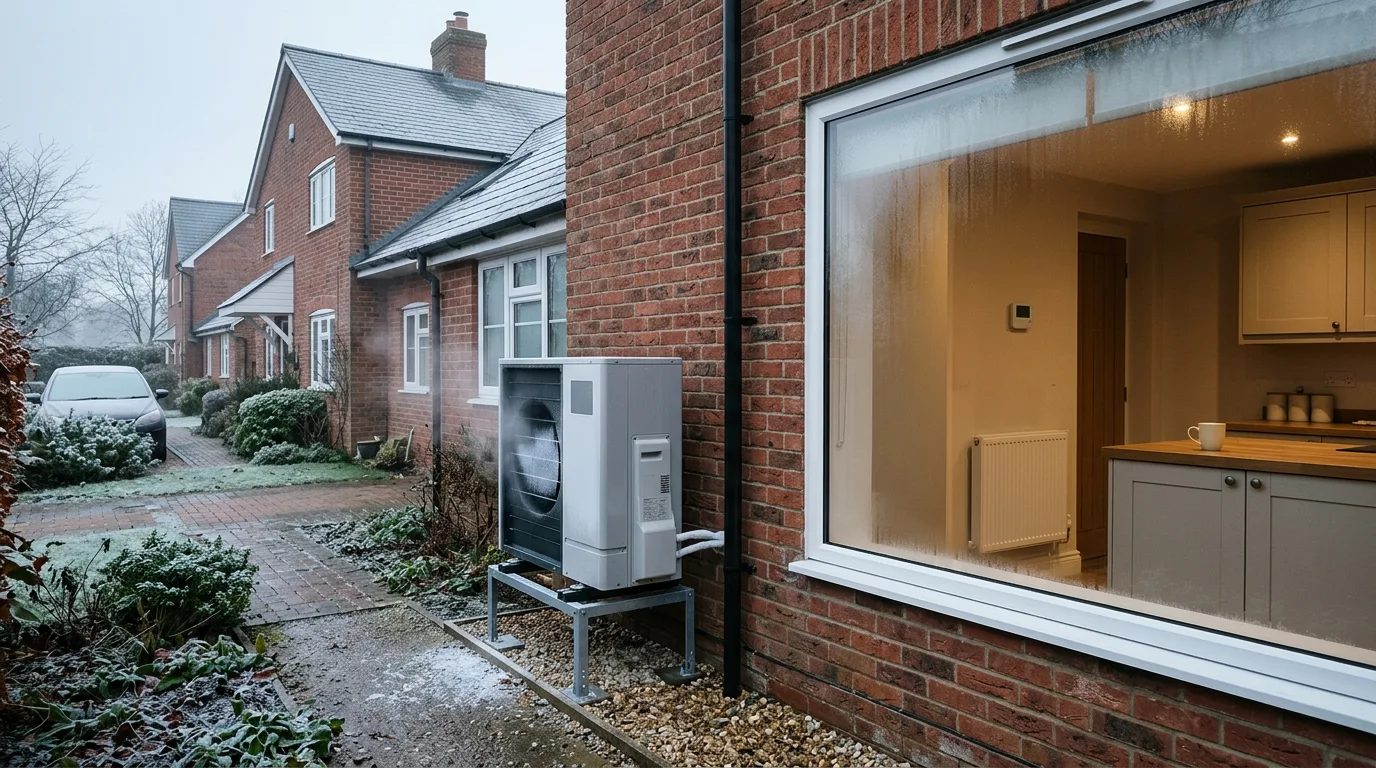
A defrost cycle on a heat pump can look remarkably like a breakdown. In a fictional first-winter scene, Clara hears a whoosh, notices the outdoor fan has stopped and sees a white cloud rise from the grille. Her radiator feels cooler. After years with a gas boiler, her instinct is to switch the machine off or reach for a kettle. Neither is a safe next step.
The surprising part: the heat pump may have paused because it is protecting its ability to heat the house. In damp winter air, frost can collect on the outdoor coil. The machine briefly redirects heat to melt it, then resumes heating. Grant's explanation of the Aerona defrost sequence describes the fan stopping, refrigerant reversing and a cloud of condensation when the fan starts again. White vapour during that sequence is not, on its own, evidence of smoke or failure.
But not every icy outdoor unit is behaving normally. What matters is what happens next: does the frost clear, does meltwater leave the unit, and does your heating recover? You can learn that without touching the equipment. If there is an acrid smell, visible burning, sparking or an electrical safety concern, move away and seek urgent professional help rather than treating it as routine vapour.
If It Needs Heat, Why Is It Sending Heat Outside?
That is the winter puzzle. The outdoor coil is supposed to absorb warmth from the air. Yet it can become frosty while the air itself is merely cold and damp, not necessarily below freezing. As frost thickens it restricts airflow and makes heat transfer harder. To keep working, the machine must interrupt the thing you bought it to do.
There is no universal stopwatch setting. Before judging a pause, watch whether the coil clears and heating returns. Repeated ice that will not melt tells you more than one misty cycle.
The Defrost Cycle on a Heat Pump: What You Actually See
An air-to-water heat pump draws air across its outdoor finned coil. Refrigerant circulating inside the sealed system absorbs heat there, and the machine transfers heat into the water that feeds radiators or underfloor heating. Because the coil must be colder than the surrounding air to collect that energy, moisture in damp air can condense and freeze on the fins. Vaillant explains why some frost is expected and why excessive build-up impairs airflow.
When its controls decide defrost is needed, the heat pump changes the refrigerant's route so warmth reaches the outdoor coil. The fan normally stops during the short reversal rather than pulling cold air through the melting ice. Heating to the home may pause while the coil thaws. As normal operation returns, the fan can push out a dramatic white plume: warm moist air meeting colder air. Grant says its Aerona ranges stop the fan, briefly reverse refrigerant flow, then restart with a cloud of condensation. A few minutes on one manufacturer's machine is not a fault threshold for every model.
| What you notice | A routine defrost can look like | What to check from a safe distance |
|---|---|---|
| White frost on fins | An even coating that later melts | Does it clear after the cycle? |
| Outdoor fan and sound | A pause, then a whoosh or change in hum | Does the fan restart without scraping? |
| White cloud | Water vapour when the coil thaws and fan resumes | Does it disperse, without a burning smell? |
| Water below the unit | Meltwater leaving via the intended route | Is it draining rather than freezing across a path? |
| Indoor heat | A temporary interruption to heat delivery | Does the home return to its normal heating pattern? |
A radiator may feel cooler than one heated by a boiler even when the room warms correctly. Energy Saving Trust says not to judge heat-pump performance by radiator touch alone.
Ice on the fins and ice in the base are not the same problem. During defrost, melted frost should fall into the tray beneath the coil and leave by the drainage arrangement the installer designed. Grant describes both the base tray and its automatic heater on its Aerona ranges. Vaillant's winter-care advice also stresses keeping the outdoor unit clear. A solid mass rising from the base, an iced-up fan or meltwater freezing on a walkway deserves attention, not an assumption that every frozen surface is normal.
What Changed After the Mist Cleared?
The important observation comes after the cloud, not in the middle of it. From indoors or well back outside, look at the fins when the fan has restarted. If the frost has gone, water is draining safely and heating recovers, you have seen the expected sequence described in the Grant FAQ. Your own controller manual should tell you whether it shows a defrost status; displays differ between manufacturers and models.
Now imagine seeing the same white frost still covering the coil after repeated attempts, or a slab of ice spreading upwards out of the bottom of the machine. That is a different observation. Take a photograph from a safe position, note the weather, record any displayed fault code and tell your original installer what you saw. The installer can distinguish a blocked drain, restricted airflow, control issue or another fault. The photograph is evidence for a technician, not a DIY diagnosis.
Watch the house, too. A brief interruption to heating while the outdoor coil clears is different from rooms continuing to cool or hot water failing to recover. Check only ordinary user settings, such as the scheduled heating mode, using your handbook. Do not override service controls to force a defrost or repeatedly reset a persistent error. For broader context on controls and room comfort, our smart-thermostat guide explains why boiler habits do not always transfer to heat pumps.
The Safe Check Before You Call an Engineer
You do not need to open a cover, reach through the grille or touch the coil to make a useful report. Energy Saving Trust recommends keeping bikes, bins and leaves away from the outdoor unit so air can move freely. If it is safe, check that there is no loose obstruction around the outside of the unit. Leave the fins, wiring and refrigerant circuit alone. Follow the clearance and cleaning instructions for your particular model rather than applying a blanket rule to all outdoor units.
| If you see... | Sensible next step | Do not... |
|---|---|---|
| A brief fan pause, melting frost and dispersing white vapour | Observe the complete sequence; consult the user manual | Switch the system off just because of the plume |
| Leaves or a bin blocking the air path | Move loose external obstructions if safely accessible | Reach into a fan grille or remove panels |
| Ice remaining after cycles, or growing up from the base | Photograph it and contact your installer promptly | Chip the ice or pour boiling water on the appliance |
| A fault code, scraping fan or heat that does not recover | Note the exact message and call the installer or manufacturer | Keep resetting it to hide a recurring problem |
| Meltwater icing over a walkway | Keep people clear of the slip hazard and report the drainage issue | Let repeated overflow go unreported |
In particular, do not pour hot water onto the heat pump. Vaillant's winter advice warns against doing so: it is an electrical appliance. Do not scrape the delicate fins or use a heat gun either. Mitsubishi's Ecodan homeowner manual identifies a white plume in cold weather as normal defrost behaviour, but directs users to professionals for faults and warns against accelerating defrost using unapproved means. A dramatic vapour cloud should not push you towards a risky intervention.
Do not routinely cut the power to a heat pump in freezing conditions as a way to stop defrosting: its frost-protection features may need electricity. If you suspect electrical danger, a leak, smoke with a burning smell or another immediate hazard, keep clear and follow your manufacturer's emergency advice instead. Your installer's handover pack should explain the specific protections and emergency procedure for your system.
Report the model, weather, photographs, fan and heating behaviour, and exact controller message. Ask your original installer or manufacturer first if the unit is in warranty; a new-installation quote form is not a repair booking. Our handover guide covers the documents to keep.
Planning an installation? Ask where thaw water will go and whether it could freeze on a path. Request the drainage route and clearances at handover. Our outdoor-unit siting guide covers location, and the heat-pump overview explains the system. Compare installation quotes with winter aftercare in mind; existing faults belong with a service engineer.
The Pause That Keeps the Heating Going
The white cloud is the part that catches your eye. The more revealing detail is whether the machine finishes the job: frost disappears, water drains, the fan restarts and comfort returns. That sequence points to a designed defrost, not a heat pump giving up on winter. If instead ice persists, the base fills, a fault appears or the home keeps getting colder, an installer needs to investigate.
You do not have to decide which sensor, valve or drain component has failed. Observe, record and call the right person when the normal sequence breaks. A heat pump may briefly stop heating the house to keep heating it through winter; frost that never clears is the warning sign.
Key Takeaways
- A fan pause, whoosh and white vapour can be normal during an automatic defrost on an air-to-water heat pump.
- Frost can form on the outdoor coil in cold, damp air; frost on the fins should clear after defrost.
- Heating can pause briefly while the cycle directs warmth to the outdoor coil; check whether comfort returns.
- There is no reliable universal defrost frequency or duration for every brand and weather condition.
- Water should leave the base safely; recurring ice growing upwards or ice on a path needs an installer assessment.
- Do not use boiling water, tools or heat guns on the appliance, and do not routinely isolate its power in freezing weather.
- Photograph persistent ice, note fault codes and contact your original installer or manufacturer support for a fault.
- If you are buying a system, ask how defrost meltwater will drain and who will provide winter aftercare.
Frequently Asked Questions
Why does my heat pump blow white mist in cold weather?
When an outdoor coil thaws, moisture can leave the unit as a white cloud when the fan starts again. Grant describes this as normal condensation after its Aerona defrost cycle; Mitsubishi's Ecodan manual also addresses the alarming-looking plume. If you notice a burning smell, sparks or another safety concern, keep away and get urgent professional advice instead.
How often should a heat pump defrost in winter?
There is no universal timetable. The need to defrost depends on dampness, outdoor temperature, coil conditions, system load and the model's controls. Rather than using an online rule such as a fixed number of minutes, check whether frost actually clears, the fan restarts and heating recovers. Ask your installer about a persistent change from your unit's usual behaviour.
Why do my radiators cool during a defrost cycle?
The machine temporarily directs heat to the outdoor coil to melt frost instead of supplying its normal heating output. Grant says this interruption on its Aerona systems lasts a few minutes. A cooler radiator alone is not a fault test: observe room comfort and whether heating returns. If rooms continue cooling or a controller fault appears, contact your installer.
When is ice on an air-source heat pump a problem?
A coating on the outdoor fins that disappears during a cycle is different from solid ice that remains after repeated defrosts or grows upwards from the base tray. Watch from a safe distance and photograph the pattern. If ice reaches the fan, drainage freezes on a walkway or heating does not recover, call your installer promptly.
Should I turn off my heat pump or pour water on it to defrost it?
No, not as a routine reaction to frost. Vaillant warns against pouring hot water on an electrical heat pump. Do not chip ice or use a heat gun. Power may also be needed for frost protection in freezing conditions. If there is an immediate electrical or fire hazard, keep clear and follow your manufacturer's emergency instructions instead.
Get Your Free Quotes
Takes under 4 minutes · No obligation

Written by
Mark Anthony Haines
Mark has over a decade of experience in the UK renewable energy sector, specialising in solar PV, heat pump systems, and home battery storage. He founded HeatPumpsAndSolar.co.uk to help UK homeowners cut through the noise around green energy installations, government grant schemes, and smart tariffs.
View LinkedIn ProfileMore from Our Insights
Homeowner questions on this topic
Compare the guide with common questions and experiences from UK homeowners.
Tools & Services Related to This Article
Take the next step with a free calculator or a local installer quote.