Commercial Solar Installation Quotes: What Should Your Business Compare?
Compare commercial solar installation quotes by capacity, generation, roof checks, grid connection, warranties and ongoing support—not panel count alone.
Industry contributor · Matt Acraman is Managing Director of our commercial solar partner, Butterfly Eco.
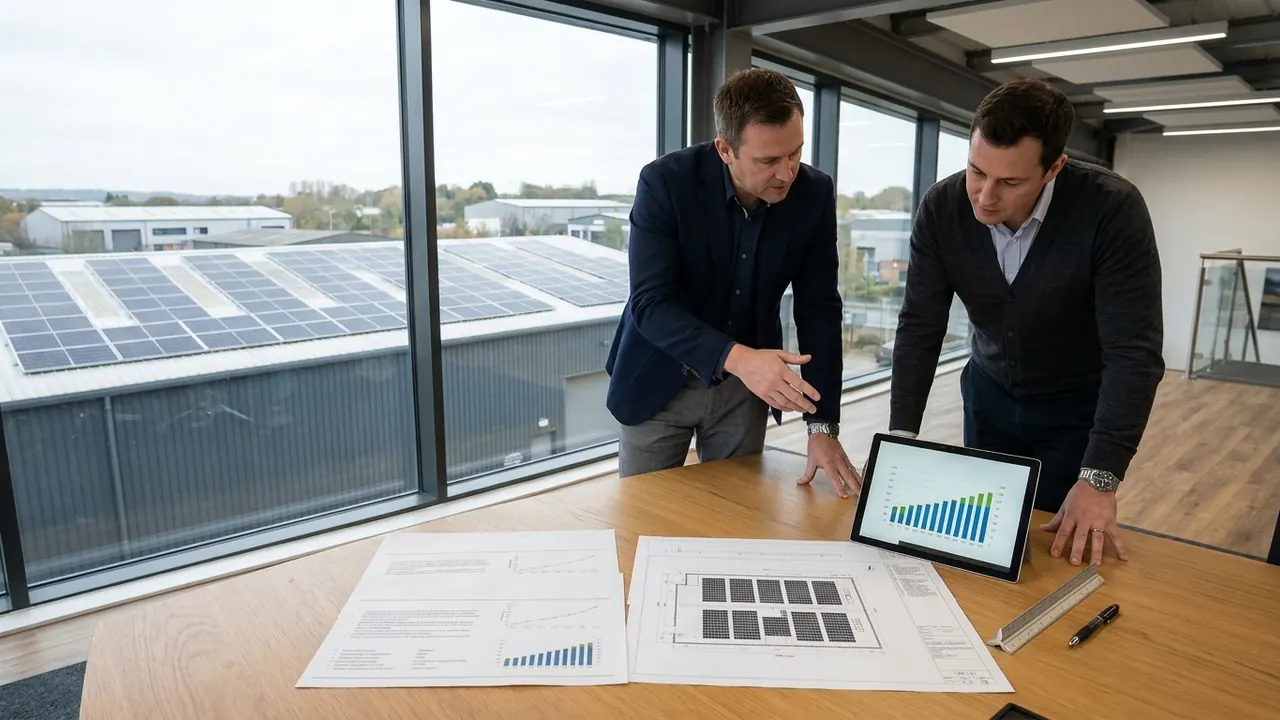
When presenting a commercial solar solution, one of the questions I am most often asked is: “How many panels is it?”
It is an understandable question. Panel count has long been used as a benchmark when comparing residential solar quotes, so buyers naturally carry that approach into commercial projects. But it tells you very little about the capacity of the system or how much electricity it will generate.
A commercial solar installation proposal should explain what you are buying, what it is expected to deliver and who takes responsibility for the installation and ongoing support.
Start with capacity, generation and yield
Solar panels come in different physical sizes and power ratings. One installer might specify 200 panels rated at 500 watts each, while another specifies 250 panels rated at 400 watts each. Both provide exactly the same total installed capacity: 100 kilowatt-peak, or 100 kWp.
More panels does not necessarily mean more power. Different panel dimensions can simply help a designer make better use of the available roof space.
When comparing quotes, start with these three measures.
A — Capacity: how powerful is the system?
The total installed capacity, expressed in kWp, should appear clearly at the top of your quote. This is the figure to compare when assessing system size, rather than panel count.
B — Annual generation: how much electricity will it produce?
Alongside capacity, the quote should show estimated annual generation in kilowatt-hours per year, or kWh/year. These are the two most important headline numbers.
Two systems with the same capacity can generate different amounts of electricity. Location, roof orientation, panel tilt, shading and system design all affect the forecast.
The quote should name the software or calculation method used, such as PVGIS or an applicable MCS calculation method, and provide a supporting calculation report. You do not need to be familiar with these tools yourself. Naming the method and showing the assumptions makes the figures traceable and easier to compare. The software name alone does not guarantee accuracy.
C — Yield: how much electricity will it produce for its size?
Specific yield, sometimes described as yield or performance, is the estimated annual generation divided by the installed capacity. It is expressed in kWh/kWp per year.
For example, a 100 kWp system expected to generate 90,000 kWh annually has a yield of 900 kWh/kWp per year.
This helps you compare systems on a common basis. Two quotes might both offer 100 kWp, but one forecasts 85,000 kWh a year and the other 95,000 kWh. The second forecasts an additional 10,000 kWh every year.
A higher-priced system could therefore offer better value, even where its capacity is the same as a cheaper proposal. However, the higher generation must be supported by credible calculations using comparable assumptions. Its financial value also depends on how much electricity your business can use and what any surplus earns through export.
Before asking “How many panels?”, check:
- A — Capacity in kWp: the size of the system.
- B — Estimated generation in kWh/year: its expected annual electricity production, supported by a named calculation method.
- C — Yield in kWh/kWp/year: its expected annual production for each kWp installed.
Roof suitability should be the installer’s responsibility
A commercial solar installation proposal should take the compliance work and heavy lifting away from the buyer. This is a business-to-business transaction: the buyer is appointing an expert and trusting them to assess, design and deliver a suitable installation.
Agree in writing who arranges and pays for a commercial roof suitability assessment, and request a report from a suitably qualified engineer where needed.
That assessment needs to reflect the actual proposed installation, including the panel manufacturer and model, panel layout, mounting system, fixing method and any ballast. These details determine the additional weight and how loads are transferred into the building. Without them, the assessment cannot fully establish whether the roof is suitable for the proposed system.
A proposal issued before these checks are complete should clearly explain what remains subject to structural approval and what happens if strengthening or other roof works are required. Any necessary works should be identified, priced and agreed before installation proceeds.
If the sales proposal promises a fully managed installation but the small print passes responsibility for confirming roof suitability back to the buyer, that should be a red flag. The installer controls the solar design and should coordinate the technical evidence needed to support it.
The installer should manage the grid connection
Ask who will manage the DNO grid connection process from application through to completion, and have the responsibility set out in your contract.
The Distribution Network Operator, or DNO, manages the local electricity network. The connection procedure depends on the proposed system and network circumstances; ask which notification or approval applies before installation.
An installer may ask for a Letter of Authority, or LOA, to act on your behalf; check which information and signatures the network operator requires from you. The installer should then prepare the technical submission, manage all correspondence, address any connection conditions and submit the final commissioning documentation.
Any export restrictions, network works or associated charges should be identified by the installer and clearly explained, including their effect on the proposed installation and financial forecast. The proposal should state what is included in the price and how any outstanding connection costs will be handled.
The buyer is appointing a specialist to deliver a complete installation. Managing the grid connection should be part of that service, with the installer accountable for taking it through to completion.
Understand what the warranties actually cover
A commercial solar proposal should clearly distinguish between manufacturers’ warranties and the installer’s installation and workmanship warranty.
Manufacturers’ warranties cover the equipment, such as panels, inverters and mounting systems, subject to their terms. The installer should ensure these warranties are registered where required and passed to the buyer, with the supporting documents included in the handover pack.
Solar panels typically also have a performance warranty. This relates to their power output over time; it is separate from the product warranty and does not guarantee the annual electricity generation forecast in your proposal.
The installer’s installation and workmanship warranty covers the quality of the installation. It should clearly state its duration, what is covered and who is responsible for putting defects right.
But there is a further question every buyer should ask:
If equipment fails during the covered period, does your warranty include the labour and access needed to replace it?
A manufacturer may supply a replacement inverter or panel without covering the electrician’s time, removal and refitting, scaffolding or specialist access equipment. These costs can be substantial on a commercial building.
Ask whether this cover is included in the installer’s warranty package and for what period. Do not assume that a long equipment warranty means a replacement will cost you nothing.
Ask for written confirmation that labour, removal, refitting, testing and any necessary access equipment are included when replacing equipment covered by warranty. If they are excluded, the proposal should make that clear before you sign.
Monitoring and reporting should be included
Solar panels require relatively little maintenance, but low maintenance does not mean no maintenance. The installer should provide a schedule for periodic inspections and electrical checks suited to the equipment and site.
Ask whether live monitoring and proactive fault alerts are included, for how long, and whether they incur an additional charge. The proposal should clearly explain who receives alerts, who investigates faults and who takes responsibility for resolving them.
If a provider offers parts, labour, access equipment or proactive monitoring as part of its warranty, request the written scope, exclusions, duration and price. Do not assume one provider’s terms apply to another.
Automated monitoring can operate 24/7/365, but this should not be confused with a promise that a person is watching the system around the clock. The installer should clearly state its response arrangements and identify any loss of monitoring connection.
Clients should also have access to their monitoring portal. However, these platforms can be time-consuming and difficult to navigate for someone unfamiliar with solar technology. Having a login should not mean the buyer is expected to become responsible for checking the system.
Ask whether the proposal includes performance reports, how often they arrive and who acts on any underperformance. These should clearly show:
- Estimated generation against actual generation.
- Estimated savings against achieved savings, identifying any assumptions used.
- Any faults, downtime or performance issues, together with the action being taken.
Generation should be considered alongside seasonal and weather conditions, while savings should reflect electricity used on site, applicable tariffs and any export income.
The buyer should receive a clear picture of how the system is performing without having to interpret technical dashboards or chase the installer for updates.
Compare the complete service
A comparable commercial solar quote should give you more than a price and a panel count. It should specify capacity, expected generation and yield, explain roof suitability and any required works, include management of the grid connection, and clearly set out warranties, maintenance, monitoring and reporting.
The right comparison is what the system is expected to deliver—and the responsibility the installer accepts for delivering and supporting it.
Ready to Take Action?
Planning solar for your business?
Explore your roof, electricity demand and procurement options with the commercial solar team. No obligation.
Request a Commercial Assessment →
Written by
Matt Acraman is Managing Director of Butterfly Eco Limited. Active in commercial solar since 2007, he works on solar project origination, financing and delivery for UK organisations.
Matt leads Butterfly Eco, a commercial solar partner of this site. Read his profile and articles.
View LinkedIn ProfileTools & Services Related to This Article
Explore business solar options, feasibility and financing.