Solar Panel and Battery Storage Cost UK: Complete 2026 System Pricing, SEG Rates, and Payback
Full 2026 solar and battery pricing from £5,000 for a 3.5 kWp solar-only array to £17,500 for a 6.5 kWp system with 13.5 kWh storage. The 31 March 2027 0% VAT deadline, SEG rates from 3p to 30p per kWh, and why self-consumption jumps from 30% to 85% with a battery.
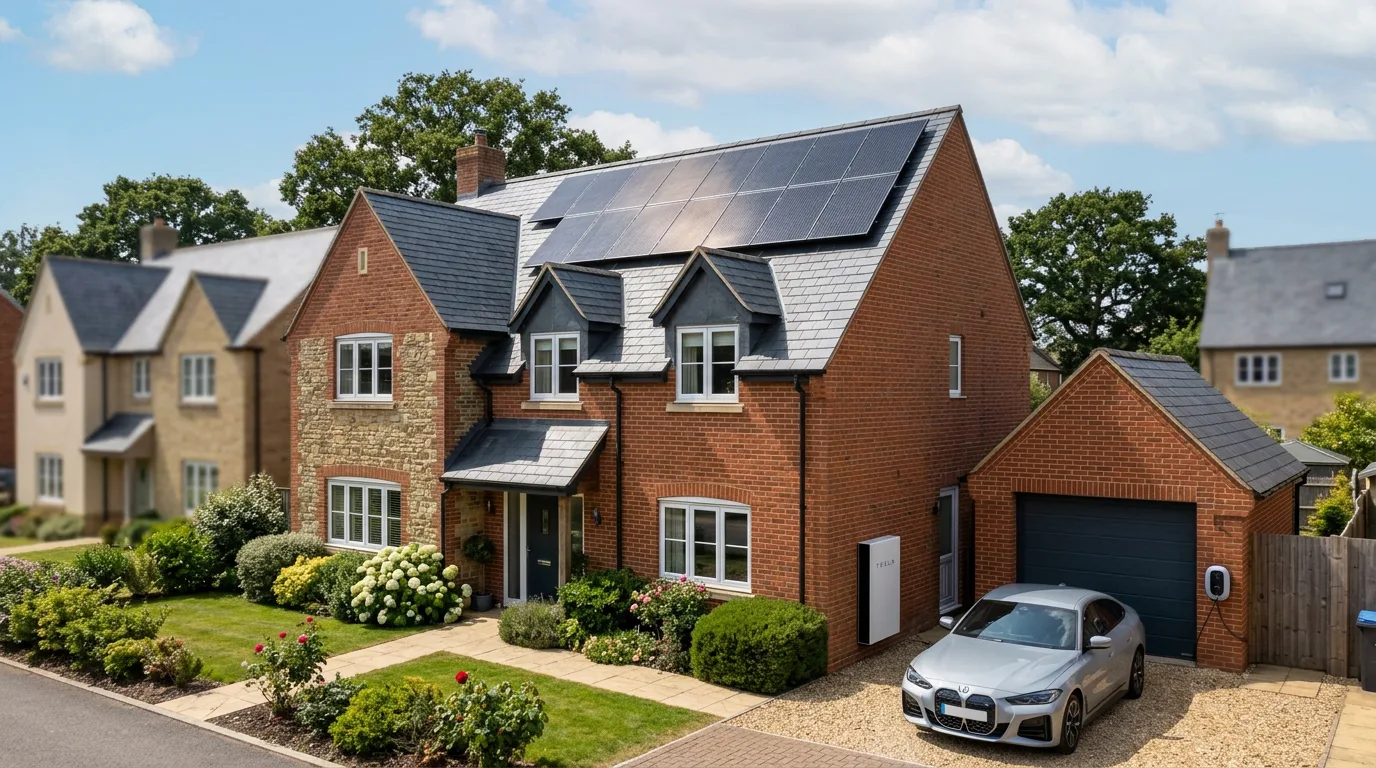
AT A GLANCE
- £11,000-£13,500 - the typical fully installed price for a 5.0 kWp solar array paired with a 9.5 kWh battery in 2026, with 0% VAT applied.
- 31 March 2027 - the date 0% VAT on solar panels and battery storage expires, after which installations revert to 20% VAT on hardware and labour.
- 70-85% - the self-consumption rate homeowners achieve with battery storage, compared with just 25-35% for solar panels alone.
If you've searched for solar panel and battery storage cost UK figures recently, you've probably noticed the numbers vary wildly depending on who you ask. That's partly because the market has genuinely changed shape. A decade ago, solar economics revolved around the Feed-in Tariff, a government subsidy that paid you for every kilowatt-hour your panels produced, whether you used it or not. That scheme closed to new applicants in 2019, and what's replaced it is a very different calculation: how much of your own generation can you actually consume, and how much can you sell back at a decent rate when you can't.
That shift matters because it changes what "good value" looks like. A solar-only system is still a sound investment, but it leaves money on the table if your roof generates power at 1pm while you're at work and your house is empty. Add a battery, and suddenly that surplus doesn't vanish into the grid for a few pence, it sits in your garage or utility cupboard until you need it at 6pm when electricity costs three or four times as much. This guide breaks down what these systems actually cost in 2026, why the VAT clock is ticking, and how the Smart Export Guarantee has evolved into something worth paying attention to.
We'll also cover the regulatory side, because DNO approval timelines and grid connection thresholds catch a surprising number of homeowners off guard partway through a project. None of this is complicated once you've seen the numbers laid out properly, so let's get into it.
Why Self-Consumption Now Drives the Numbers
Retail electricity in the UK currently sits at around 27.69p per kWh under the Ofgem price cap, give or take supplier variation. That single figure is the reason battery storage has become so central to the solar conversation. Every kWh of your own solar generation that you use directly in your home saves you 27.69p. Every kWh you export instead earns you somewhere between 3p and 30p, depending on your export tariff, which we'll get to shortly. The gap between those two numbers is the entire economic argument for adding a battery.
Here's the problem with solar alone: your panels generate most of their output between roughly 10am and 4pm, when the sun is highest. Most households, however, use the bulk of their electricity in the morning before work and school, and again from about 5pm through to bedtime, when kettles, ovens, TVs, and lighting all come on at once. Without storage, a typical home only manages to use 25% to 35% of what its panels produce directly. The rest gets exported at whatever rate the supplier offers, which even on a good tariff is a fraction of the retail price you'd otherwise be paying.
Add a battery sized appropriately to your daily consumption and that self-consumption rate climbs to between 70% and 85%. The panels charge the battery through the day, and the stored energy covers your evening peak instead of exporting it for pennies and then buying it back from the grid at four times the price a few hours later. That swing, from 30% self-consumption to 80%, is usually the single biggest lever in any solar payback calculation, bigger than panel efficiency, bigger than roof orientation, bigger than almost anything else you can control.
Solar Panel and Battery Storage Cost UK: The 2026 Price Bands
Pricing scales with both array size and battery capacity, and the two need to be matched sensibly rather than maximised independently. An oversized battery paired with an undersized array will spend half the year only partially charged. Here's what fully installed systems, hardware plus labour, at 0% VAT, actually cost across the common configurations we see quoted in 2026.
| Array Size & Battery Capacity | Roof Space Needed | Installed Cost (0% VAT) | Typical Annual Generation | Annual Bill Savings | Payback Period |
|---|---|---|---|---|---|
| 3.5 kWp array (solar only) | 16-18 m² | £5,000-£6,200 | 3,100-3,400 kWh | £500-£650 | 8-10 years |
| 4.0 kWp array + 5.0 kWh battery | 19-22 m² | £8,500-£10,500 | 3,600-4,100 kWh | £850-£1,050 | 8-10 years |
| 5.0 kWp array + 9.5 kWh battery | 24-28 m² | £11,000-£13,500 | 4,500-5,200 kWh | £1,200-£1,500 | 7-9 years |
| 6.5 kWp array + 13.5 kWh battery | 32-36 m² | £14,000-£17,500 | 5,800-6,700 kWh | £1,600-£2,050 | 7-9 years |
Notice that adding a battery to a solar array doesn't just add cost, it also improves the payback period slightly, from 8-10 years for solar-only to 7-9 years for the larger combined systems. That seems counterintuitive given the higher upfront spend, but it reflects the self-consumption effect above: more of the generated electricity is being used at its full retail value rather than exported at a discount, so the larger systems earn their keep faster in relative terms even though the absolute outlay is bigger.
On the hardware side, most 2026 quotes will specify either a DC-coupled hybrid inverter, where the battery sits on the same circuit as the solar array and the whole system is managed by a single inverter, or an AC-coupled retrofit setup, where an existing solar installation gets a battery bolted on afterwards with its own separate inverter. DC-coupled systems are marginally more efficient because the electricity only converts between DC and AC once, but AC-coupled retrofits are the only sensible option if you already have panels installed and don't want to replace a perfectly functional existing inverter. If you're in that position, our guide on adding a battery to an existing solar system covers the practical wiring and compatibility questions in more depth.
The 0% VAT Deadline You Need to Know About
Since April 2022, the UK government has applied a 0% VAT rate to energy-saving materials including solar panels and battery storage, whether installed alongside solar or as a standalone retrofit. That relief has been extended more than once, but the current legislation sets a firm expiry date of 31 March 2027. After that, VAT reverts to 20% on both hardware and installation labour unless the government announces a further extension, which at the time of writing it has not.
What the VAT deadline actually costs you if you wait
On a typical £12,000 system (5.0 kWp array plus 9.5 kWh battery), a 20% VAT charge would add roughly £2,400 to the price. Installers are already booking into Q1 2027, and given typical lead times of 8 to 12 weeks from survey to commissioning, anyone wanting to guarantee 0% VAT should be getting quotes now rather than waiting until early 2027 when capacity tightens further. This applies equally to standalone battery retrofits, not just new combined systems, so read our note on the battery storage VAT exemption deadline if you're only adding storage to an existing array.
It's worth being clear-eyed about why this deadline exists and why it's unlikely to be extended indefinitely. The relief was originally introduced as a temporary measure to accelerate residential decarbonisation during a period of high gas prices. With domestic solar and battery installation rates now well established and installer capacity built out across most of the UK, the Treasury has less pressure to keep subsidising the sector through the tax system. Whether or not a fresh extension gets announced closer to the date, the safest assumption for anyone planning a purchase in the next 12 months is that the March 2027 cutoff will hold.
Smart Export Guarantee Rates: Flat vs Dynamic Tariffs
Once your battery is full and your house is fully powered, any surplus generation still gets exported to the grid, and this is where the Smart Export Guarantee, or SEG, comes in. Every licensed electricity supplier with over 150,000 customers is legally required to offer an export tariff, though the rates and structures vary enormously.
Flat-rate SEG tariffs pay a fixed amount per kWh exported regardless of time of day, typically somewhere between 3p and 12p depending on the supplier. These are simple to understand and don't require any smart meter data juggling, but they're a poor deal if you're exporting during periods when wholesale electricity is expensive, because you're getting the same low flat rate whether the grid needs your power or not.
Dynamic, half-hourly export tariffs work differently. They track wholesale electricity prices in near real-time and pay you accordingly, which means export rates during high-demand evening periods can spike to 24p, sometimes even 30p per kWh, while overnight rates when demand is low might drop close to zero or occasionally negative. For a battery owner, this creates a genuinely useful arbitrage opportunity: charge from cheap overnight grid electricity or daytime solar, then either use that stored energy yourself during the evening peak or, if your battery is already full and the export rate is high enough, discharge into the grid deliberately to capture the premium rate. Suppliers running this model, like Octopus with its Flux tariff, have made this kind of two-way trading increasingly automated, and our breakdown of Octopus Flux export rates walks through how the algorithm decides when to charge, hold, or discharge.
| SEG Tariff Type | Typical Rate Range | Best Suited To |
|---|---|---|
| Flat-rate SEG | 3p-12p/kWh, fixed all day | Solar-only households with limited daytime consumption flexibility |
| Dynamic half-hourly SEG | 0p-30p/kWh, varies by demand | Battery owners able to time exports around evening peak pricing |
The practical takeaway is that a battery doesn't just improve your self-consumption, it also unlocks the higher end of the SEG market, because you can choose when to export rather than being at the mercy of whenever the sun happens to be shining.
See What Your Roof Could Save You
Run your own numbers through our payback calculator, tailored to your postcode, roof orientation, and current electricity usage.
Try the Solar Payback CalculatorG98 vs G99: What the Grid Connection Rules Mean for You
Before any solar or battery inverter can be connected to the national grid, it needs sign-off from your local Distribution Network Operator, or DNO. Which process applies depends entirely on the size of your inverter, not the size of your battery or panel array in isolation.
Systems with a single-phase inverter rated up to 3.68 kW fall under Engineering Recommendation G98. This is the straightforward route: your installer notifies the DNO after the system is connected, and in the vast majority of cases that's the end of it. No pre-approval is required, and most domestic solar and battery installations, including combined hybrid systems, comfortably fit within this threshold.
Systems exceeding 3.68 kW, whether that's a larger single array, a three-phase installation, or a combined solar-plus-battery hybrid inverter pushing more capacity, fall under G99. This requires prior approval from the DNO before installation can even begin, which typically adds a few weeks to the project timeline while the network operator confirms the local grid can accommodate the extra capacity. It's not usually a barrier, but it's worth asking your installer upfront which category your proposed system falls into, so you're not caught out by an unexpected delay midway through a project you'd hoped to have running before winter.
How Long Does the Hardware Actually Last?
Solar panels are remarkably durable pieces of kit. Manufacturers typically guarantee 25 to 30 years of operation, with performance warranties promising the panels will still produce at least 80-85% of their original rated output at the end of that period. Degradation is gradual, usually around 0.3% to 0.5% per year, so the difference in output between year 1 and year 10 is barely noticeable in practice.
The inverter is the weaker link. Whether it's a standard string inverter or a hybrid unit managing both solar and battery, most inverters carry manufacturer warranties of 10 to 12 years, and it's realistic to budget for a replacement around year 12 of the system's life. Inverter replacement typically costs somewhere between £800 and £1,800 depending on capacity and whether it's a simple string inverter or a more complex hybrid unit. This isn't a hidden cost so much as a known one that rarely gets mentioned in initial sales conversations, so it's worth factoring into your long-term cost of ownership rather than treating the headline installed price as the final number you'll ever pay.
Batteries have their own lifecycle considerations, generally rated in charge cycles rather than years. Most lithium iron phosphate (LiFePO4) batteries installed today are warrantied for somewhere between 6,000 and 10,000 cycles, which at one full cycle per day works out to roughly 16 to 27 years of use, comfortably outlasting the typical 10-year warranty period itself. In practice, most homeowners will replace or upgrade their battery for capacity reasons, wanting more storage as their household electricity use grows, well before the cells themselves genuinely wear out.
Choosing an Installer: What Actually Matters
Not every quote you receive will be comparable on a like-for-like basis, so it's worth knowing what to check before signing anything.
- Confirm the installer holds current MCS (Microgeneration Certification Scheme) accreditation, which is required for you to qualify for SEG payments and for the 0% VAT relief to apply correctly.
- Check they're registered with RECC (Renewable Energy Consumer Code), which provides a consumer protection framework and dispute resolution process if something goes wrong post-installation.
- Ask specifically whether the quoted price includes DNO notification and, if relevant, G99 application fees, since these are sometimes left out of headline pricing.
- Get at least three comparable quotes specifying identical panel wattage, battery chemistry, and inverter brand, so you're comparing genuinely equivalent systems rather than apples and oranges.
- Review warranty terms closely, particularly what's covered on labour versus hardware, since a 25-year panel warranty is only as good as the installer's willingness to still be trading and honouring claims a decade or two from now.
A properly matched installer will also right-size your system to your actual consumption pattern rather than simply maximising roof coverage. It's a common upsell tactic to push the largest array a roof can physically accommodate, but if your household only uses 3,500 kWh a year, a 6.5 kWp array is going to spend a lot of its output being exported at SEG rates rather than consumed at retail value, which drags out your payback period unnecessarily.
Compare Quotes From Vetted UK Installers
Get matched with up to three MCS-certified solar and battery storage installers in your area, free of charge and with no obligation.
Find a Local InstallerReady to Take Action?
Get free quotes from local MCS-certified installers
Takes under 4 minutes. No cold calls. No obligation.
Get My Free Quotes →Get Your Free Quotes
Takes under 4 minutes · No obligation

Written by
Mark Anthony Haines
Mark has over a decade of experience in the UK renewable energy sector, specialising in solar PV, heat pump systems, and home battery storage. He founded HeatPumpsAndSolar.co.uk to help UK homeowners cut through the noise around green energy installations, government grant schemes, and smart tariffs.
View LinkedIn Profile