The 4 PM Paradox: Why Emptying Your Battery Pays More Than Hoarding It
Discover why hoarding solar is a myth. Uncover the Octopus Flux export rates 2026 and learn how battery storage arbitrage can earn you hundreds a year.
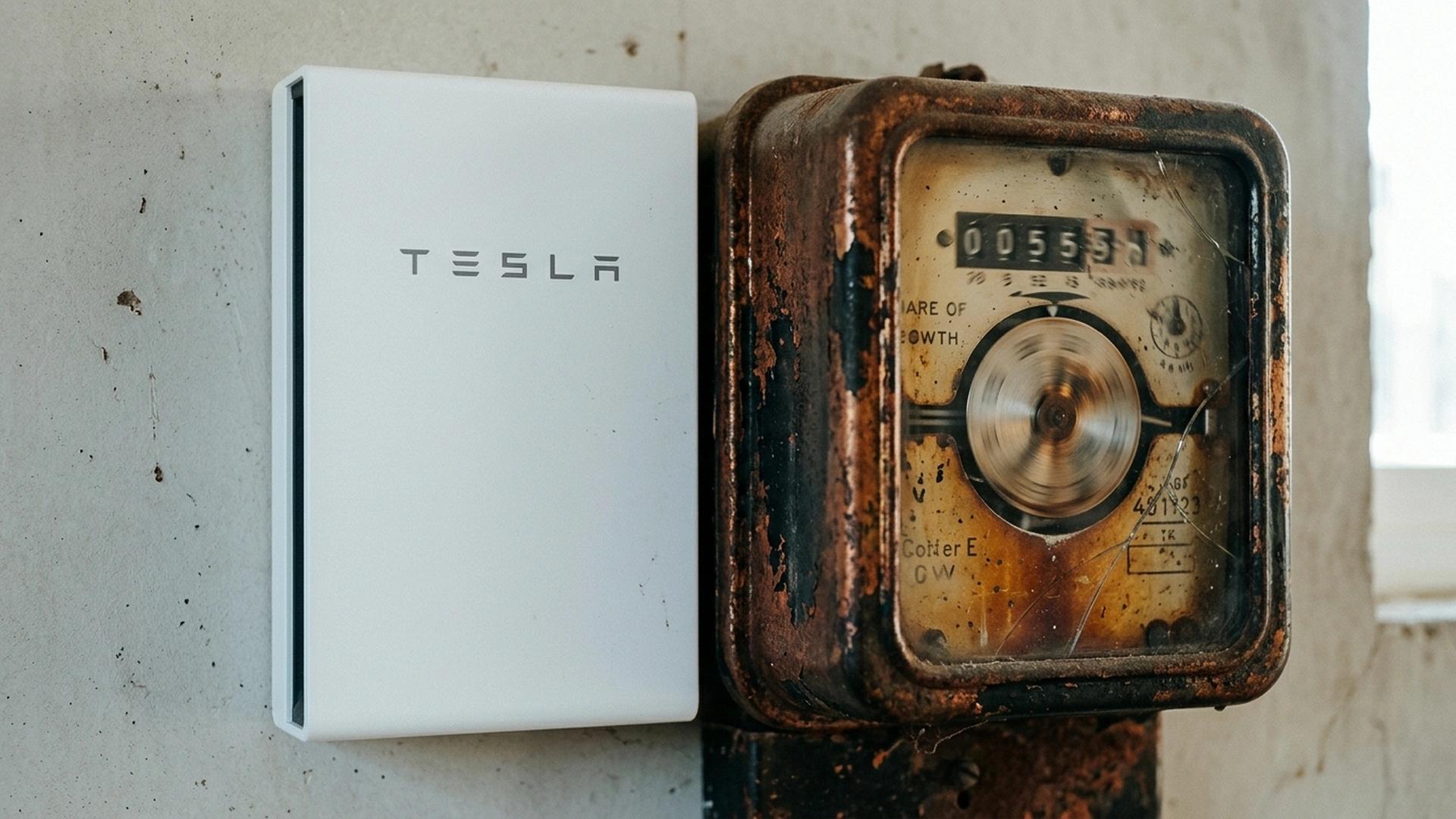
Quick Summary
- The self-consumption myth assumes a battery should hoard solar for total grid independence, but dynamic time-of-use tariffs pay more to sell power at the 4 PM peak than it costs to buy it back at 2 AM.
- Octopus Flux offers a roughly 12.7p/kWh gross arbitrage spread between the 15.89p off-peak import and the 28.60p peak export, and a 13.5 kWh battery can earn around £1.30 gross per daily cycle.
- The fix is a high-output 11.04 kW Tesla Powerwall 3 unlocked by a G99 DNO application, allowing the full battery payload to be dumped into the three-hour peak window rather than choked by a 3.68 kW G98 cap.
The Misconception
Homeowners believe the sole purpose of a domestic battery is to hoard stored solar energy to power the home and achieve complete grid independence, never buying electricity from the national grid.
Table of Contents
An Aerospace Engineer Who Built a £14,200 Vault and Left It Idle
Arthur Pendelton, an aerospace engineer in a mid-terrace property in St Albans, Hertfordshire, approached his domestic energy architecture with mathematical rigidity. He believed the pinnacle of renewable success was absolute energy autonomy, a state where his smart meter read exactly 0 kWh imported from the grid. To achieve it, he authorised £14,200 for a 6.4 kWp rooftop solar array paired with a 13.5 kWh home battery, and instructed his installer to configure the hybrid inverter strictly for maximum self-consumption, blocking export entirely. To dodge the perceived bureaucracy of a DNO application, he also insisted on a hard G100 export limit of 3.68 kW. He had ignored the octopus flux export rates 2026 homeowners were using to turn a battery into a trading asset, because his model had no room for buying and selling power.
The strategy looked clever through a long August 2025 of clear skies, when his grid imports dropped to zero and the battery carried the house through the night. The structure failed the moment the seasons turned. By October, cloud cover across Hertfordshire meant the 6.4 kWp array struggled to push the 13.5 kWh battery past 40 percent state of charge by dusk. By November the collapse was steep: between 16:00 and 19:00 the oven, induction hob and heating pushed demand up exactly when the battery was already low, and it depleted by 17:30. For the rest of the peak window Arthur imported at standard variable rates near 28p/kWh.
By January 2026 the telemetry was catastrophic. The 13.5 kWh battery sat at a 10 percent baseline for 18 hours a day, idle and useless, while Arthur bought all his energy during the most expensive domestic periods. Next door, his neighbour ran an identical battery on a time-of-use tariff, force-charging overnight and discharging to the grid between 16:00 and 19:00. Arthur paid roughly £588 to the grid over six winter months. Had he traded instead, the daily arbitrage spread would have earned him around £309 across the same period. A high-technology asset had become a dormant wall ornament for half the year.
Why Hoarding Your Battery Misses the octopus flux export rates 2026 Peak Window
If the point of a battery is to never buy from the grid, why is hoarding it quietly losing money? Because a modern time-of-use tariff pays more to sell power at 4 PM than it costs to buy it back at 2 AM.
The Mechanics of Battery Arbitrage and Cycle Economics
Battery arbitrage exploits the volatility of half-hourly electricity pricing. Between 02:00 and 05:00, national demand is low and baseload generation from nuclear and offshore wind often exceeds it, so wholesale prices fall. Between 16:00 and 19:00, domestic consumption spikes just as solar generation drops to zero, and consumer pricing peaks. A battery treated as a passive vault misses this spread; a battery treated as a trading vehicle captures it.
The Octopus Flux tariff structures the day into three bands. Off-peak sits roughly between 02:00 and 05:00 at about 15.89p/kWh, the day rate runs near 28p/kWh, and the peak export window between 16:00 and 19:00 pays roughly 28.60p/kWh in the London region, with regional variance. The gross arbitrage spread between off-peak import and peak export is around 12.71p/kWh.
| UK Region | Peak Import (p/kWh) | Off-Peak Import (p/kWh) | Peak Export (p/kWh) | Off-Peak Export (p/kWh) | Gross Arbitrage Spread (p/kWh) |
|---|---|---|---|---|---|
| London | 37.07 | 15.89 | 28.60 | 5.24 | 12.71 |
| Bristol | 38.61 | 16.55 | 29.22 | 4.55 | 12.67 |
| Cardiff | 38.65 | 16.57 | 29.35 | 4.69 | 12.78 |
| Birmingham | 37.05 | 15.88 | 27.81 | 4.39 | 11.93 |
| Edinburgh | 36.15 | 15.49 | 27.19 | 4.42 | 11.70 |
Charging a 13.5 kWh battery overnight at 15.89p/kWh costs about £2.14. Because grid energy must be inverted from AC to DC for storage and back to AC on discharge, an AC-coupled round-trip loses roughly 11 percent, leaving about 12.02 kWh retrievable. Selling that at 28.60p/kWh earns £3.44, a daily gross arbitrage profit of £1.30, or £474.50 across a year of pure grid-to-grid trading. That is the worst case, with no solar contributing free energy to the charge.
| Operational Metric | Value | Unit |
|---|---|---|
| Off-peak charge cost (13.5 kWh at 15.89p) | £2.14 | GBP per day |
| AC-coupled round-trip losses (11%) | 1.48 | kWh lost per cycle |
| Usable export energy available | 12.02 | kWh per cycle |
| Peak export revenue (12.02 kWh at 28.60p) | £3.44 | GBP per day |
| Daily gross arbitrage profit | £1.30 | GBP per day |
| Annual gross arbitrage revenue (365 cycles) | £474.50 | GBP per year |
| Estimated cycle degradation cost (8.5p/kWh) | £371.38 | GBP per year |
| True net profit (after hardware degradation) | £103.12 | GBP per year |
The profitability ceiling is governed by thermodynamics and degradation. Modern lithium iron phosphate systems reach about 97.5 percent round-trip efficiency when DC-coupled to solar, dropping to roughly 89 percent when AC-coupled from the grid. Every cycle also degrades the cells, so the true profit must beat the Levelised Cost of Storage. For a premium battery costing around £7,750 over an assumed 8,760 cycles, the degradation cost sits at roughly 7p to 11p per kWh. The arbitrage spread must clear that figure to be genuinely profitable, and on Flux it does, particularly once free solar energy replaces paid grid energy in the charge step.
The Winter the Battery Sat Full and the Bill Stayed High
Arthur's inverter dashboard told the story in two colours. The battery trace was flat for 18 hours a day, holding its 10 percent floor, while the import trace spiked red through every winter evening. He had paid £14,200 to own a storage vault and then refused to open the door. His neighbour, running the same hardware on a dynamic tariff, was force-charging at 2 AM and selling back at 4 PM, turning the battery into an income stream Arthur had deliberately walled off. The self-consumption model that justified the purchase in summer was quietly costing him hundreds in winter.
The Fix: A High-Output Inverter and a G99 Export Gateway
The architectural fix requires a shift in both hardware specification and regulatory engagement. The inverter is not a passive conduit for roof-mounted solar; it is a trading gateway to the national grid, and its output bandwidth dictates how much of the daily peak can be captured. A standard G98-compliant inverter is hardware-limited to a continuous AC output of 3.68 kW on a single phase. Because the Octopus Flux peak window is only three hours long, a 3.68 kW cap means a 13.5 kWh battery takes three hours and forty minutes to empty, and the final forty minutes of discharge spills into the cheaper day rate. The system is physically prevented from maximising the arbitrage yield.
The Tesla Powerwall 3 resolves this with an internal hybrid inverter capable of 11.04 kW continuous AC output on a standard 230 V single-phase supply, emptying the full 13.5 kWh in about 75 minutes and dumping the entire payload inside the peak window. Unlocking that output requires a G99 DNO application rather than a G98 notification, often via the Fast Track SGI route for type-tested equipment.
| System Specification | Legacy Setup (G98 Limit) | High-Output Setup (Tesla PW3, G99) |
|---|---|---|
| Continuous AC output | 3.68 kW | 11.04 kW |
| Max energy exported in 3-hour peak | 11.04 kWh | 33.12 kWh (with battery expansion) |
| Time to discharge 13.5 kWh battery | 3 hours 40 minutes | 1 hour 13 minutes |
| Missed peak window capability | 40 minutes forced into standard rate | Zero, full payload at peak rates |
| DNO approval required | Post-install notification | Pre-install application (SGI-2) |
| Round-trip efficiency (DC-coupled) | ~90% | 97.5% |
Scaling multiplies the effect. The Powerwall 3 supports up to three expansion units for 54 kWh of usable capacity driven through the primary 11.04 kW inverter. Under an approved G99 application, that stack could charge overnight at 15.89p/kWh and export at 11.04 kW across a five-hour window, effectively operating the home as a small virtual power plant. Accessing the premium export rates that make this profitable requires an MCS-certified installation, a SMETS2 smart meter in half-hourly settlement mode, and a valid export MPAN. A G99 lets the system export above 3.68 kW; if the local grid is constrained the DNO may impose a G100 limitation, which is better than G98 but still curtails maximum profit.
What This Means for Your Battery
Arthur's story ends with a change of mental model. The battery on his garage wall was never meant to sit full and proud; it was meant to move. Once he lifted the G100 cap through a G99 application, switched to a dynamic tariff, and let the inverter discharge aggressively into the 4 PM peak, the same hardware that had cost him money all winter began paying him. Takeaway: a home battery does not need to hoard stored energy for off-grid isolation; it needs a high-output inverter and a dynamic export tariff to aggressively trade that energy with the grid during peak pricing windows.
Key Takeaways
- The average UK solar home with a 4.9 kWp array and a 5.2 kWh battery can cut annual bills by around £937 using the Octopus Flux tariff architecture.
- Discharging a 13.5 kWh battery to the grid during the 16:00 to 19:00 peak can earn up to £3.86 in direct revenue per daily cycle.
- Standard Octopus Flux drops to roughly 15.89p/kWh between 02:00 and 05:00, allowing cheap overnight force-charging of depleted batteries.
- The Tesla Powerwall 3 reaches about 97.5 percent round-trip efficiency when DC-coupled, sharply reducing the thermodynamic losses of arbitrage.
- A standard G98 inverter is hardware-limited to 3.68 kW continuous AC output, suffocating a high-capacity battery's ability to empty during the three-hour peak.
- A G99 application unlocks the 11.04 kW continuous output of the Tesla Powerwall 3 on a single-phase supply, tripling export speed.
- The chemical cycle degradation cost for a premium LFP home battery sits between 7p and 11p per kWh, so the arbitrage spread must exceed this to be profitable.
- DESNZ data shows over 22,398 domestic batteries were installed in the UK between April 2024 and March 2025, and median cost for 11 to 30 kWh systems has fallen to around £590 per kWh.
Frequently Asked Questions
Do I need to fill my battery entirely from solar to use the Octopus Flux tariff?
No. Flux lets you force-charge your battery from the grid during the cheap 02:00 to 05:00 off-peak window at around 15.89p/kWh, then sell that stored energy back at peak times for roughly 28.60p/kWh, engaging in profitable battery storage arbitrage.
Can I use standard battery storage arbitrage without a solar panel system?
Yes for general arbitrage, but to qualify specifically for Octopus Flux you generally must be a registered MCS solar owner with an active export MPAN. Standalone battery owners should check alternative intelligent tariffs that accept grid-only storage setups.
Will a standard 3.68 kW inverter restrict my Octopus Flux export rates in 2026?
Yes. The highest export rates apply only during the strict three-hour 16:00 to 19:00 window. A 3.68 kW G98 inverter cannot empty a large 13.5 kWh battery before the peak price window closes, stranding your earning potential.
How much money can I make by exporting battery power during peak hours?
An optimised battery on Octopus Flux can achieve combined bill savings and export earnings of roughly £937 per year. Pure export revenue alone can exceed £400 annually if the battery is aggressively discharged during the evening peak.
Do I need a DNO G99 application to get the best export tariff for a solar battery?
To maximise earnings you need a high-output inverter like the 11.04 kW Tesla Powerwall 3. Because this exceeds the 3.68 kW G98 limit, your installer must submit a formal G99 application to your Distribution Network Operator for pre-approval.
Get Your Free Quotes
Takes under 4 minutes · No obligation

Written by
Mark Anthony Haines
Mark has over a decade of experience in the UK renewable energy sector, specialising in solar PV, heat pump systems, and home battery storage. He founded HeatPumpsAndSolar.co.uk to help UK homeowners cut through the noise around green energy installations, government grant schemes, and smart tariffs.
View LinkedIn ProfileMore from Our Insights
Tools & Services Related to This Article
Take the next step with a free calculator or a local installer quote.