The 75 kWh Elephant: Why Your Home Battery Can't Charge Your EV
Can you charge ev from home battery storage? Discover the 15x scale mismatch, DC-AC-DC conversion losses, and why a smart 7p/kWh tariff is the smarter fix.
Quick Summary
- The closed-loop myth assumes a 9.5 kWh home battery can fill an EV overnight, but a 63 to 75 kWh car battery is up to 15 times larger, so the home battery is drained instantly.
- The DC to AC to DC conversion path strips away 10 to 25 percent of the energy as heat, and a continuous 1 to 2 kW parasitic load from the vehicle's thermal management compounds the loss.
- The fix is CT clamp segregation to hide the EV load from the home battery, paired with a smart 7p/kWh off-peak grid tariff that charges the car for less than the 8.7p/kWh hardware wear cost.
The Misconception
Homeowners believe that installing a residential battery creates a closed-loop system where solar energy captured during the day seamlessly transfers to an electric vehicle overnight, providing free zero-carbon driving without ever interacting with the grid.
Table of Contents
A 9.5 kWh Vault Emptied Into a Tesla in 90 Minutes
When Gareth Peregrine, a retired architectural technician, paid £11,500 for a 4 kWp solar array and a 9.5 kWh GivEnergy Gen 3 battery for his 1930s mid-terrace in Llandaff, Cardiff, he believed he had built a closed-loop energy island. His plan to charge ev from home battery storage overnight and wake to a free Tesla was, he thought, the entire point of buying residential storage. On a flat 28p/kWh tariff with no off-peak window, he configured the hybrid inverter strictly for self-consumption, blocking grid export and grid charging entirely.
The failure began at 10:00 PM on a crisp Tuesday. His GivEnergy portal read 100% state of charge, and the Tesla sat at 20% with a 63 kWh usable pack. Gareth plugged in the tethered 7 kW driveway charger, expecting the home battery to carry the load. Instead, the inverter detected the 7 kW draw as ordinary household demand, ramped to its 5 kW maximum continuous discharge, and pulled the remaining 2 kW straight from the grid. Inside the Tesla, the onboard rectifier and liquid cooling pumps lit up immediately, drawing a continuous 1 kW parasitic load to protect the lithium-ion cell chemistry. By 11:50 PM the GivEnergy battery hit its 4% depth-of-discharge protection limit and shut down to prevent irreversible cell damage. For the rest of the night the car charged on peak-rate grid power at 28p/kWh.
At 7:00 AM the damage was quantified. The Tesla had reached only 85%, the home battery read 0%, and telemetry confirmed that roughly 7.5 kWh of the dumped energy had become driving range, about 30 miles. The house had imported 48 kWh from the grid overnight at a cost of £13.44, and because the home battery was flat, Gareth's morning shower and kettle added another £1.50. A £5,000 storage asset had been subjected to a deep, high-stress cycle, and he had still paid the utility company nearly £15 for a single charge.
Why Can't You Charge EV From Home Battery Overnight?
If a home battery holds 9.5 kWh and a car needs 63 kWh, why not simply top it up? The answer is a brutal scale mismatch and a thermodynamic penalty that turns a storage asset into a worn-out ornament.
The Volumetric Mismatch and the DC-AC-DC Penalty
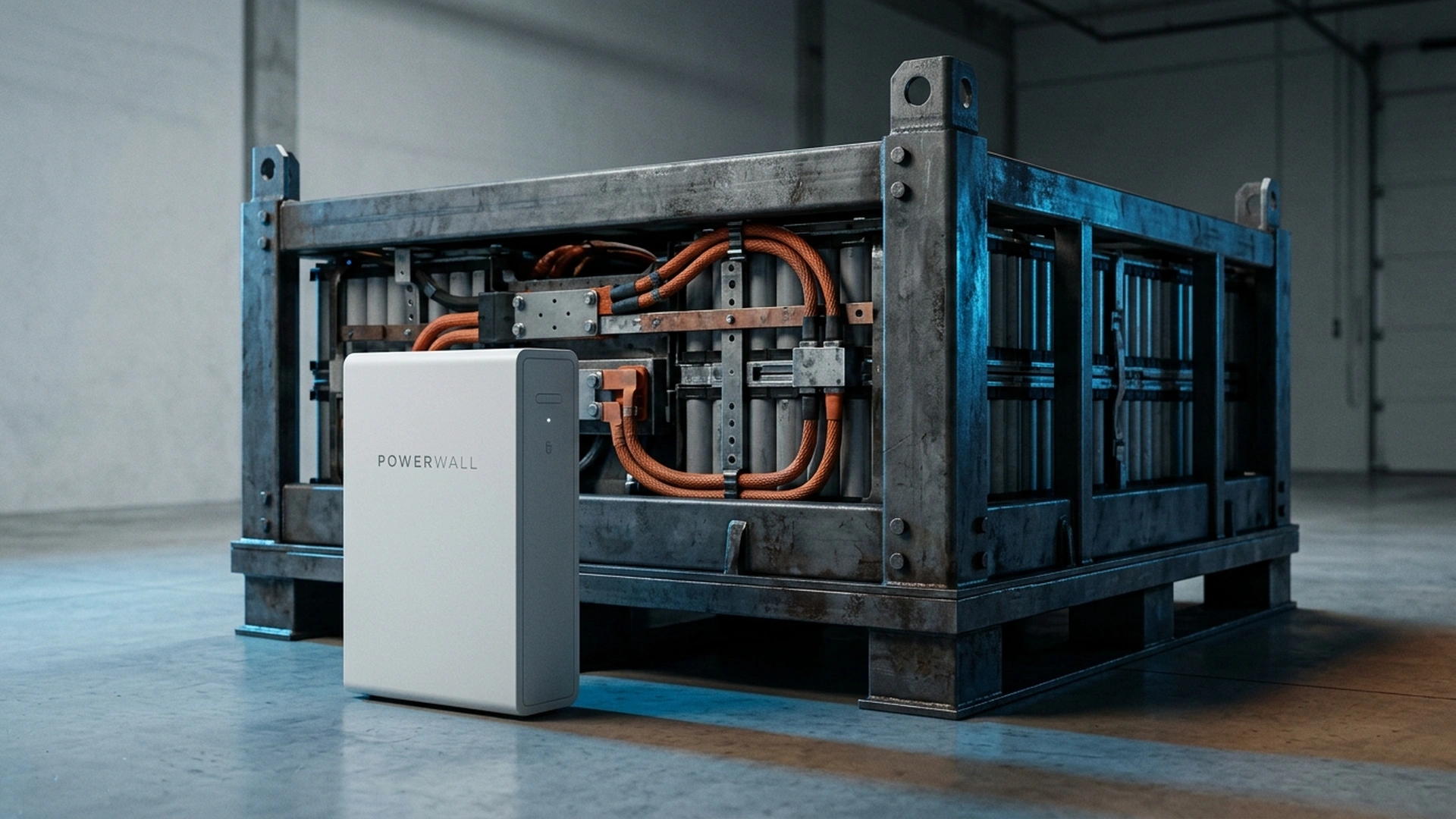
The first barrier is arithmetic. A typical UK household consumes 10 to 15 kWh over a full day, which is why residential units like the 13.5 kWh Tesla Powerwall 3 or the 9.5 kWh GivEnergy Gen 3 are calibrated to sustain a property's baseline load through the night. An electric vehicle, by contrast, is a heavy-duty machine designed to propel two tonnes at motorway speeds. A Tesla Model Y Long Range holds a 75 kWh pack, the energy equivalent of powering a standard home for nearly a week, so filling that void from a 9.5 kWh reserve is a ratio of roughly 15 to one.
The second barrier is thermodynamic. Every energy transformation loses energy as heat. The residential battery stores energy as direct current, so the inverter must convert it to alternating current for the consumer unit and wiring, losing 3 to 5 percent. The AC power then travels through external cabling to the charger, where resistance governed by the current-squared-times-resistance law generates further waste. Once the AC reaches the vehicle, the onboard charger deploys transformers and rectifiers to step the voltage down and convert it back to DC, losing another 10 to 15 percent. The heat from these rectifiers forces the battery management system to run liquid cooling pumps throughout the session, a continuous parasitic load of roughly 1 to 2 kW.
| Storage Unit | Usable Capacity (kWh) | Continuous Output (kW) | Equivalent Miles Driven |
|---|---|---|---|
| GivEnergy Gen 3 (home) | 9.5 | 5.0 | ~35 |
| Tesla Powerwall 3 (home) | 13.5 | 11.0 | ~50 |
| Tesla Model Y RWD (EV) | 63.0 | Receives 7-11 kW | 260 |
| Tesla Model Y LR (EV) | 75.0 | Receives 7-11 kW | 330 |
| BMW iX xDrive50 (EV) | 105.2 | Receives 11-22 kW | 380 |
Independent testing by the German Automobile Club quantifies the deficit. Under controlled 23C conditions, filling the 105.2 kWh pack of a BMW iX required drawing 125.2 kWh from the source, a 20 kWh loss, and a Jaguar I-Pace needed 100.8 kWh to fill a 90 kWh pack. A home battery's entire usable capacity can vanish into the conversion gap before the car even registers meaningful range.
| Vehicle Model | Usable Battery Capacity | Total Energy Required to Fill | Absolute Energy Lost as Heat | Percentage Loss |
|---|---|---|---|---|
| BMW iX | 105.2 kWh | 125.2 kWh | 20.0 kWh | 15.9% |
| Jaguar I-Pace | 90.0 kWh | 100.8 kWh | 10.8 kWh | 10.7% |
| Tesla Model Y (est) | 75.0 kWh | ~89.2 kWh | 14.2 kWh | 15.9% |
The economics compound through chemical degradation. Residential lithium-ion batteries are warrantied for a finite cycle count, typically 6,000 to 10,000 cycles over a 10 to 12 year period at 70 to 80 percent capacity retention. Every deep discharge into a vehicle forces a high-stress cycle. Amortising the £5,000 to £7,500 capital cost over its warranted cycles reveals a hidden wear cost of roughly 8.7p per kWh in hardware degradation alone, which is more expensive than simply buying off-peak grid energy at 7p/kWh on an intelligent tariff.
| Metric | Home Battery Discharge | Smart Tariff Grid Pull |
|---|---|---|
| Energy source | 9.5 kWh GivEnergy battery | Octopus Intelligent Flux (off-peak) |
| Upfront hardware cost | ~£5,000 | £0 |
| Warranty lifespan | 12 years / ~6,000 cycles | N/A |
| Cost per cycle | ~83p per full cycle | N/A |
| Cost per kWh delivered | ~8.7p/kWh (hardware wear) | 7.0p/kWh (actual tariff) |
| EV charging efficiency | ~80% (DC-AC-DC losses) | ~85% (grid-AC-DC) |
The Morning the Battery Was Flat and the Car Was Barely Charged
Gareth's telemetry told the whole story. The home battery was empty, the car was short of a full charge, and the inverter had spent the night hammering its maximum discharge rate into a load it was never built to serve. It could not differentiate between a 7 kW electric vehicle and a cluster of fan heaters, so it simply threw everything it had at the driveway. By attempting to run his car from his house, Gareth had drained the asset meant to protect his home and then paid premium rates anyway.
The Fix: CT Clamp Segregation and an Intelligent Tariff
The resolution is a paradigm shift in system design. Residential batteries exist to manage a property's baseline load; electric vehicles must be fuelled by intelligent, time-of-use grid tariffs. Forcing the former to accomplish the latter destroys the economics of both. The correct architecture has two pillars: physical exclusion of the EV load from the battery's sight, and a smart off-peak tariff for the car.
Residential storage systems rely on a main current transformer clamp, wrapped around the incoming mains tail after the utility meter, to measure total property consumption and dictate discharge rates. If the EV charger is wired downstream of this clamp, the inverter interprets the vehicle's 7 kW draw as household demand and drains the battery. The fix is physical exclusion: the electrician relocates the CT clamp so it sits after the EV charger circuit but before the general household consumer unit. In this topology the vehicle's load is invisible to the residential battery. When the car initiates a 7 kW grid draw at 2:00 AM, the battery registers zero household load and stays dormant, preserving its full capacity for the morning routine.
| Design Topology | CT Clamp Location | Home Battery Status During EV Charge | System Outcome |
|---|---|---|---|
| The wrong approach | Grid meter (reads all site load) | Discharges at maximum rate | Battery flattened; house imports peak-rate grid energy |
| The correct approach | Downstream of EV circuit | Idle (does not register EV load) | Battery preserved for morning; EV charges on 7p/kWh tariff |
| Metric | Myth Approach (Flat Tariff + Home Battery) | Correct Approach (Smart Tariff + Bypass) |
|---|---|---|
| Home battery contribution | 9.5 kWh drained instantly | 0 kWh preserved for the house |
| Grid import required | ~78 kWh (with conversion loss) | ~86 kWh (with conversion loss) |
| Tariff rate applied | 28p/kWh standard flat rate | 7p/kWh intelligent off-peak |
| Direct electricity cost | £21.84 | £6.02 |
| House morning load cost | ~£1.50 (grid import, flat battery) | £0.00 (powered by full home battery) |
| Total event cost | £23.34 | £6.02 (74% saving per charge) |
Beyond hardwiring, smart chargers such as the myenergi Zappi add software control, diverting surplus solar into the vehicle while being programmed never to draw from the residential battery.
This combination triggers regulatory obligations. A Tesla Powerwall 3 can output 11.04 kW and a standard home EV charger draws 7.4 kW, a combined potential that exceeds the 16 Amp per phase G98 threshold. Installers must therefore submit a G99 application to the local Distribution Network Operator, and possibly a G100 export limitation device, before commissioning. The whole system must be MCS certified under the MIS 3012 battery standard.
What This Means for Your Driveway
Gareth's story ends with a simple realisation. His home battery was never broken; it was being asked to do a job the laws of physics and scale forbid. Once the CT clamp was relocated to bypass the EV circuit and the car was moved to an intelligent 7p/kWh off-peak tariff, the home battery went back to running his house through the night and the car charged cheaply from the grid. Takeaway: an electric vehicle does not need a home battery to charge cheaply; it needs an intelligent charger, correct CT clamp segregation, and a smart off-peak grid tariff.
Key Takeaways
- A 75 kWh EV pack is up to 15 times larger than a 9.5 kWh home battery, making full overnight transfers mathematically impossible.
- ADAC testing confirmed charging a 105.2 kWh vehicle requires drawing 125.2 kWh, a 20 kWh thermodynamic loss.
- The DC to AC to DC conversion path from a home battery to an EV strips away 10 to 15 percent of the transferred energy.
- An EV's onboard computers and thermal management draw a continuous parasitic load of roughly 1 to 2 kW during AC charging.
- Deep discharging a £5,000 battery to fill a car costs about 8.7p per kWh in hardware wear, more than 7p per kWh off-peak grid energy.
- Installers must wire the EV charger upstream of the home battery's CT clamp so the inverter never sees the 7.4 kW load.
- Combining an 11.04 kW Powerwall 3 and a 7.4 kW charger exceeds G98 limits, legally requiring a G99 DNO application and MIS 3012 certification.
Frequently Asked Questions
Can I use my home battery to charge my electric car overnight?
No, attempting this will instantly drain your home's capacity. A standard 75 kWh EV battery is up to 15 times larger than a 5 kWh home battery, so your house is left without power and forced to import peak-rate grid electricity by morning.
Why does my Zappi EV charger drain my home battery?
Your charger drains the battery because the CT monitoring clamp is in the wrong location. If the charger is wired downstream of the main CT clamp, the battery treats the car as a household appliance. An electrician must relocate the clamp to bypass the EV load.
How much energy is lost during EV charging conversion?
Between 10 and 25 percent of electricity is lost as heat. Independent testing shows charging a 105 kWh battery requires drawing 125 kWh, because moving energy from a DC home battery to AC and back to a DC car battery causes severe thermodynamic waste.
Do I need a bigger solar battery for EV charging?
You do not need a bigger battery; you need an intelligent grid tariff. Instead of cycling expensive hardware, use a smart charger to draw grid power during off-peak windows at around 7p/kWh and preserve your home battery for running household appliances.
Will charging my EV void my home battery warranty?
It may not void it instantly, but it rapidly accelerates chemical degradation. Most residential batteries are warrantied for 6,000 to 10,000 cycles over 10 to 12 years, and emptying the full capacity into an EV every night burns through these cycles twice as fast.
Get Your Free Quotes
Takes under 4 minutes · No obligation

Written by
Mark Anthony Haines
Mark has over a decade of experience in the UK renewable energy sector, specialising in solar PV, heat pump systems, and home battery storage. He founded HeatPumpsAndSolar.co.uk to help UK homeowners cut through the noise around green energy installations, government grant schemes, and smart tariffs.
View LinkedIn ProfileMore from Our Insights
Tools & Services Related to This Article
Take the next step with a free calculator or a local installer quote.