The £400 Battery Alternative Hiding in Your Airing Cupboard
Compare solar diverters vs batteries for UK homes. Learn how a £400 immersion controller turns your hot water tank into an 11 kWh thermal store with a 2-year ROI.
Quick Summary
- A £400 to £700 smart solar immersion diverter routes surplus midday solar electricity directly into an existing hot water cylinder, storing 11.6 kWh of thermal energy - matching a £6,000 lithium battery - at 10% of the cost.
- Under the July 2026 Ofgem price cap, self-consuming solar at 26.11p/kWh yields over double the value of exporting it at 7.5p to 12p/kWh, giving diverters a 2 to 4 year payback versus 8 to 15 years for stand-alone batteries.
- Because a diverter operates downstream of the consumer unit as an internal load, it preserves G98 eligibility under 3.68 kW without triggering G99 pre-approval, making it the optimal diverter-first topology for any property with a hot water tank.
The Misconception
Budget-conscious UK homeowners believe that if they cannot afford a £5,000 to £8,000 lithium-ion home battery, their excess midday solar energy is hopelessly wasted or sold back to the grid for negligible financial compensation.
Table of Contents
A Deferred Installation That Cost a Yorkshire Couple £1,096
Peregrine and Cordelia Quenby reside in a 1930s semi-detached house in Hebden Bridge, West Yorkshire. The property has a south-facing roof and a vented 210-litre indirect hot water cylinder connected to a gas boiler with a standard 3 kW immersion rod. When they weighed up the solar diverter vs battery question in mid-2024, they received a quote of £9,800 for a 4 kWp solar array bundled with a 10 kWh lithium-ion battery. Believing that solar without a battery was financially non-viable - assuming daytime surplus would be sold to the grid for a fraction of what they paid for evening electricity - they abandoned the project entirely and continued relying on grid electricity and gas.
The sting arrived in July 2026. A local electrician inspecting their consumer unit noticed the unused 3 kW immersion heater in their 210-litre cylinder. He demonstrated that a £450 smart solar diverter would have routed surplus midday solar directly into the cylinder, providing 100% of their summer hot water for free and letting them switch off the gas boiler from May through September. Smart meter readings confirmed a daily gas consumption of 18 kWh for water heating alone, costing £1.32 per day at 7.33p/kWh. A 4 kWp array on their roof would have generated 16.4 kWh per day in July, producing 12.2 kWh of excess midday power above baseload - more than the 10.98 kWh of thermal energy their daily hot water demanded. Over the 24-month delay, the couple spent £316 on summer gas water heating and missed £780 in self-consumption savings, a cumulative loss of £1,096.
Why Did the Quenbys Believe a Battery Was Mandatory?
Why did a couple with a perfectly good hot water cylinder believe that solar was pointless without a £5,000 to £8,000 lithium battery? The answer lies in a widespread misunderstanding of how a solar diverter vs battery comparison actually works - and a £400 device that turns an existing cylinder into an 11.6 kWh thermal store.
The Thermodynamics of Storing Solar Energy in Water
A solar immersion diverter continuously monitors current and voltage at the property's main electricity meter tails using a Current Transformer clamp, sampling power flow at 50 Hz to 100 Hz. When generated solar AC power exceeds baseline household demand and net export begins, the diverter's solid-state controller modulates the AC waveform delivered to the resistive immersion element using Pulse Width Modulation. If net surplus is 450 watts, the diverter supplies exactly 450 watts to a 3 kW immersion rod, preventing grid export while drawing zero power from the grid.
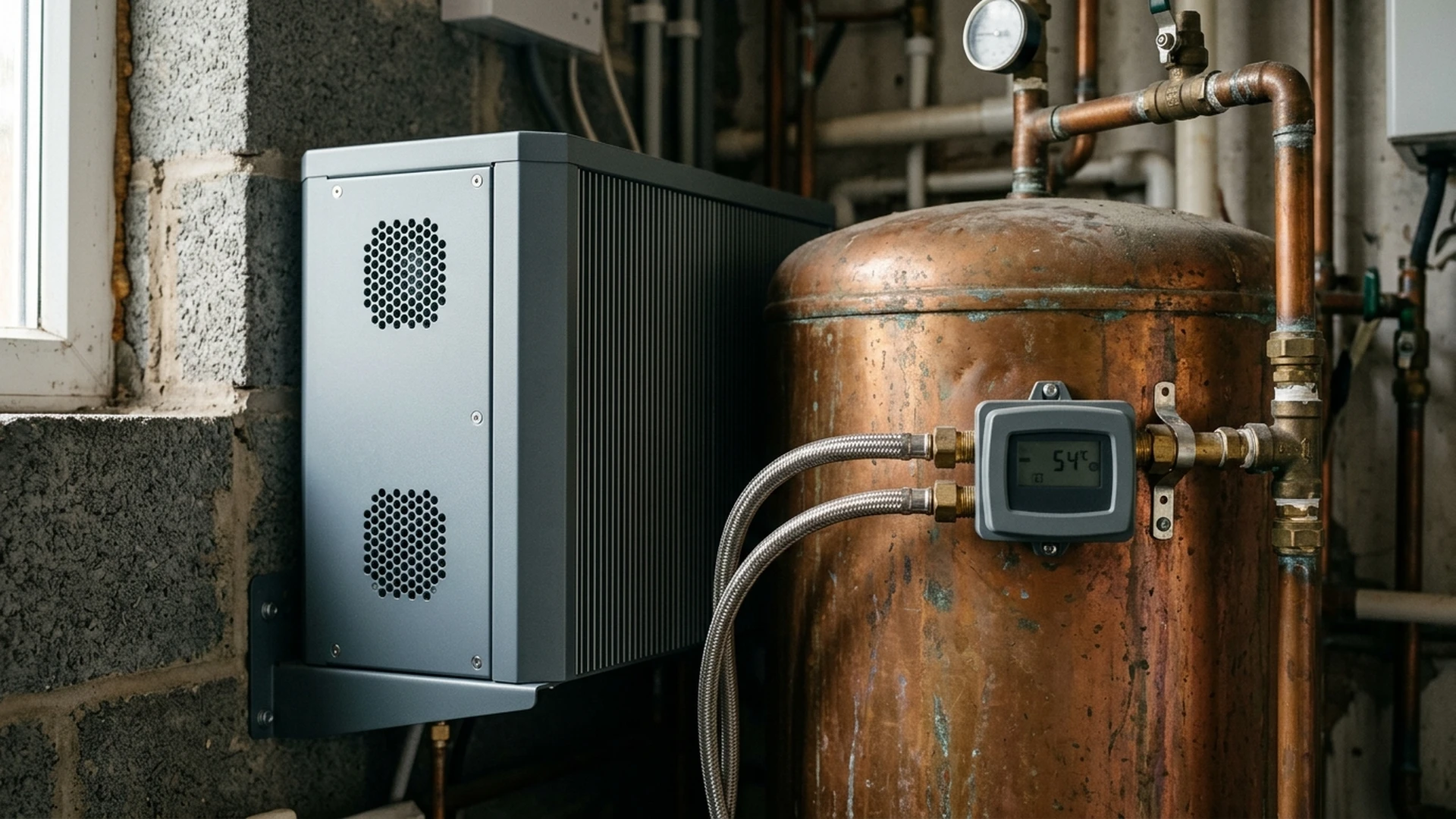
The thermal energy stored in a water cylinder follows the sensible heat equation: Q = mcT, where m is the mass of water, c is the specific heat capacity of water at 4.18 kJ/kg K, and T is the temperature differential. For a standard 200-litre cylinder heated from 10C mains inlet to 60C, the stored thermal energy is 11.62 kWh - matching or exceeding the usable capacity of a £6,000 lithium battery pack.
| Storage Metric | Smart Solar Diverter | 10 kWh LFP Battery |
|---|---|---|
| Storage Medium | Sensible heat in water | Electro-chemical cells |
| Capital Cost per Usable kWh | £38 to £60/kWh thermal | £450 to £700/kWh electrical |
| Round-Trip Efficiency | 98% | 88% to 92% |
| Lifespan | 20+ years | 10 years / 6,000 cycles |
| Standby Consumption | Under 2 watts | 15 to 45 watts |
Modern unvented cylinders feature polyurethane foam insulation with standing losses of 1.1 to 2.1 kWh per 24 hours, retaining over 80% of midday thermal energy for evening and morning use.
What the Tariff Spread Revealed About Self-Consumption Value
Under the July 2026 Ofgem price cap, standard variable electricity imports average 26.11p per kWh while gas averages 7.33p. Standard Smart Export Guarantee tariffs pay between 7.5p and 12p per kWh. This creates an economic spread where self-consuming solar power yields over double the value of exporting it. A diverter displacing grid electricity for water heating captures 26.11p per kWh of value; exporting the same energy returns just 12p. Pairing a 4 kWp array with a smart diverter lifts household solar self-consumption from a 35-40% baseline to over 75% without chemical storage.
| Scenario | Upfront Cost | Annual Saving | Payback |
|---|---|---|---|
| Export surplus via SEG | £0 | £216 income | Immediate |
| Diverter displacing electric immersion | £550 | £254 net | 2.16 years |
| 10 kWh battery storage | £5,500 | £338.60 net | 16.24 years |
The Fix: A Diverter-First Topology for Cylinder Owners
The optimal strategy for any property with a domestic hot water tank is a diverter-first topology. Installing an intelligent controller such as the myenergi Eddi alongside a standard solar array allows complete utilisation of output. The diverter operates strictly downstream of the consumer unit as an internal load, adding no export capacity to the grid connection and preserving G98 eligibility under 3.68 kW without triggering G99 pre-approval.
| Architecture | Hardware | Total Cost | Self-Consumption | Payback |
|---|---|---|---|---|
| Diverter-first | 4 kWp PV + Eddi | £5,500 to £6,500 | 65-75% | 3.5 to 4.5 years |
| Battery-first | 4 kWp PV + 10 kWh battery | £9,500 to £12,000 | 75-85% | 9.0 to 11.5 years |
| Combined hybrid | 4 kWp PV + 5 kWh battery + Eddi | £10,500 to £13,000 | 85-95% | 7.5 to 9.0 years |
Installation must be executed by a competent person registered with NAPIT or NICEIC under Building Regulations Part P. Under HMRC rules, solar PV arrays, immersion diverters, and thermal storage tanks all qualify for 0% VAT on both supply and installation.
What This Means for Your Home
Peregrine and Cordelia's story ends with a £450 device fitted in under two hours to a cylinder they already owned. Their south-facing roof never needed a £9,800 battery bundle to make solar viable - it needed a diverter that converts excess midday generation into free hot water, cutting their summer gas bill to zero and paying for itself in under three years. Takeaway: a budget-conscious solar installation does not need a £5,000 battery to store daytime energy; it needs a £400 smart diverter to convert an existing hot water cylinder into a high-capacity thermal store.
Key Takeaways
- Under the July 2026 Ofgem price cap, electricity costs 26.11p/kWh while gas is 7.33p/kWh, making self-consumption over twice as valuable as standard SEG export rates of 7.5p to 12p/kWh.
- Smart solar immersion diverters cost £400 to £750 installed, compared to £3,500 to £7,000 for standard domestic battery storage.
- Heating a 200-litre hot water cylinder from 10C to 60C stores approximately 11.6 kWh of thermal energy, matching the usable capacity of a £6,000 lithium battery.
- Solar diverter payback periods range from 2 to 4 years, whereas stand-alone home batteries average payback of 8 to 15 years.
- Diverters use solid-state micro-controllers operating at 50 Hz to 100 Hz to modulate power delivery, matching excess solar output in under one second.
- A solar diverter operates downstream of the consumer unit as an internal load, maintaining G98 compliance under 3.68 kW without requiring G99 DNO pre-approval.
- Unvented cylinder thermal losses average 1.1 to 2.1 kWh per 24 hours, retaining over 80% of diverted daytime thermal energy for evening use.
- Solar PV arrays, immersion diverters, and hot water cylinders all qualify for 0% VAT on both materials and installation under current UK legislation.
- Pairing a 4 kWp array with a smart diverter increases household solar self-consumption from 40% to over 75% without chemical battery storage.
Frequently Asked Questions
Do I need a battery if I have a solar diverter?
No. If your primary goal is to maximise solar self-consumption and your home has a hot water cylinder, a solar diverter acts as a thermal battery. It redirects daytime surplus electricity directly to your immersion heater for £400 to £700 installed, achieving full payback in 2 to 4 years without requiring a £5,000 chemical battery.
What is the myenergi Eddi payback period for UK homes?
The typical myenergi Eddi payback period is 2 to 3 years. By displacing grid electricity at 26.11p/kWh or gas water heating, a fully installed system costing around £550 saves a typical UK household between £150 and £250 annually on fuel bills.
Can I heat water with solar panels using a combi boiler?
No. A solar diverter requires a hot water storage cylinder with an electric immersion heater element to store energy. Combi boilers heat water on demand and lack a storage cylinder, meaning surplus solar power cannot be diverted into thermal hot water storage.
How does a solar immersion controller ROI compare to a battery?
A solar immersion controller yields an ROI of 25% to 40% per year, paying for itself in under 3 years. Home batteries costing £3,500 to £7,000 offer a lower annual return with payback of 8 to 15 years, making diverters a faster investment for hot water owners.
What is the best value solar storage for UK properties on a budget?
The best value solar storage is a smart immersion diverter paired with an existing hot water tank. For under £600 installed, a 200-litre cylinder stores up to 11.6 kWh of thermal energy, matching a £6,000 home battery at 10% of the cost.
Get Your Free Quotes
Takes under 4 minutes · No obligation

Written by
Mark Anthony Haines
Mark has over a decade of experience in the UK renewable energy sector, specialising in solar PV, heat pump systems, and home battery storage. He founded HeatPumpsAndSolar.co.uk to help UK homeowners cut through the noise around green energy installations, government grant schemes, and smart tariffs.
View LinkedIn Profile