The Chimney Fallacy: How One Shadow Exposed Solar's Most Costly Myth
Worried about a chimney or tree? Discover how modern microinverters make solar panels on a shaded roof efficient and profitable. Get your yield quote.
Quick Summary
- In a traditional series string, a single shaded cell chokes the current of every unshaded panel through Kirchhoff's Current Law, causing 30% to 70% generation drops across the entire array.
- Module-Level Power Electronics such as the Enphase IQ8+ microinverter perform MPPT tracking at individual module level, restricting shading losses to just 1% to 3% annually while unshaded panels generate at 100% capacity.
- A £1,200 to £1,500 microinverter upgrade pays for itself by preventing annual generation losses of 20% to 40% on partially shaded roofs, turning dismissed roof space into reliable low-carbon generation.
The Misconception
Homeowners assume that if a single shadow from a chimney, dormer window, or nearby tree touches any portion of a solar array, the electrical generation of the entire roof drops instantly to zero.
Table of Contents
An Eleven-Year Deferral Caused by a Single Chimney Shadow
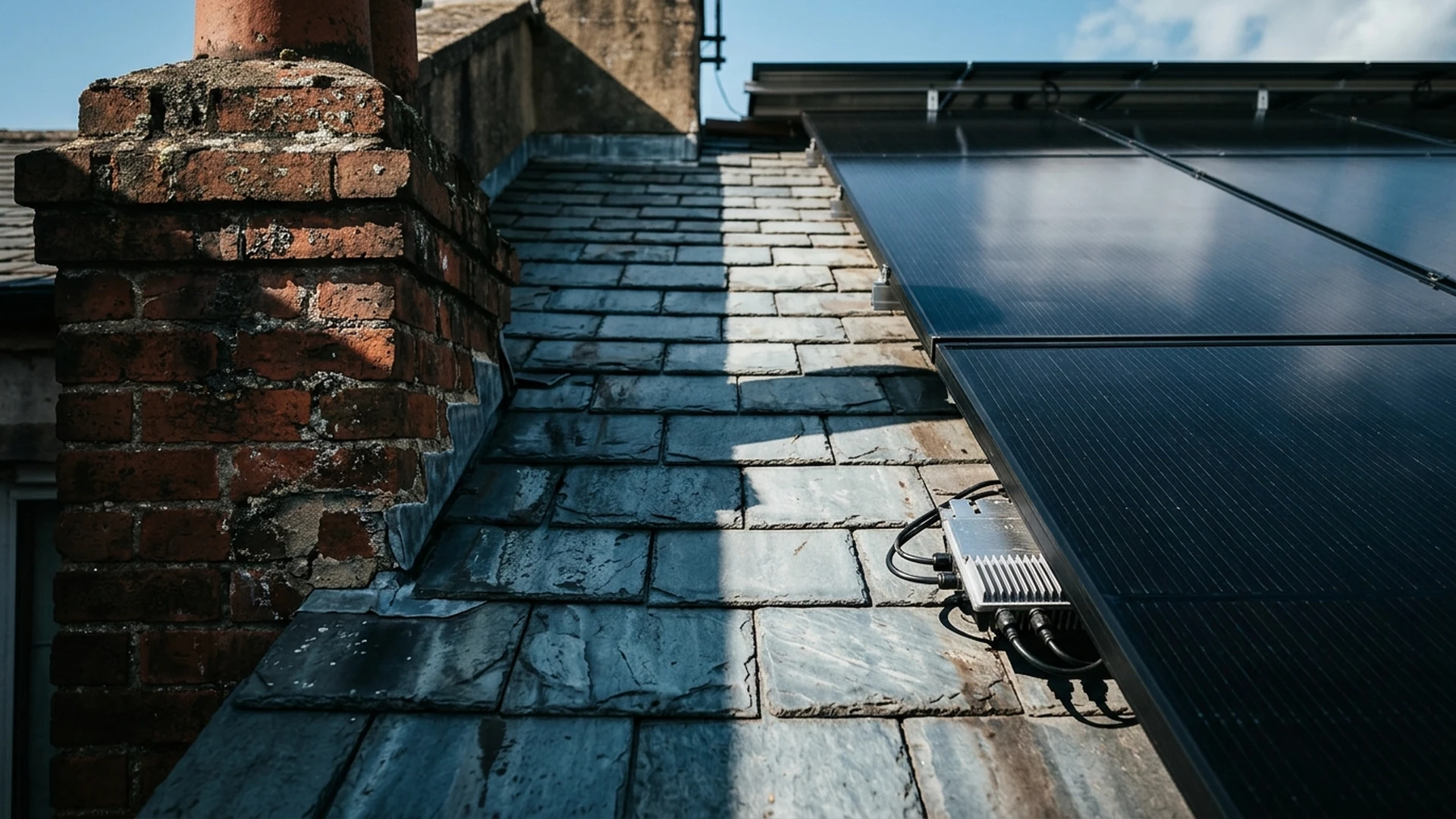
In May 2015, Dr. Bartholomew Vance, a resident of Malvern, Worcestershire, wanted to know whether solar panels on shaded roof pitches were viable. His south-facing Victorian home featured a central brick chimney stack. The site surveyor noted that between 10:30 AM and 1:30 PM, the chimney cast a narrow, moving shadow across two proposed solar panels. Operating under legacy string-inverter design protocols, the installer advised Dr. Vance that the chimney shadow would shut down the entire roof during peak mid-day hours. Unwilling to spend thousands on an array that would allegedly drop to zero output on sunny days, he cancelled the project.
The cost of that decision compounded over eleven years. From 2015 through 2026, Dr. Vance remained entirely dependent on grid electricity as tariffs escalated to variable cap rates around 24.5p/kWh. His household consumed 4,100 kWh annually, with a daytime baseline load averaging 1.8 kW continuously between 10:00 AM and 4:00 PM. Had he installed the array, it would have generated 3,800 kWh per year - 41,800 kWh cumulatively - displacing £10,241 in grid imports and earning £3,200 in forfeited export revenue. The cumulative financial loss from the eleven-year deferral exceeded £15,050.
A re-evaluation in 2026 using modern microinverter technology demonstrated that the chimney shadow would affect only the two physically shaded modules. Under an Enphase IQ8+ architecture, the remaining eight modules continue operating at 100% capacity regardless of the shadow's position. The chimney shadow causes a minor 3.2% loss in total annual yield - reducing generation from 3,800 kWh to 3,678 kWh - rather than the 100% loss assumed in 2015.
Why Did One Shadow Condemn an Entire Roof?
Why did a single chimney shadow convince a professional installer that an entire solar array was unviable? The answer lies in how traditional string inverters wire panels together - and why a shadow on one panel genuinely did throttle every other panel on the string.
The Physics of Series Circuits and Bypass Diodes
A standard silicon solar panel consists of individual photovoltaic cells connected electrically in series. In a series circuit, Kirchhoff's Current Law dictates that the current flowing through every element must be identical. When sunlight illuminates an unshaded cell, light energy liberates electrons within the silicon junction, generating a photocurrent directly proportional to incident irradiance. When a shadow falls on a single cell, the light intensity drops and the shaded cell can no longer pass the higher photocurrent produced by surrounding fully illuminated cells. The shaded cell acts as an electrical bottleneck, forcing the total current across the entire series string down to its own reduced output.
If a central inverter attempts to draw more current than the shaded cell can pass, the shaded cell is forced into reverse bias. Instead of generating power, it acts as a resistor, dissipating the energy produced by adjacent cells as localised heat. This thermal hotspot drives cell temperatures dangerously high, accelerating solder joint degradation, yellowing the protective encapsulation, and risking shattering the module glass.
To prevent this damage, manufacturers install silicon bypass diodes inside the rear junction box. Modern 60 or 72-cell panels are divided into three sub-strings, each wired in parallel with a bypass diode. When a shadow forward-biases a diode, current routes around the affected sub-string - but activating a single diode disconnects one-third of the module's cells. Shading just one cell drops a 400W panel to roughly 266W, a 33.3% loss.
| Inverter Topology | Shading Yield Deficit | MPPT Granularity | Roof Voltage |
|---|---|---|---|
| Traditional string inverter | -22% to -40% annually | 1-2 per array | 300-600V DC |
| Central inverter + DC optimisers | -2% to -5% annually | Per module | 300-500V DC |
| Distributed microinverters | -1% to -3% annually | Per module | Under 60V DC |
What Module-Level Power Electronics Changed in 2026
The breakthrough that rewrites the shading rule is Module-Level Power Electronics. DC power optimisers, such as the SolarEdge S440, are buck-boost DC-to-DC converters fitted to each module frame. When a panel is shaded, the optimiser reduces its output voltage while boosting current to match the rest of the string, keeping unshaded panels at full power while the central inverter receives a fixed DC bus voltage.
Microinverters, such as the Enphase IQ8+, replace central string inverters entirely by converting DC to 230V AC directly beneath each panel. If a chimney shadow covers a single panel, its microinverter adjusts output to match its reduced generation, leaving all unshaded microinverters operating at 100% capacity. The IQ8+ features a low start-up threshold of 16V DC and an MPPT window between 27V and 45V, allowing panels to generate during low-light morning hours long before a central string inverter meets its start-up voltage. Microinverters also eliminate high-voltage DC wiring from attic spaces, replacing it with standard AC building circuits to reduce fire risk.
| Feature | Legacy Central String | SolarEdge Optimiser | Enphase Microinverters |
|---|---|---|---|
| Shade isolation | Poor (string throttled) | High (panel isolated) | High (panel isolated) |
| Warranty | 10-12 years | 25 yrs / 12 yrs | 25 years full system |
| Single-point failure | High (central inverter) | Moderate | Extremely low |
| Roof voltage safety | 300-600V DC | 300-500V DC | Under 60V DC |
The Fix: Decoupling Panel Performance With MLPE
The correct approach is to decouple panel performance using Module-Level Power Electronics so a shadow on one panel never chokes the rest of the array. For a 4 kWp system on a shaded UK roof, a microinverter-equipped array costs around £7,500 installed and yields 3,680 kWh annually - against £5,800 and just 2,650 kWh for a legacy string system that loses 22% to 40% of generation to shading.
| Financial Metric | Legacy String | SolarEdge System | Enphase IQ8+ |
|---|---|---|---|
| Installed cost (0% VAT) | £5,800 | £7,100 | £7,500 |
| Annual AC yield | 2,650 kWh | 3,610 kWh | 3,680 kWh |
| Year 1 bill savings | £649 | £884 | £902 |
| 25-year net ROI | +107% | +212% | +220% |
Under MCS MIS 3002, MLPE installations allow installers to evaluate shade factors on a per-module basis rather than penalising the entire array, directly improving the building's EPC score under SAP 10. The 0% VAT rate on residential solar PV and energy storage applies through 31 March 2027, and a £1,200 to £1,500 microinverter upgrade pays for itself by preventing annual generation losses of 20% to 40% on partially shaded roofs.
What This Means for Your Home
Dr. Vance's story ends with the realisation that the shadow he feared for eleven years was a problem already solved. His Victorian chimney never made his roof unviable - it made it a candidate for microinverters, which would have limited the annual yield loss to 3.2% while the rest of the array generated at full capacity. The £15,050 he lost deferring the decision dwarfs the £1,200 upgrade that would have unlocked a decade of self-generation. Takeaway: a partially shaded rooftop does not need unshaded southern exposure; it needs module-level power electronics to isolate shadows and maintain array performance.
Key Takeaways
- In a traditional series string, a single shaded cell chokes the current of every unshaded panel, causing 30% to 70% generation drops across the array.
- Activating a single bypass diode disconnects one-third of a module's cells, dropping a 400W panel to roughly 266W - a 33.3% loss from shading just one cell.
- Unprotected shaded cells forced into reverse bias create thermal hotspots that accelerate degradation, yellow encapsulation, and risk shattering module glass.
- Microinverters restrict shading yield losses to just 1% to 3% annually by performing MPPT tracking at individual module level.
- DC power optimisers limit shading losses to 2% to 5% by adjusting panel voltage while keeping unshaded panels at full power.
- The Enphase IQ8+ MPPT window of 27V to 45V DC enables generation during low-light morning hours before a central string inverter starts up.
- Microinverters eliminate high-voltage DC wiring from attics, replacing 300-600V strings with under 60V extra-low-voltage circuits to reduce fire risk.
- A £1,200 to £1,500 microinverter upgrade pays for itself by preventing annual generation losses of 20% to 40% on partially shaded roofs.
- Under MCS MIS 3002, MLPE installations allow per-module shade factor evaluation, improving EPC scores under SAP 10.
Frequently Asked Questions
Do solar panels work on a shaded roof in the UK?
Yes. While heavy shade reduces overall generation, modern solar panel systems equipped with microinverters or DC power optimisers operate effectively on partially shaded roofs. These devices isolate shaded panels, allowing unshaded modules to produce electricity at 100% capacity. An MCS-certified site survey confirms exact expected yields.
How do bypass diodes protect solar panels from partial shade?
Bypass diodes are safety components inside solar panel junction boxes that create alternate current pathways when cells are shaded. When shade lowers a cell's current output, the diode routes current around that cell sub-string. This prevents thermal hotspot overheating while keeping the rest of the panel operating.
Solar optimisers vs microinverters: which is better for a shaded roof?
Microinverters convert DC to AC at each module, delivering maximum shade isolation and eliminating central inverter single-point failures. DC optimisers adjust panel voltage but rely on a central inverter. Microinverters are ideal for heavily shaded or complex roofs, whereas optimisers offer a lower upfront cost.
Does shade ruin solar panels or cause permanent damage?
Unmitigated partial shading on older series-string arrays can cause thermal hotspots, degrading cells and causing cracking over time. Modern solar panels use internal bypass diodes and half-cut cell layouts to prevent physical damage. Adding microinverters eliminates thermal stress, helping panels reach their full 25-year lifespan.
How much does a microinverter upgrade cost for a shaded roof?
Equipping a 4 kWp solar array with module-level power electronics costs an additional £1,200 to £2,000 compared to a basic central string inverter. A microinverter system typically costs around £7,500 installed and yields 3,680 kWh annually on a shaded roof, achieving a 25-year net ROI of 220%.
Get Your Free Quotes
Takes under 4 minutes · No obligation

Written by
Mark Anthony Haines
Mark has over a decade of experience in the UK renewable energy sector, specialising in solar PV, heat pump systems, and home battery storage. He founded HeatPumpsAndSolar.co.uk to help UK homeowners cut through the noise around green energy installations, government grant schemes, and smart tariffs.
View LinkedIn Profile