Quick Summary
- Identical panels can sit behind different inverter designs, with different output, repair access and storage options.
- A flat output peak can be ordinary clipping rather than a failed inverter; model-specific heat derating and grid limits need separate checks.
- Compare itemised string, hybrid and microinverter proposals on the same roof assumptions, including warranty and battery retrofit paths.
The Misconception
The inverter is just a standard accessory; the panels alone determine a solar system's quality and future options.
Table of Contents
The Solar Panel Inverter Your Quote Barely Mentions
Two quotes list the same roof, the same number of panels and almost the same predicted generation. One costs more. The tempting answer is to compare panel brands and haggle over the difference. Yet the line that could change the installation in ten years is often shorter than the panel specification: solar panel inverter, model to be confirmed.
Picture a fictional homeowner in Chichester with those proposals: a string inverter in a loft, or a hybrid unit in a utility room. These are invented quotes. Neither is automatically better. The mistake is treating the inverter as interchangeable.
An inverter converts the panels’ direct current (DC) into alternating current (AC) for the home. Its AC rating, siting, warranty, monitoring and battery compatibility determine what the rest of the system can actually do. A long panel performance warranty does not extend the inverter’s warranty. For perspective, Enphase says its IQ8 microinverters carry a 25-year limited warranty, while the GivEnergy Hybrid Inverter 5.0 (Gen 3) datasheet lists 12 years. Neither term tells you when any particular unit will fail; confirm the written UK terms for the exact model you are offered.
How Can the Same Panels Need a Different Inverter?
Imagine that both quotes promise a 5 kWp array. Will its output be limited at the AC side? Does a chimney shade one roof face? Will you add storage later, and does that mean replacing anything? Could the proposed mounting place make servicing awkward? A panel’s nameplate power cannot answer those questions.
The missing sheet lists the model, AC rating, string layout, battery route, position, grid-connection route and warranty. Without it, the same panels could mean different systems.
String, Hybrid, Optimiser or Microinverter: What Actually Changes?
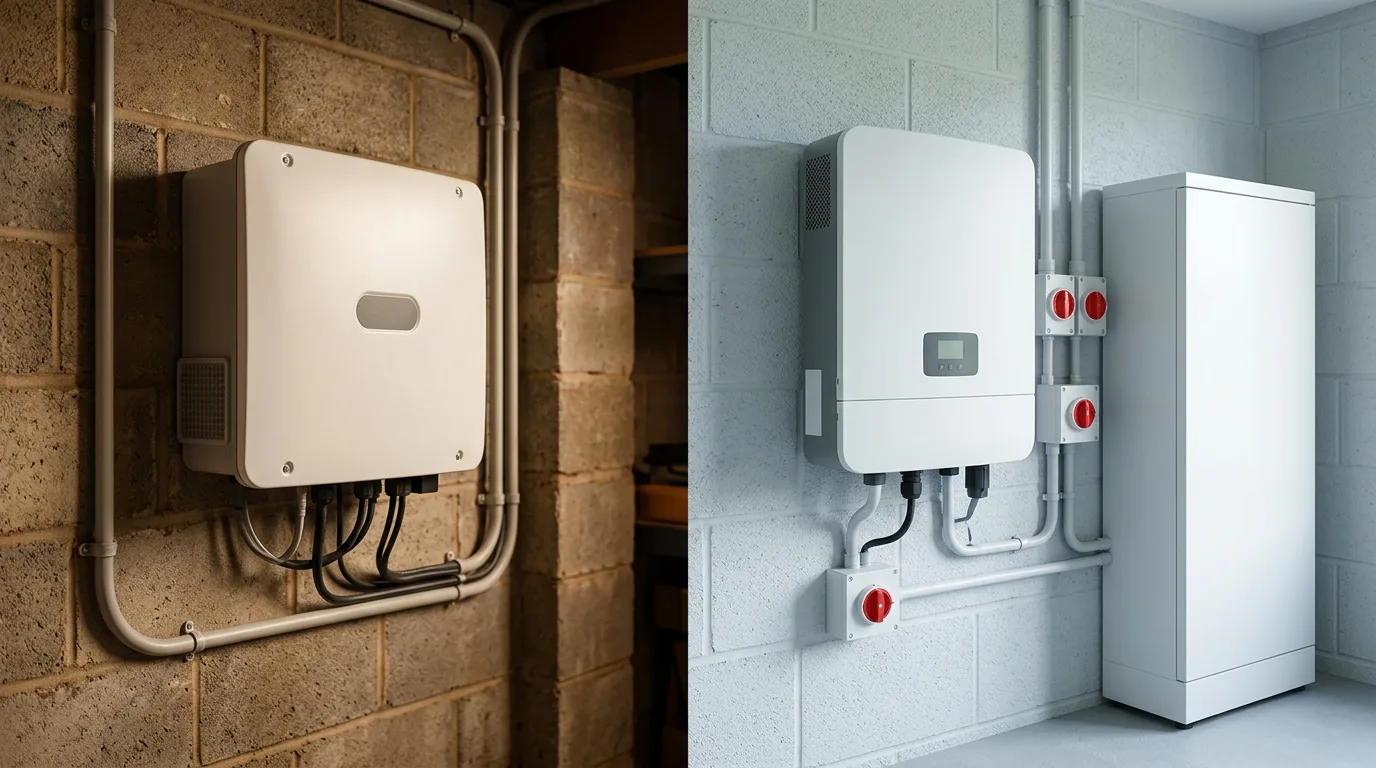
A standard string inverter converts one or more panel strings at a central unit. It can suit an uncomplicated roof. Separate maximum power point trackers (MPPTs) can accommodate different roof aspects, depending on wiring. If the unit fails, its strings stop producing AC until repair.
A hybrid string inverter also works with compatible battery storage. But “hybrid” is not a universal socket: check supported batteries and charge limits. The GivEnergy unit cited above lists 5,000 W nominal AC output, 3,300 W battery charging and 3,600 W discharging. Different jobs, different limits.
DC optimisers sit at modules and work with a compatible central inverter. They may help on partly shaded roofs and offer panel-level monitoring, but they do not remove the central unit. Bypass diodes and good string design already mitigate some shade; compare predicted annual yield before paying extra.
Microinverters convert DC to AC at each panel. They can help with recurring localised shade or complex orientations. Their roof location makes repair access and labour coverage worth checking. Storage usually needs a separately specified AC-side arrangement.
No design makes a shaded panel produce sunshine it never received.
| What the quote should identify | Central string or hybrid | Optimisers with central inverter | Microinverters |
|---|---|---|---|
| Conversion point | Central unit | Central unit after module-level electronics | Individual modules |
| Localised shade | Depends on layout, trackers and bypass diodes | Module-level control can help | Module-level conversion can help |
| Battery pathway | Hybrid may support specified DC batteries; standard string can retain its inverter with a separate AC-coupled battery | Depends on compatible inverter and battery | Typically a separately specified AC-coupled solution |
| Maintenance question | Can the central unit be reached safely? | What happens if an optimiser or central unit fails? | What roof access and labour are covered? |
A standard string inverter does not automatically need replacing for storage. An AC-coupled battery can work alongside it. DC coupling may avoid conversion stages, but replacing a working inverter has a price. Compare complete installed costs; see our existing-solar battery guide.
Is That Flat Midday Graph Actually a Fault?
Your monitoring app shows a flat peak on a bright day. Before blaming the loft, check the inverter’s AC rating and any temperature messages. A flat line alone is not a diagnosis.
A 5 kWp array paired with a 4 kW AC inverter has a DC-to-AC ratio of 1.25. On a clear spell the inverter can reach its 4 kW ceiling and flatten the curve. That is ordinary clipping, not proof of damage or bad design. Roof aspect, panel temperature and local weather affect how often it happens; panel efficiency ratings do not tell you the annual clipping loss. Ask the installer to model it. There is no single mandatory UK ratio that makes every quote correct.
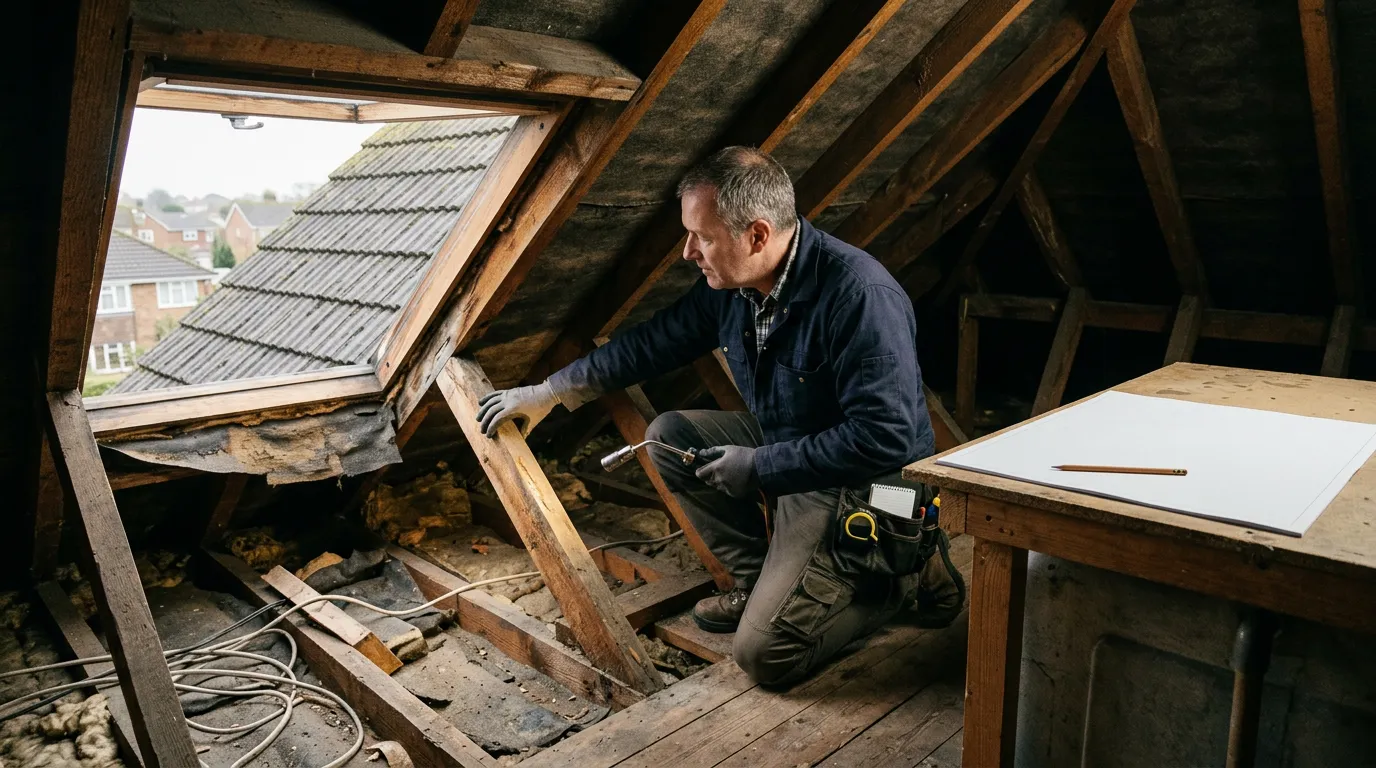
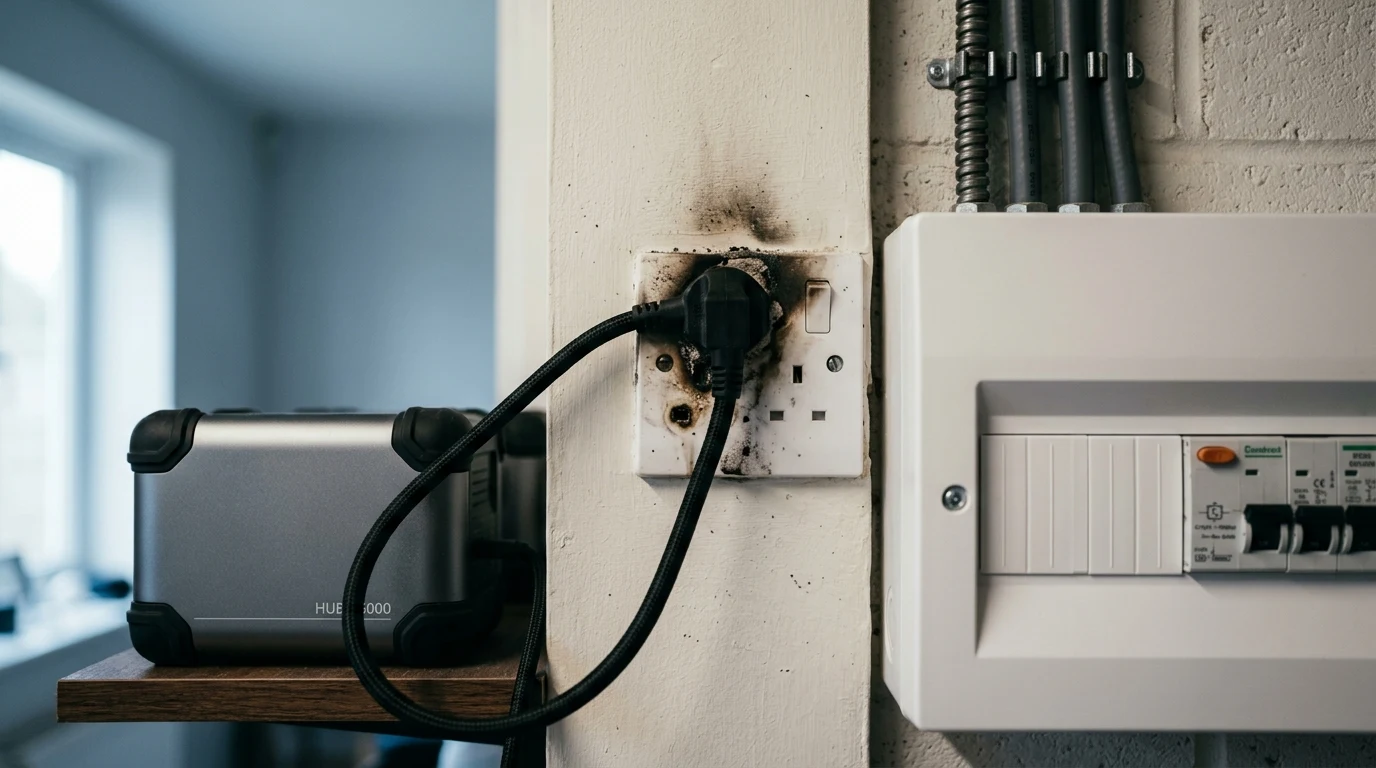
Heat is a different possible limit. The GivEnergy 5.0 (Gen 3) datasheet specifies operation from -20°C to 60°C, with derating at 50°C for that model. That is a product-specific threshold, not a claim that every loft reaches it or that every inverter loses a fixed share of its annual output. Ask whether your proposed location meets the manufacturer’s clearances, temperature limits and access requirements. An inverter in a loft is not, by itself, proof of a rule breach; the battery’s siting is a separate safety decision.
For repeated losses on an existing system, record weather, AC power and any error messages. Ask the original installer or manufacturer to inspect logs and warranty terms. Do not open or move live equipment. A flat graph alone cannot distinguish clipping, heat, an export limit, grid voltage or a fault.
The Grid Limit Hidden Behind the Inverter Rating
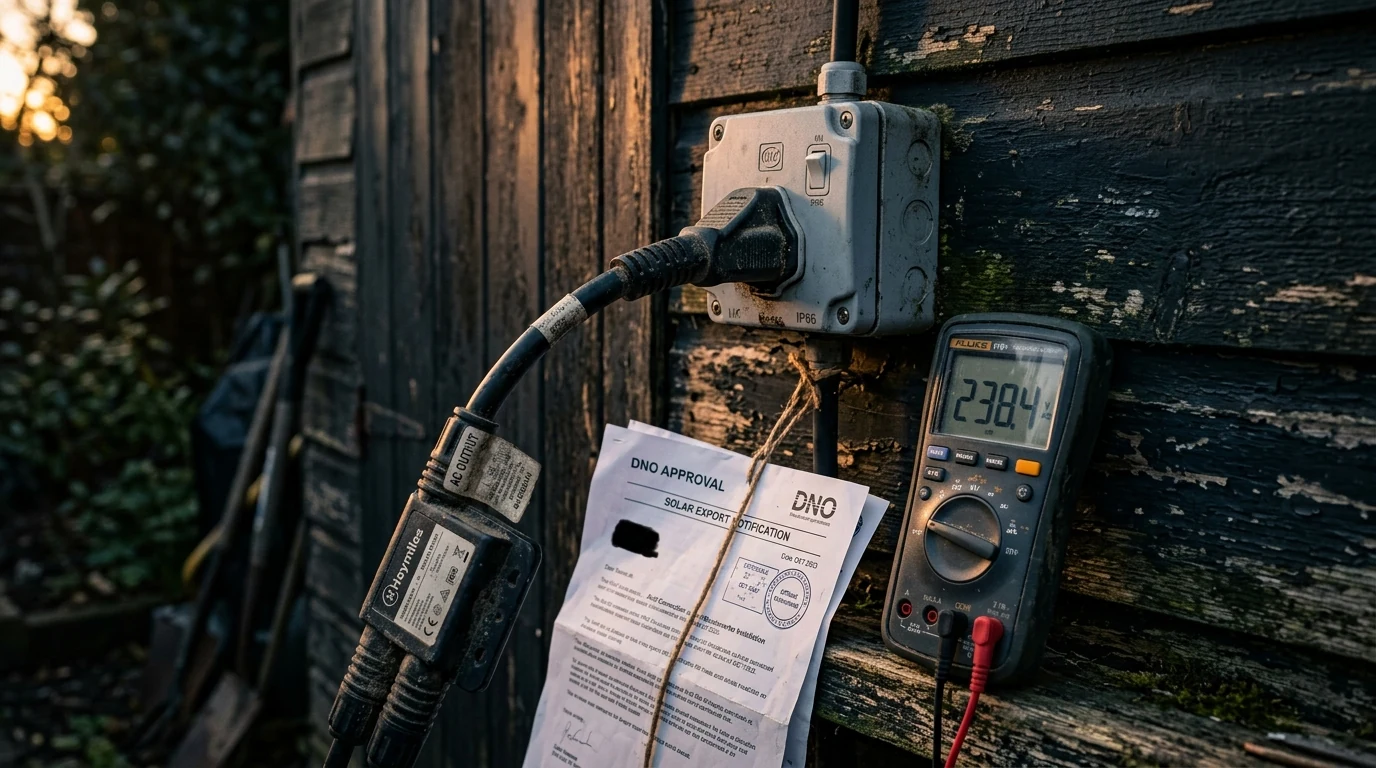
The label 5 kWp panels describes DC nameplate capacity, not necessarily the maximum AC power delivered to the home or grid. In Great Britain, the installer must also assess the connection with the distribution network operator (DNO). G98 is the route commonly used for fully type-tested small generation at no more than 16 A per phase, roughly 3.68 kW at 230 V on a single phase. Larger or more complex arrangements may need a G99 application and approval before connection. Existing generating or storage equipment also matters.
An export cap is not the same as a small inverter: a DNO-approved design may limit power sent to the street while retaining capacity for on-site use. But permission depends on the site. National Grid Electricity Distribution’s G99 fast-track guidance considers combined equipment ratings, type testing and export limits; its process does not guarantee approval by every network.
Ask the installer to put these five answers beside the total price:
- Exact make, model and AC rating: What is the proposed inverter’s rated continuous output, not merely the panel total or its maximum marketing figure?
- Roof design and shading: How many strings and MPPTs? What annual generation and clipping or shade assumptions support this layout?
- Battery pathway: If storage is later added, which compatible DC batteries work with this hybrid model, or what would a separate AC-coupled retrofit require?
- Siting and access: Where is the unit going, what clearances and temperature limits apply, and what work would a replacement need?
- Connection and warranty: Is the proposal G98, G99 or a DNO-approved export-limited arrangement? Which written warranties cover equipment, replacement labour and roof access?
A proposed battery location deserves its own safety assessment, not an assumption that it can sit beside an inverter in a loft. Ask the designer to confirm applicable battery siting guidance and the manufacturer’s installation instructions before accepting a room on the drawing. Grid approvals, metering and any backup functionality must also be specified separately: “battery-ready” does not mean “power during a power cut”.
Use our solar contract red-flag checker to organise questions about a quote, and solar payback calculator to test assumptions rather than taking a brochure yield at face value. Neither replaces a site-specific electrical design.
Compare the Boxes, Not Just the Roof
Go back to those two fictional proposals. The right choice is not automatically the costlier microinverter setup, nor automatically the cheaper string inverter. A simple unshaded roof without plans for storage can make a well-specified central unit compelling. A complex roof may justify module-level equipment. If you expect to add a battery, price both a compatible hybrid option now and an AC-coupled retrofit later, including labour and connection work.
There is no honest “it will fail in year 12” line to write into your payback. Instead, check the actual warranty, keep a reasonable allowance for future servicing or replacement in your long-term estimate, and make sure the proposed position is practical to access. A 25-year panel warranty is not a 25-year whole-system guarantee.
For a new installation, compare solar quotes using the same requested inverter specification and grid assumptions so the prices are genuinely comparable. If you already have a fault, contact your installer or manufacturer first; a quote enquiry is not a repair service.
The inverter is not an afterthought: it is the part of the quote that decides how the roof’s electricity reaches your home, battery and grid.
Key Takeaways
- Compare inverter models, not just panels: request the AC rating, string layout, siting and written warranty for each proposed system.
- 5 kWp DC with 4 kW AC gives a 1.25 ratio: a flat peak may be expected clipping; ask for an annual yield model before calling it a fault.
- Heat derating is model-specific: GivEnergy’s Hybrid 5.0 (Gen 3) lists derating at 50°C, not a universal annual loss for loft installations.
- A standard string inverter does not bar future storage: an AC-coupled retrofit may keep a working existing inverter.
- Microinverter warranty is not whole-system life: Enphase lists 25 years for IQ8 units; check the exact UK model, parts, labour and roof-access terms.
- G98’s 16 A per-phase threshold is about connection equipment: discuss G99 and any DNO-approved export limit before fixing an AC rating.
- For a fault, check logs with your installer: for a new installation, compare itemised quotes built on identical design assumptions.
Frequently Asked Questions
How long does a solar panel inverter last?
There is no guaranteed replacement year. Installation and operating conditions matter; a warranty term does not predict lifespan. Check your model’s written warranty and labour cover. Allow for possible servicing or replacement when comparing long-term returns. Panel warranties cover different equipment.
Is a hybrid inverter always better than a string inverter?
No. A hybrid model can simplify a compatible DC battery installation, but may cost more and still has battery-specific limits. A straightforward roof without storage plans can suit a standard string inverter. If adding storage later, compare a hybrid installed now with a separate AC-coupled battery retrofit and request itemised total prices.
Is a microinverter worth paying extra for on a UK roof?
It depends on the roof and the quotes. Module-level conversion can help when panels have different orientations or recurring localised shade; it does not erase the shade itself. On a simple clear roof, the extra installed price may not buy much additional energy. Ask for annual generation estimates, warranty coverage and roof-access costs for both designs.
Can I put a solar inverter in the loft?
Sometimes, if the selected model’s installation instructions, clearances, environmental limits and service access can all be met. A hot or cramped loft deserves particular scrutiny, but a loft position alone does not prove the inverter will overheat. Battery location follows separate safety guidance. Ask the installer to specify both positions and justify them in writing.
What is the difference between G98 and G99 for solar?
G98 generally covers eligible fully type-tested smaller generating equipment within its 16 A per-phase threshold, about 3.68 kW on a 230 V single-phase supply. Other systems may need G99 approval before connection, including some combinations of solar and storage. Your installer should assess all equipment already connected and confirm the actual DNO route before installation.
Ready to Compare Real Quotes?
Get free quotes from local MCS-certified installers
Takes 90 seconds. Compare up to 3 vetted local MCS quotes with zero spam calls.