Combined Solar and Heat Pump Installation: Why "Solar First" Doubles Your Electrical Bill
Combined solar and heat pump installation planning avoids the £1,060 sequencing trap: duplicate consumer units, DNO delays, and lost self-consumption savings.
Quick Summary
- Installing solar and a heat pump as two separate projects rather than a combined solar and heat pump installation forces most UK homeowners into a second £450-£1,200 consumer unit replacement once the original board's spare ways run out.
- Adding a heat pump after solar routinely pushes diversified household demand above the 60A DNO threshold, triggering a mandatory 'Apply to Connect' review that can delay commissioning by up to eight weeks.
- Co-designing solar and a heat pump lifts on-site solar self-consumption from around 28% to 58% or more by using the hot water cylinder as thermal storage, saving roughly £2,410 over a 10-year lifecycle versus uncoordinated phasing.
The Misconception
Homeowners believe domestic solar PV and air-source heat pumps are modular, electrically decoupled purchases that can be installed sequentially with no mutual technical dependency or cost penalty.
Table of Contents
Why "Solar First, Heat Pump Later" Is Quietly Doubling Your Electrical Upgrade Bill
Alistair Vance, a mechanical engineer, lives in an extended four-bedroom 1970s detached home in Harrogate, North Yorkshire, with a single-phase 230V supply protected by an original 60A metal-clad service cut-out fuse, a 10-way dual-RCD consumer unit installed in 2011, and a fifteen-year-old gas boiler. Planning a combined solar and heat pump installation over three years, he decided against doing both at once, reasoning that solar panels and a heat pump are separate technological projects that can be safely staged one after the other.
In May 2025, Alistair contracted a local solar installer to fit a 4 kWp rooftop array with a 3.68 kW string inverter. To keep costs down, the electrician terminated the AC supply into the two remaining spare ways of Alistair's existing consumer unit, added a 16A breaker and surge protection, and registered the system under standard EREC G98 rules within 28 days. No one checked the rating of the original 60A service fuse, and no one asked what electrical capacity a future heat pump might need. The solar array cost £6,400 and performed well through the summer, and Alistair felt his phased approach had been vindicated.
What Nobody Checked Before the Second Van Arrived
Eleven months later, in April 2026, Alistair's ageing gas boiler suffered a catastrophic heat exchanger failure. Rather than replace it like-for-like, he decided to bring forward his heating electrification plan and claim the £7,500 Boiler Upgrade Scheme grant. An MCS-certified designer specified an 8 kW monobloc heat pump and 200-litre cylinder after a full heat loss survey - technically straightforward. What happened next during the electrical survey was not.
The Consumer Unit Trap: How Independent Sizing Breaks Down
A domestic consumer unit is not simply a rack of switches; it is a busbar with a defined thermal current rating, protected upstream by the incoming DNO service cut-out fuse. Under BS 7671:2018+A3:2024, Regulation 536.4.3.2 requires that when an assembly includes embedded generation - such as a solar inverter feeding back into the same board as the grid supply - the busbar's overload protection cannot rely solely on downstream diversity factors. If a 100A busbar receives both a 100A grid feed and a 16A solar backfeed simultaneously with heavy domestic demand, current can exceed the board's rated capacity without either the grid fuse or the solar breaker tripping, creating a real overheating and fire risk.
Generation and demand are also regulated through two separate DNO pathways. Under Engineering Recommendation G98, microgeneration up to 16A per phase (3.68 kW single-phase) can be connected first and notified to the DNO within 28 days - exactly what Alistair's solar installer did. Anything larger, or any combination of generation and storage exceeding that threshold, requires the "Apply to Connect" process under G99, with formal engineering consent taking anywhere from 10 to 65 working days. Heat pump demand is governed separately again: the ENA Low Carbon Technology process allows "Connect and Notify" only if total diversified household demand stays under 60A (13.8 kVA) and the heat pump's own AC input is below 32A (7.36 kW). Cross either threshold and the installer must submit a formal "Apply to Connect" application before starting work.
| System Configuration | Continuous Generation Rating | Peak Diversified Demand | Governing Route | Pre-Consent Required? | Cut-Out Fuse Minimum |
|---|---|---|---|---|---|
| Solar PV only | 3.68 kW / 16.0A | 0.0 kW | EREC G98 (Connect & Notify) | No | 60A adequate |
| Solar + AC-coupled battery | 5.00 kW / 21.7A | 3.68 kW (charging) | EREC G99 (Apply to Connect) | Yes | 80A recommended |
| Heat pump retrofit (sequential) | Existing 3.68 kW | 4.60 kW / 20.0A | ENA LCT (Apply to Connect if MD >60A) | Yes, if fuse <80A or looped | 80–100A mandatory |
| Unified solar + heat pump | Coordinated 3.68–5.00 kW | 4.60 kW / 20.0A | Coordinated single-stage submission | Streamlined | 100A delivered at inception |
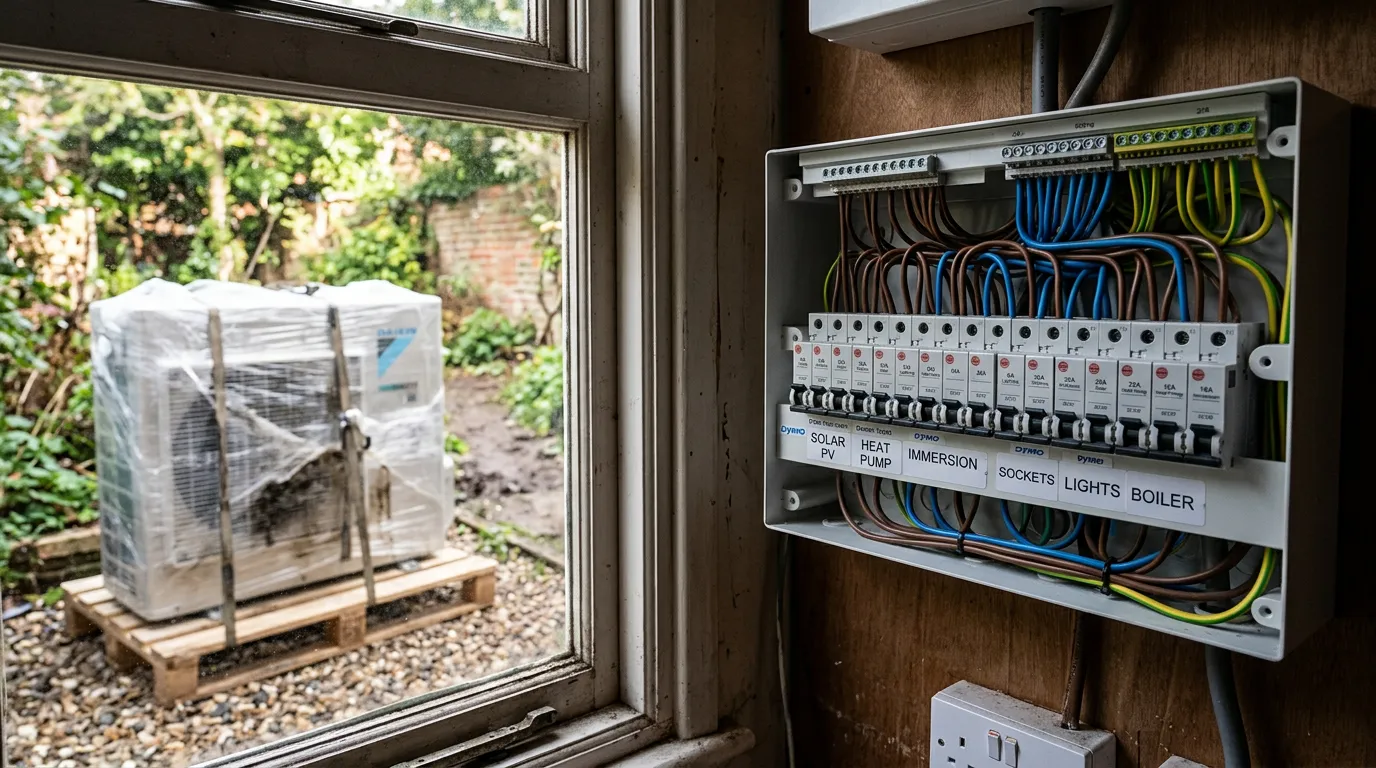
Alistair's consumer unit had zero spare ways left for the heat pump's dedicated 32A compressor circuit, 16A hydraulic station circuit, and immersion back-up circuit, and his dual-RCD board lacked the Type A/B residual current protection an inverter-driven compressor needs. Worse, his 60A cut-out fuse - inspected by no one during the solar install - could not support the combined diversified demand of the heat pump alongside his induction hob and electric shower. Because his calculated maximum demand exceeded 60A, the installation could not proceed under "Connect and Notify"; it required a full "Apply to Connect" submission to Northern Powergrid, and the heat pump sat on hold for six weeks while the network operator assessed headroom and scheduled a fuse uprate to 100A. To get the heat pump legally energised, Alistair also had to commission an emergency replacement of his 10-way board with an 18-way all-RCBO enclosure and upgraded meter tails.
What the Combined Solar Heat Pump Installation Actually Cost Him
The bill for treating solar and heat pump as two unrelated purchases came to considerably more than the heat pump quote alone.
| Line Item | Unified Day-One Spec | Alistair's Sequential Retrofit | Avoidable Cost |
|---|---|---|---|
| Initial electrical works & panel sizing | £850 | £250 | -£600 |
| Secondary consumer unit replacement | £0 | £820 | +£820 |
| Meter tails & isolator upgrade | £0 | £180 | +£180 |
| Electrical certification (Part P/EIC) | £0 | £160 | +£160 |
| DNO grid application & admin fees | £0 | £120 | +£120 |
| Forfeited thermal self-consumption (Year 1) | £0 | £380 | +£380 |
| Total system expenditure | £850 | £1,910 | +£1,060 |
A combined solar and heat pump installation planned as one project would have cost £850 in electrical works. Doing it in two uncoordinated stages cost Alistair £1,910 - a £1,060 premium in duplicate switchgear, repeated contractor call-outs, repeated Part P notifications, and lost self-consumption, on top of a six-week delay he had not budgeted for.
Maximising Return: The Economics of Combined Solar and Heat Pump Installation
The financial penalty runs deeper than hardware. Solar generation peaks between May and September; space heating and hot water demand peaks between November and March. Without a heat pump to absorb daytime surplus, an unmanaged solar-only system typically self-consumes just 20% to 35% of what it generates, exporting the rest at Smart Export Guarantee rates of around 13p/kWh while the household later imports grid electricity at 26.11p/kWh to run appliances. Once a heat pump is co-designed with the solar array - using the hot water cylinder as thermal storage and SG-Ready relays to shift reheat cycles into daylight hours - self-consumption rises to 58% or more, because 1 kWh of solar electricity run through a heat pump at SCOP 3.5 displaces 3.5 kWh of otherwise-imported heat, worth roughly double what the same kWh would earn as an export.
| System Configuration | Annual PV Output | Self-Consumption Rate | Net Annual Operational Value |
|---|---|---|---|
| Solar PV alone (unmanaged) | 3,800 kWh | 28% | £633.49 |
| Sequential phasing (no controls) | 3,800 kWh | 38% | £683.31 |
| Co-designed solar + heat pump | 3,800 kWh | 58% | £782.94 |
| Co-designed + 5kWh battery storage | 3,800 kWh | 74% | £862.65 |
Over a 10-year lifecycle, a co-designed master plan - one electrical survey, one 18- to 24-way board with pre-allocated ways for solar, heat pump, and immersion circuits, one DNO submission covering both generation and demand - comes out roughly £2,410 cheaper than Alistair's phased path once the duplicate electrical rebuild, admin fees, and lost thermal self-consumption are added up. It also sidesteps the looming deadline that makes timing itself a cost factor: the 0% VAT relief on energy-saving materials and their associated electrical works is scheduled to revert to 5% after 31 March 2027, and any BUS-funded heat pump held up by an unplanned electrical rebuild risks running past its three-month voucher validity window entirely.
What to Ask Before You Sign the First Contract
A phased home clean-energy plan does not need to be abandoned for budget reasons - it needs a single, unified electrical survey at the outset, even if the equipment itself arrives in stages. Before signing a contract for solar panels alone, ask your installer three questions: what is my incoming service cut-out fuse rated at, and is there headroom for a future heat pump; does my consumer unit have enough spare, correctly rated ways pre-allocated for a heat pump's compressor, controls, and immersion circuits; and has a whole-house maximum demand calculation been run assuming both systems are installed, not just the one being quoted today. A combined solar and heat pump installation costs the same in hardware whichever order you buy it in - the difference of over £1,000 and six weeks of delay comes entirely from whether someone thought about both before either van turned up.
Key Takeaways
- Installing solar PV into an existing consumer unit without pre-allocating dedicated ways for a future heat pump frequently forces a second board replacement costing £450 to £850, or up to £1,200 for an all-RCBO board.
- Adding a heat pump to a home with existing solar routinely pushes total diversified maximum demand beyond 60A (13.8 kVA), triggering mandatory DNO "Apply to Connect" approval and delays of up to eight weeks.
- Under BS 7671 Regulation 536.4.3.2, backfeeding solar power into a standard 100A consumer unit busbar without proper design can expose it to overload conditions that neither the grid fuse nor the solar breaker will trip on.
- Co-designing a heat pump with a 200- to 300-litre hot water cylinder as thermal storage lifts household solar self-consumption from around 28% to between 58% and 74%.
- Using self-generated solar electricity internally displaces grid imports at 26.11p/kWh - more than double the value of exporting the same unit under the Smart Export Guarantee at 12-15p/kWh.
- A unified electrical and thermal master plan for a combined solar and heat pump installation can save roughly £2,410 over a 10-year lifecycle versus phasing the two projects independently and uncoordinated.
- The 0% VAT relief on energy-saving materials and associated electrical works is due to revert to 5% after 31 March 2027, adding a timing incentive to plan both systems together.
Frequently Asked Questions
Should I install solar panels or a heat pump first?
Homeowners planning both upgrades should design them together from day one, even if purchasing the equipment in stages. Installing solar panels first often consumes all available consumer unit ways and neglects heat pump electrical demands, triggering an avoidable second electrical panel replacement costing £450 to £850 later. A unified electrical plan eliminates this redundant expense.
How much does a heat pump consumer unit upgrade cost in the UK?
A dedicated consumer unit replacement for a heat pump typically costs between £450 and £850, or up to £1,200 for larger properties requiring an all-RCBO board, Type 2 surge protection, and upgraded 25mm² meter tails. Pre-allocating spare ways during an earlier solar install avoids this secondary cost entirely.
Do solar panels and heat pumps work together efficiently in the UK?
Yes. Pairing solar panels and a heat pump together creates substantial operating synergies. An air-source heat pump can convert excess solar generation into stored domestic hot water at 300% to 400% efficiency, lifting total household solar self-consumption from 28% to over 58% and dramatically reducing peak grid electricity imports.
Do I need DNO approval for a combined solar and heat pump installation?
Yes, your Distribution Network Operator must be notified. Standard domestic solar arrays follow G98 Connect and Notify rules, but adding a heat pump can push total household demand above 60A. This requires an ENA Apply to Connect application to verify network capacity and execute a cut-out fuse upgrade if needed.
Can my existing fuse box handle both solar panels and a heat pump?
Most older fuse boxes cannot. An air-source heat pump requires two to four dedicated circuits, and BS 7671 wiring regulations restrict feeding solar backfeed into standard consumer unit busbars without verifying overload protection. A combined solar and heat pump installation typically demands an 18- to 24-way high-integrity board.
Get Your Free Quotes
Takes under 4 minutes · No obligation

Written by
Mark Anthony Haines
Mark has over a decade of experience in the UK renewable energy sector, specialising in solar PV, heat pump systems, and home battery storage. He founded HeatPumpsAndSolar.co.uk to help UK homeowners cut through the noise around green energy installations, government grant schemes, and smart tariffs.
View LinkedIn ProfileMore from Our Insights
Tools & Services Related to This Article
Take the next step with a free calculator or a local installer quote.