Heat Pump Installation Quotes Comparison: Same Unit, Different Job?
Your heat pump installation quotes comparison can show the same unit but different jobs. Check design, exclusions and grant assumptions before choosing a price.
Quick Summary
- Matching outdoor units and grant deductions do not establish that two heat pump proposals price the same installation.
- Design assumptions, radiators, hot-water provision, electrical work and exclusions can change the scope without changing the outdoor model.
- Request comparable written scopes, separate funding assumptions from approval and judge the price difference without assuming the dearer offer is better.
The Misconception
Two heat pump quotes showing the same outdoor unit and grant deduction are directly comparable on headline price.
Table of Contents
Same Machine, Same Grant, Different Purchase
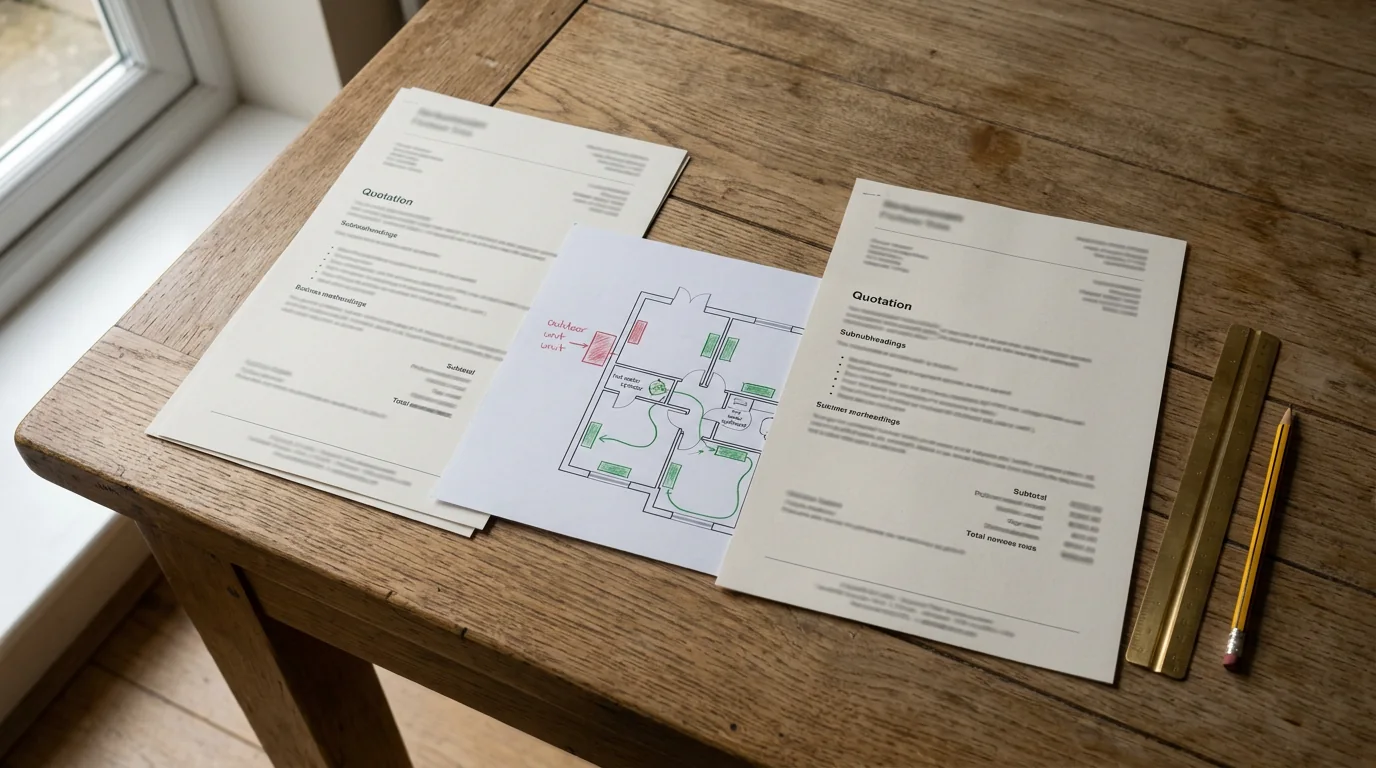
Same outdoor unit, same grant: surely the cheaper offer wins a heat pump installation quotes comparison? In this explicitly fictional scene, a homeowner spreads two proposals across the kitchen table beside a cooling mug. The model names match. So do the grant deductions. One total is lower, and the pen is already hovering over it.
Then the pages turn. One proposal says existing radiators and cylinder will stay, with electrical work subject to assessment. The other lists radiator replacements, a new cylinder and specified electrical work. These are invented proposals, not evidence about an actual installer or a measured price difference. But they expose the problem: matching equipment names do not establish matching scope.
The concern is not invented. The Competition and Markets Authority's pricing guidance specifically identifies radiators and thermal controls as possible enabling works alongside a heat pump. It says headline prices should include charges reasonably foreseeable for most consumers, with important qualifications clearly displayed. A price should help you understand the purchase, not merely attract your attention.
That does not make the dearer proposal better. Keeping suitable equipment could be sensible. Replacing equipment without a clear reason could add unnecessary cost. Before choosing either, you need to know what each installer has actually agreed to deliver.
What Are You Buying When the Model Names Match?
Put your finger over the outdoor unit's name. Can you still tell what each proposal promises for every room, the hot-water cupboard and the electrical installation?
If one document says “complete installation” while another has several pages of specifications, which details are genuinely different, and which are simply described differently? Is the lower total a better price for the same job, or a price for a different job?
You do not need to become a heating designer to answer. You need a way to test whether the paperwork describes the same outcome before the price comparison means anything.
Heat Pump Installation Quotes Comparison Starts Behind the Price
First, compare documents at the same stage. An online indication before assessment is not equivalent to a developed proposal following a survey. The CMA's guidance on clear pricing says indicative prices should be identified as such, with an explanation that final costs follow assessment and how those costs will be calculated.
Ask each installer what remains unassessed and what could change. Our heat-loss survey article covers that earlier stage; here, the task is checking whether the resulting assumptions match across offers.
Request the room-by-room heat-loss schedule, proposed indoor temperatures and outdoor design condition. If the totals differ, ask each designer to explain the difference rather than averaging the figures or choosing the biggest machine. You are comparing evidence for a design, not collecting impressive-looking numbers.
Next, ask for the design flow temperature: the heating-water temperature proposed for the stated cold-weather design condition. Have the installer connect that figure to the radiator schedule and performance estimate. A brochure efficiency figure is not enough to establish how the whole installation will perform. The CMA's product-claims advice warns that laboratory performance can differ from performance in a home and calls for fair comparisons using similar assumptions.
For your own paperwork, the useful test is simple: can the installer show where the design promise appears in the priced scope?
| Quote line | Ask for this written detail | What you can then compare |
|---|---|---|
| Radiators and pipework | Rooms affected, radiator sizes and types, pipework changes | Which physical alterations each total buys |
| Hot water | Retained or new cylinder, model, capacity and suitability assessment | Whether both offers address your household's hot-water needs |
| Controls | Named controller, weather compensation and zoning arrangements | Equipment and setup included, not just “smart controls” |
| Electrics | Circuit, protection, cable route and any consumer-unit work | Defined work versus an unresolved allowance |
| Network connection | Who checks requirements with the distribution network operator (DNO) and handles the process | Responsibility, outstanding decisions and possible delay |
These are comparison requests, not a universal bill of materials. A new cylinder, particular electrical protection or pipework replacement should be justified for the chosen equipment and property, not assumed necessary because another quote includes it.
Circle the Words That Leave the Job Unfinished
With both proposals open, circle “if required”, “standard installation”, “allowance”, “subject to survey” and “by others”. None automatically signals poor practice. Each does signal a question you should settle before relying on the total.
If one quote includes radiator changes, look for the rooms and specifications. If another retains them, ask for its design justification. A shorter list is not automatically an omission; a longer list is not automatically good engineering. What matters is whether the priced solution meets the agreed requirement.
Open the hot-water cupboard only as you normally would, without removing covers or touching wiring. Can you identify the existing cylinder for the installer? Ask whether reuse has been assessed and what replacement would involve. Do not conclude that an old cylinder is unsuitable solely from its age, or that a larger new one must be better.
Outside, look at the proposed route from unit to house. Does the offer name the base, drainage and any trenching? Indoors, does it explain floor lifting and making good? Our outdoor-unit siting article covers location decisions; your comparison should establish who prices the agreed work.
Finally, separate the installation total, proposed grant deduction and amount you would pay. The CMA cautions against implying automatic grant eligibility. Identical deductions on two pages do not establish that either application has been approved.
Ask for One Comparable Scope Before You Commit
Send both installers the same questions. Explain your priorities, including which rooms must remain usable, hot-water needs and acceptable disruption. Ask for revised written proposals against those needs, with alternatives priced separately. Like-for-like does not mean forcing both designers to use identical components regardless of their reasoning.
Use a small comparison sheet rather than trying to remember assurances from separate calls:
| Decision | Put this question to each installer |
|---|---|
| Price certainty | Is this indicative or a post-survey proposal, and which costs remain unresolved? |
| Additional work | How will you investigate, price and seek agreement for a changed scope? |
| Exclusions | Who arranges and pays for access, drainage, disposal and making good? |
| Completion | Are flushing, commissioning, user instruction and applicable certification included? |
| Pre-contract support terms | Are manufacturer registration, workmanship cover and servicing terms stated? |
Ask for deposit and payment stages, protection arrangements and cancellation terms in writing too. This checklist is good comparison practice, not a statement that every contract has identical protections. Do not assume a universal deposit cap or cancellation outcome; seek independent consumer advice if a proposed term is unclear.
For completion documents, use our commissioning and handover article as a reference, not a reason to repeat every commissioning test in your quotation spreadsheet.
Now check the funding separately. The Boiler Upgrade Scheme covers England and Wales; do not apply its process automatically to a Scottish or Northern Irish proposal. Under the government's application process, you obtain quotes from suitable MCS-certified installers, confirm eligibility and agree a quote. Your chosen installer applies on your behalf. The grant value is deducted from what you pay and shown on the quotation and invoice, rather than presented as cashback to you.
For your decision, distinguish eligibility, an application and approval. Ofgem's current property-owner guidance, version 5.1, updated 2 July 2026, says a voucher application is only “properly made” once it has the necessary information to assess eligibility and you have provided consent and identity verification. An installer saying it has started an application does not establish that this stage is complete, still less that approval is guaranteed.
Ask which grant amount is being assumed, why it applies to your circumstances, who tracks outstanding evidence and what happens to the price and timetable if funding is delayed or refused. Ask what the contract says about those outcomes; do not rely on a verbal “the grant is sorted”.
Once the scopes and funding assumptions are clear, you can request installation quotes with a useful brief. Coverage and suitability depend on your location and project; this is not a promise of three installers or guaranteed grant access. Existing-system faults belong with your original installer or manufacturer support, not a new-installation enquiry.
The Cheaper Offer Can Still Be the Right One
Return to your own two totals. You may discover that the lower-priced installer has justified retaining equipment and included all the work you need. You may discover that an apparent saving depends on work priced elsewhere. Or you may find that a dearer proposal contains extras you do not want and the designer cannot justify.
The point is not to manufacture a reason to spend more. It is to make the difference visible before you decide. Keep the revised scope, exclusions and funding assumptions together so the price you accept refers to an identifiable job.
The same heat pump is not necessarily the same purchase: compare the designed, priced scope before comparing the bottom line.
Key Takeaways
- Compare proposals at the same survey and design stage, not an online indication against a developed offer.
- Request room-by-room heat loss and the design flow temperature, with differences explained.
- Identify radiator, pipework and cylinder work explicitly; neither reuse nor replacement proves quality.
- Name responsibility for electrical assessment, DNO requirements, drainage and making good.
- Keep the installation total, assumed grant deduction and homeowner payment distinct.
- BUS application progress is not approval; Ofgem also needs consent, identity verification and eligibility information.
- Resolve exclusions, changes, payment stages and support terms in writing before committing.
Frequently Asked Questions
What should a heat pump installation quotes comparison include?
Compare the survey stage, design assumptions, radiator and pipework schedule, cylinder provision, controls, electrical work and exclusions. Keep funding assumptions separate from the installation total. Ask each installer to explain differences in writing. Matching the outdoor model alone does not establish that both proposals cover the same work or outcome.
Is a more expensive heat pump quote necessarily better?
No. A higher total may include useful work, but it can also include unnecessary or unwanted additions. Equally, a cheaper proposal may retain suitable equipment with a sound justification. Request the design reasoning and an itemised scope before deciding whether the price difference represents value for your home.
Does a grant deduction on the quote mean BUS approval?
No. The government says the grant deduction appears on your quotation and invoice, but Ofgem still assesses eligibility. Its guidance says a voucher application is only properly made once the required information, your consent and identity verification are supplied. Ask about actual application status rather than treating a deduction as approval.
What if the installer changes the price after a survey?
First establish whether the earlier figure was explicitly indicative and what the proposed agreement says about changes. Ask for the revised work, price and reasons in writing before deciding whether to proceed. If you have already signed or paid and dispute a change, seek independent consumer advice about your circumstances.
Do both installers need to replace the same radiators and cylinder?
Not necessarily. Different proposals may meet your needs through different designs. Ask each installer to explain how retained or replacement equipment fits its heat-loss assessment, heating-water temperature and hot-water requirements. Compare the resulting scope and evidence, rather than assuming that replacing more equipment automatically produces a better installation.
Get Your Free Quotes
Takes under 4 minutes · No obligation

Written by
Mark Anthony Haines
Mark has over a decade of experience in the UK renewable energy sector, specialising in solar PV, heat pump systems, and home battery storage. He founded HeatPumpsAndSolar.co.uk to help UK homeowners cut through the noise around green energy installations, government grant schemes, and smart tariffs.
View LinkedIn ProfileMore from Our Insights
Homeowner questions on this topic
Compare the guide with common questions and experiences from UK homeowners.
Tools & Services Related to This Article
Take the next step with a free calculator or a local installer quote.