The Cold Start Fallacy: Why Turning Your Heat Pump Off at Night Costs You More
Should I leave my heat pump on all the time? Discover the counter-intuitive physics of weather compensation and why turning it off spikes your bills by 33%.
Quick Summary
- Homeowners conditioned by gas boiler usage switch their heat pumps off overnight, forcing 55C cold-start reheating that degrades the COP to 2.25 and pushes January bills to £307.
- The Electrification of Heat trial proved that shifting from an intermittent cold start to continuous weather-compensated operation cuts daily electricity consumption by 33% and peak demand by 76.4%.
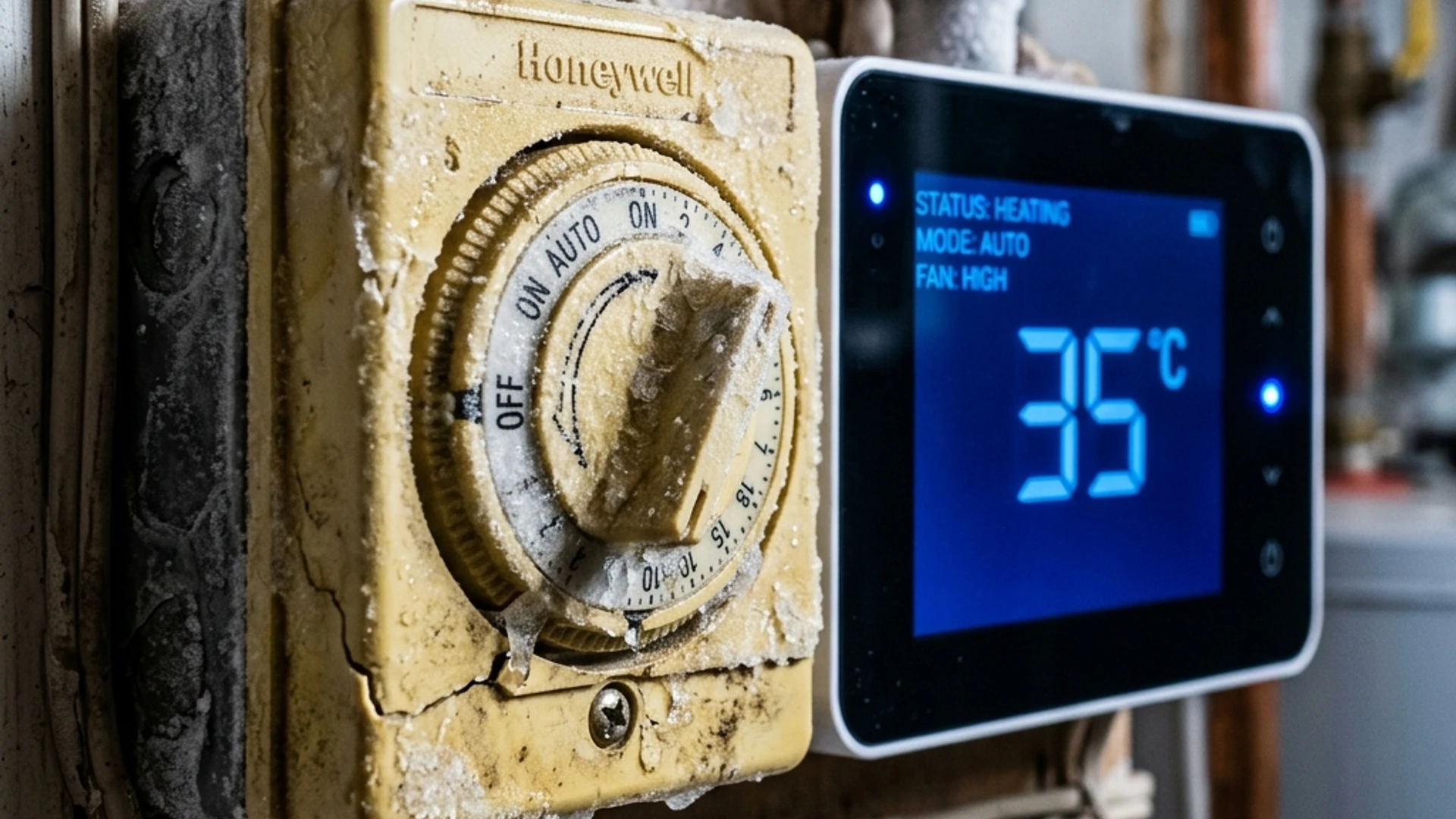
- The correct approach is weather compensation - an automated closed-loop control that matches flow temperature to outdoor conditions, maintaining a continuous 35C flow that achieves a COP of 4.0 and delivers heat at 6.52p per kWh.
The Misconception
Conditioned by decades of gas boiler usage, homeowners believe that leaving a heat pump running continuously overnight wastes massive amounts of electricity and will result in catastrophic winter energy bills.
Table of Contents
A January Bill That Proved the Boiler Mindset Was Wrong
Derek Fictitiouson transitioned from a 30-year-old gas combi boiler to an 8 kW air source heat pump in his 1970s mid-terrace property in Harrogate, North Yorkshire, in October 2025. Like most British homeowners, he firmly believed that any heating appliance left running while the household was asleep was actively hemorrhaging money. The question he kept asking himself was simple: should I leave my heat pump on all the time, or switch it off like my old boiler? His intuition said switch it off. So he did.
Upon handover, Derek actively bypassed the installer's carefully calibrated weather compensation curve. Using his smart thermostat, he programmed the heat pump to mirror his decommissioned gas boiler's exact schedule: off from 20:00 through the night, rapid heat-up from 06:00 to 08:00, off during the day, then back on from 16:00 to 20:00. To ensure the radiators grew hot to the touch during those constrained four-hour windows, he locked the heat pump into a fixed maximum flow temperature of 55C.
The failure became acute during the first major cold snap in January 2026, when outdoor temperatures in Harrogate hovered around -2C. Because the property's thermal mass had been allowed to bleed its stored heat during the ten-hour overnight off period, the indoor temperature regularly plummeted to 14.5C by dawn. At 06:00, the thermostat demanded an immediate rise to 20C. To achieve this massive temperature lift using 55C water against sub-zero outdoor conditions, the compressor activated at 100% capacity. Smart meter telemetry showed a sustained peak electrical draw of 5.1 kW. The heat pump, straining under the thermodynamic penalty of producing high-temperature water in freezing conditions, achieved a dismal COP of just 2.25. Derek's January electricity bill for space heating alone hit £307.31 - consuming 38 kWh per day. Had he left his old gas boiler running at 7.33p/kWh, the same thermal demand would have cost approximately £185.
Why Did Turning the Heat Pump Off at Night Cost Derek More?
Why did Derek's attempt to save money by switching off his heat pump overnight produce bills 66% higher than his old gas boiler? The answer lies in a fundamental misunderstanding of how heat pumps work - they do not create heat like a boiler, they transport it, and the efficiency of that transport is destroyed by high flow temperatures.
The Thermodynamics of Temperature Lift and COP
A conventional gas boiler creates energy through combustion. Whether it produces 40C or 80C water, a modern condensing boiler operates at roughly 90% efficiency. Leaving it off until heat is needed, then blasting the property with high-temperature water, is an economically viable strategy. A heat pump is not an energy creator - it is an energy transport mechanism. It uses electricity to compress refrigerant, absorbing ambient thermal energy from outside air and releasing it inside. The efficiency of this cycle is dictated by the temperature lift: the difference between the outdoor source temperature and the required indoor flow temperature.
For every 1C increase in required flow temperature, the heat pump's COP degrades by approximately 2% to 3%. When Derek turned his heat pump off overnight, the building fabric bled its stored heat into the cold external environment. To quickly replace that deficit in a narrow morning window, the heat pump was forced to generate 55C water on a -2C morning - an extreme temperature lift that drove the COP down to 2.25. Conversely, continuous operation capitalises on the thermal mass of the building envelope. Because the system runs 24 hours a day, it never allows the masonry to cool. The heat pump merely tops up the minimal heat being lost in real-time using lukewarm water as low as 35C, yielding a COP of 4.0 or greater.
| Flow Temperature | Application Scenario | Estimated SCOP |
|---|---|---|
| 35C | Underfloor heating or oversized radiators, continuous | 3.8 to 4.5 |
| 40C | Good retrofit with radiator upgrades, weather compensated | 3.3 to 3.8 |
| 45C | Standard retrofit with moderate radiator upgrades | 2.8 to 3.3 |
| 55C | Legacy radiators, intermittent aggressive reheating | 1.8 to 2.3 |
The economic impact is amplified by UK energy tariffs. Under the July 2026 Ofgem price cap, electricity is 26.11p/kWh while gas sits at 7.33p/kWh. A heat pump must achieve a COP of at least 3.56 to reach running cost parity with gas. Operating intermittently at 55C with a COP of 2.5 guarantees bills higher than a fossil fuel system. Operating continuously at 35C with a COP of 4.0 delivers heat at just 6.52p per kWh - definitively cheaper than gas.
| Heating System | Operational Strategy | COP | Cost per kWh of Heat |
|---|---|---|---|
| Gas Boiler | Intermittent (traditional) | 0.90 | 8.14p |
| Heat Pump | Intermittent (55C flow) | 2.50 | 10.44p |
| Heat Pump | Continuous (35C flow) | 4.00 | 6.52p |
What the Electrification of Heat Trial Telemetry Revealed
The open-source HeatPumpMonitor.org database, tracking real-world telemetry using MID-certified meters, confirms that the highest-performing heat pump systems in the UK operate almost exclusively on continuous, weather-compensated curves. These optimised systems achieve an average SPF of 3.86 by maintaining a low average flow temperature of 36.6C even on the coldest days. Conversely, the broader Electrification of Heat trial, which monitored 742 homes where intermittent schedules were frequently used, returned a significantly lower average SPF of just 2.81.
Dynamic simulations of trial system EOH2578, a Vaillant AroTherm 12 kW unit, forensically quantified the penalty. When programmed for a cold start at 05:00, the system consumed 26.4 kWh daily at a COP of 2.86. When shifted to continuous modulated pre-heating from 01:45, the COP surged to 4.61 and daily consumption dropped to 17.7 kWh - a 33% reduction.
| Telemetry Metric | Boiler Mindset (Intermittent) | Heat Pump Optimal (Continuous) | Variance |
|---|---|---|---|
| Peak Electrical Demand | 5.1 kW | 1.2 kW | -76.4% |
| Daily Electricity Consumed | 26.4 kWh | 17.7 kWh | -32.9% |
| Measured Operating COP | 2.86 | 4.61 | +61.1% |
The Fix: Weather Compensation and Low Flow Temperatures
The solution is weather compensation - an automated, closed-loop control strategy that continuously adjusts the flow temperature in inverse relationship to the outdoor ambient temperature. An external NTC sensor mounted on a shaded north-facing wall feeds data to the heat pump controller, which references a pre-configured heating curve. If the outdoor temperature drops to -3C, the curve dictates a flow temperature of 45C. If it rises to 12C during the afternoon, the curve reduces the flow to 32C, modulating the compressor down to its minimum stable speed. By constantly matching thermal input to the exact rate of thermal loss, the property remains at a static temperature 24 hours a day while the heat pump luxuriates in ultra-high efficiency.
| Outdoor Temperature | Required Flow Temp | Resulting COP |
|---|---|---|
| -5C | 50C | 2.4 |
| 5C | 40C | 3.4 |
| 15C | 25C | 5.0+ |
To fully exploit weather compensation, the heat emitters must be properly sized. Because a heat pump delivers lukewarm water rather than scalding boiler water, a larger surface area is required to transfer sufficient thermal energy without increasing the flow temperature. Room-by-room heat loss calculations to BS EN 12831 methodology identify which radiators need upgrading from single-panel K1 to double-panel K2 units, costing £80 to £350 per unit. Under MCS 020 and MCS 026 design standards, the system must achieve a minimum SCOP of 2.85 to qualify for the £7,500 Boiler Upgrade Scheme grant.
| Operational Paradigm | Annual Electricity (12,000 kWh demand) | Annual Cost (26.11p/kWh) |
|---|---|---|
| Boiler Mindset (Intermittent, SCOP 2.3) | 5,217 kWh | £1,362 |
| Weather Compensated (Continuous, SCOP 3.8) | 3,157 kWh | £824 |
What This Means for Your Home
Derek's story ends with a simple adjustment. An MCS-accredited engineer visited his Harrogate property, re-enabled the weather compensation curve, and lowered the maximum flow temperature from 55C to 40C. The heat pump now runs continuously at a whisper, modulating down to 1.2 kW overnight. Derek's February electricity bill dropped from £307 to £187 - a 39% reduction achieved by stopping the very behaviour he believed would save him money. Takeaway: a heat pump does not need intermittent periods of aggressive, high-temperature reheating to save money; it needs continuous, weather-compensated operation at the lowest possible flow temperature to maximise thermodynamic efficiency.
Key Takeaways
- Under the July 2026 Ofgem price cap, electricity costs 26.11p/kWh compared to 7.33p/kWh for gas, meaning a heat pump must achieve a COP of 3.56 to match gas running costs.
- The Electrification of Heat trial proved that switching from an intermittent 05:00 cold start to continuous overnight operation reduced daily electricity consumption by 33%.
- Continuous weather-compensated operation slashes peak electrical demand by 76.4%, dropping from 5.1 kW to 1.2 kW.
- For every 1C increase in flow temperature, COP degrades by approximately 2% to 3%, severely penalising high-temperature rapid reheating.
- The highest-performing monitored UK heat pumps achieve an SPF of 3.86 by maintaining a low average flow temperature of 36.6C even on the coldest days.
- Visual inspections of 165 trial heat pumps revealed 55% were operating inefficiently due to weather compensation settings being set too high.
- Operating at an intermittent 55C yields a COP of 2.5, costing 10.44p per kWh of heat - more expensive than a gas boiler.
- A fully optimised continuous 35C system yields a COP of 4.0, delivering heat at just 6.52p per kWh, definitively undercutting gas.
- An analysis of 61,483 forum posts revealed a 24-fold increase in heat pump complaints, with 342 instances of disabled weather compensation or fixed 55C to 60C flow temperatures.
Frequently Asked Questions
Should I leave my heat pump on all the time in the winter?
Yes, you should leave your heat pump on all the time. Heat pumps use weather compensation to maintain a steady temperature using lukewarm water. Turning them off overnight forces them to aggressively reheat a cold house in the morning, which degrades efficiency and can increase electricity consumption by up to 33%.
Do I need to turn down my heat pump flow temperature?
Lowering your heat pump flow temperature is the most effective way to cut running costs. Operating at a 35C flow temperature can achieve a 4.0 efficiency rating (COP), delivering heat for around 6.5p per kWh. Running at 55C drops efficiency to 2.5, making it more expensive than a gas boiler.
How do heat pump running costs vs gas boiler compare in 2026?
Under the July 2026 Ofgem price cap, electricity is roughly 26p/kWh and gas is 7p/kWh. To beat a gas boiler, a heat pump must be highly efficient. A well-designed, continuously running system at a low flow temperature will cost less than gas, saving an average 3-bed home over £150 annually.
What is weather compensation on a heat pump?
Weather compensation is a smart control system that uses an outdoor sensor to automatically adjust your radiators' temperature. When it is freezing outside, it sends hotter water to the radiators. On milder days, it reduces the water temperature, ensuring you use a heat pump efficiently without manual adjustments.
Will turning my heat pump off at night save electricity?
No, turning it off at night rarely saves electricity. Because a heat pump works best "low and slow," the massive surge of power required to reheat a freezing house in the morning uses more electricity than simply letting the system tick over continuously at a very low capacity overnight.
Get Your Free Quotes
Takes under 4 minutes · No obligation

Written by
Mark Anthony Haines
Mark has over a decade of experience in the UK renewable energy sector, specialising in solar PV, heat pump systems, and home battery storage. He founded HeatPumpsAndSolar.co.uk to help UK homeowners cut through the noise around green energy installations, government grant schemes, and smart tariffs.
View LinkedIn ProfileMore from Our Insights
Homeowner questions on this topic
Compare the guide with common questions and experiences from UK homeowners.
Tools & Services Related to This Article
Take the next step with a free calculator or a local installer quote.