Install Heat Pump Without Losing Heating? The Week Nobody Quoted
Can you install heat pump without losing heating? Check when your boiler stops, what happens to hot water and which backup your installer will put in writing.
Quick Summary
- A heat pump retrofit is not an uninterrupted boiler swap: system changes may mean losing central heating and hot water at different points.
- UK guidance describes multi-day installations, but those times are not measured household outage durations and a property's work schedule matters.
- Agree the isolation sequence, safe temporary provision and operational handover with the installer before the old system is disconnected.
The Misconception
Replacing a boiler with a heat pump is an uninterrupted one-day appliance swap, so heating and hot water will remain available throughout.
Table of Contents
The Missing Line on the Quote
"They'll take out the boiler on Monday and the heat pump will be running by teatime." If you're hoping to install heat pump without losing heating, that sounds like a reassuring plan. But it is an assumption about a whole heating system, not a promise an installer can make from the appliance specification.
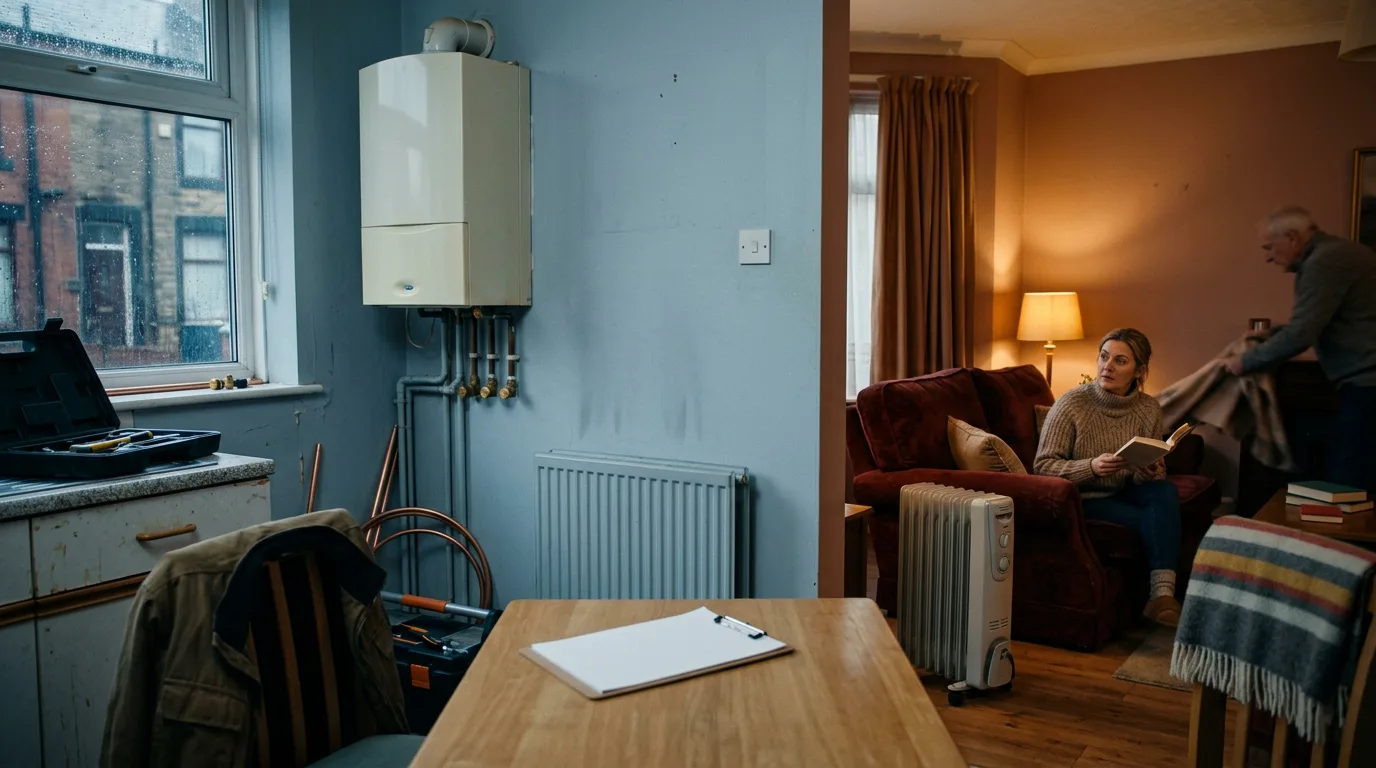
Imagine Honoria Penrose, an expressly fictional homeowner arranging a late-autumn retrofit while a relative who depends on a reliably warm home stays with her. Her household and the following conversation are illustrative, not a recorded case, testimonial or measured outcome. The quote lists an outdoor unit, a new hot water cylinder and some radiator changes. It says nothing about the interval between disconnecting the old boiler and commissioning the new system.
Honoria pictures an ordinary boiler swap. Then she asks what happens to heating during radiator changes, and to hot water when the old cylinder goes. The installer says the survey and schedule must answer for her house. Neither a same-day changeover nor an unheated week has been promised.
That omission matters because Energy Saving Trust's July 2026 installation guide says an installation typically takes around three days, and that heating will be turned off for most of that time. In winter, it says an installer will probably lend electric heaters. The headline duration is not an outage guarantee, but it demolishes the idea of a seamless appliance swap.
When Does the House Actually Go Cold?
Which days require the old system to stop? Can the outdoor unit go in before the boiler goes? Does central heating stop at the same time as hot water?
Honoria needs more than arrival and departure dates. A household can stay occupied yet lose essential services during building work. What must be finished before heating returns, and what happens if that milestone slips?
Why a Three-Day Job Is Not a Three-Day Outage Forecast
An air-to-water heat pump needs a suitable wet heating system, controls and usually stored hot water. The Energy Saving Trust guide describes installing an outdoor unit, possibly changing radiators and pipework, fitting or replacing a cylinder, connecting electrical supplies, flushing the system, then commissioning it. Some work may be scheduled while the old heating still runs; work on shared heating circuits may require isolation. Neither order is automatic.
| Work in the quote | Why it can affect service | Question for the installer |
|---|---|---|
| Outdoor unit and site preparation | May be possible before the old boiler is disconnected, subject to the actual site and design | Which preparatory work can be completed while our existing system still operates? |
| Radiators and heating pipework | Changes to the existing wet circuit can require draining or isolating parts of it | Which rooms or circuits will lose heating, and when? |
| Hot water cylinder | An existing cylinder may need replacing, or a combi-boiler home may need storage added | When will taps and showers lose hot water, and what is the fallback? |
| Connections, flushing and commissioning | Equipment being physically installed is not yet a tested, working heating system | What must pass before you say heating and hot water are restored? |
These are possible dependencies, not a universal day-by-day schedule. A government guide to finding a heat pump installer explicitly tells homeowners to ask how long the work will take and how long they might be without heating or hot water. It says most installations take a team of two people a couple of days, but can take longer. That broad planning estimate and Energy Saving Trust's around-three-days estimate describe the work, not a guaranteed number of hours without heat.
Evidence from the Energy Systems Catapult's Electrification of Heat trial sharpens the distinction. Across 742 installed heat pumps, the report says installation took 2-4 days on average for a team of two installers and an electrician, excluding energy efficiency works. 93% of those homes had at least one radiator replaced and 81% required a new thermal store. Those are findings for this trial, not probabilities for Honoria's home or measurements of each household's outage. The trial contractors found it important to discuss disruption early and provide alternative heat during installation.
If your own design calls for radiator changes, a new cylinder or major pipework, ask how those tasks alter the handover of heat and hot water. Our room-by-room heat loss survey explainer shows why the radiator list should be settled before a quote feels final. An earlier outdoor-unit siting check can also expose placement questions before the crew arrives.
Honoria Reads the Quote Again
In this fictional scenario, Honoria sees three dates behind "installation complete": the old boiler's last day, usable hot water's return and tested new heating. None follows automatically from the quote.
She asks the installer to mark them on a schedule. Her relative's needs make the question urgent, but this story asserts no measured temperature, medical outcome or saving. Perhaps her boiler can operate during preparation; perhaps it must be disconnected earlier. The crew must answer for her home.
The Energy Systems Catapult report does not document Honoria's experience or promise that staging compresses downtime to a fixed window. It reports that alternative heat and early expectation-setting helped trial contractors manage disruption. That changes her negotiation: instead of asking for a zero-outage guarantee, she asks what she can rely on if the switchover takes longer than planned.
Install Heat Pump Without Losing Heating? Plan the Service Gap
Before you sign, ask the installer to include a property-specific continuity schedule with the quote. It should distinguish on-site days from service interruptions and name who will supply, position and check any temporary heating. Energy Saving Trust says winter electric heaters may be loaned, but "probably" is not a contract term. Confirm availability, practical suitability and any associated charges with the installer rather than assuming heaters or uninterrupted hot water are included.
| Decision to record in writing | Minimum answer to request | If the schedule changes |
|---|---|---|
| Old system switch-off | Planned point when the boiler and existing hot water stop; what can happen beforehand | Who tells the household, and how early? |
| Rooms and people needing heat | Which occupied spaces need a safe interim arrangement, especially where someone is vulnerable | Who checks that the arrangement is still suitable? |
| Hot water provision | Whether stored hot water remains available, and when the new provision will be ready to use | What alternative has been agreed, rather than assumed? |
| Handover threshold | Which tests, controls explanation and contact details are needed before the team leaves | Who returns if heating or hot water is not working? |
Ask the installer to assess temporary appliances, electrical capacity and placement. Do not improvise wiring or attempt boiler and cylinder alterations yourself. Explain any health or accessibility needs before booking and agree a suitable fallback with the installer or relevant care professional. A different date or somewhere else to stay may be more appropriate than a plug-in heater.
The Energy Saving Trust installer toolkit's consumer-protection section says MCS contractors must provide the Customer Commitment before contract signing; it covers customers in vulnerable circumstances, proposals, costs and contracts. It does not prescribe a named "continuity plan" or guarantee a particular downtime. Request the schedule because it makes your agreement clearer, not because a published rule promises zero interruption.
When comparing quotes, ask each firm to state which temporary provisions, radiator works and hot water arrangements are included. The government installer guidance recommends more than one quote and says an MCS commissioning certificate should arrive within 10 days of completion if you use an MCS-certified installer. That administrative deadline is not permission to leave the home without usable heating for ten days. Ask separately for a working-system demonstration, instructions and a contact for problems; Energy Saving Trust describes these as part of commissioning and handover.
For the broader process, visit our air source heat pump installation overview. To compare written, house-specific disruption plans as well as prices, find a local installer and put the same continuity questions to each one. A clear answer may be more useful than a confident but unsupported promise that you will never notice the switchover.
The Question Worth Asking Before Monday
Honoria's illustrative story ends with questions on paper, not a claimed completed installation. Perhaps the installer can phase some tasks while her old heating works; perhaps the available fallback changes her preferred start date. Either outcome is better understood before removal starts than after the home has gone cold.
The date when engineers finish fitting equipment is not necessarily the date when a household has dependable heating and hot water again. Installing a heat pump does not need a promise of zero disruption; it needs an agreed sequence, safe interim provision and a clear handover test.
Key Takeaways
- Energy Saving Trust says fitting an air-to-water heat pump typically takes around three days and heating is off for most of that time; neither figure predicts your exact outage.
- GOV.UK says a team of two people may take a couple of days or longer and specifically recommends asking about heating and hot water interruption.
- In the Catapult's 742-installation trial, the average installation window was 2-4 days, excluding energy efficiency measures; this is not an outage measurement.
- In that trial, 93% of homes needed at least one radiator replaced, which can affect the wet-system work sequence.
- The same trial reported 81% needed a new thermal store, so ask separately when hot water will be available.
- GOV.UK says an MCS commissioning certificate should arrive within 10 days of completion; agree a separate operational handover at the property.
- Compare at least three installer quotes, as Energy Saving Trust recommends, and ask each to put the proposed fallback in writing.
Frequently Asked Questions
Can I install heat pump without losing heating at any point?
Do not assume so. Some preparatory work might happen while your old boiler still runs, but radiator or pipework changes and commissioning can interrupt service. Energy Saving Trust says heating is off for most of a typical installation. Ask your installer to set out the planned isolation and safe alternative for your actual home.
Heat pump installation: how long without heating in a UK home?
There is no reliable universal outage duration. GOV.UK says to ask your installer this exact question; it describes a couple of days for many installations, sometimes longer, but that is total installation time. The heating interruption depends on the work and sequence, so request a written household-specific estimate and contingency.
Will I have hot water during a heat pump installation?
Not necessarily. Many homes need a new cylinder, and the changeover can interrupt hot water separately from space heating. Energy Saving Trust describes cylinder replacement and commissioning as installation steps. Ask when hot water will stop, when usable supply is expected back and what is agreed if that timing slips.
Who provides temporary heating during heat pump installation?
Energy Saving Trust says installers will probably lend electric heaters during winter work, while the Catapult trial found alternative heat important. Neither source guarantees it for your booking. Confirm in writing who provides suitable equipment, what it covers, who checks safety and whether there is a charge.
What if someone in the household needs reliable warmth?
Tell the installer before accepting a date, describe the occupied spaces and discuss the household's particular needs and an appropriate fallback. The MCS Customer Commitment guidance covers customers in vulnerable circumstances but does not mandate a named continuity plan. Do not rely on a generic portable heater as a medical safeguard; seek individual advice when needed.
Get Your Free Quotes
Takes under 4 minutes · No obligation

Written by
Mark Anthony Haines
Mark has over a decade of experience in the UK renewable energy sector, specialising in solar PV, heat pump systems, and home battery storage. He founded HeatPumpsAndSolar.co.uk to help UK homeowners cut through the noise around green energy installations, government grant schemes, and smart tariffs.
View LinkedIn ProfileMore from Our Insights
Tools & Services Related to This Article
Take the next step with a free calculator or a local installer quote.