The Microbore Paradox: Why a Heat Pump With Microbore Pipes Isn't a Death Sentence
A heat pump with microbore pipes is widely called impossible. The maths says otherwise - and could save you £4,500 in unnecessary repiping. Here is the proof.
Quick Summary
- Homeowners with 10mm microbore pipework are routinely told a heat pump is impossible and quoted up to £4,500 for a full repipe that destroys floors and walls.
- The maths shows 10mm copper can carry up to 1,000W at a 5C Delta T without exceeding the CIBSE velocity limit - enough for most UK rooms.
- Widening the Delta T to 7C, upgrading only bottleneck radiators, and adding a £55 volumiser lets microbore systems support a heat pump for a fraction of the cost.
The Misconception
Installing a heat pump in a property with 8mm or 10mm microbore pipework requires destroying floors and walls to replace every single pipe.
Table of Contents
A Quote That Cost £8,450 Before a Pipe Was Laid
When Alaric Fictitiouson's gas boiler died in his 1988 four-bedroom detached home in Cyncoed, Cardiff, he saw an opportunity. He claimed the £7,500 Boiler Upgrade Scheme grant and commissioned an air source heat pump. Three surveyors told him the same thing: installing a heat pump with microbore pipes was a death sentence for the system. It would stall, throw fault codes, and leave his family freezing.
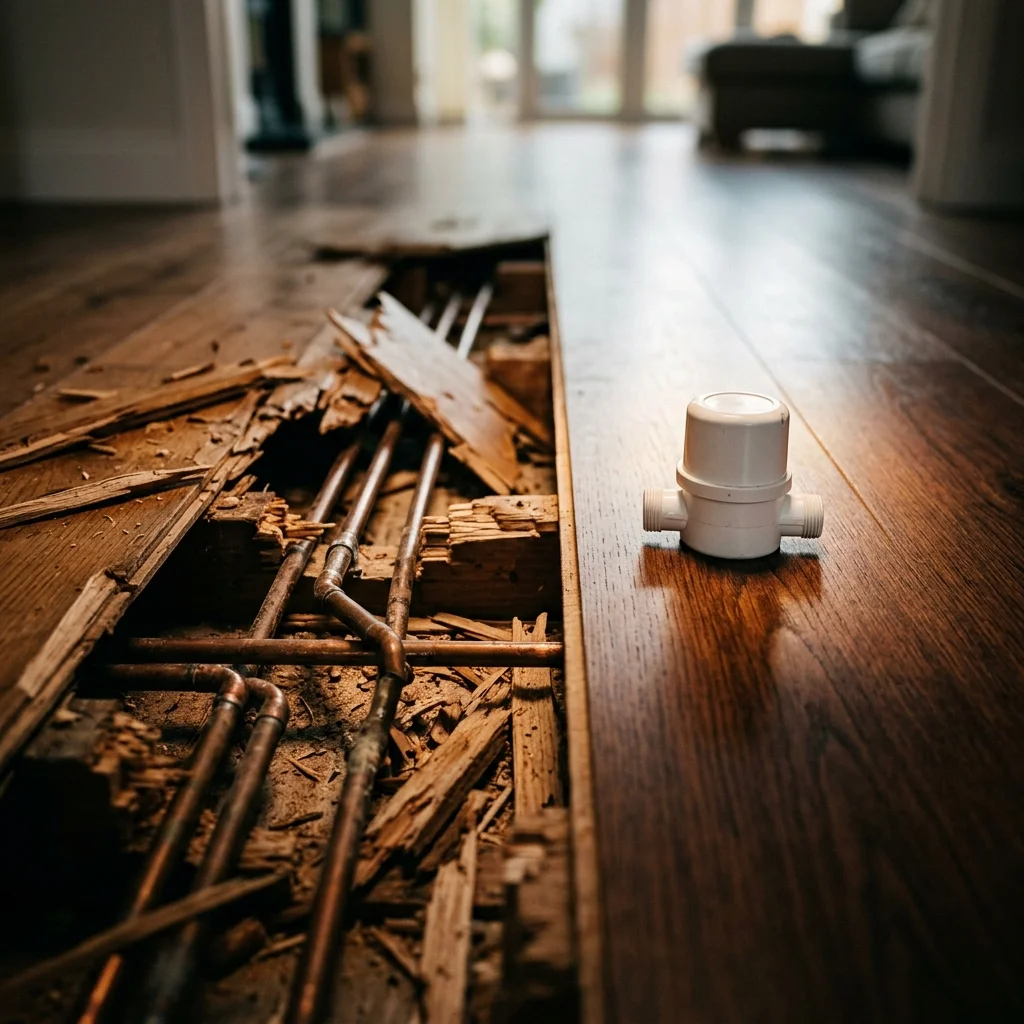
He believed them. He accepted a quote that included ripping up £4,600 of engineered oak flooring to replace every pipe with 15mm and 22mm copper. The repipe alone added £3,850 to the bill. His family lived on the upper floor for nine days while contractors chased walls and lifted floorboards.
Two months after commissioning, an independent performance audit revealed the truth. His property's peak heat loss was just 5.2kW. His largest room needed only 850W. The original 10mm copper pipe could have delivered that at a fluid velocity of 0.70 m/s - comfortably below the 1.0 m/s CIBSE noise threshold. The repipe was entirely unnecessary. £8,450 was wasted on a myth.
Why Did Three Surveyors Get the Same Thing Wrong?
Why did three surveyors insist that 10mm pipes would kill a heat pump when the maths says otherwise? The answer is not in the pipes themselves but in a hidden number that most installers never calculate: the relationship between temperature differential, flow rate, and the actual heat loss of each individual room.
The Maths Behind a Heat Pump With Microbore Pipes
The crisis begins with Delta T - the temperature difference between flow and return water. A gas boiler operates with a Delta T of 20C, meaning water leaves at 70C and returns at 50C. Because each litre drops 20C, it releases a large amount of energy, so the pump only needs to push a small volume slowly.
A heat pump is different. To maintain high efficiency (COP above 4.0), it must run at low flow temperatures (40-45C) with a narrow Delta T of just 5C. Because each litre only drops 5C, it releases one-quarter of the energy per litre compared to a boiler. To deliver the same heat, the circulation pump must push four times the volume through the same pipes.
| Heat Output | Delta T | Flow Rate Required | Velocity (10mm Copper) | CIBSE Compliant |
|---|---|---|---|---|
| 500W | 5C | 1.45 L/min | 0.42 m/s | Pass |
| 1,000W | 5C | 2.89 L/min | 0.83 m/s | Pass |
| 1,500W | 5C | 4.34 L/min | 1.25 m/s | Fail |
When installers see "four times the flow rate," they assume 10mm pipe will choke. But they are comparing the total system output against the pipe, when the correct calculation is the heat demand of the individual room each pipe serves. A 10mm copper pipe has an internal diameter of 8.6mm and can carry up to 1,000W at a 5C Delta T without exceeding the 1.0 m/s velocity limit. Most UK rooms in 1980s housing need only 500-900W.
The real killer is 10mm plastic pipe, not copper. Plastic microbore uses stiffening inserts at every joint to maintain structural integrity. These inserts choke the internal diameter from 8.6mm down to just 5.5mm. According to the Darcy-Weisbach equation, frictional resistance increases by the square of the velocity. Even at a modest 500W load, the velocity in 10mm plastic hits 1.02 m/s and friction spikes to 3,146 Pa/m - far above the 350 Pa/m that standard circulation pumps can overcome. The result is terminal: the pump stalls, flow sensors trip, and the system locks out.
| Heat Output | Velocity (10mm Copper) | Velocity (10mm Plastic) | Copper Status | Plastic Status |
|---|---|---|---|---|
| 500W | 0.42 m/s | 1.02 m/s | Pass | Fail |
| 1,000W | 0.83 m/s | 2.03 m/s | Pass | Fail |
| 1,500W | 1.25 m/s | 3.05 m/s | Fail | Fail |
When flow is restricted, modern heat pumps detect the pressure collapse and shut down. A Mitsubishi Ecodan throws an L9 fault code indicating insufficient primary circuit flow. A Vaillant aroTHERM triggers an F.75 lockout when its pressure differential sensor fails to detect water movement upon pump activation. The homeowner is left without heating, and the installer blames the pipes - when the real fault was failing to distinguish between copper and plastic, or failing to calculate whether the room's actual heat demand was within the pipe's capacity.
What Alaric's Telemetry Revealed
Looking at Alaric's telemetry data from November 2025, the numbers were damning. His heat pump was cruising at 42C flow temperature, producing a SCOP of 4.15. The lounge needed just 850W at a 5C Delta T, requiring only 2.45 litres per minute. His original 10mm copper pipe could have carried that at 0.70 m/s - less than three-quarters of the noise threshold.
The audit showed that upgrading the lounge radiator to a Type 22 (K2) emitter and adding a £55 inline volumiser for defrost cycle protection would have been the complete fix. Total cost: £550. Instead, he spent £8,450 destroying floors and chasing walls to solve a problem that did not exist.
The irony: the low-loss header his installer added "to help with the microbore" was actually degrading efficiency by mixing flow and return water, forcing the heat pump to run hotter to compensate.
The Fix That Saves Your Floors - and £3,000
The correct approach to microbore is hydraulic mathematics, not brute-force repiping. Three interventions solve the problem without lifting a single floorboard.
First, widen the Delta T from 5C to 7C. This reduces the required flow rate by 28%, pulling velocity back beneath the 1.0 m/s threshold. The COP drops marginally but remains well above 3.5.
| System Setup | Repipe Cost | Extra Upgrades | BUS Grant | Net Cost |
|---|---|---|---|---|
| Blanket Repipe | £3,500 | £0 | -£7,500 | £8,500 |
| Optimised Microbore | £0 | £550 | -£7,500 | £5,550 |
Second, upgrade only the bottleneck radiators. A room-by-room heat loss calculation to the MCS MIS 3005-D standard (2025 revision) reveals which rooms actually need larger emitters. Most do not. A typical 1980s property might need one or two radiators upgraded to Type 22 (K2) to deliver sufficient heat at 45C flow. The MCS standard mandates calculations to BS EN 12831-1:2017, which accounts for fabric heat loss, ventilation rates, and specific room geometry - not the blanket "add 50% to every radiator" heuristic that drives unnecessary costs.
| Radiator Type | Output at 50C Flow | Output at 45C Flow | Pipe Requirement |
|---|---|---|---|
| Type 21 (P+) | 1,000W | 782W | 10mm Copper viable |
| Type 22 (K2) | 1,214W | 949W | 10mm Copper viable |
| Type 33 (K3) | 1,641W | 1,283W | 15mm Copper required |
Third, install an inline volumiser - a simple 20 to 50 litre un-pumped cylinder on the primary circuit. Microbore systems hold very little water (10mm copper carries just 0.05 litres per metre, compared to 0.31 litres per metre for 22mm). During a defrost cycle, the heat pump reverses the refrigeration cycle and needs 20-30 litres of thermal mass to draw from without pulling a slug of cold water through the radiators. A volumiser provides this volume without the efficiency penalty of a low-loss header, which creates hydraulic mixing and degrades COP. It costs £45-£100 and takes an hour to fit.
| Component | Function | Efficiency Impact | Cost |
|---|---|---|---|
| Low-Loss Header | Decouples primary/secondary flow | Negative (mixing degrades COP) | £250-£1,200 |
| Inline Volumiser | Adds static water volume | Neutral (maintains Delta T) | £45-£100 |
Properly sizing the heat pump to the actual heat loss - not oversizing to brute-force flow through small pipes - keeps the inverter draw below 16A per phase (3.68kW). This keeps the installation within the DNO G98 "connect and notify" pathway, avoiding a 45-day G99 application delay that can derail an entire project timeline. Oversizing to 12kW or 14kW for a 6kW heat loss property is a common consequence of the microbore myth, and it pushes the electrical draw past the G98 threshold into regulatory limbo.
What This Means for Your Home
Alaric's story ends with a lesson printed on his audit report. His property never needed a repipe. A hydraulic survey - calculating the exact pressure drop of his existing index circuit - would have proven in 20 minutes that his 10mm copper could carry the load. The £7,500 grant, applied to a correctly engineered system with £550 of targeted upgrades, would have left him with a net cost of £5,550 and intact hardwood floors. Takeaway: a microbore heating system does not need invasive pipe replacement; it needs precise hydraulic mathematics, widened temperature differentials, and an inline volumiser.
Key Takeaways
- 10mm copper pipe (8.6mm internal diameter) can carry up to 1,000W at a 5C Delta T while keeping velocity below the 1.0 m/s CIBSE noise threshold.
- 10mm plastic microbore is the real problem - stiffening inserts choke the internal diameter to 5.5mm, causing failure even at 500W loads.
- Widening the heat pump Delta T from 5C to 7C cuts the required flow rate by 28%, easing pipe friction and velocity.
- A typical UK repipe costs £3,000-£4,500 - avoidable in most cases with a £55 inline volumiser and targeted radiator upgrades.
- A 24-litre inline volumiser (£45-£100) provides the thermal mass needed for defrost cycles without the efficiency penalty of a low-loss header.
- Proper heat pump sizing keeps inverter output below 3.68kW, staying within the DNO G98 connect-and-notify pathway.
- The Boiler Upgrade Scheme grant of £7,500 makes an optimised microbore heat pump installation cost as little as £5,550 net.
Frequently Asked Questions
Do I need to replace my microbore pipes for a heat pump?
No, in most cases. 10mm copper microbore can carry up to 1,000W at a 5C Delta T without breaching the CIBSE velocity limit, which covers most UK rooms. A room-by-room heat loss calculation, not a blanket repipe, tells you which pipes - if any - actually need upgrading.
Can a heat pump with microbore pipes still qualify for the Boiler Upgrade Scheme grant?
Yes. The £7,500 BUS grant (rising to £9,000 for oil and LPG homes) applies regardless of your existing pipework, as long as the installation is MCS-certified. Optimising microbore with a volumiser and targeted radiator upgrades keeps you eligible while cutting net cost to around £5,550.
What is the difference between 10mm copper and 10mm plastic microbore for heat pumps?
Copper has an 8.6mm internal diameter and usually works fine. Plastic microbore uses stiffening inserts that choke the bore to 5.5mm, spiking friction and causing pump lockouts even at 500W. If you have plastic microbore, that is the pipe that genuinely needs replacing.
How much does it cost to make microbore work with a heat pump?
A 20-50 litre inline volumiser costs £45-£100, plus targeted radiator upgrades and a wider Delta T setting. Total fix is typically £550, against £3,000-£4,500 for a blanket repipe that destroys floors and walls in the process.
Will a heat pump on microbore be as efficient as one on new pipework?
Yes, if engineered correctly. Alaric's system achieved a SCOP of 4.15 on 10mm copper. The key is widening the Delta T to 7C, adding a volumiser for defrost cycles, and avoiding a low-loss header, which mixes flow and return water and degrades COP.
Get Your Free Quotes
Takes under 4 minutes · No obligation

Written by
Mark Anthony Haines
Mark has over a decade of experience in the UK renewable energy sector, specialising in solar PV, heat pump systems, and home battery storage. He founded HeatPumpsAndSolar.co.uk to help UK homeowners cut through the noise around green energy installations, government grant schemes, and smart tariffs.
View LinkedIn ProfileMore from Our Insights
Homeowner questions on this topic
Compare the guide with common questions and experiences from UK homeowners.
Tools & Services Related to This Article
Take the next step with a free calculator or a local installer quote.