The Combi-Boiler Illusion: Where to Hide a Heat Pump Cylinder in a Terraced House
Want a heat pump without hot water cylinder space? Discover how phase-change heat batteries replace combi boilers, fitting under a kitchen counter.
Quick Summary
- Approximately 80% of UK homes rely on combi-boilers with no airing cupboard, and three installers routinely tell them a heat pump requires a 1.8-metre unvented cylinder that demands £2,250 in bespoke carpentry.
- Phase-change heat batteries using Sodium Acetate Trihydrate store up to four times more energy per litre than bulk water, fitting a 210-litre equivalent capacity into a unit just 365mm wide beneath a kitchen counter.
- Because heat batteries hold less than 15 litres of internal water, they are legally exempt from G3 Building Regulations, eliminating disruptive tundish pipework and saving £663 to £1,363 before the £7,500 grant is applied.
The Misconception
Homeowners living in modern properties with combi-boilers believe they are entirely disqualified from installing a heat pump because they lack the physical space for a giant hot water cylinder.
Table of Contents
A Quote That Locked a Terraced House Into Gas for Fifteen Years
When Barnaby Fictitiouson's combi-boiler cracked its heat exchanger in his 1960s mid-terrace house in Totterdown, Bristol, he wanted to install a heat pump without hot water cylinder space requirements defeating him. He booked three site surveys, confident that the £7,500 Boiler Upgrade Scheme grant would make the transition affordable. Every survey ended the same way. The installers looked at his kitchen, shook their heads, and told him he had nowhere to put the cylinder. A modern heat pump needs a 200-litre unvented hot water cylinder standing 1.8 metres tall in a dedicated airing cupboard, they explained. Barnaby's home had been modernised in the late 1990s - the loft tank and airing cupboard were long gone, replaced by a wall-mounted combi-boiler tucked under the kitchen counter. The quotes included £2,400 to build a bespoke G3-compliant enclosure, plus the cost of lifting floorboards across the ground floor to route mandatory tundish discharge pipework to an exterior drain. Concluding that the spatial sacrifice and structural costs were impossible, Barnaby abandoned the project and paid £3,500 for a like-for-like gas combi-boiler replacement, locking his home into fossil fuels for another fifteen years.
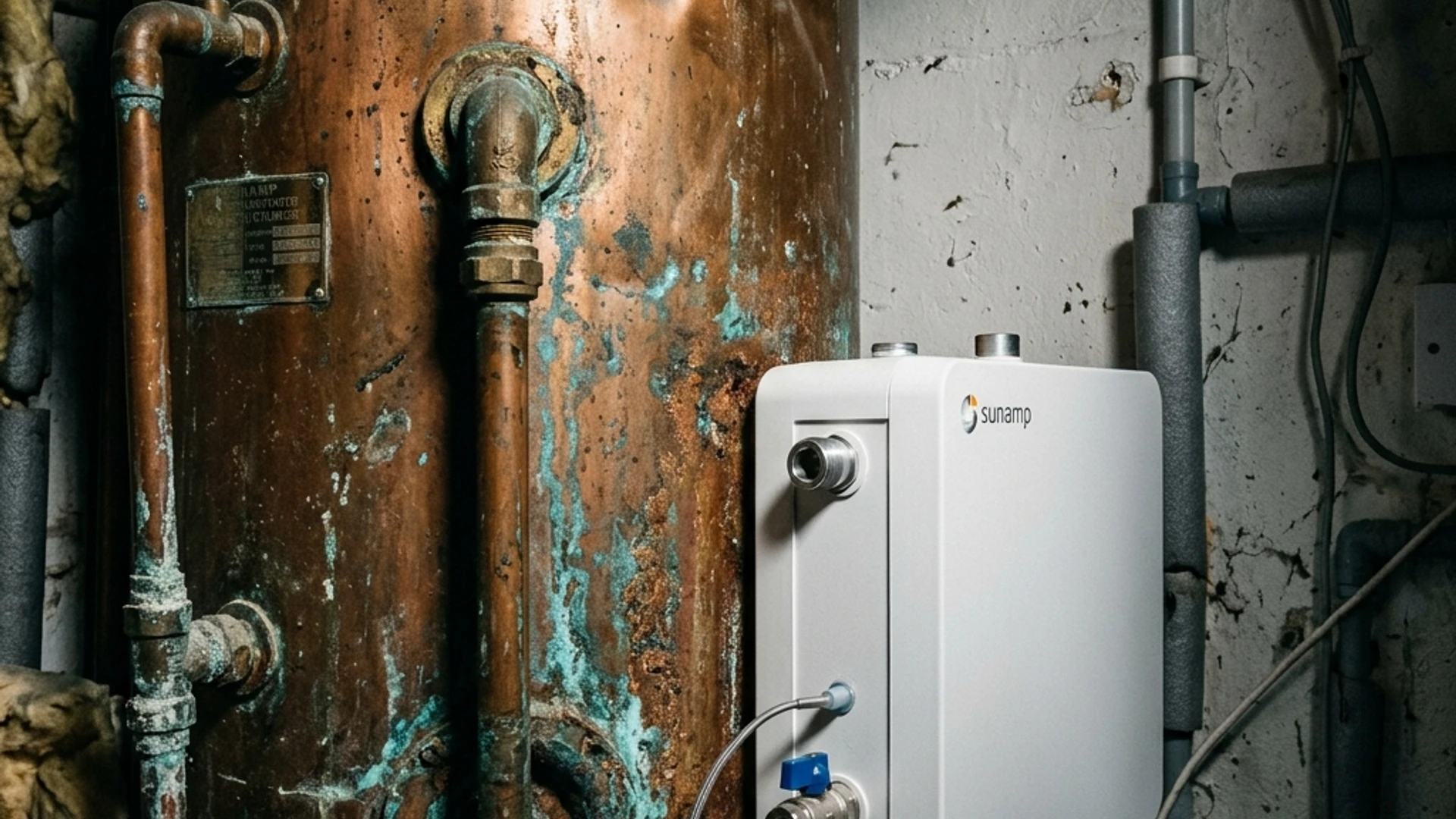
The sting came in August 2026. Barnaby visited a neighbour two doors down whose home shared an identical mid-terrace floorplan. The neighbour had installed an air source heat pump earlier that summer. When Barnaby asked where they had hidden the massive water tank, the neighbour simply opened a standard 600mm base cabinet beneath the kitchen counter to reveal a Sunamp Thermino 210 - a sleek white unit no larger than a microwave oven. The neighbour's smart meter showed a daily hot water cost of just 22.5p, charging the battery overnight at an off-peak rate of 5p/kWh. Barnaby had forfeited the £7,500 grant, sunk £3,500 into a stranded fossil-fuel asset, and locked himself into escalating gas prices - all because neither he nor his installers knew that a heat pump without a hot water cylinder was possible.
Why Did Three Installers Tell Barnaby He Needed a Giant Cylinder?
Why did three professional installers insist that a heat pump required a full-height unvented cylinder when a unit a fraction of the size could do the same job? The answer lies in a fundamental misunderstanding of how thermal energy can be stored - and a regulatory loophole that makes the traditional cylinder unnecessary in millions of British homes.
The Physics of Phase-Change Thermal Storage
Traditional hot water cylinders rely on sensible heat - raising the temperature of a mass of liquid water without changing its phase. Because water has a specific heat capacity of approximately 4.18 kJ/kg K, storing enough thermal energy for a family's daily hot water demands roughly 250 litres of water held at 50C to 55C. That demands a physically enormous vessel.
Phase-change materials operate on an entirely different principle: latent heat. When a substance changes from solid to liquid, it absorbs massive amounts of thermal energy without a change in temperature. A heat battery using Sodium Acetate Trihydrate (SAT) stores thermal energy in the molecular bonds of a chemical salt as it melts. When a hot tap is opened, cold mains water flows through a heat exchanger embedded in the molten salt. The salt crystallises back to a solid, instantly releasing its latent heat and flash-heating the water to mains-pressure temperatures. The latent heat of fusion for SAT is 252 to 264 kJ/kg - up to four times the energy density of sensible bulk water.
| Storage Metric | Bulk Water (Sensible Heat) | Sodium Acetate Trihydrate (Latent Heat) |
|---|---|---|
| Primary Storage Mechanism | Temperature elevation | Phase transition (solid to liquid) |
| Energy Density | ~4.18 kJ/kg K | 252 to 264 kJ/kg |
| Volume Required for 14 kWh | ~250 litres | ~60 litres |
| Operating Temperature | Variable (ambient to 60C) | Constant (58C phase change) |
The volumetric difference is dramatic. A standard 250-litre unvented cylinder stands 1,500 to 1,800mm tall with a 600mm by 600mm footprint. A Sunamp Thermino 210 measures just 365mm wide by 575mm deep by 870mm tall - fitting neatly beneath a standard kitchen counter.
| Dimension | 250L Unvented Cylinder | Sunamp Thermino 210 | Difference |
|---|---|---|---|
| Height | 1,500 to 1,800mm | 870mm | 42% to 51% reduction |
| Width | 580 to 600mm | 365mm | 37% to 39% reduction |
| Weight (full) | 238 to 240kg | 176kg | 62kg lighter |
The regulatory implications are equally transformative. Building Regulations Approved Document G3 mandates that unvented cylinders holding large volumes of pressurised hot water require a tundish and rigid discharge pipework routed with a continuous 1:200 downward fall to a safe exterior termination. In a landlocked mid-terrace house, routing that pipe is architecturally destructive. Phase-change heat batteries store less than 15 litres of mains water internally - the Thermino 210 holds just 5.3 litres across its circuits. Because the bulk storage medium is a stable salt, not pressurised water, they are legally exempt from G3 unvented discharge pipework requirements entirely.
| Regulatory Factor | 200L Unvented Cylinder | Phase-Change Heat Battery |
|---|---|---|
| G3 Discharge Pipework | Mandatory (tundish + exterior routing) | Exempt (under 15 litres internal water) |
| Legionella Pasteurisation | Weekly 60C cycle required | Not required (no stagnant bulk water) |
| Standing Heat Loss | 1.5 to 2.0 kWh/day | 0.77 kWh/day |
| Annual Wasted Energy | ~638 kWh | ~281 kWh |
What Barnaby's Neighbour Telemetry Revealed
The neighbour's smart meter told the full story. By charging the heat battery overnight on a time-of-use tariff at 5p/kWh, their daily hot water cost was 22.5p for 4.5 kWh. Barnaby, still on a gas combi at 7.33p/kWh, was paying more for the same hot water while losing heat through the boiler flue during every ignition cycle. The heat battery's vacuum insulation restricted standby losses to 0.77 kWh per day, saving roughly £93 annually compared to a standard cylinder's 1.5 to 2.0 kWh daily losses at the July 2026 electricity cap of 26.11p/kWh.
The Fix: Installing a Heat Pump Without Hot Water Cylinder Space
The correct approach is to decouple low-carbon heat generation from volumetric water storage. A phase-change heat battery like the Sunamp Thermino hp-SG or hp-DN series is engineered with optimised internal heat exchangers to accept the lower flow temperatures produced by modern heat pumps. The heat pump slowly charges the battery over time, melting the PCM salt core. When a tap opens, cold mains water passes through the heat exchanger and the salt crystallises around the copper walls, delivering mains-pressure hot water instantly - mimicking the convenience of a gas combi-boiler but operating entirely on low-carbon electricity.
| Cost Component | Unvented Cylinder Setup | Sunamp Thermino Setup |
|---|---|---|
| Appliance Cost | £900 to £1,400 | £2,487 (Thermino 210 xPlus) |
| Architectural Carpentry | £2,250 (bespoke cupboard) | £0 (existing 600mm cabinet) |
| Installation Labour | £400 to £600 (G3 pipework) | £400 (simplified plumbing) |
| Total Pre-Grant | ~£3,550 to £4,250 | ~£2,887 |
The heat battery carries a capital premium of roughly £1,087 on the unit itself, but immediately saves £2,250 in destructive carpentry and up to £200 in complex labour. Both systems qualify for the £7,500 Boiler Upgrade Scheme grant, as Ofgem classifies thermal storage as eligible ancillary equipment. The net result is a saving of £663 to £1,363 before the grant is even applied - and the entire installation can be completed without lifting a single floorboard or drilling an exterior wall.
What This Means for Your Home
Barnaby's story ends with the realisation that the logistical "no" he accepted from three installers was based on a technology that no longer represents the state of the art. His terraced house never needed a full-height unvented cylinder or a rebuilt airing cupboard. It needed a unit the size of a microwave, sitting beneath his kitchen counter, charging overnight on cheap electricity and delivering mains-pressure hot water on demand. The £7,500 grant he forfeited would have covered the vast majority of a system that his neighbour installed in under a day. Takeaway: a modern UK combi-boiler home does not need a sprawling hot water cylinder to transition to a heat pump; it needs high-density phase-change thermal storage that fits under the kitchen counter.
Key Takeaways
- Approximately 80% of UK homes rely on combination boilers, leaving them without the airing cupboard space traditionally required for a heat pump hot water cylinder.
- A phase-change heat battery stores thermal energy in a chemical salt with a latent heat of 252 to 264 kJ/kg, holding up to four times more energy per litre than sensible bulk water.
- A Sunamp Thermino 210 measures just 365mm wide by 870mm tall, fitting beneath a standard 600mm kitchen counter - versus 1,800mm for an equivalent 250-litre cylinder.
- Heat batteries storing less than 15 litres of internal water are legally exempt from G3 Building Regulations, eliminating the need for tundish discharge pipework routed through exterior walls.
- Vacuum insulation restricts heat battery standby losses to 0.77 kWh per day, saving roughly £93 annually compared to a standard cylinder losing 1.5 to 2.0 kWh at July 2026 electricity rates.
- Heat batteries hold no stagnant bulk water, eradicating the Legionella risk and eliminating the need for weekly 60C pasteurisation cycles that degrade heat pump SCOP.
- Phase-change thermal storage qualifies as ancillary equipment under Ofgem guidelines, meaning the £7,500 Boiler Upgrade Scheme grant covers both the heat pump and the heat battery.
- The total installed cost of a heat battery setup is approximately £2,887, saving £663 to £1,363 compared to building a bespoke cylinder cupboard at £3,550 to £4,250.
Frequently Asked Questions
Can I get a heat pump without a hot water cylinder?
Yes. If you lack space for a standard 200-litre unvented cylinder, you can install a phase-change heat battery like the Sunamp Thermino. It stores thermal energy chemically, taking up four times less space, and fits under a kitchen counter to provide mains-pressure hot water.
Do I need an airing cupboard to replace my combi boiler with a heat pump?
No. Replacing a combi boiler with a heat pump no longer requires building an airing cupboard. A phase-change thermal storage battery can be installed in a standard kitchen base cabinet, saving you up to £2,250 in bespoke carpentry costs while still delivering instant hot water.
Are Sunamp heat batteries exempt from G3 building regulations?
Yes. Because a space saving heat pump hot water battery stores thermal energy in salt rather than bulk water, its internal heat exchanger holds less than 15 litres. This legally exempts it from G3 regulations, meaning no disruptive discharge pipework or tundish needs to be routed through your home.
Does a space saving heat pump hot water battery qualify for the BUS grant?
Yes. Phase-change thermal storage units are officially classed as ancillary equipment under Ofgem guidelines. This means they are fully covered under the £7,500 Boiler Upgrade Scheme grant when installed simultaneously with a new air source or ground source heat pump.
Does a heat battery cost more to run than a hot water cylinder?
No, it costs less. A standard 250-litre hot water cylinder loses around 1.5 to 2.0 kWh of heat per day. A modern vacuum-insulated phase change thermal storage battery loses just 0.77 kWh per day. At July 2026 electricity rates, this reduces standby heat loss waste, saving you roughly £93 annually.
Get Your Free Quotes
Takes under 4 minutes · No obligation

Written by
Mark Anthony Haines
Mark has over a decade of experience in the UK renewable energy sector, specialising in solar PV, heat pump systems, and home battery storage. He founded HeatPumpsAndSolar.co.uk to help UK homeowners cut through the noise around green energy installations, government grant schemes, and smart tariffs.
View LinkedIn ProfileMore from Our Insights
Homeowner questions on this topic
Compare the guide with common questions and experiences from UK homeowners.
Tools & Services Related to This Article
Take the next step with a free calculator or a local installer quote.