Quick Summary
- A solar roof can produce electricity reliably while the homeowner's financed purchase fails to pay back during their ownership.
- Full loan repayments, realistic direct use versus export and the expected moving date matter more than a national sunshine stereotype.
- Compare itemised cash and finance quotes, stress-test your own benefits and decline a deal that only works on optimistic assumptions.
The Misconception
British cloud makes solar financially pointless, or conversely any solar installation will automatically pay for itself regardless of finance, household demand and time in the home.
Table of Contents
The Solar Quote That Promises to Pay for Itself
"Britain is too cloudy for solar." That is an easy answer to the question are solar panels worth it in the UK? The harder answer is on the second page of a quote: the instalments, the hours you use electricity and the date you might sell the house. A roof can generate perfectly well while the purchase makes poor financial sense.
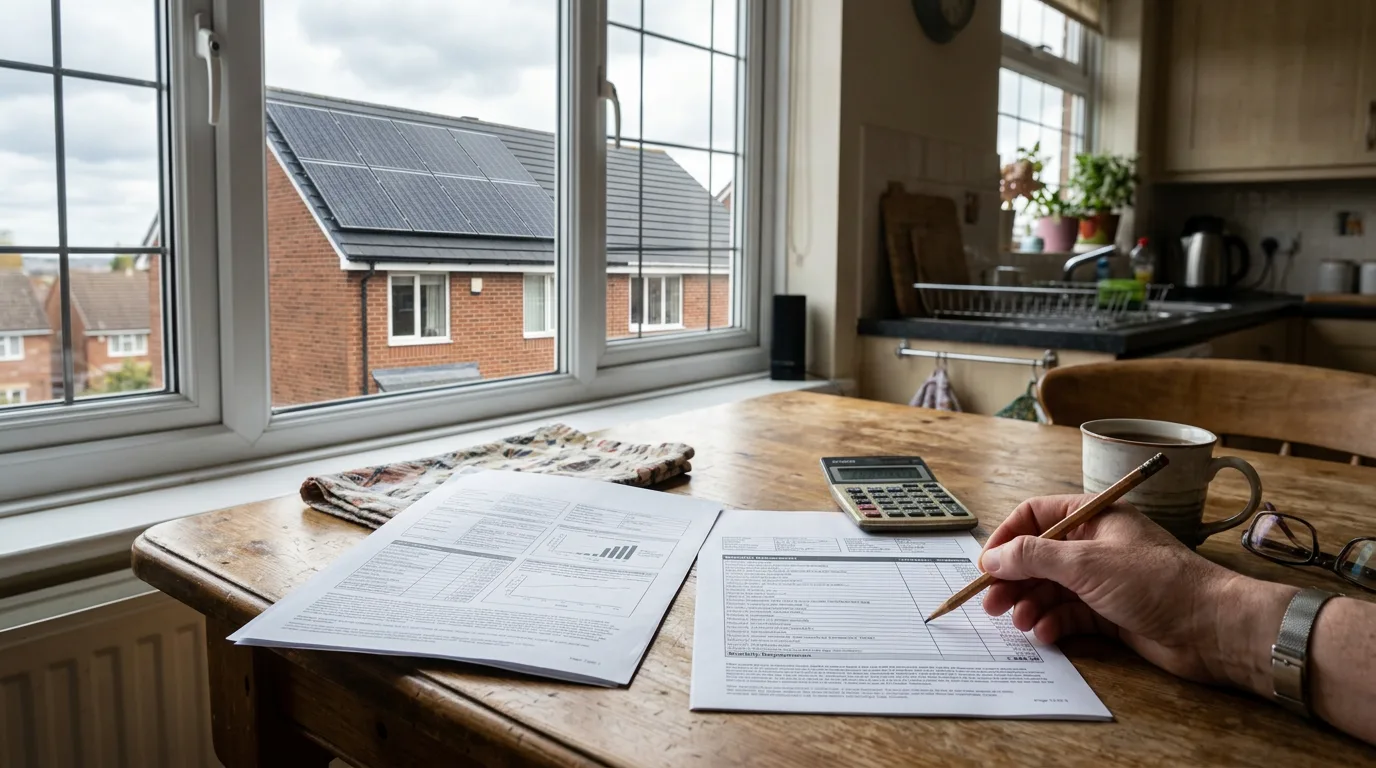
Picture an explicitly fictional homeowner in Nottingham who plans to downsize in four years. A salesperson offers a £13,500 package of panels and a battery, financed over ten years. The brochure says "self-funding"; the credit agreement says 12.9% APR. The roof is sunny enough. Is the loan?
Energy Saving Trust says panels generate even on cloudy days. It lists about £7,600 for a typical 4.5 kWp installation and illustrative payback of nine to twelve years across listed locations and occupancy patterns. Those examples use July 2026 fuel prices, not the cost of a financed solar-and-battery package.
Are Solar Panels Worth It in the UK When You Might Move?
Which part of the savings graph is bill reduction, which is eligible export income, and which assumes electricity you will use at midday? Does the repayment finish before or after you move? Write three numbers in the margin: full financed cost, plausible annual benefit, and years you expect to own the home. Without them, a payback headline is not an answer.
The Three Numbers That Can Reverse a Solar Return
First, count the full price, not the instalment. Take the fictional £13,500 purchase, financed in full by a level-payment loan over 120 months at an assumed 12.9% effective annual APR, with no fees. Converting that annual rate to an equivalent monthly rate gives about 1.016% per month. The standard amortisation calculation gives £195.21 a month, about £23,425 in total repayments, of which about £9,925 is interest. Rounding the monthly payment before multiplying 120 months may differ by pennies; actual lenders may use different repayment dates, fees and APR conventions. Ask for the lender's binding total amount payable.
Now suppose, purely to test affordability, that this particular package saves £65 a month on average including export payments. That is £780 a year of assumed benefit, not evidence that this roof will deliver it. The household still pays roughly £130 more each month during the loan than it receives in bill savings and export payments. A long-term benefit may remain after the loan ends, but "self-funding from day one" does not follow. Comparing a payment against only bill savings while quietly adding export income elsewhere would make matters worse.
After 48 payments, about £9,370 has been paid and £9,933 remains on the illustrative loan; assumed benefits total £3,120. These are cash-flow figures, not a property valuation or an early settlement quote. Owned panels generally remain with the house, while an unsecured personal loan remains your obligation. Lease, hire and secured arrangements differ; ask your lender and conveyancer. Never assume the buyer will clear your debt through a higher offer. See our solar house-value evidence guide.
The FCA's October 2026 consumer-finance fair-value findings stress assessment of the expected total price, including continuing costs, against benefits that customers can reasonably expect. The regulator examined some third-party ownership arrangements for home energy infrastructure, including solar. Its publication is not a ruling that a specific solar APR or product is unlawful, and it sets no magic "walk away above X%" threshold. It is a good reason to insist that the full credit cost appears alongside realistic benefits.
Second, separate energy you use from energy you sell. For October to December 2026, Ofgem reports an average 26.32p/kWh electricity unit rate for a default-tariff Direct Debit customer across England, Scotland and Wales, reflecting the temporary removal of electricity VAT. Your tariff and region can differ; fixed tariffs are not capped the same way. Generating a unit does not automatically save 26.32p: only a unit used at home instead of an import does that. A unit exported earns whatever your eligible export contract actually pays. Solar normally does not remove your daily standing charge.
Here is a small illustration, not a generation forecast or quoted tariff. Assume 3,600 kWh annual output, 30% used directly (1,080 kWh), the other 2,520 kWh exported, a 26.32p avoided import rate and a hypothetical 8p/kWh export rate. That gives £284.26 avoided imports plus £201.60 export income = £485.86 in year-one benefit before maintenance. If a quote instead assumes 80% used directly without a battery or a demonstrated daytime load, the same inputs produce £815.62: £758.02 avoided imports and £57.60 export. The £329.76 difference is entirely an assumption about when electricity is used, not extra generation. Neither percentage describes all households. A battery changes both timing and losses; it must be modelled separately, including its price and forgone export.
Under Ofgem's Smart Export Guarantee, eligible generators in Great Britain can receive payments based on export meter readings. Suppliers set their own above-zero SEG rates and terms. Northern Ireland has separate arrangements; do not paste a GB SEG rate into a Northern Ireland forecast. Check your meter, eligibility and supplier offer before assuming any export income. For the battery trade-off, see our panels-versus-storage comparison.
Third, count your own years of benefit. If you may move after four years, model those four years, outstanding credit and uncertain resale value. Early sale is not an automatic loss, but a future owner's savings are not yours. Allow for maintenance: Energy Saving Trust says inverters may need replacing after around 12 years, not that every unit will fail then. See our payback-period explainer.
What Can You Check on Your Own Quote Tonight?
Look at the back of an electricity bill and the proposal together. Your annual consumption is a better starting point than a national household average. If you are out most daylight hours, ask how much of the predicted solar output your appliances would use at the same time. Demand that the installer separate direct use, battery-delivered use and metered export, rather than adding them as though each unit could do three jobs.
Here is a practical comparison sheet. Fill it with your figures, not the sample above.
| Ask for this in writing | Why it changes the decision |
|---|---|
| Itemised cash price, with panels, battery, scaffolding and any roof work separated | A costly battery or excluded access work can hide inside a reassuring headline price. |
| Finance APR, deposit, fees, term and total amount repayable | A small monthly instalment can conceal a large lifetime cost. |
| Annual output adjusted for orientation, shade and any export limit | A national average cannot price your roof or connection. |
| Direct self-use, battery losses and export units, with tariff assumptions | Imported electricity avoided and exported electricity have different values. |
| Your likely ownership period and contractual sale or settlement obligations | You may move before receiving later years of benefit. |
If the roof needs repair soon, assess it before signing and price any removal and refit. Energy Saving Trust notes that renewing roof covering alongside installation can cost less overall. There is no universal refit fee: see our roof-survey and scaffolding-exclusions guides.
Ask for a year-round shade assessment, not a summer photograph. Energy Saving Trust says east- or west-facing roofs tend to generate 15-20% less than south-facing ones, but that is not a site forecast or a verdict on Scotland. Severe persistent shade deserves a redesigned proposal. See our shaded-roof guide.
The Decision Is in the Assumptions, Not the Sales Pitch
Get itemised cash quotes from at least three MCS-certified installers, as Energy Saving Trust recommends. Match roof, battery choice and access work. Its typical £7,600 price is for 4.5 kWp, not a cap on solar-and-battery packages. The government's solar PV cost statistics need system-size and period context too.
Test a lower self-use share, a weaker export tariff, roof costs and an earlier move. Use our solar payback calculator, then compare other uses of your money with the solar-versus-investment calculator. Neither promises a return; investments and savings carry different risks.
Finally, price finance independently. The government's Warm Homes Loan Scheme factsheet, published 27 October 2026, says eligible households across the UK may borrow up to £15,000 for solar panels through participating lenders. Some products are interest-free, others are low-interest; rates, eligibility, installers and terms depend on the lender. The factsheet explicitly tells households to compare the total amount repayable, not only monthly fees. A cheaper loan can improve a project without making a bad roof or inflated quote good. Our solar grants guide explains why a loan is not a grant.
No itemised proposal or credible generation and export model? Do not sign yet. If realistic numbers fail, do nothing. If they work, compare solar installation quotes on matching assumptions.
When Is Walking Away the Sensible Solar Decision?
Back at that fictional Nottingham table, the ten-year loan and four-year ownership plan do not fit the rosy forecast. Even if the roof performs, the buyer of the system may not recover its cost.
Moving soon, a particular APR or a northern postcode is no automatic verdict. If the full price and plausible benefits during your ownership do not justify uncertain resale and repayment risks, walk away or change the proposal. A smaller array, no battery or cheaper finance may change the answer.
The question is not whether Britain gets enough sun. It is whether this particular quote works for the person who must pay it.
Key Takeaways
- Cloudy days are not the whole story: Energy Saving Trust says panels still generate in cloud; its illustrative payback ranges from nine to twelve years across listed places and occupancy patterns, not for every financed package.
- Count the loan's lifetime cost: £13,500 financed at an illustrative 12.9% effective annual APR over ten years is about £195.21 a month and £23,425 in repayments, assuming no fees.
- A sale does not settle your personal borrowing: in the example, about £9,933 remains after 48 scheduled payments; buyer premium and settlement terms cannot be assumed.
- Do not double-count electricity: only electricity used at home avoids imports, and eligible metered exports earn the applicable supplier tariff.
- Challenge self-use forecasts: changing an illustrative no-battery model from 30% to 80% direct use raises year-one benefit by £329.76 without producing a single extra kWh.
- Budget for the roof and equipment: shade, access, roof covering and future inverter work can outweigh an attractive headline yield.
- Compare before committing: get like-for-like cash quotes, stress-test the numbers and examine any finance contract's total repayable.
Frequently Asked Questions
Are solar panels worth it in the UK if I plan to move soon?
Possibly, but a long-term payback projection is not the amount you will personally recover before moving. Count the benefits during your expected ownership, check outstanding finance and ownership paperwork, and treat any extra sale price as uncertain. Compare a realistic short-stay scenario with waiting or investing elsewhere before signing.
Are solar panels worth it in Scotland despite the weather?
They can be. Panels generate on cloudy days, though roof direction, shade and local conditions change annual output. Energy Saving Trust's illustrative Stirling payback is eleven to twelve years under its stated July 2026 assumptions, not a universal Scottish result. Ask for a site-specific generation and export estimate rather than rejecting a postcode.
How much of my solar output should a quote assume I use at home?
There is no universal percentage. Your daytime occupancy, appliance schedules, battery design, seasonal generation and export restrictions all matter. Ask the installer to show separate annual kWh for direct use, storage delivered after losses and metered export. Compare those assumptions with your own bill and routine; reject unsupported claims of near-total self-use.
Can a Warm Homes Loan make an otherwise poor solar quote worthwhile?
A lower borrowing cost helps but cannot fix an overpriced design, serious shade or unrealistic benefit projection. The October 2026 government factsheet lists up to £15,000 for eligible solar borrowing across the UK, with participating lenders offering varying rates and terms. Compare total repayable and like-for-like cash quotes first; borrowing is not free money.
Ready to Compare Real Quotes?
Get free quotes from local MCS-certified installers
Takes 90 seconds. Compare up to 3 vetted local MCS quotes with zero spam calls.